STEMhp

STEM, one short lesson at a time.

Free biology lessons, films and simulations, from age 5 to graduate school, with more sciences on the way. No account, no ads.

I’m a

See the page for students, parents or teachers.

Start where you are

Everyone starts somewhere different, and we all have blind spots. When a lesson loses you, hop down a level, get the idea, and hop back up. If osmosis stops making sense in high school Biology, the grade 7 lesson starts with salt on a cucumber slice. Read that first, then come back.

One idea, four levels: osmosis

Down a level is the same idea, told more simply. Up a level adds the detail.

  1. College, upper level

    Body Water and Its Compartments

    Where a litre of water goes in your body, and why saline differs.

  2. College, a first course

    Osmoregulation and Nitrogenous Waste

    Count dissolved particles, then ask how a sea fish keeps its water.

    Moving Water and Sugar in Plants

    Water potential: one number that says which way water will cross.

  3. High school

    Crossing the Membrane

    In distilled water a red blood cell may burst; a plant cell's wall holds.

  4. Grade 7

    Diffusion and Osmosis

    Water drifts to the saltier side: weigh cucumber slices and see.

Play the ladder · 4 films, about 13 min, from grade 7 to upper-level college. Each film waits for you to press play.

Here for one thing?

Or pick your level

Every level is open, and you need no account.

You don’t need to know the answers

Biology Together is 30 activities for children aged 5 to 10, done away from the screen with things from the kitchen and the yard. Each guide tells you what to gather, what to ask, and what children often say, so the two of you find out together.

This week’s one to try

A Watershed in a Pan

About 25 minutes, indoors

Where does rain go after it lands on our street? A paper landscape and a spray bottle show the way downhill.
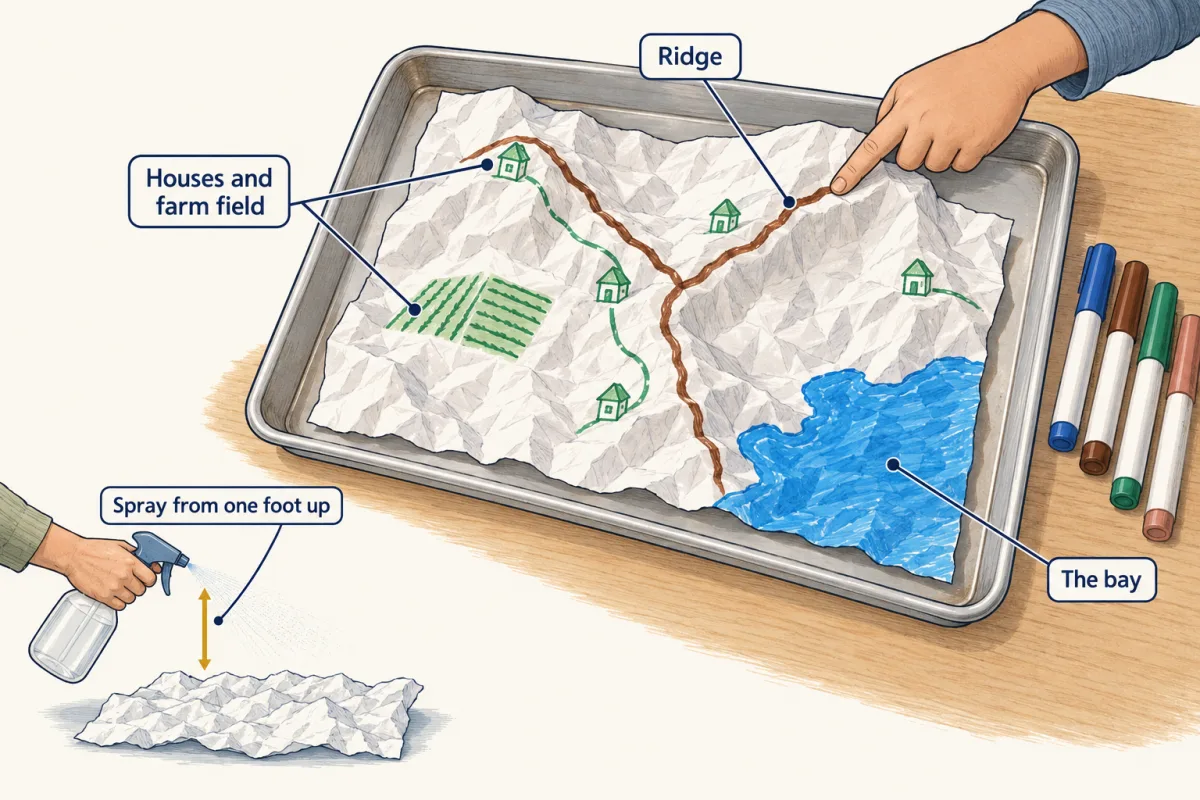
A crumpled sheet of white paper, opened but not flattened, sits in a baking tray with brown marker lines traced along its ridges, one low corner colored blue, and small green houses, a farm field and a road drawn on hills and in valleys. A child's finger traces a ridge. A small inset shows a spray bottle held about a foot above the paper.
The set-up, from the guide. AI-generated illustration.

You will need

  • 1 sheet of white printer paper per landscape
  • Washable markers: blue, brown or black, green and one other colour (they must be washable)
  • A spray bottle of plain water (new, or one that only ever held water)
  • A baking tray, roasting pan or shallow plastic tub
  • Paper towels or an old towel
  • A pinch of cocoa powder, or a few drops of food colouring in a spoonful of water
  • A few hole-punch paper dots or tiny torn paper bits for litter
  • A printed or on-screen map of Virginia’s watersheds (optional)

Your part. Stay nearby to help with spraying and spills. Keep paper bits and cocoa away from toddlers and pets.

Open the activity guide All 30 activities

Last week’s: Wake Up a Seed

Each guide has safety notes for the adult, placed before the steps. No lesson needs an account, there are no ads, and no AI tutor talks to your child. AI models from more than one company check the guides. I make this site, and I have not yet read them all myself.

The calendar puts one activity on the days that suit you, with one list of what to gather.

Where this goes later

This activity is the first lesson on one idea: watersheds and dead zones. Later courses teach the same idea again. If you have an older child, or you are curious yourself, this is where it goes.

  1. Grade 7 · film in two parts, about 7 min Big Changes: Dead Zones, Storms and Climate Feed a model Bay nitrogen and watch the deep oxygen fall.
  2. High school · film in two parts, about 7 min The Chesapeake Under Pressure The 2010 Bay TMDL capped nitrogen, phosphorus and sediment; read whether oxygen recovered.
  3. College: the core · film in two parts, about 6 min Nutrient Cycling Schindler fertilised whole lakes: Lake 227 stayed eutrophic on phosphorus alone.

If your child is in grade 7 or high school, their course is here too: Life Science and Biology, both written to Virginia’s standards.

Fast tools for you, slow thinking for them

Planning is the part of teaching a tool can make fast. Let it, and spend the hours on your students. Their part should stay slow, because the slow part is the thinking. No AI tutor talks to them here.

Match your syllabus to lessons

Paste your syllabus and pick your class’s level. You get your topics, in your order, with the lessons and films that teach each one. The matching runs in your browser: what you paste is never sent, and no AI reads it.

Match your syllabus

Find the lesson for a standard

Every Virginia standard, with the lessons that teach it:

For example, LS.2 e is taught by Diffusion and Osmosis, where students read the masses of cucumber slices kept in salt water and say which way the water moved. Other states’ standards are not mapped yet.

Make a class

Give students a code and assign lessons. Each morning, read how they reasoned before class. Students join with a nickname: no email, no real name, no password. It is free and uses no AI.

Make a class

More for teachers

Everything for teachers has a guide to each school course, with its reading level. “Fast tools, slow thinking” is where I landed in a talk for teachers in October 2026: the talk, its slides and the source for every number.

Pick a subject

Biology

Open now
  • 414lessons
  • 13courses
  • 1,132short films
  • 354simulations
  • 3,362practice questions
Start with biology

Chemistry

Coming

Not built yet. Until then, Biochemistry is under Biology.

Physics

Coming

Not built yet.

Mathematics and statistics

Coming

Not built yet. The math toolkit covers the math inside the biology lessons.

Psychology and sociology

Coming

Not built yet. Brain and behaviour start in Neuroscience, under Biology.

ComingChemistryPhysicsMathematics and statisticsPsychology and sociology

None of these is built yet. The math toolkit covers the math inside the biology lessons.

Recently rewritten

Fresh off the workbench: new text, and often a new film. 414 lessons rewritten so far.

Things to try

Built in public. I choose what goes in and direct the AI that makes it. AI models from more than one company check the lessons; a person has not yet read every one, and those waiting for my check carry an Under review tag.