Sensory Systems · Unit 3: Temperature, pain and itch
Itch: A Sense of Its Own
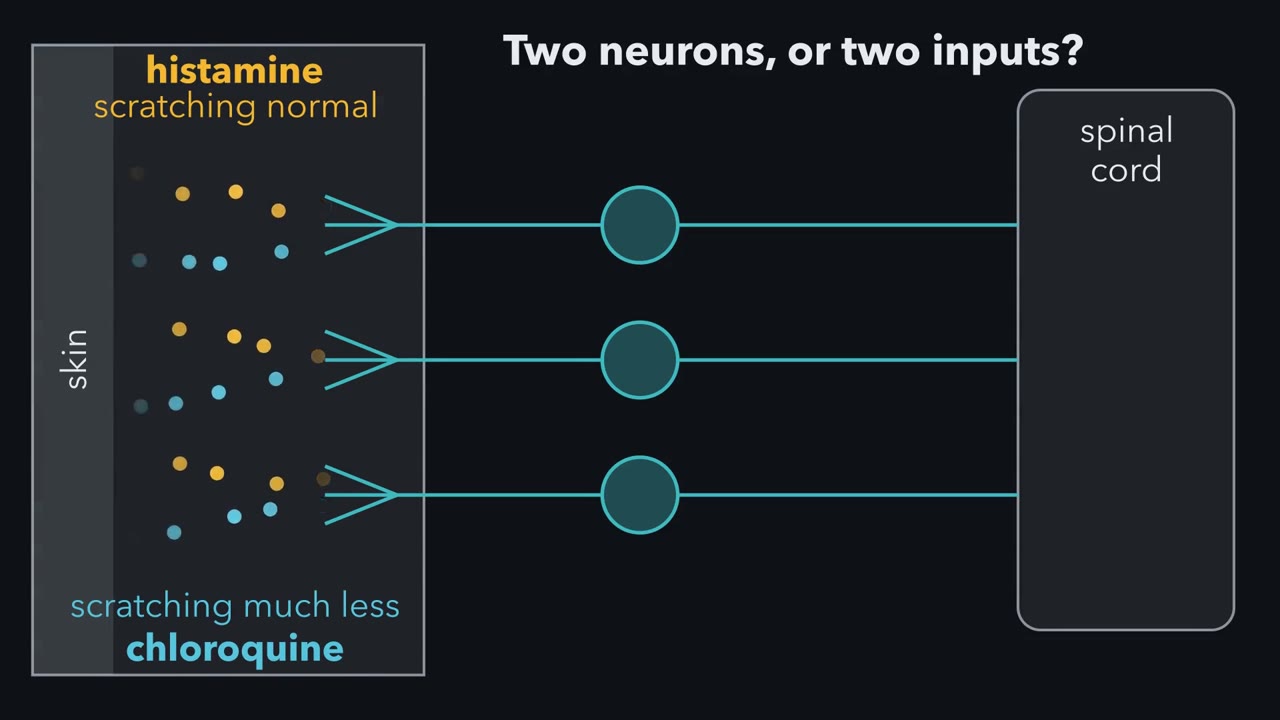
A mouse missing one cluster of Mrgpr genes scratches normally to histamine but much less to chloroquine. Which parts of the itch pathway are shared with pain, and which are not?
Pause when the reading reaches a film, and offer to play it. Saved on this device.
Watch the film now, or keep listening
Builds on:Spinal Circuits That Gate PainNociceptors and the Sodium Channels of PainThe Low-Threshold Mechanoreceptors: One Touch, Several SignalsWhy these?
 ▶ Watch Which Line Carries the Itch? · 3:21
Read the transcript of “Which Line Carries the Itch?”
Film transcript: Which Line Carries the Itch?
One mouse scratches normally to histamine, yet scratches much less to chloroquine. Did one experiment separate two neurons, or only two inputs? Watch one skin-to-cord pathway. Gold histamine and blue chloroquine approach the same teal sensory population. Researchers deleted one cluster of Mrgpr receptor genes. The blue chloroquine route broke, so scratching fell. Gold histamine scratching remained. The intervention separated receptor routes. It did not yet separate the neurons carrying them. The routes also recruit different channel machinery in mice. Histamine itch involves PLC-beta-3 and TRPV1. Chloroquine and BAM8-22 scratching instead falls markedly without TRPA1.
Now remove every sensory neuron marked by MrgprA3. What should happen to histamine scratching? Predict before the cells disappear. Does the gold route survive, as it did before? Histamine scratching also fell. Removing a receptor route and removing its whole neuron population are different interventions. The neurons receive several itch-producing inputs. Ablation shows they are needed for much scratching in these mouse assays. A second test started with mice lacking working TRPV1. Researchers restored that channel only in the teal neurons.
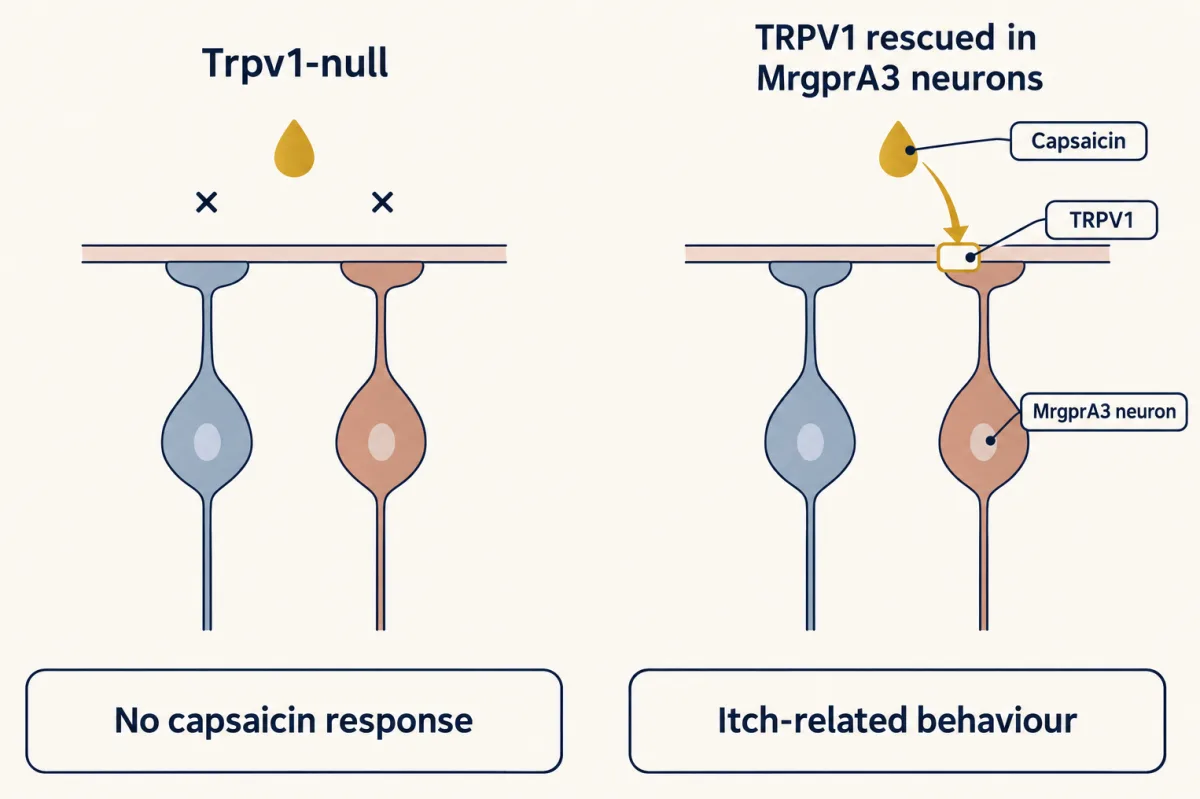
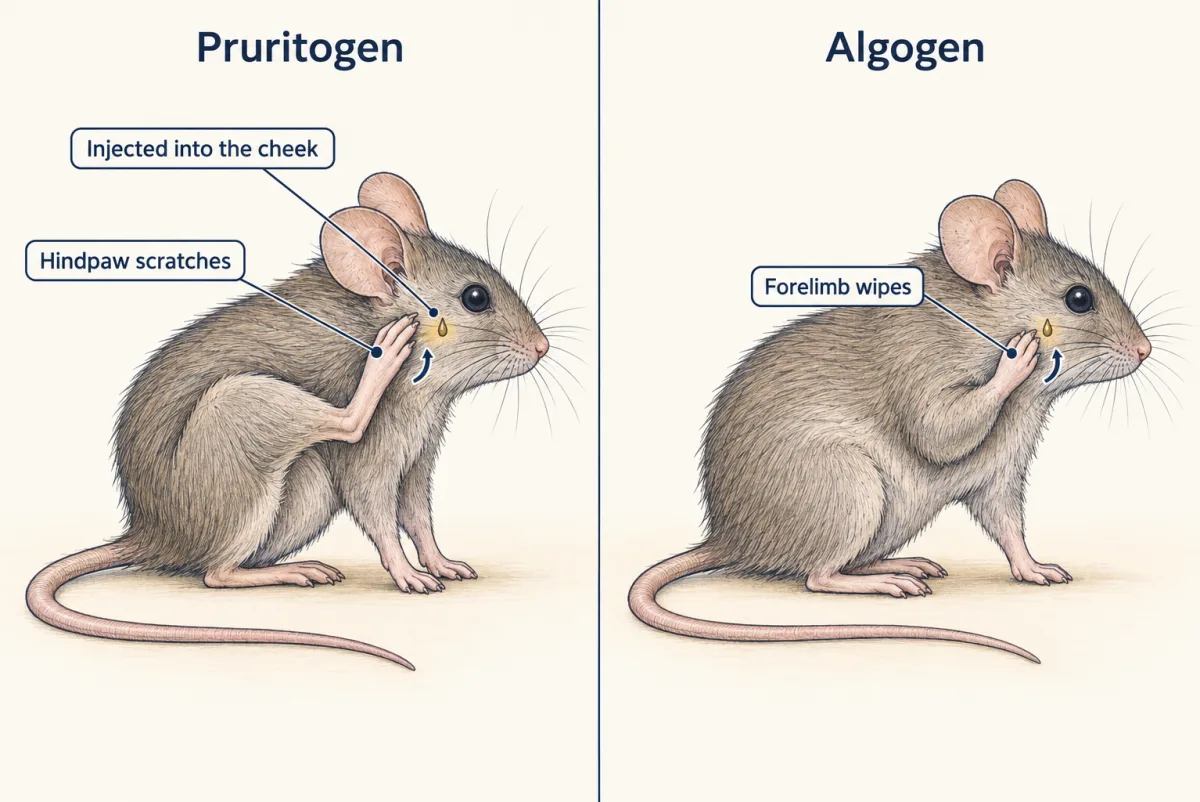
Capsaicin could now recruit only that population. The mouse produced itch-related behaviour instead of its usual pain-related wiping. The rescue shows what these neurons can drive when they alone respond to capsaicin. It does not prove every activation means itch. Later, fast ionotropic stimulation mostly evoked pain-related defence. Gq-linked stimulation evoked itch behaviour. Behaviour matters too. In the cheek assay, hindpaw scratching counts as itch-related output. Forelimb wiping counts as pain-related output. Those readouts distinguish actions, not a mouse's reported sensation.
Human MRGPRX1 is also a different gene. Both receptors respond to chloroquine in transfected cells, but not equally. The human receptor's functional potency was lower in that assay. Shared ligand responses do not make the genes, neurons, or sensations equivalent across species. Here is the rule for this lesson.
Trigger, recruited population, spinal route, and inhibition together shape scratching. Each perturbation supports only the link it tests. Chapter 2 will carry this pathway into the spinal cord.
From the film
- Deleting a receptor route and ablating its whole neuron population answer different questions.
- MrgprA3-marked neurons receive several itch-producing inputs in the mouse assays shown.
- Restricted rescue shows what those neurons can drive when they alone respond.
- The behavioural assays distinguish scratching from wiping, not a reported sensation.
- Each perturbation supports only the link and assay it tests.
The first film separated a receptor route from the sensory population carrying it; now keep those causal verbs separate. Itch is the unpleasant sensation associated with a desire to scratch. A pruriceptor is a primary sensory neuron that detects itch-producing stimuli. The term is functional: a molecular marker is useful only insofar as an experiment shows what the marked cells do.
Guiding idea. In the mouse experiments covered here, trigger, recruited sensory population, spinal route and inhibitory state together determine scratching; each perturbation supports only the link it actually tests.
Scope: this rule interprets the chemical- and mechanical-itch assays in this lesson. It does not make scratching a report of sensation, make any marker itch-only under every manipulation or establish the same cell classes in people.
The answer these experiments support is that itch is a sense of its own, not simply weak pain. Identifiable sensory populations detect itch-producing stimuli, histamine is only one trigger, spinal relays carry the signal, and inhibition and scratching itself can brake it. The systems still share neurons and channels with pain.
Start at the skin: one sensation, several inputs
A chemical pruritogen, such as histamine, chloroquine or a cytokine, acts on receptors or channels at a free nerve ending. A light mechanical trigger can evoke scratching in dry or inflamed skin; touch-evoked itch is alloknesis. Chemical and mechanical itch use partly different spinal circuits, although they are not assigned to mutually exclusive peripheral cell types.
Primates also have more than one pruriceptive class, although that split is not the chemical-versus-mechanical one. Microneurography in people and monkeys finds mechanically insensitive C fibres that respond to histamine and mechanosensitive polymodal afferents that respond to cowhage spicules, a nonhistaminergic pruritogen. Psychophysics gives the two inputs a similar itch magnitude and time course, each with weaker pricking or burning (LaMotte and colleagues, Nature Reviews Neuroscience, 2014). Touch and pain left itch out, and spinal pain circuits supplies the dorsal-horn vocabulary used here.
Histamine comes mostly from skin mast cells and acts on histamine receptors; H1 antagonists block most histamine itch in people. Not all chemical itch is histaminergic, and the routes differ downstream of the receptor. In mice, histamine itch involves PLC-beta-3 and transient receptor potential vanilloid 1 (TRPV1) (Imamachi and colleagues, PNAS, 2009), while chloroquine and BAM8-22 scratching is markedly reduced in Trpa1-deficient mice (Wilson and colleagues, Nature Neuroscience, 2011). That is the signalling introduced in the first film, and it connects to G protein signalling and PLC, IP3 and DAG. One important refinement is that deleting Trpv1 does not remove chloroquine calcium responses from cultured mouse neurons. Carrying a channel does not mean using it for every input.
How far the labelled-line claim can go
A strict labelled line is a pathway whose activity means one thing regardless of how it is activated. The first film tested that proposal rather than assuming it. Its inferences are bounded: ablation tests necessity in the assays used, while restricted rescue tests what a population can drive under one isolated input. The two kinds of result also split at different levels: deleting the Mrgpr cluster removes one receptor route, whereas ablation removes every input through those neurons, which themselves respond to histamine and are needed for normal histamine scratching.
Those inferences are narrower than “itch-only neuron.” A later mouse study used fast ionotropic stimulation through light-gated channels or P2X3 and predominantly evoked nocifensive, or pain-related defensive, behaviour. Gq-linked stimulation of the same MrgprA3 population evoked itch behaviour (Sharif and colleagues, Neuron, 2020). MrgprA3 and human MRGPRX1 are also different genes; the shared chloroquine response does not establish a human MrgprA3 lineage.
The figures preserve the two experimental readouts. In the rescue, functional transient receptor potential vanilloid 1 (TRPV1) existed only in MrgprA3-positive neurons on a Trpv1-null background. In the cheek assay, scratching with a hindpaw and wiping with a forelimb are scored separately.
Worked problem: potency is not identity
Liu and colleagues measured chloroquine responses in transfected HEK293 calcium assays. The functional half-maximal effective concentration (EC50) was 27.55 ± 2.03 µM at mouse MrgprA3 and 297.68 ± 2.10 µM at human MRGPRX1 (mean ± SEM).
Predict. The human EC50 is 10.8 times the mouse value. At 30 µM, will the simple model below therefore predict exactly 10.8 times less response at the human receptor?
Check your prediction
No. The response is nonlinear and bounded by its maximum, so an EC50 ratio is not a response ratio at every concentration.
(a) Ratio of central estimates: 297.68 / 27.55 = 10.81. Chloroquine is about eleven times less potent at the human receptor in this assay.
(b) Impose a deliberately simple model with unit Hill slope, zero baseline and a maximum of 1:
R(C) = C / (EC50 + C)
At C = 30 µM, mouse: 30 / (27.55 + 30) = 30 / 57.55 = 0.521. Human receptor: 30 / (297.68 + 30) = 30 / 327.68 = 0.0916. The response ratio is about 5.69, not 10.81.
The same concentration gives about half of the maximal response at the mouse receptor and under a tenth at the human one. The assumed slope and matched maxima are ours, not fitted values. EC50 here is functional potency in a transfected cell, not binding affinity, neuronal firing, perceived itch or evidence that mouse and human neurons match.
In this sketch: one site, unit Hill slope, zero baseline, matched maxima of 1, no desensitization. Curves use the central EC50 estimates; ± is the SEM. Rule to keep: EC50 here is functional potency in a transfected cell, not binding affinity, neuronal firing or perceived itch, and a shared ligand does not make two receptors interchangeable.
The receptor experiments stop at the peripheral neuron. The next question is how the spinal cord orders that input and controls its output.
Read the transcript of “Order the Relay, Find the Brake”
Film transcript: Order the Relay, Find the Brake
Chapter 1 separated an itch-producing input from the neurons carrying it. Once those neurons fire, how can experiments order a spinal relay? Carry the same teal pathway from skin into the dorsal horn. In one mouse model, the afferent supplies Nppb. Without Nppb, almost all tested itch responses disappeared. Injecting Nppb around the cord itself evoked scratching. The missing signal was upstream; downstream machinery could still respond. Next, researchers removed about 70 percent of spinal cells carrying NPRA, the Nppb receptor. If GRP acts later, should added GRP still evoke scratching?
It still evoked scratching. The simplest order is sensory Nppb, then NPRA cells, GRP and GRPR. follow. A downstream signal bypassed loss of the proposed upstream population. Independent tests support the later GRPR step.
Grpr-mutant mice scratched less to tested itch-producing agents. Removing GRPR-expressing spinal neurons also lowered scratching, while measured pain behaviours remained. This orders functions, not complete anatomy. The experiments did not show direct synapses. They did not identify one source of GRP. The sequence is one supported route in mice, not every itch route or a human circuit. Relays are only half the story.
Bhlhb5-dependent spinal interneurons provide inhibition. Mice missing that developmental population scratched excessively. Removing a brake can raise output without strengthening the incoming itch-producing signal. Light touch can use another control route. Removing or silencing NPY-lineage spinal interneurons increased mechanical scratching in one paradigm. Tested chemical itch and pain did not rise. Mechanical scratching also survived GRPR-cell ablation there. Scratching can feed back too. In primate recordings, scratching suppressed histamine-evoked activity in spinothalamic neurons. It spared baseline and capsaicin-evoked activity. That is a firing measurement, not a reported sensation.
The guiding rule now has its full circuit. Trigger, recruited population, spinal route, and inhibition together shape scratching. Use perturbations to order links, but do not mistake functional order for complete wiring.
From the film
- Downstream rescue and bypass experiments can order functions in a mouse spinal relay.
- The supported order is sensory Nppb, NPRA cells, GRP and GRPR.
- Functional order does not prove direct synapses or one source of GRP.
- Removing spinal inhibitory populations can raise scratching without strengthening sensory input.
- Chemical and mechanical scratching can use partly different gates.
What the ordered relay does not settle
The second film built one functional order — afferent Nppb, then NPRA-expressing spinal cells, then GRP and GRPR (Mishra and Hoon, Science, 2013) — and what it did not show is as important. The later steps have independent support: Grpr-mutant mice scratched less to the pruritogens tested while responding normally in the pain assays reported (Sun and Chen, Nature, 2007), and ablating GRPR-expressing spinal neurons markedly reduced scratching to the tested pruritogens while the measured pain behaviours did not change (Sun and colleagues, Science, 2009). In the Mishra and Hoon model, Nppb is supplied by a subset of TRPV1-positive primary sensory neurons rather than dorsal-horn cells. The experiments did not demonstrate direct synaptic contacts, identify a unique source of GRP or establish the same circuit in humans. Transcriptomic work places Nppb mainly in the Nppb- and Sst-marked afferent class rather than the MrgprA3 class, so MrgprA3 afferents probably reach GRP neurons by another transmitter. This is one route, not the route from every pruriceptor.
The inhibitory result also needs its developmental scope. Bhlhb5 is expressed transiently in the developing dorsal spinal cord and is needed for a subset of inhibitory interneurons. Mutant mice, tested mainly at four weeks, scratched excessively, which Ross and colleagues (Neuron, 2010) linked to loss of those cells. Disinhibition can therefore produce itch-related output, but this was not an acute manipulation. Later work found that these interneurons respond to counter-itch stimuli such as pain and menthol and release the kappa-opioid peptide dynorphin; pharmacological evidence places its antipruritic action at GRPR-expressing neurons or farther downstream (reviewed by Dong and Dong, Neuron, 2018). This can help explain why counter-stimuli and kappa-opioid agonists reduce itch, whereas mu agonists can provoke it.
The disputed source of GRP
The proposed position of GRP does not reveal where it originates. Solorzano and colleagues (Journal of Neuroscience, 2015) found abundant Grp expression in mouse spinal cord but not uninjured dorsal root ganglion (DRG) neurons with their assays. Titration against Grp-null tissue also showed that a commonly used GRP antiserum was selective for GRP only at high dilutions.
Barry and colleagues (Nature Communications, 2020) deleted Grp in sensory neurons and found reduced nonhistaminergic scratching with histamine scratching spared. In the same study, intersectional ablation of spinal Grp neurons did not reduce itch in the tests used. Albisetti and colleagues (Journal of Neuroscience, 2019) reported the opposite after a spinally restricted ablation of GRP neurons: itch-related behaviour fell.
Other approaches add candidates rather than settle the source. Null-validated pro-GRP antibody mapping found the highest co-expression in axons of NPFF-expressing cells, over 50 percent; 10 to 20 percent appeared in cells expressing substance P or NKB, and under 10 percent in other excitatory classes (Gutierrez-Mecinas and colleagues, Neuroscience, 2023). In slices from 3- to 5-week-old mice, repeated burst firing of spinal GRP neurons progressively excited GRPR neurons (Pagani and colleagues, Neuron, 2019).
Predict. Suppose sensory and spinal sources both release GRP and partly compensate for one another. Which comparison is most likely to expose that redundancy?
Check your prediction
Compare each source-specific deletion with the combined deletion, then add source-specific rescues. Either single deletion could have a modest effect even when both sources contribute.
Mechanical itch: a partly separate route
Reminder: scratching depends on the route and its gate, not on a marker alone.
Bourane and colleagues (Science, 2015) used an intersection of NPY::Cre and Lbx1 to target interneurons in dorsal spinal cord and medulla. Ablating or silencing those cells raised mechanical itch without a matching rise in the tested chemical itch or pain sensitivity, and the raised scratching persisted after GRPR-cell ablation, so in that paradigm it did not depend on the chemical relay. The second film placed this population at a mechanical gate; the first extension is that the label records lineage, not necessarily adult expression.
Predict. At postnatal day 30, only 35 percent of reporter-positive cells still expressed NPY. Does an NPY::Cre reporter identify current NPY expression or developmental history?
Check your prediction
Developmental history. Cre permanently marks cells that passed through the expression state, including cells no longer expressing NPY at the time of testing.
Later work looked downstream of this gate. Ablating or silencing Y1-receptor-marked spinal excitatory neurons reduced mechanical itch (Acton and colleagues, Cell Reports, 2019). Calcrl- and Lbx1-marked spinoparabrachial neurons, which project to the parabrachial nucleus, were required for normal mechanical-itch scratching (Ren and colleagues, Neuron, 2023). The role of GRPR remains model-dependent: Chen and colleagues (Nature Communications, 2020) found that Tac2-Cre interneurons receive A-beta input and contact GRPR neurons, and that GRPR-neuron ablation abolished mechanical itch.
The peripheral brake is also state-dependent. In mice with Piezo2 deleted across skin epithelium by K14-Cre, and in a smaller group using tamoxifen-inducible Atoh1-CreERT to target Merkel cells, touch-evoked scratching increased. Chemogenetic activation of Merkel cells reduced alloknesis in a dry-skin model (Feng and colleagues, Science, 2018).
Predict. Do those two directions of effect make Merkel-cell Piezo2 signalling a generator or a brake for touch-evoked scratching in these experiments?
Check your prediction
A brake: loss raised touch-evoked scratching, whereas activation lowered alloknesis. The experiments did not show a direct Merkel-to-NPY synapse.
Keep the endpoint narrow. A later study found that Merkel-cell Piezo2 signalling can promote spontaneous itch in chronic dry skin (Feng and colleagues, Science Translational Medicine, 2022). The earlier restraint applies to touch-evoked scratching, not every itch behaviour. Aged mice also scratched to light von Frey forces that did not evoke scratching in young mice. See Merkel cells for the cell itself.
Nor is the peripheral split absolute. Deleting Piezo1 in peripheral neurons reduced mechanically evoked scratching. Piezo1 transcript appeared in most Nppb-positive dorsal root ganglion (DRG) neurons, and after combined Piezo1 and Piezo2 knockdown nearly all cultured SST-marked neurons lacked mechanically activated responses (Hill and colleagues, Nature, 2022). A pruriceptor can therefore transduce touch. See mechanotransduction channels and the sensory neuron atlas for the channels and cell classes.
Scratching itself is part of the circuit. In extracellular recordings from lumbar spinothalamic neurons of a primate in vivo, scratching suppressed histamine-evoked activity but not baseline or capsaicin-evoked activity (Davidson and colleagues, Nature Neuroscience, 2009). That is a firing measurement, not a reported sensation.
Immune molecules can trigger or change gain
Epithelial TSLP acted directly on TRPA1-positive sensory neurons in mouse dorsal root ganglion (DRG) cultures, where the neurons responded with calcium (Wilson and colleagues, Cell, 2013). IL-31RA lies largely in TRPV1-positive neurons in human donor and mouse DRG sections. IL-31-evoked scratching was reduced in both Trpv1-deficient and Trpa1-deficient mice (Cevikbas and colleagues, 2014).
IL-4 evoked calcium responses in cultured DRG neurons from mice and from a human donor; IL-13 did so in mouse neurons (Oetjen and colleagues, Cell, 2017).
Predict. Does a calcium response in culture require either cytokine to produce acute scratching after skin injection?
Check your prediction
No. Cellular responsiveness, acute behavioural output and sensitization are different claims.
High-dose IL-4 or IL-13 alone did not evoke acute scratching under the tested conditions. IL-4 instead sensitized cultured neurons to pruritogens that were subthreshold alone. Deleting Il4ra or Jak1 in sensory neurons reduced scratching in mouse chronic-itch models; see JAK-STAT. A cytokine can therefore change gain without acting as an acute trigger.
Two antibody drugs act on these routes: nemolizumab blocks IL-31 receptor alpha, and dupilumab blocks IL-4R-alpha, the subunit shared by IL-4 and IL-13 signalling. Clinical chronic itch means itch lasting longer than six weeks. These studies do not partition a drug’s effects between neurons and immune cells. For persistent pain, see chronic pain.
Design problem: where does spinal GRP come from?
Design an experiment that decides which source supplies the GRP acting on GRPR, given the disagreements above.
One way to do it
First list the targeting strategy, reporter coverage and age behind every published result: the Cre line, any intersection and the fraction of GRP-expressing cells reached. Then compare sensory-neuron and spinal-neuron Grp deletions in one laboratory, one mouse background and one age. Score the same assays, including histamine and nonhistaminergic pruritogens.
Do not infer release from transcript. In each group measure Grp transcript, GRP peptide and release, and validate every antibody in Grp-null tissue. Record from GRPR neurons in spinal slices while stimulating each candidate source, sensory afferents or spinal GRP neurons. Block GRPR as a control for the recorded response.
If both sources contribute, redundancy can hide either one. Add the combined deletion and source-specific rescues. Behavioural effect sizes need not track each source’s peptide contribution, so weigh release and slice measurements most heavily.
Going deeper
Ages, treatment schedules and rescue scope
Liu and colleagues (Cell, 2009) deleted the Mrgpr cluster in male mice aged 2 to 3 months. Han and colleagues (Nature Neuroscience, February 2013 issue, online 2012) used male mice of the same age range. In their ablation, toxin treatment began at five weeks, and behaviour was tested three weeks later.
Liu and colleagues first showed in transfected HEK293 cells that chloroquine activates mouse MrgprA3 and human MRGPRX1. Han and colleagues removed MrgprA3-positive neurons after development; scratching to several pruritogens, including histamine, fell while the pain assays tested were unchanged. Their restricted transient receptor potential vanilloid 1 (TRPV1) rescue then made cheek-injected capsaicin evoke itch-related behaviour. These dates and schedules matter because ablation and rescue support conclusions only for the driver, age and assays used.
In the spinal-rescue experiment, intrathecal Nppb, injected into the fluid around the cord, evoked scratching in both wild-type and Nppb-null mice. The result shows that the downstream machinery in the null animals could still respond; it does not by itself show direct synapses. GRP also still evoked scratching after about 70 percent of the spinal cells expressing NPRA, the Nppb receptor, were removed, which is what places GRP and GRPR after those cells.
Mechanical itch: ages, forces and counts
In the Merkel-cell work of Feng and colleagues (Science, 2018), mice older than 24 months scratched to von Frey forces of 0.02 to 0.16 gram-force that did not evoke scratching in 2-month-old mice.
Deleting Piezo1 in peripheral neurons of 2- to 6-month-old mice reduced mechanically evoked scratching. Piezo1 transcript appeared in 92 percent of Nppb-positive dorsal root ganglion (DRG) neurons. After combined Piezo1 and Piezo2 knockdown, 32 of 33 cultured SST-marked neurons lacked mechanically activated responses (Hill and colleagues, Nature, 2022).
Davidson and colleagues recorded extracellularly from lumbar spinothalamic neurons of a primate in vivo; the species is not specified here. For eight histamine-responsive cells, firing during the first 10 seconds after scratching was 62 ± 8 percent of the pre-scratch level (mean ± SEM).
Culture and animal details in the immune experiments
Wilson and colleagues (Cell, 2013) used mouse DRG cultures from P18 to P30 animals; 4.1 ± 0.6 percent of cultured neurons responded to TSLP with calcium. Oetjen and colleagues (Cell, 2017) used cultured DRG neurons from 8- to 12-week-old mice.
Your notes
Select any text in the lesson to highlight it or add a note to it. Your highlights and notes are saved in this browser and collected in your notebook.
This browser is not letting the site save anything (a private window or strict privacy settings), so highlights and notes will be lost when you leave the page.
How we measure it
Cell-type ablation and genetic rescue in mice
A defined group of neurons is removed with a Cre-dependent or ligand-targeted approach, or a missing channel is restored only in that group on a null background. Ablation tests necessity and rescue tests what the cells can do alone, each only for the assay, age and driver used.
Cheek scratch-versus-wipe assay
A test substance is injected into the skin of the mouse cheek. Pruritogens evoke scratching with the hindpaw and algogens evoke wiping with the forelimb, which lets one injection site separate itch-related from pain-related output.
Ratiometric calcium imaging of cultured neurons and cells
A calcium-sensitive dye reports intracellular calcium in transfected HEK293 cells or in cultured dorsal root ganglion neurons as a ligand is applied. It gives responsiveness and potency in a dish, not firing in an animal or sensation in a person.
Whole-cell recording in spinal slices
An optogenetically activated population is stimulated while synaptic currents or spikes are recorded from a neighbouring cell in an acute slice. It tests whether one population can drive another under a defined stimulus pattern.
Practice questions on this lesson (3) → MCAT-style, original, each with an explanation
Where this lesson fits
Before thisReview first
- Spinal Circuits That Gate PainThis course · Lesson 12
It gives the dorsal-horn circuit vocabulary and gating ideas that this lesson uses for itch relays and inhibition.
- Nociceptors and the Sodium Channels of PainThis course · Lesson 11
Itch neurons share channels and neurons with nociceptors, so you need how pain neurons are defined first.
- The Low-Threshold Mechanoreceptors: One Touch, Several SignalsThis course · Lesson 4
Mechanical itch and touch-evoked scratching assume you know the low-threshold touch neuron classes.
After thisStudy next
- Vagal Sensory Neurons: The Body Reports to the BrainThis course · Lesson 16
It uses the same genetically defined sensory neuron classes and ablation or activation logic to link neuron types to behaviour.
Suggested by an AI model from the lessons themselves, then checked. How we use AI
Finish line
Test yourself
8 questions
Practice and MCAT-style, with explained answers.
Next · Lesson 14
When Pain Persists
After a nerve injury, a touch the animal used to ignore makes it pull away, and it keeps doing so for weeks. Is persistent pain an alarm that never switched off, or a nervous system that has changed?
Continue →