Genetics and Molecular Biology · Unit 1: Inheritance
New to this? Review it at high school level: Mendel and Punnett Squares
Mendel's Peas: Segregation and Independent Assortment
Rewritten on : new text, flashcards and film. Your notes and highlights stay, but the text around them may have moved.
Mendel crossed round peas with wrinkled ones and every hybrid seed came out round. A generation later he counted 5,474 round seeds and 1,850 wrinkled. Where had wrinkled been hiding, and why one in four?
Pause when the reading reaches a film, and offer to play it. Saved on this device.
Watch the film now, or keep listening
Builds on:Mendel and Punnett SquaresWhy these?
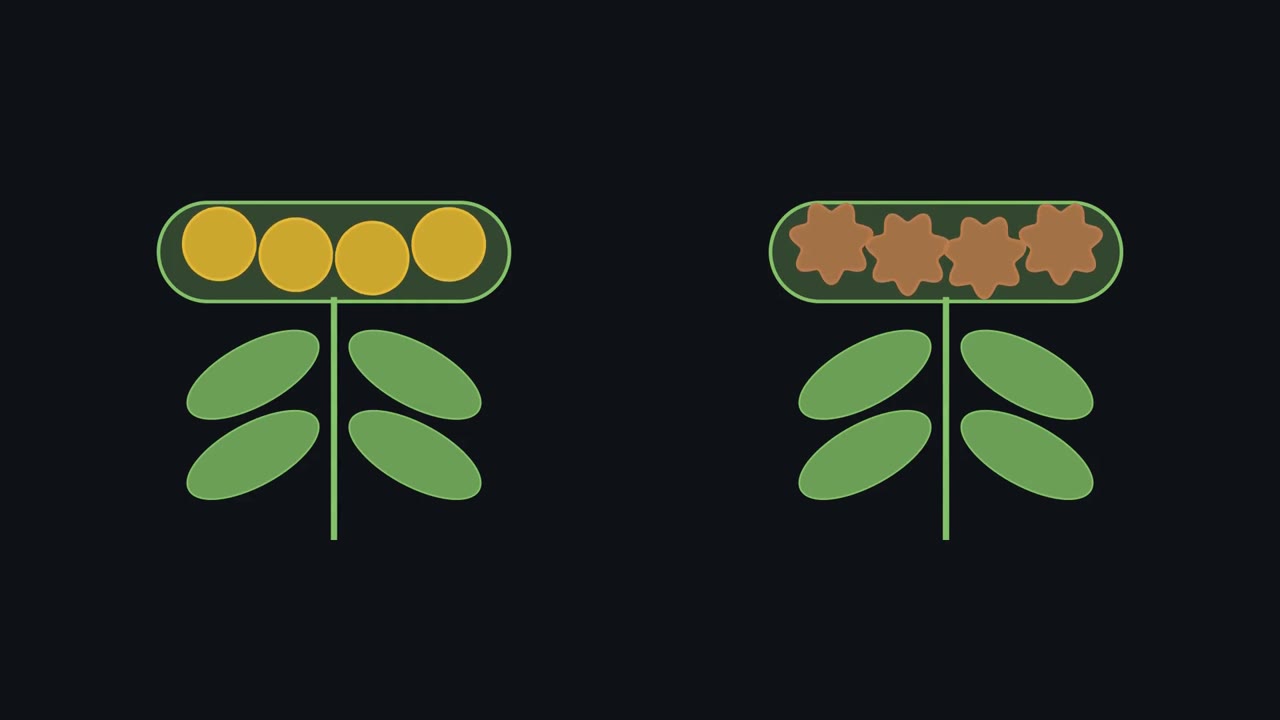 ▶ Watch Two Copies, One Coin Toss · 3:15
Read the transcript of “Two Copies, One Coin Toss”
Film transcript: Two Copies, One Coin Toss
Where can a trait hide for a whole generation? Mendel asked that of garden peas. He started with lines that always bred true. One line always gave round seeds. The other always gave wrinkled seeds. Then he crossed them by hand. He opened a young flower, removed its stamens, which make pollen, and brushed on pollen from the other line. Every hybrid seed was round, like the round parent. Not halfway between. Wrinkled seemed to be gone. He planted those round hybrid seeds and let each plant pollinate itself. Their pods held round and wrinkled peas, side by side. Wrinkled was back, unchanged. He counted thousands of these seeds. Round beat wrinkled by about 3 to 1.
So where was wrinkled hiding, and why one in four? Here is the answer in modern terms. Each pea plant carries two copies of the gene for seed shape. One copy came from each parent. Picture the copies as cards. A round line holds two round cards. A wrinkled line holds two wrinkled cards. The hybrid holds one of each. When the hybrid makes an egg or a pollen grain, it puts in just one card. Which card is decided like a fair coin toss. So half its eggs carry a round copy, and half carry a wrinkled copy. The same is true of its pollen. Now the hybrid pollinates itself.
Eggs meet pollen at random, so four unions are equally likely. One box gets two round copies. Two get one of each. One gets two wrinkled copies. Remember, every hybrid seed was round, with one copy of each. So which of these four boxes will look round?
Three of them. One round copy is enough for a round seed. Mendel called round the dominant form, the one the hybrid shows. Wrinkled is the recessive form. It hides in the hybrid, and shows only with two wrinkled copies. So the hidden mix is 1 : 2 : 1. What you see is 3 round to 1 wrinkled. Back to Mendel's count. It came close to 3 to 1, but not exactly.
Real counts scatter around what the coin toss predicts. So here is the idea. Every pea plant has two copies. Every egg and pollen grain gets one, by a coin toss. One round copy is enough to look round. If that is right, the round seeds are not all the same. Some hide a wrinkled copy. How could you find out which?
From the film
- Crossing true-breeding round and wrinkled peas gives only round hybrid seeds, yet wrinkled seeds return in the next generation.
- In modern terms, each pea plant carries two copies of the seed-shape gene, one from each parent.
- Each egg or pollen grain gets one of the two copies, chosen as if by a fair coin toss.
- One round copy is enough for a round seed, so a 1:2:1 mix of genotypes looks like about 3 round to 1 wrinkled.
- Mendel's 7,324 seeds came out 2.96 to 1: near 3 to 1, with the scatter of real counts.
Gregor Mendel counted 7,324 seeds borne by his round-by-wrinkled pea hybrids: 5,474 round and 1,850 wrinkled.
That is 2.96 round for every wrinkled seed. Yet these hybrids, the offspring of a cross between a round line and a wrinkled one, had all grown from round seeds. Left to pollinate themselves, they gave back wrinkled seeds at about 1 in 4. The first film, at the top of this page, built an answer from two copies of a gene, a unit of heredity that affects a character such as seed shape (Mendel called these units elements; today we know a gene is a stretch of DNA).
The one idea. Each pea plant carries two copies of each gene and puts one of them, chosen like a fair coin toss, into each egg or pollen grain. For genes that assort independently, each gene gets its own coin, so the chance of a combination is the product of the separate chances. Dominance (one copy being enough to show) decides which combinations look alike.
Scope, stated once for the whole lesson: this is the modern reading of Mendel’s result (what he wrote is under What Mendel knew). It covers genes in the nucleus of a diploid organism such as the pea; plants with extra chromosome sets, and genes in chloroplasts and mitochondria, follow other rules. The coin stands for a heterozygote’s equal chance of passing on either allele. The rule predicts averages, not exact counts, and assumes that transmission is equal, eggs and pollen meet at random, and all offspring survive equally. A 3:1 ratio also needs complete dominance: a plant with one copy of each form looks just like one with two dominant copies. Separate coins hold only for genes on different chromosomes or far apart on one; Mendel’s seed shape and colour fit, but not every pair does.
The setup
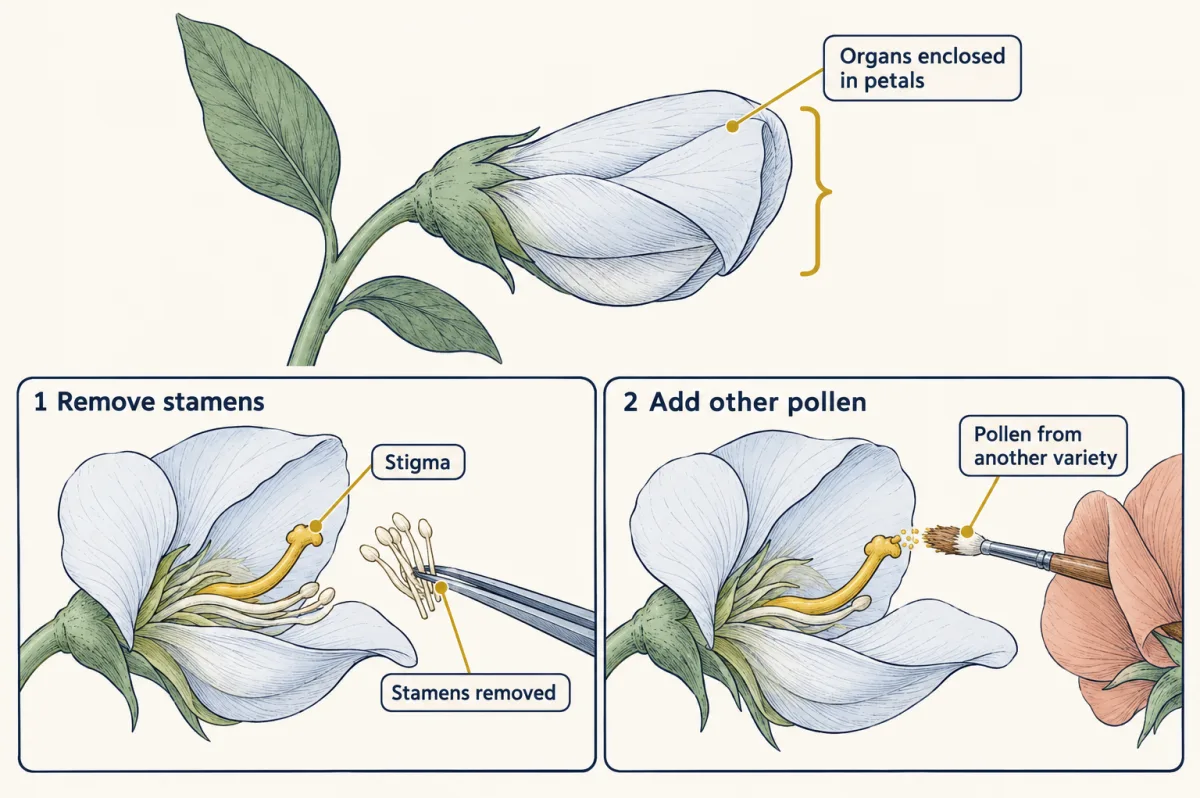
Mendel worked with the garden pea, Pisum sativum. A pea flower encloses its reproductive organs in its petals and sheds pollen early, so it normally fertilises itself (self-pollination), safe from stray pollen. Left alone, a pea line stays pure; opened by hand, it can be crossed.
He kept only true-breeding lines. A line is a strain kept going by self-pollination; in a true-breeding line, the offspring of selfed plants show the same form, generation after generation. He chose characters with two clear forms, such as round or wrinkled seeds and tall or short stems. He made each cross both ways, each variety serving once as seed parent and once as pollen parent. These reciprocal crosses gave the same hybrid: it did not matter which parent was the mother.
In modern labels, which Mendel did not use, the true-breeding parents are the P generation, their hybrids the F1, and the offspring of selfed F1 plants the F2. One twist: the seed characters he scored, shape and the colour of the seed leaves, are set by the embryo’s own genotype, so they show the next generation. (The seed coat is the mother’s tissue; it wrinkles as an rr embryo inside shrinks on drying.) The cross runs like this:
- P plants, round x wrinkled, bear the F1 seeds in their pods: all round.
- F1 plants grow from those seeds and self-pollinate. Their pods hold the F2 seeds, round and wrinkled side by side.
So Mendel could score the F2 by opening the F1 plants’ pods, without growing another generation.
Two kinds of round
- An allele is one version of a gene (a card, in the films). Here they are R (round) and r (wrinkled). The capital letter marks the allele that shows in a hybrid. A gene’s place on a chromosome is its locus (see chromosomes and meiosis); Mendel had no idea of such a place.
- A gamete is a reproductive cell: in a pea, an egg cell, or a sperm cell carried in a pollen grain (the grids below say pollen for short). Each gamete carries one allele of each gene.
- The genotype is the pair of alleles a plant carries (RR, Rr or rr). The phenotype is what you can see (round or wrinkled).
- Homozygous means the two alleles are the same (RR or rr). Heterozygous means they differ (Rr). An F1 hybrid in Mendel’s crosses is heterozygous at the locus, or loci, being followed.
- Mendel called round the dominant character, the one seen, wholly or nearly unchanged, in the hybrid, and wrinkled the recessive character, the one that becomes latent in the hybrid and reappears later.
Here is a selfed Rr plant as a grid: eggs down the side, pollen across the top, each box one union of egg and pollen.
| Selfed Rr | pollen R (1/2) | pollen r (1/2) |
|---|---|---|
| egg R (1/2) | RR, round (1/4) | Rr, round (1/4) |
| egg r (1/2) | Rr, round (1/4) | rr, wrinkled (1/4) |
Rr x Rr → 1/4 RR : 1/2 Rr : 1/4 rr, which shows as 3/4 round : 1/4 wrinkled
Each box is a product of halves. One R is enough for a round seed, so three boxes look round, and the round fraction is their sum. If this is right, the round F2 seeds are not all alike: some should be RR and some Rr, and you cannot tell which by looking.
Predict. Mendel grew 565 plants from round F2 seeds and let each one self-pollinate. What fraction should give only round seeds? What should the rest give?
Check your prediction
Of the four boxes, three are round: one RR and two Rr. So one round plant in three should breed true, and two in three should give round and wrinkled seeds again. Mendel found 193 plants with only round seeds and 372 that bore both, the seeds of those 372 again near 3 round to 1 wrinkled. So 34 percent of the plants bred true and 66 percent segregated: close to one third and two thirds, or 1.93 segregating plants to 1 true-breeding.
Mendel scored the seeds these F2 plants bore, the next generation, the F3. This test turned a ratio into a rule. The 3:1 says how often wrinkled comes back. The 1-to-2 split among plants that look identical says why: round seeds come in two hidden kinds, in the proportions the coin toss predicts. The wrinkled F2 plants all bred true, as rr plants must.
This is the law of segregation: the two alleles of a plant separate into different gametes, one to each, at random. The names of this law and the next came after 1900; Mendel wrote of rules found by experiment.
Keep two ratios apart: 3:1 is a phenotype ratio, what you see; 1:2:1 is a genotype ratio, what the plants carry. Only the F3 test let Mendel see the second through the first.
What “dominant” means
Dominance describes only what a heterozygote looks like. It does not mean an allele is stronger, better, or commoner in a population.
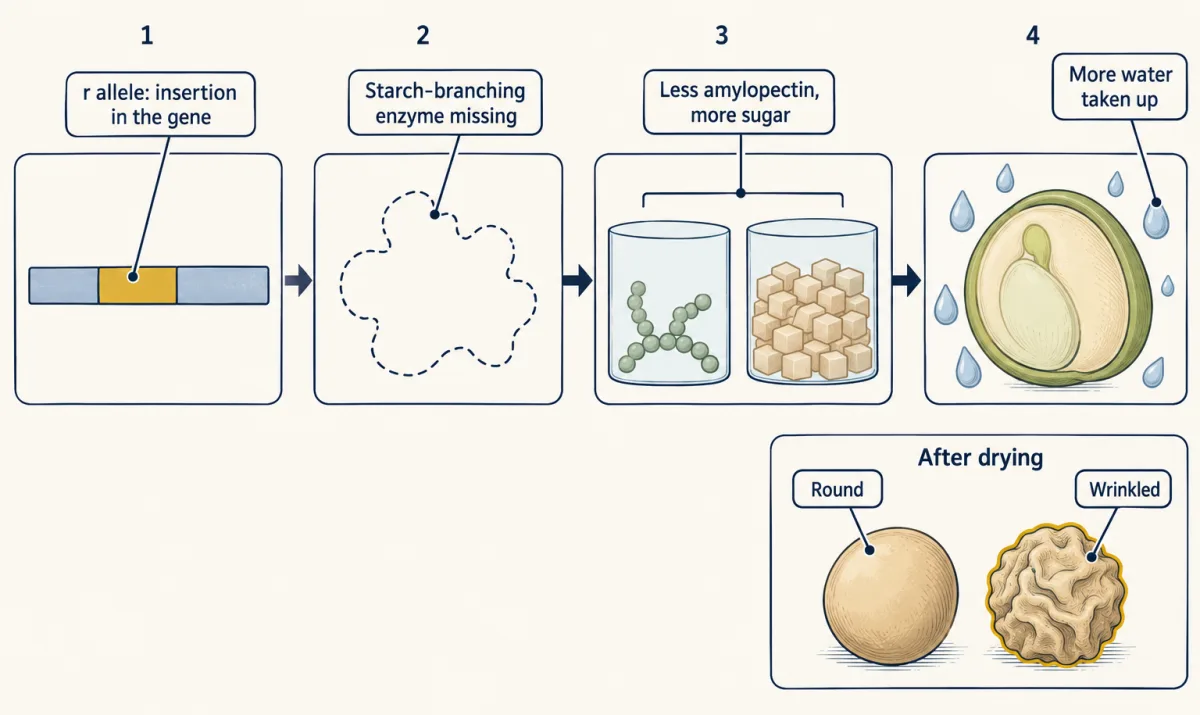
For seed shape the reason is known. In 1990 Bhattacharyya, Smith, Ellis, Hedley and Martin reported that r carries an insertion resembling a transposable element, a stretch of DNA that can move within the genome, in a gene for a starch-branching enzyme. Without that enzyme (the SBEI form), rr embryos make less amylopectin, the branched form of starch (see carbohydrates), and hold more sugar, so they take up more water as they develop and wrinkle as they dry. One working copy in Rr seeds appears to be enough for seed shape, which is why round is dominant. That is a common reason an allele is recessive: one working copy of an enzyme’s gene makes enough enzyme (see how enzymes work).
Predict. Round is dominant for seed shape. Would you expect an Rr seed to match an RR seed in every way, down to the starch grains inside it?
Check your prediction
Not necessarily. Dominance describes one phenotype at a time. Seed shape, the phenotype Mendel scored, looks the same in RR and Rr seeds, but the starch grains inside Rr seeds have been reported to be intermediate between those of RR and rr seeds. Judged by starch grains, neither allele is fully dominant. “Round is dominant” is a statement about seed shape, not about everything the gene does.
Counts scatter
Predict. One of Mendel’s hybrids bore 43 round seeds and only 2 wrinkled ones (his word was angular). Does that plant refute the coin-toss rule?
Check your prediction
Not by itself. Single plants scatter widely. Mendel held that a ratio should be estimated from the sum of many observations, since one plant is a small sample; summed, his seeds gave the 2.96 to 1 of the opening. Still, this plant is unusual. In one family of 45 seeds, each with a 1/4 chance of being wrinkled, the chance of 2 or fewer wrinkled is about 3 in 10,000. If all 253 of his hybrids had borne 45 seeds, the chance that at least one came out this lopsided would be about 7 percent. His family sizes varied, so that is only a rough guide. Seeds in one pod may not be independent, and misscoring or other causes cannot be ruled out.
Sample a selfed hybrid, a test cross or a round F2 plant, and watch small samples stray.
- round : wrinkled, simulated
- –
- round : wrinkled, expected
- –
- resamples shown (latest 24 kept)
- –
Rule to keep: each seed is an independent draw with the cross's own odds (3/4 round from Rr x Rr, 1/2 round from Rr x rr), so counts scatter around the expected values and only large sums settle near the ratio, assuming complete dominance, equal transmission of R and r, and equal survival.
The test cross: reading a genotype you cannot see
A round plant might be RR or Rr. Self it and wait a generation, as Mendel did with his 565 plants, or cross it to a plant homozygous for the recessive allele: a test cross. The rr tester can give only r, so each seed’s phenotype reports which allele came from the unknown plant:
RR x rr → all Rr (round); Rr x rr → 1/2 Rr (round) : 1/2 rr (wrinkled)
Predict. You test-cross a round plant. In case A, one of its seeds is wrinkled. In case B, ten seeds are all round. How sure can you be of the round plant’s genotype in each case?
Check your prediction
Case A: the plant carries r. A wrinkled seed is rr, the tester gave only one r, so the round parent gave the other. One wrinkled seed is enough, barring stray pollen, which Mendel himself reported in a few cases. Case B is weaker evidence: an Rr parent gives each seed an even chance of being round, so a short run of round seeds can happen by luck. Ten in a row from an Rr parent has probability (1/2)10, about 1 in 1,000. That is the chance of the result if the plant is Rr, not the chance that the plant is Rr. It is strong evidence for RR, but not proof.
Mendel used the test cross for his second question: does the gene for seed shape go into a gamete together with the gene for seed colour, or separately? Yellow (Y) is dominant to green (y), and he crossed his double hybrid to wrinkled green plants both ways. The second film sets up the two possible answers and runs that test.
Read the transcript of “Two Genes, Two Coins”
Film transcript: Two Genes, Two Coins
Does a pea hand on its genes one at a time, or in bundles? Chapter 1 followed one gene, for seed shape. Now add a second, for seed colour. Mendel crossed a line with round yellow seeds to a line with wrinkled green seeds. Every hybrid seed was round and yellow. So the hybrid holds two pairs of cards. A shape pair, one round and one wrinkled. A colour pair, one yellow and one green. When it makes an egg or pollen grain, does it toss the two pairs together, or separately? Suppose they were glued together.
Round and yellow came in from one parent, so they would leave together. The hybrid would make only two kinds of gamete. Now suppose each pair has its own coin. Any shape card can go with any colour card. The hybrid would make four kinds of gamete, a quarter each. A selfed seed mixes two of the hybrid's gametes, and dominance hides some copies. So how could you read the hybrid's gametes directly?
Cross the hybrid to a wrinkled green plant. That tester can only give wrinkled and green copies. So each seed shows which copies the hybrid gave it. Mendel ran this cross with the hybrid as the seed parent. The seeds fell into four kinds, in roughly equal numbers.
Then he ran it the other way, with the hybrid as the pollen parent. Again, four kinds, roughly equal. So eggs and pollen alike carried all four combinations about equally. Fully glued pairs cannot do that. Two separate coins can. Now let the double hybrid pollinate itself, as Mendel did. Separate coins predict how its seeds should split. Draw a square for all the seeds.
Shape cuts it into three quarters round and one quarter wrinkled. Colour cuts it the other way. Separate coins multiply, so each box's share is a product. The round yellow corner is the biggest. The wrinkled green corner is the smallest. Mendel's counts sat close to those shares.
Close, but not exact, as real counts usually are. This held for seed shape and seed colour. It does not hold for every pair of genes. Why not comes in a later lesson. So here is the whole idea. Two copies of each gene, and one goes to each gamete by a coin toss. Genes that assort independently are separate coins, like seed shape and colour.
From the film
- Mendel asked whether the genes for seed shape and seed colour go into gametes together or separately.
- Crossing the double hybrid to wrinkled green lets each seed show one gamete of the hybrid.
- Eggs and pollen alike carried all four combinations in about equal numbers, so the two genes were sorted separately.
- Separate tosses multiply, so the selfed double hybrid gives four classes near 9:3:3:1.
- This held for seed shape and colour; it does not hold for every pair of genes.
Two characters: what the film left out
In the second film’s test cross, with the hybrid as seed parent, the seeds were 31 round yellow, 26 round green, 27 wrinkled yellow and 26 wrinkled green. With the hybrid as pollen parent, they were 24, 25, 22 and 27. Both are close to 1:1:1:1, so the hybrid’s eggs and its pollen each carried the four allele combinations in about equal numbers.
The F1 of round yellow x wrinkled green was round and yellow, RrYy. Fifteen F1 plants, selfed, gave 556 seeds: 315 round yellow, 108 round green, 101 wrinkled yellow and 32 wrinkled green. Assume, at both loci, the conditions in the scope note above, complete dominance included.
In words The chance of both equals the chance of the first times the chance of the second, when knowing one tells you nothing about the other.
- P(A)“P of A”
- probability of the first event, such as a seed being round: 3/4
- P(B)“P of B”
- probability of the second event, such as a seed being yellow: 3/4
- P(A and B)“P of A and B”
- probability that both happen
Sanity check If the second event is certain, P(B) = 1 and the chance of both is just P(A). If either event is impossible, so is the pair.
Try one number
Round and yellow: 3/4 × 3/4 = 9/16. Round and green: 3/4 × 1/4 = 3/16. Wrinkled and yellow: 1/4 × 3/4 = 3/16. Wrinkled and green: 1/4 × 1/4 = 1/16.
Need a refresher? reading an equation
As a square, shape cuts it 3/4 to 1/4 one way and colour 3/4 to 1/4 the other; each box’s area is a product:
| Selfed RrYy | yellow (3/4) | green (1/4) |
|---|---|---|
| round (3/4) | 9/16: expect 312.75, saw 315 | 3/16: expect 104.25, saw 108 |
| wrinkled (1/4) | 3/16: expect 104.25, saw 101 | 1/16: expect 34.75, saw 32 |
Equivalently, an RrYy plant makes four gamete types, RY, Ry, rY and ry, at 1/4 each, and the 16 equally likely unions sort into 9, 3, 3 and 1. A class that spans boxes is a sum: all round seeds are 9/16 + 3/16 = 3/4.
Two checks. Each character alone segregates near 3:1: round 315 + 108 = 423 to wrinkled 101 + 32 = 133 is 3.18 to 1, and yellow 315 + 101 = 416 to green 108 + 32 = 140 is 2.97 to 1. And among yellow seeds the fraction round is 315/416 = 0.757, among green seeds 108/140 = 0.771, both near 3/4: knowing a seed’s colour does not change the odds on its shape.
This is the law of independent assortment: alleles at one locus enter gametes independently of alleles at another. Whether 315:108:101:32 is close enough to 9:3:3:1 needs a statistical test, which waits for probability and crosses. The test cross reads it more directly: a round yellow plant that, crossed to wrinkled green (rryy), gives all four classes in roughly equal numbers must be RrYy.
Predict. Suppose the genes for shape and colour usually, but not always, went into a gamete together. A double hybrid got R with Y from one parent and r with y from the other. What would its test cross to wrinkled green show?
Check your prediction
Still four classes, but not equal. Round yellow and wrinkled green, the combinations the hybrid inherited, would clearly outnumber round green and wrinkled yellow. Fully glued together would give only those two classes; fully separate, four equal ones. Mendel’s test crosses fit separate coins. The law holds for these two characters; it does not hold for every pair of genes, as linkage and mapping will show.
Design problem
You have a tall pea plant with purple flowers from an unknown source. Tall (T) is dominant to short (t), and purple (P) to white (p). Design crosses to find its genotype at both loci and to test whether the two characters assort independently.
Saved in this browser only.
One way to do it
Test-cross it to a true-breeding short, white line (ttpp). The tester gives only t and p, so each offspring’s phenotype reads one gamete of the unknown plant (assume complete dominance and equal survival).
Predictions: TTPP gives all tall purple. TtPP gives all purple, tall and short at 1:1. TTPp gives all tall, purple and white at 1:1. TtPp gives tall purple, tall white, short purple and short white at 1:1:1:1, if the loci assort independently.
How many offspring? A class expected at 1/4 is missing by chance with probability (3/4)n, about 0.003 for 20 offspring. A class expected at 1/2 is missing with probability (1/2)20, about 1 in a million. So with 20 or more offspring, an absent single-locus class (no short offspring, or no white ones) is good evidence that the allele is absent. To judge a ratio, raise about 100, or 25 per class.
If the plant is TtPp and the four classes come out near 25 each, the data fit independent assortment, though a sample this size can miss weak linkage. If two complementary classes (tall purple and short white, or tall white and short purple) clearly outnumber the other two, the alleles are travelling together, which points ahead to linkage.
What Mendel knew
Mendel inferred his elements from counts. He wrote of differing “elements” (Elemente) and of dominant and recessive characters, and he placed the elements in the reproductive cells without tying them to any structure inside those cells. He did not know of chromosomes or meiosis, which explain his laws, and the word gene was coined by Wilhelm Johannsen in 1909. His paper was cited a few times before 1900 but not taken up until Hugo de Vries and Carl Correns reported crosses that followed his rules in 1900. The physical basis is the subject of chromosomes and meiosis.
Going deeper
A second count: seed colour
Seed colour gave a similar result in the second generation: 6,022 yellow and 2,001 green among 8,023 seeds, or 3.01 to 1.
Checking the materials
Mendel grew 34 varieties for two years and kept 22 for crossing. In his crosses, stray pollen got through in only a few of more than 10,000 plants he examined. He scored seeds only once the pods were ripe and dry.
Mendel and his paper
Mendel was an Augustinian friar at St Thomas’s Abbey in Brünn, now Brno, and later its abbot. He presented the pea work to the town’s Natural History Society on 8 February and 8 March 1865, and the paper, “Versuche über Pflanzen-Hybriden”, was printed in 1866.
Mendel’s own notation
Mendel wrote the series of forms in the hybrids’ offspring as A + 2Aa + a, not AA + 2Aa + aa: each true-breeding form got a single letter. Historians have argued over whether he pictured paired elements in true-breeding plants, which is why this lesson calls the two-copy account the modern reading.
The rediscovery in 1900
Of the two 1900 reports, de Vries’s French note did not mention Mendel, and Correns credited Mendel’s priority. Erich von Tschermak is often named a third rediscoverer, though his place is disputed. In 1902 William Bateson published a book defending the paper, with an English translation of it reprinted inside.
Two later stories that need correcting
A popular claim says each of Mendel’s seven characters sat on a different one of the pea’s seven chromosomes. It is false: several lie on the same chromosome, and seed shape (R) and pod colour (Gp) are weakly linked. And in 1936 Ronald Fisher argued that Mendel’s data fit too well, a point Walter Weldon had first raised in 1902. It is a statistical debate, not a finding of fraud, and a 2019 reanalysis by Ellis and colleagues did not find remarkable disagreement with expectation.
Your notes
Select any text in the lesson to highlight it or add a note to it. Your highlights and notes are saved in this browser and collected in your notebook.
This browser is not letting the site save anything (a private window or strict privacy settings), so highlights and notes will be lost when you leave the page.
How we measure it
Emasculation and controlled pollination
The stamens of an immature flower are removed before they shed pollen, and pollen from a chosen plant is placed on the stigma. In peas, whose flowers normally pollinate themselves inside closed petals, this lets the breeder choose the father of each seed, with only rare contamination by stray pollen.
Reciprocal crosses
The same two lines are crossed both ways, each serving once as seed parent and once as pollen parent. Mendel found the same hybrid either way, so his characters were transmitted equally through egg and pollen.
Progeny testing by self-pollination
A plant is allowed to self-pollinate and its offspring are scored. A plant whose offspring all match it, in a large enough family, breeds true; one whose offspring include the other form is a hybrid. This split the round-seeded F2 plants into two hidden classes.
Test cross
A plant showing the dominant form is crossed to a plant homozygous for the recessive allele. The tester contributes only recessive alleles, so the offspring's phenotypes report the alleles in the unknown plant's gametes.
Practice questions on this lesson (3) → MCAT-style, original, each with an explanation
Where this lesson fits
Before thisReview first
- Mendel and Punnett SquaresBiology · High school
It teaches the 3:1 cross, genotype versus phenotype and Punnett squares, which this lesson uses at full depth.
After thisStudy next
- Chromosomes and Meiosis: The Physical Basis of Mendel's LawsThis course · Lesson 2
It shows the chromosome behaviour in meiosis that physically explains segregation and independent assortment.
- Probability, Crosses and the Chi-Square TestThis course · Lesson 3
It tests whether counts like 315:108:101:32 fit 9:3:3:1 using the chi-square test.
- Extending Mendel: Dominance, Multiple Alleles and Gene InteractionThis course · Lesson 4
It takes the idea further when dominance is incomplete or genes interact, so ratios differ from 3:1 and 9:3:3:1.
Elsewhere on the siteFilms, simulations and method films in other courses
- Chi-square testMethod film
It decides whether counts such as 5,474 round to 1,850 wrinkled fit a 3:1 expectation.
- Breed pea plantsSimulation · Life Science
Breeding pea plants one-gene crosses shows how hidden recessive alleles return as a 3:1 ratio.
Suggested by an AI model from the lessons themselves, then checked. How we use AI
Finish line
Test yourself
8 questions
Practice and MCAT-style, with explained answers.
Next · Lesson 2
Chromosomes and Meiosis: The Physical Basis of Mendel's Laws
A fruit fly cell has eight chromosomes and its sperm have four. Which four does a sperm get, and what decides it?
Continue →