Organismal Biology · Unit 6: How plants work
Moving Water and Sugar in Plants
Rewritten on : new text, flashcards and film. Your notes and highlights stay, but the text around them may have moved.
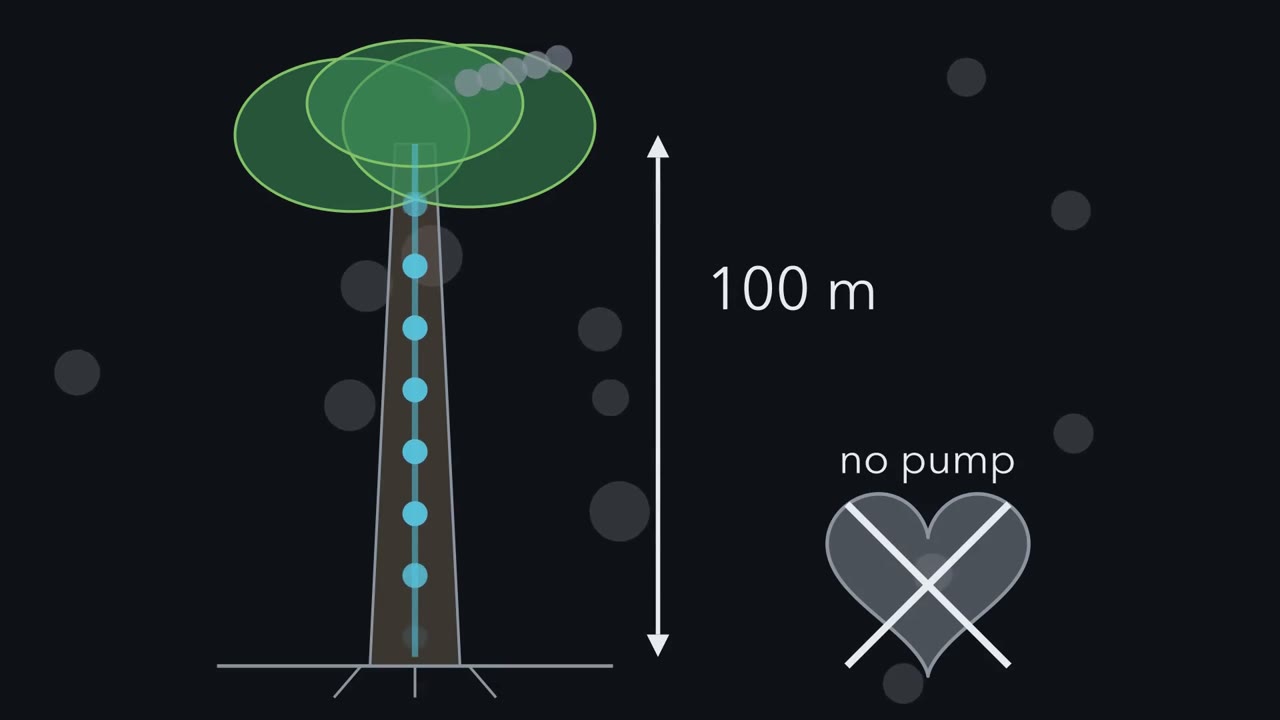
A coast redwood lifts water more than 100 m with no heart or other pump organ. Where does the force come from?
Pause when the reading reaches a film, and offer to play it. Saved on this device.
Watch the film now, or keep listening
Builds on:Plant Body and GrowthSize, Scale and SurfaceWhat an Organism Has to DoWhy these?
 ▶ Watch Pulled From the Top · 3:16
Read the transcript of “Pulled From the Top”
Film transcript: Pulled From the Top
A coast redwood lifts water more than one hundred metres, with no heart or other pump organ. Where does the force come from? Plant biologists track water with one number, its water potential Pure water at atmospheric pressure is set at zero.
Dissolve a solute in open water, and the number drops below zero. Water crossing a membrane moves toward lower water potential. Now line up a plant, with illustrative values. The soil sits a little below zero, the root lower, the leaf lower still. The air sits far below them all. So water runs downhill all the way. The biggest drop by far is from the leaf to the dry air.
Inside a leaf, water evaporates from the wet walls of the mesophyll cells. These inner cells do photosynthesis. The vapour diffuses out to the drier air. As water leaves, the water still held in the tiny pores of the walls is held more tightly. Its pressure falls below zero. That is tension, a pull. Negative pressure means the water is stretched, not squeezed.
Picture a sealed syringe full of water, its plunger pulled back. If no bubble forms, the water pulls on the plunger instead of pushing. Why does the pull not just snap the water? Water molecules cling to each other through hydrogen bonds. This cohesion lets a thin column in a narrow tube be pulled like a rope.
The tubes are xylem cells called tracheids and vessel elements. They are dead when they work, with their contents gone. They leave a hollow pathway from root to leaf. Henry Dixon and John Joly proposed this in the 1890s. Evaporation pulls, cohesion passes the pull down, and the column stays under tension. Height adds a cost. Each metre takes about 0.01 MPa more tension, just to hold a still column. At the top of a 110 m redwood, gravity alone adds over 1 MPa. Roots can push water too, a little. If xylem water were pushed from below, what would happen when you cut it on a sunny afternoon?
Pushed water would spurt out. It does not. Cut the xylem of a transpiring tree and air is drawn in. The water was under tension. So the force comes from the top. Evaporation lowers the pressure in the leaf, and the water column below is pulled up toward it. Water leaves for lower water potential, and the dry air is lowest of all. So the xylem is pulled, not pushed.
From the film
- Water crossing a membrane moves toward lower water potential, and dry air sits far below a typical leaf.
- Evaporation from wet leaf cell walls puts the water behind it under tension, a negative pressure.
- Water molecules cling together, so the pull is passed down unbroken columns of dead, hollow xylem cells to the roots.
- Height adds about 0.01 MPa of tension per metre, so the top of a 110 m redwood needs over 1 MPa before any flow.
The tallest measured coast redwoods (Sequoia sempervirens) stand more than 100 m high, and every leaf at the top is supplied mainly with water from roots in the soil. The first film showed the force comes from the top. This page adds where that pull fails, the valve that controls it, and the other half: sugar, which is pushed.
You met the two tissues in plant body and growth: xylem, whose dead, hollow cells carry water and minerals up from the roots, and phloem, whose living cells carry sugar from where it is made to where it is used. Both rely on bulk flow, movement of a whole fluid driven by a pressure difference, far faster than diffusion over long distances (size and scaling).
The one idea. A plant has no heart or other pump organ. Two local processes set up pressure differences, and sap flows in bulk down the resulting differences in pressure plus height. In the xylem, evaporation from wet leaf cell walls lowers the pressure at the top, so the water column is pulled up under tension, a pressure below zero. In the phloem, sugar loaded at a source (a part that exports sugar, usually a mature leaf) draws water in by osmosis and raises the pressure, so sap is pushed toward a sink (a part that takes sugar up, such as a root, a fruit or a growing shoot tip).
Scope: water crossing a membrane moves toward lower total water potential. Inside an open conduit (xylem tracheids and vessels, phloem sieve tubes), sap moves as one fluid, solutes and all, toward lower pressure plus height; dissolved sugar still matters there by making sap thicker (more viscous). Along a short phloem path height is small next to source-to-sink pressure differences, so later sections say “pressure” for short; uphill, the pressure difference must also pay for height. This is a steady-state picture; the tallest trees and the refilling of emptied conduits are open questions (Going deeper).
Water potential: which way water crosses
The film’s one number, water potential (Ψ, the Greek letter psi), is the potential energy of water relative to pure water at atmospheric pressure and the same temperature and height. It is measured in megapascals (MPa; 1 MPa is about ten atmospheres), and that reference is defined as 0 MPa. Three parts add up:
In words Water potential equals solute potential plus pressure potential plus gravitational potential.
- Ψ“psi”
- total water potential, relative to pure water at atmospheric pressureMPa
- Ψs“psi s”
- solute potential: zero for pure water, negative for any solution because solutes lower water's free energy; roughly -iCRT for a dilute solution (i particles per dissolved molecule, C molar concentration, R the gas constant, T absolute temperature)MPa
- Ψp“psi p”
- pressure potential: usually positive (turgor) in a living walled cell, usually negative (tension) in transpiring xylemMPa
- Ψg“psi g”
- gravitational potential: about 0.01 MPa more per metre of height, the cost of lifting waterMPa
Sanity check A solute always makes Ψs more negative, so its sign is never positive.
Try one number
0.30 M sucrose at 20 degrees C (293 K), with i = 1 because sucrose does not split into ions, and R = 0.008314 L MPa per mol per K: Ψs = -(1)(0.30)(0.008314)(293) = -0.73 MPa.
Need a refresher? subscripts and Greek letters · units and prefixes
Turgor is a walled cell’s contents pushing out against the wall: a positive Ψp, the opposite of tension. How water crosses membranes, through channels called aquaporins, is in membrane transport.
Predict. Assume equal heights (so ignore Ψg) and a membrane that passes water but not solutes. In this made-up example a walled cell has Ψs = -0.80 MPa and turgor Ψp = +0.50 MPa, and sits in a large bath at -0.40 MPa. The cell holds more solute than the bath. Which way does water move? (Add the cell’s parts; water leaves whichever side has the higher total.)
Check your prediction
Out of the cell. Its total is -0.80 + 0.50 = -0.30 MPa, higher than the bath’s -0.40 MPa, so water leaves despite the extra solute: turgor counts as much as solute. Where it stops is in Going deeper.
Where the air’s -94 MPa comes from (optional; the point is the size). Water vapour in air has Ψ = (RT / molar volume of water) × ln(relative humidity). At 20 degrees C the first factor is about 135 MPa, so air at 50% relative humidity sits at 135 × ln 0.50 = 135 × (-0.69), about -94 MPa. In the ladder below, raise the humidity to 80%: the air step shrinks to about -30 MPa, still far below every step inside the plant.
- Air (from relative humidity)
- Extra tension to hold a still column
- Leaf total (illustrative value)
- Soil to root
- Root to leaf
- Leaf to air
- Downhill all the way?
In this sketch: illustrative values, not a measured plant; 20 °C; steady flow; gravity about 0.01 MPa per m. The root (−0.6 MPa) and the leaf (−1.5 MPa) are the lesson’s illustrative values; the slider ranges are chosen for the sketch (the lesson cites air at 50 to 80% relative humidity). Blocks and arrows are a schematic of the route, not anatomy.
Rule to keep: water always moves toward lower total water potential. Evaporation powers the pull, and cohesion passes it down continuous xylem columns; the plant does not pump the water up.
The pull: what the first film left out
The evaporation the first film showed is transpiration, the loss of water vapour from a plant to the air, mostly through the leaves. Of the two conducting cell types, conifers such as Douglas fir (Pseudotsuga menziesii) move water mainly through tracheids, while most flowering plants also have wider vessels. The hydrogen bonds behind cohesion, a network that constantly breaks and re-forms, are in water and weak bonds.
Could the roots push instead? Root pressure builds when roots move minerals into the xylem and water follows by osmosis; it causes the drops seen on some leaf edges at dawn. In woody plants and vines it is small: the highest value in a survey of 109 tropical vines and woody species was about 0.15 MPa.
Predict. Gravity costs about 0.01 MPa per metre. Could the strongest root pressure in that survey hold water up to a leaf 30 m high?
Check your prediction
No. A leaf 30 m up needs 0.30 MPa of extra tension just to hold a still column, before any flow; 0.15 MPa could in principle raise water about 15 m, half the height, and root pressure is weak or absent when transpiration is fastest.
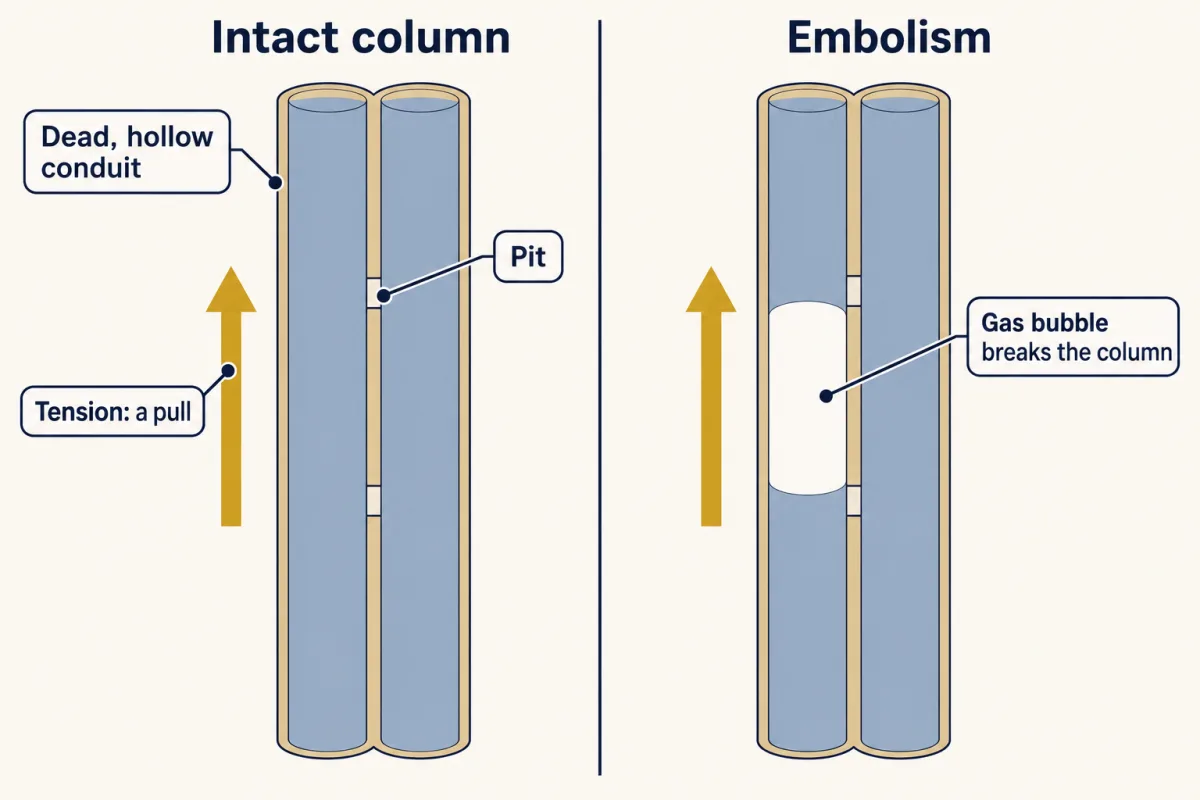
A pulled column can fail. An embolism, a gas bubble that fills a conduit and breaks its column, grows more likely as drought raises tension; pits, thin patches in the walls between neighbouring conduits, limit its spread.
Stomata: the valve on the pull
A waxy cuticle greatly slows both water and carbon dioxide, so gas moves mainly through stomata, pores each bordered by two guard cells. Guard cells that take up potassium ions and accompanying anions (negative ions) lower their water potential, so water flows in and turgor bows them apart, opening the pore; losing those solutes closes it. Light favours opening; drought, through the hormone abscisic acid (plant signals), favours closing.
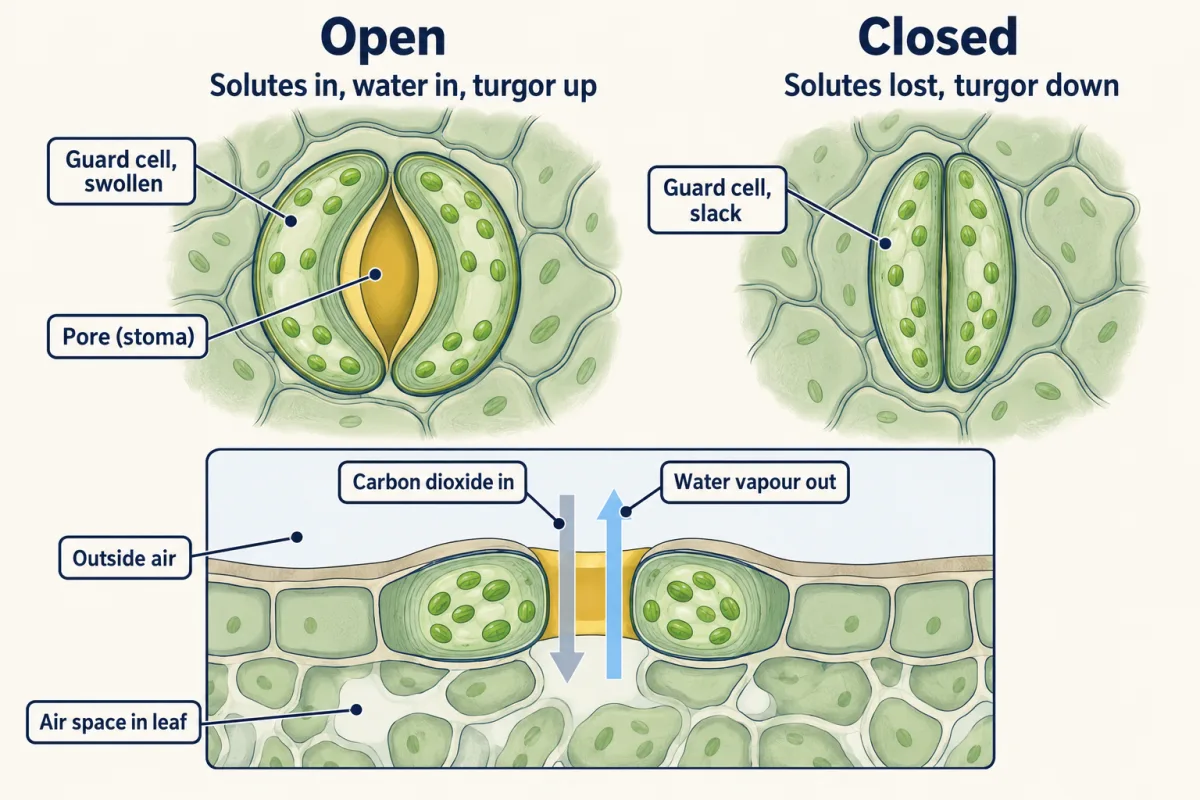
Far more water leaves an open stoma than carbon enters: the leaf’s air spaces are nearly saturated with vapour and outside air is much drier, so the vapour gradient out is far steeper than the small carbon dioxide gradient in. You computed water-use efficiency in organism problems. Many cacti use crassulacean acid metabolism (CAM), opening their stomata at night when air is cooler and evaporation slower; the biochemistry is in the Calvin cycle.
Some of the carbon an open stoma lets in is fixed into sugar, and the sugar a leaf exports must reach roots, fruits and shoot tips. In flowering plants it travels in sieve tubes, chains of living sieve-tube elements joined end to end through perforated end walls called sieve plates; each element has lost its nucleus and depends on a neighbouring companion cell. Conifers move sugar in a related cell type, sieve cells. Nothing evaporates at a root to pull sap there, so what moves it? The second film follows Ernst Münch’s answer and its test.
Read the transcript of “Pushed From the Source”
Film transcript: Pushed From the Source
Sugar made in a leaf ends up in a root below it and a shoot tip above it. What moves it both ways, with no heart and nothing pulling? Water in the xylem is pulled toward dry air. Sugar rides in the phloem, in living sieve tubes. And nothing evaporates at a root to pull it. In 1930, Ernst Münch pictured two bulbs joined by a tube. Each is wrapped in a membrane that lets water through but holds sugar back. Both sit in water. Put strong sugar solution in one bulb. The sugar lowers its water potential, so water rushes in by osmosis. The pressure inside rises. That pressure pushes the solution along the tube toward the other bulb. The sap flows in bulk, from higher pressure to lower.
In the plant, a leaf making sugar is the first bulb, the source. A root, a fruit or a shoot tip using sugar is the second bulb, a sink. At a sink, sugar is removed, water leaves, and the pressure falls. The xylem alongside supplies the water at the source. Sap flows from source to sink, wherever the sink sits. So it can run down to the roots or up to a growing shoot tip. For decades there was an objection.
Sieve tubes are narrow, and blocked at intervals by perforated end walls, the sieve plates. Pushing sap through metres of them seemed to need impossible pressures. In 2016, Michael Knoblauch, Michele Holbrook and colleagues tested this in the morning glory. They measured the pressure inside working sieve tubes with tiny probes. Then they made the sugar's path longer, by removing leaves from long vines.
Now the sugar had to travel much farther to reach the roots. With the same narrow tubes, the pressure needed would soar. If you make the path much longer, what must change for the sap still to arrive? Two things changed together. First, source pressure rose with path length. It passed 2.2 MPa in the longest vine. Second, the tubes conducted five to six times better, mainly because the sieve-plate pores were wider. With both changes, the estimated reach of pressure flow matched the length of the vine. That is one species, measured with care. The authors read it as strong support for pressure flow in this plant. Where sugar goes in, water follows and the pressure rises.
Sap is pushed to wherever sugar is taken out.
From the film
- At a source, such as a mature leaf, loading sugar into sieve tubes draws water in from the xylem and raises the pressure.
- At a sink, such as a root, fruit or shoot tip, sugar is removed, water leaves and the pressure falls.
- Sap flows in bulk from source to sink, down the difference in pressure plus height, so it can run down to the roots or up to a shoot tip.
- In morning glory vines, longer paths came with higher source pressure, from about 0.75 to more than 2.2 MPa, and wider sieve-plate pores, so the estimated reach of pressure flow matched the length of the vine.
The push: what the second film left out
A sink is defined by what it does, not where it sits. A storage organ can switch roles: a potato tuber is a sink while filling and a source when sprouting.
Predict. Recall the scope rule: water crossing a membrane follows total water potential, but sap inside an open tube follows pressure plus height. Take the first film’s illustrative values: leaf xylem about -1.5 MPa, root xylem about -0.6 MPa. Assume the sieve tubes at each end are close to balance with the xylem beside them. Phloem sap runs from the leaf to the root. Does it run toward lower total water potential?
Check your prediction
No. It runs from about -1.5 MPa to about -0.6 MPa: up the total water-potential gradient. What falls along the path is pressure plus height. In the morning glory study, for example, source sieve tubes of moderate-sized plants held about 1.08 MPa of turgor, against about 0.59 MPa estimated at the sink.
Why would slightly wider pores matter so much? A sieve plate is a wall of narrow holes, and a hole’s resistance to flow climbs steeply as it narrows, faster than its area shrinks, so a modest widening multiplies how easily sap passes.
Loading can be active or passive. In Arabidopsis thaliana, SWEET proteins export sucrose from cells beside the phloem into the cell walls. Proton-coupled carriers, powered by a proton gradient across the membrane, then take it into the sieve-tube and companion-cell complex, spending energy; Chen and colleagues (2012) found that sweet11 sweet12 double mutants loaded the phloem poorly. Many trees studied so far load passively instead, with sugar moving down its concentration gradient into the phloem (Fu and colleagues surveyed 45 dicot species in 2011).
Two plumbing systems compared: xylem, phloem and a vertebrate circulation
A vertebrate heart pushes blood round a closed loop at positive pressure (circulation and the heart); a resting adult human’s peak (systolic) arterial pressure, 120 mmHg above atmospheric, is about 0.016 MPa. Xylem water moves mainly one way, under negative pressure powered by evaporation, and most is lost to the air, not returned. Source phloem runs at about 1 MPa in moderate-sized morning glory plants (roughly 70 times that arterial pressure) and over 2 MPa in the longest vines, set by osmosis at each end, not a pump organ. Root uptake of water and minerals is in plant nutrition.
Design problem
Physiologists count embolized conduits to judge drought damage, and some studies reported overnight refilling; stems are usually cut under water to keep air out. Torres-Ruiz and colleagues (2015) found that cutting under water while the xylem was under tension itself created embolisms in Juglans microcarpa, Eucalyptus pauciflora, Helianthus annuus and Acer campestre. Design a test of whether air-filled vessels seen in a cut stem were already there in the living plant.
Saved in this browser only.
One way to do it
Scan an intact stem with X-ray microtomography, which tells air-filled from water-filled conduits, then cut it under water and scan the same region again. Conduits full before and empty after were emptied by the cut.
Control for the suspected cause: relax the tension before cutting (let the plant rehydrate until its water potential is only slightly negative; Torres-Ruiz and colleagues suggest about -0.2 to -0.4 MPa), scan again to check that rehydration has not itself refilled any conduits, then cut and scan. If cutting at low tension adds few embolisms and cutting at high tension adds many, with handling and timing matched, tension at the moment of cutting is the likely cause.
Repeat across species and tensions, with several plants per tension (the original study had one scan per tension in two of its species), since Torres-Ruiz and colleagues found the effect depended on species, tension and existing embolism.
A clean result shows that cutting can create false embolisms; it does not prove that refilling never happens in intact plants, which needs repeated scans of uncut stems over time.
Going deeper
More on water potential
Equilibrium. In the Predict cell above, if the cell’s solute potential stayed at -0.80 MPa, water would stop moving when turgor fell to Ψp = -0.40 - (-0.80) = +0.40 MPa. Check: -0.80 + 0.40 = -0.40 MPa. A real cell losing water concentrates its solutes, so Ψs would shift too.
Gravity. The precise figure is about 0.0098 MPa per metre; the rounded 0.01 MPa per metre is the one Woodruff and colleagues used in their 2004 study of Douglas fir.
Matric potential, a fourth term, matters in dry soil and cell walls; this lesson sets it aside.
Faster stomata
Papanatsiou and colleagues (2019) expressed a light-gated potassium channel, BLINK1, in Arabidopsis thaliana guard cells. The stomata opened and closed faster, and under fluctuating light the plants made about 2.2 times the biomass of controls without using more water: one species, one light regime.
The morning glory measurements
In moderate-sized plants they measured a sap speed of about 123 micrometres per second by carbon-11 tracing (three plants), a sap viscosity of about 1.7 mPa s from fluorescence lifetime imaging, and a source sieve-tube turgor of about 1.08 MPa with a pico-gauge pressure probe. Sink pressure was constrained from root cortex cells (about 0.59 MPa), not measured in sieve tubes, so the real source-to-sink pressure difference may be somewhat smaller than calculated. From the tube anatomy they calculated that flow needed about 0.21 MPa per metre. The authors estimated that, at the faster sap speed measured in the long vines (about 256 micrometres per second) and with the tube geometry of the smaller plants, the higher pressure alone would have carried sap only about 3.7 m.
The root cortex value from 7.5 m plants was also assumed for the longer vines, which adds to that sink-pressure caveat.
Open questions
Whether pressure flow alone serves the tallest trees has not been tested: sieve-tube anatomy and sink pressures have not been measured along a whole path. How often embolized conduits refill in intact plants is also unsettled (see the Design problem).
Your notes
Select any text in the lesson to highlight it or add a note to it. Your highlights and notes are saved in this browser and collected in your notebook.
This browser is not letting the site save anything (a private window or strict privacy settings), so highlights and notes will be lost when you leave the page.
How we measure it
Scholander pressure chamber
A cut leaf or twig is sealed in a steel chamber with its cut end poking out, and gas pressure is raised until sap just appears at the cut surface. The pressure needed balances the tension the xylem water was under, so it gives an estimate of the shoot's water potential.
Pressure probes in sieve tubes
A fine glass tip is pushed into a single living sieve tube. The tip holds a tiny trapped volume of oil, and how far that oil is squeezed shows the pressure (the pico-gauge Knoblauch and colleagues used). The probe reads the turgor pressure inside a working cell rather than inferring it from the tissue.
Radiotracers and aphid stylets
A leaf fed carbon dioxide labelled with carbon-11 makes labelled sugar, and detectors along the stem time its arrival, giving a flow speed. Separately, an aphid feeding from a sieve tube can be cut away from its mouthparts; sap keeps oozing from the severed stylet, which shows the sieve tube is under positive pressure and yields nearly pure phloem sap.
X-ray microtomography
X-ray images taken from many angles are combined into a three-dimensional picture of a stem. Air-filled and water-filled xylem conduits look different, so the same intact stem can be scanned before and after a treatment to count embolisms.
Practice questions on this lesson (3) → MCAT-style, original, each with an explanation
Where this lesson fits
Before thisReview first
- Plant Body and GrowthThis course · Lesson 22
It introduces xylem and phloem, the two conducting tissues whose flow this lesson explains.
- Size, Scale and SurfaceThis course · Lesson 2
It shows why bulk flow beats diffusion over long distances, which plant sap relies on.
- What an Organism Has to DoThis course · Lesson 1
It covers the trade-off between water loss and carbon dioxide uptake that stomata control here.
After thisStudy next
- Soil, Nutrients and PartnersThis course · Lesson 24
Roots take up water and minerals into the xylem stream you have just seen pulled upward.
- Auxin and Plant Hormones: How Plants Steer GrowthThis course · Lesson 25
Abscisic acid closing stomata in drought builds on how guard cells control the pull.
Elsewhere on the siteFilms, simulations and method films in other courses
- Random Moves, One-Way DriftFilm · Life Science
It shows how water moves across a membrane toward the side with more dissolved particles.
- A Tree Made of AirFilm · Biology
It shows the sugar made in leaves that becomes the phloem cargo moved from source to sink.
- Osmosis chamberSimulation · Biology
It lets you test osmosis across a membrane, the base for predicting water movement from water potential.
Suggested by an AI model from the lessons themselves, then checked. How we use AI
Finish line
Test yourself
8 questions
Practice and MCAT-style, with explained answers.
Next · Lesson 24
Soil, Nutrients and Partners
A green plant builds most of its body from carbon dioxide and water. What else does it need from the soil, and why can't it make it?
Continue →