Organismal Biology · Unit 4: Water, salts and wastes
Osmoregulation and Nitrogenous Waste
Rewritten on : new text, flashcards and film. Your notes and highlights stay, but the text around them may have moved.
A goldfish in a bowl is soaking up water all day, and a cod in the sea is losing it. How does each one stay the same size?
Pause when the reading reaches a film, and offer to play it. Saved on this device.
Watch the film now, or keep listening
Builds on:Tissues, Organs and HomeostasisWhat an Organism Has to DoCrossing the MembraneWhy these?
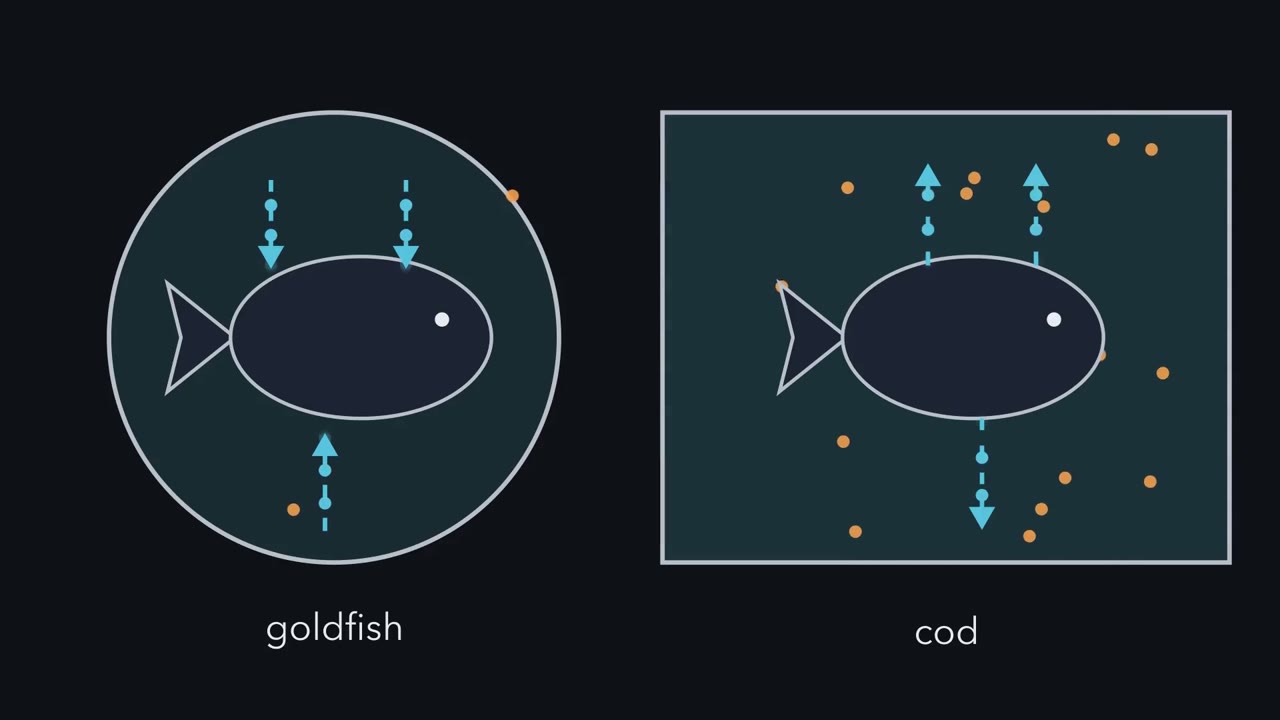 ▶ Watch Which Way Does the Water Go? · 3:09
Read the transcript of “Which Way Does the Water Go?”
Film transcript: Which Way Does the Water Go?
A goldfish in a bowl soaks up water all day, and a cod in the sea loses it. How does each one stay the same size? Start with one rule, for a surface water can cross. With nothing pushing back, water moves on its own toward the side with more dissolved particles. That count is called osmolality. In these fish, each salt leaks toward the side where it is scarcer. Watch the bar in the corner of every tank. One mark shows the body's osmolality, and one shows the water outside.
Water drifts toward the higher mark. Now give the fish a ledger: one column for what comes in, one for what goes out. If its water and salts hold steady, the columns must match, for water and for each salt separately. Drop a bony fish into the sea. Its blood holds far fewer dissolved particles than seawater. So water leaks out across its gills, and salt leaks in. Water is short, so the fish drinks seawater. Its gut absorbs the water, but the salt comes in with it. Now salt is the problem.
Cells in the gills send sodium and chloride back out into the sea. That runs against the leak, so it costs ATP. Now move a bony fish to river. The bar flips. Its blood is far saltier than fresh water. So water pours in across the gills, and salt leaks out. The water is easy to fix. The kidney makes a large volume of dilute urine, and the extra water leaves that way. But that urine carries a little salt away, and salt keeps leaking out across the gills. What must the gills now do with salt?
Take it in. Gill cells pull sodium and chloride from the river water, against the leak. Again, that costs ATP. One more tank. A shark lives in the same sea as the cod, and its blood holds less salt than seawater. Yet it does not lose water. Why not? Its blood also carries a large load of urea, which the shark makes itself and holds on to. A little TMAO rides along. Both count as dissolved particles. With them, the blood sits just above seawater. So the water leak runs the other way, as a slow trickle inward. The shark need not drink seawater. Three tanks, one budget. The gap between body and water sets which way the leaks run.
Drinking, urine and paid salt transport close each gap.
From the film
- Where water can cross and nothing pushes back, it moves on its own toward the side with more dissolved particles, the higher osmolality; in these fish each salt leaks toward the side where it is scarcer.
- A marine bony fish loses water and gains salt, so it drinks seawater and its gills spend ATP to send salt back out.
- A freshwater fish gains water and loses salt, so it makes a lot of dilute urine and its gills use ATP to take salt in.
- A shark makes urea and holds it in its blood with a little TMAO, which brings its total osmolality just above seawater, so water enters slowly and it need not drink.
- Gains must equal losses, for water and for each salt: the gap between body and water sets the leaks, and drinking, urine and ATP-driven salt transport close each gap.
The first film balanced three fish budgets with one rule; here it is with its limits, then what the film left out.
The one idea. In the cases here, water can cross the surface and no pressure pushes back, so it moves on its own toward the side with more dissolved particles; that drift is osmosis. Each salt leaks down its combined charge and concentration gradient, here always toward the side where that salt is scarcer. An animal at steady state, its body water and salt not changing, must match every leak: total gains = total losses, for water and for each salt. The gaps set which way the leaks run; the surface’s leakiness and area help set how fast. Drinking and urine close the water budget, and transport powered by ATP, directly or indirectly, moves salt the other way.
Three osmotic worlds
Only the count of dissolved particles matters: one sodium chloride dissolves into two ions, a sodium and a chloride, while one urea stays one. That count per kilogram of water is the osmolality, in milliosmoles per kilogram (mOsm per kg). Approximate values:
| Fluid | Osmolality (mOsm per kg) |
|---|---|
| Fresh water | usually below 10 |
| Adult human plasma | about 290 |
| Blood of bony fish | roughly 270 to 400, lower in freshwater species than in marine ones |
| Seawater | near 1,000 |
| Shark plasma (illustrative values, worked below) | about 1,020 |
How water and ions cross membranes is in membrane transport.
An osmoconformer lets the osmolality of its extracellular fluid, the blood plasma and the fluid that bathes its cells, follow its surroundings. An osmoregulator holds its extracellular osmolality relatively steady when the surroundings change. Conformers still regulate: many marine invertebrates keep their cells from swelling or shrinking by adjusting organic osmolytes, small organic molecules such as amino acids that cells accumulate to match the outside without disturbing their proteins (tissues and homeostasis has examples). The budgets in this lesson are for the extracellular fluid of osmoregulators, averaged over a day or more; the worked cases ignore water and salt from food and metabolism unless they say otherwise.
On land the leak is evaporation from skin and breathing surfaces, plus water in urine and feces, and in mammals sweat. Land animals gain water by drinking, in food, and as metabolic water, made when fuels are oxidized. The kangaroo rat Dipodomys merriami can live on dry seeds and metabolic water without drinking, though in the wild it also eats insects and succulent plants that supply water; the kidney lesson explains how.
Fish in sea and river, and a shark full of urea
Teleosts, the large group of bony fish that includes salmon, cod and goldfish, are osmoregulators. Behind the first film’s drinking marine teleost lie two reasons it skipped.
First, why the gills and not the kidney. A fish kidney cannot make urine more concentrated than the fish’s own blood, roughly a third as concentrated as seawater, so such urine would need about three litres to carry out the salt of each litre drunk. Instead, gill cells called ionocytes spend ATP to send sodium and chloride out with almost no water.
Second, not all of seawater’s salt is sodium chloride. Seawater also carries divalent ions, ions with two charges, such as magnesium (Mg²⁺) and sulfate (SO₄²⁻). Most are never absorbed and leave with the gut fluid; the absorbed share leaves in a small volume of urine. So the kidney is a minor route for sodium chloride but the main route for absorbed divalent ions.
Freshwater teleosts make roughly 1 to 6 mL of urine per kg per hour across species (review by Takvam and colleagues, 2021). A euryhaline fish tolerates a broad range of salinity; a stenohaline one tolerates only a narrow range. Euryhaline fish such as salmon and eels move between the two worlds, and as they do, their ionocytes switch between salt uptake and salt secretion (Going deeper has the timing).
Worked problem. These numbers are illustrative. Take a freshwater teleost of 1.0 kg at steady state over the day. Assume urine is its only route of water loss and that it gains no sodium from food.
Step 1, water. Urine flow is 4.0 mL per kg per hour, inside the reported range. Daily urine = 4.0 x 1.0 x 24 = 96 mL per day, so the fish also gains 96 mL of water a day by osmosis.
Predict. The first film drew the two sodium losses as equal boxes. Here urine sodium is 10 mmol per L, and the gills leak 2.0 mmol of sodium a day. Which loss is bigger, so which does most of the uptake replace?
Check your prediction
Step 2, sodium. Urinary loss = 0.096 L x 10 mmol per L = 0.96 mmol per day. Total loss is 0.96 + 2.0 = 2.96 mmol per day, so the gills must take up 2.96 mmol per day. Most of the uptake replaces the gill leak, because dilute urine carries little salt. Across the whole reported range of urine flow, urine at 10 mmol per L carries only about 0.24 to 1.44 mmol a day from a 1-kg fish. Measured gill sodium losses in real fish are usually larger than 2.0, so in life the gill’s share is bigger still.
Sharks, skates and rays, the first film’s third tank, are elasmobranchs, fish with skeletons of cartilage. In the spiny dogfish Squalus acanthias and its relatives, the kidney returns most filtered urea to the blood and the gills let very little leak out; Homer Smith gathered the evidence for this retention in a 1936 review. Urea at these levels tends to destabilize proteins. In laboratory tests Paul Yancey and George Somero (1979) found that methylamines such as trimethylamine N-oxide (TMAO) counteract that effect.
Shark osmolality. Take illustrative plasma values of 600 mOsm per kg of inorganic ions, 350 of urea and 70 of TMAO: total 1,020 mOsm per kg, against seawater taken as 1,000. The plasma is slightly hyperosmotic (more concentrated), so water enters slowly. If nothing replaced lost urea, the total would fall to 600 + 70 = 670 and water would leave; the shark would have to make more urea, or drink seawater and clear its salt like a marine teleost.
Predict. Urea lifts the shark’s plasma just above seawater. Does it also stop salt leaking in?
Check your prediction
No. Urea balances water, not salt: sodium and chloride still leak in from a sea saltier than the shark’s plasma. So elasmobranchs regulate ions too: a rectal gland near the end of the gut secretes a concentrated sodium chloride solution.
Rule to keep (in these cases): where water can cross and nothing pushes back, it moves by osmosis toward more dissolved particles, and each salt leaks down its gradient; at steady state a freshwater fish’s osmotic water gain equals its urine volume, and the sodium its gills take up equals its urinary plus gill losses.
The rectal gland is a route for salt that is neither gill nor kidney. The second film asks whether a bird at sea, which has no gills, has one too.
Read the transcript of “Where Does a Seabird's Salt Go?”
Film transcript: Where Does a Seabird's Salt Go?
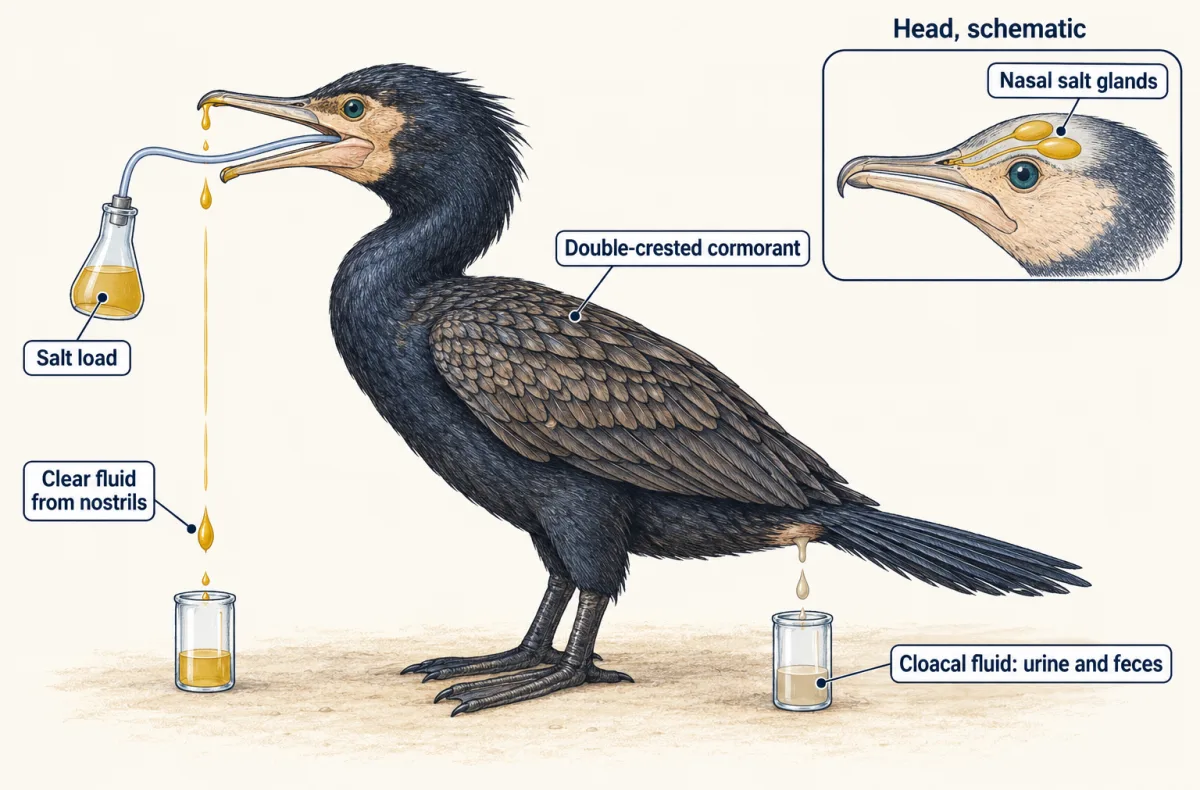
A cormorant at sea has salt water all around. Its kidneys cannot make urine as salty as the sea, so where does its extra salt go? The first film balanced a fish's water and salt in a ledger of gains and losses. A sea fish pumps its extra salt out across its gills. A bird has no gills. Clearing seawater's salt through its kidneys alone would cost the bird more water than it drank. The ledger cannot balance that way. Is there another route out? Knut Schmidt-Nielsen, C. B. Jørgensen and H. Osaki tested that question. They worked with double-crested cormorants. They gave the birds a load of salt, by mouth or by infusion. Then they collected two separate fluids from each bird, and compared them.
One vial caught fluid from the cloaca, which is urine mixed with feces. The other caught a clear fluid that dripped from the tip of the beak. Before the results, make a guess. Which vial do you think will be the saltier one?
If the kidney route ran saltier, the cloacal vial would plot higher. Instead, the beak vial filled with a concentrated salt solution. The cloacal fluid stayed much less salty. On the bar, the beak fluid reached about the level of seawater, or somewhat more. And the glands made it fast. Steady secretion could clear the body's salt within hours. The fluid came from paired glands in the head, the nasal salt glands. It ran out through the internal nostrils inside the mouth, and dripped from the tip of the beak. Back to the ledger. Getting rid of salt costs water. The saltier the gland fluid, the less water each bit of salt takes with it. Gulls reach higher salt levels still.
In a later experiment on a gull, the salt gland removed many times as much salt as the cloaca. The experiment showed a second route for salt, one that bypasses the kidney. It did not show how the gland concentrates salt, or that every bird has one. The bookkeeping is the same as the fish's. The bird's second route out is a gland, and how salty it runs sets the water cost.
From the film
- Schmidt-Nielsen, Jørgensen and Osaki gave cormorants a salt load and collected two fluids: the drip from the beak and the fluid from the cloaca.
- The beak fluid, made by paired nasal salt glands, carried the salt at about the concentration of seawater or somewhat more; the cloacal fluid stayed much less salty.
- A more concentrated salt secretion costs less water per unit salt; whether the bird nets water depends on the volume and makeup of every input and output.
- The experiment showed a second route for salt that bypasses the kidney; it did not show how the gland concentrates salt or that every bird has one.
A bird with a second route for salt
The second film found the bird’s route around kidneys that cannot reach seawater’s level: the nasal salt glands, paired glands above the eyes. The paper’s abstract puts the gland fluid at about 500 to 600 mmol per L of sodium chloride; seawater’s sodium is about 470.
Predict. A cormorant swallows 100 mL of seawater and clears its sodium through the gland at 500 mmol per L. How much gland fluid does that take, and does the answer tell you how much water the bird keeps?
Check your prediction
The 100 mL holds 47 mmol of sodium (0.1 L x 470), which needs 47 / 500 = 0.094 L, or 94 mL, of gland fluid; at 600 mmol per L, about 78 mL. That does not mean the bird keeps the other 6 or 22 mL. The gland fluid carries chloride at nearly the same concentration, but seawater holds somewhat more chloride than sodium, plus magnesium and sulfate, so the gut, kidney and cloaca must handle the rest. A net water gain needs the volume and composition of every input and output, which the experiment did not measure. What the numbers do show: at the cormorant’s gland concentration, each unit of salt costs nearly the water it came in.
Gulls, whose gland removed about ten times as much salt as the cloaca in the film’s later experiment (Schmidt-Nielsen, 1960), reach higher gland concentrations, so each unit of salt costs them less water. The cormorant study also found no evidence that cormorants fed fish must drink seawater; the gland’s job is the salt load, from any source. Marine reptiles, including sea turtles and the marine iguana, have salt glands too, in different positions in the head.
Ammonia, urea, uric acid
Same bookkeeping, one more line. In an adult holding steady, the nitrogen eaten in protein must leave, and the form it leaves in sets how much water that costs.
Breaking down protein strips the amino groups from amino acids, producing ammonia. Making it needs no ATP, though moving it out can lean on ATP-driven ion transport (the design problem below tests one case). It is very soluble and diffuses fast, but it is toxic at low concentrations, so getting rid of it takes plenty of water. Most aquatic animals, including most bony fish, excrete mostly ammonia, much of it across the gills.
Urea is made from ammonia and carbon dioxide, in mammals in the liver, by a cycle of reactions that costs ATP (protein turnover covers the chemistry). It is much less toxic, so it can be held at higher concentration and excreted in less water. Urea is the main waste of mammals, many adult amphibians (fully aquatic ones often excrete more ammonia) and elasmobranchs. Uric acid is poorly soluble, so it can leave as a paste or solid with very little water. It is usually described as costlier still to make. It is the main waste of birds, many reptiles and many land insects. Humans also make some uric acid, from the breakdown of nucleotides (nucleotide metabolism).
Development matters too. A tadpole living in water excretes mostly ammonia; in frogs such as the bullfrog, urea production rises at metamorphosis. A bird’s shelled egg is the one case here off steady state: gases and water vapour cross the shell, but for weeks the embryo cannot flush its nitrogenous waste away in water, so the waste stays inside.
Predict. If a bird embryo stored its waste nitrogen as dissolved urea, the way a shark holds urea, what would happen to the osmolality of its egg fluid?
Check your prediction
It would climb. As an illustration only, 1 mmol of nitrogen held as dissolved urea in 10 mL of egg fluid adds about 50 mOsm per kg, because each urea carries two nitrogens but counts as one particle. Held as uric acid that has come out of solution, the same nitrogen adds almost nothing, since a solid is not dissolved particles.
A bird embryo makes some ammonia and urea, but it turns more and more of its waste nitrogen into uric acid as it develops. Uric acid comes out of solution and collects in the allantois, the sac that holds the embryo’s wastes. Not every shelled egg does this; snapping-turtle embryos, for example, accumulate mostly urea.
So habitat gives tendencies, not fixed labels. Many teleosts excrete some urea, and African lungfish make more urea when they lie dormant out of water, though in one study fish dormant in mud mostly slowed their nitrogen production instead, and Patricia Wright’s 1995 review treats water supply as a major factor in which waste an animal makes. No waste is a step up from another; each trades toxicity, water and energy.
Four ways to make urine
Excretory organs use three steps in different mixes. Filtration pushes or pulls body fluid through a barrier that holds back large molecules and cells; the fluid that passes is the filtrate. Reabsorption returns useful substances to the body. Secretion moves substances from the body into the tubule.
| Organ | Animal | How fluid gets in | Then |
|---|---|---|---|
| Protonephridia | planarians | branched tubules end in flame cells, whose beating cilia drive fluid through a fine filter | the tubule modifies it |
| Metanephridia | earthworms | fluid filtered from the blood into the body cavity, the coelom, enters a funnel, the nephrostome | the tubule modifies it before it leaves through a pore; most segments carry a pair |
| Malpighian tubules | insects | no filtration: the cells of these blind-ended tubules, which open into the gut, secrete ions, often mostly potassium salts, and water follows by osmosis; wastes such as uric acid are moved in too | the rectum reabsorbs salts and water |
| Vertebrate kidneys | vertebrates | blood pressure usually filters the blood in the glomerulus, a knot of capillaries | the tubule reabsorbs most of the filtrate and secretes some substances into it |
A few marine bony fish have no glomeruli and make urine by tubular secretion. How epithelia move ions is in epithelia; the nephron’s segments are in kidney.
Design problem
The acoel Isodiametra pulchra, a small marine worm, has no excretory organ at all. Is its ammonia excretion purely passive diffusion, or does an active, energy-using step contribute? Design an experiment.
Saved in this browser only.
One way to do it
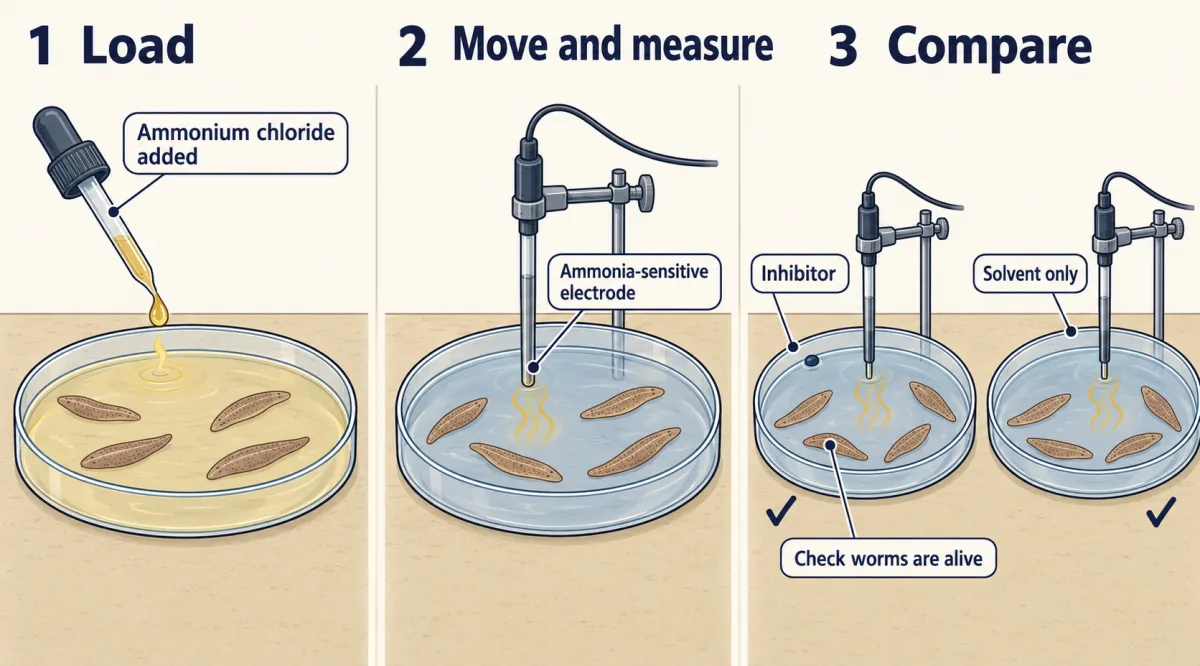
Load and measure. Andrikou, Thiel, Ruiz-Santiesteban and Hejnol (2019) did much of this. Hold the worms in seawater with added ammonium chloride, move them to clean seawater, and measure ammonia appearing over time with an ammonia-sensitive electrode. In their study, 200 and 500 micromolar loads raised later excretion while 50 and 100 did not.
Treatment and control. Give loaded worms an inhibitor of the ATP-driven sodium-potassium pump, or of microtubules, which support vesicle transport; give control worms the solvent alone. Check that treated worms are alive, since a dying worm also excretes less.
What counts as evidence. Less ammonia from living treated worms than from controls points to an active step; both treatments reduced acoel excretion. For comparison, the anemone Nematostella vectensis showed no change with the pump inhibitor and appeared mostly passive. Localizing transporter messages and proteins shows where excretion could happen.
Interpret with care. A drug effect suggests, not proves, an active route, since drugs can act off target, and the study reports no randomization or blinding, which a repeat should add. Whether such mechanisms are ancestral to bilaterian animals or arose more than once is unsettled.
Going deeper
Charge and pressure
Strictly, water follows the effective osmolality, which counts only solutes that cannot cross freely, and pressure can oppose osmosis. Ions follow their electrochemical gradient, charge as well as concentration, and cross only where the surface is permeable to them; at gills both effects are central. The cases here assume no important opposing pressure, and that each ion’s electrical and concentration gradients together drive net flux the way the arrows show.
Particles, not charges
Osmolality counts dissolved particles, not electric charges, so mOsm is not the same as mEq, the milliequivalent, which counts charge. A magnesium ion is one particle but carries two charges.
How gill cells switch
In tilapia moved into salt water, some existing ion-transporting cells start to change within hours, while others close and are lost; full acclimation takes longer.
Your notes
Select any text in the lesson to highlight it or add a note to it. Your highlights and notes are saved in this browser and collected in your notebook.
This browser is not letting the site save anything (a private window or strict privacy settings), so highlights and notes will be lost when you leave the page.
How we measure it
Salt loading with collection of excreted fluids
Give an animal a known load of salt and collect each fluid that leaves the body, such as nasal-gland secretion and cloacal fluid in a bird, then measure their sodium concentrations. Comparing the routes shows which organ excretes the load and at what concentration.
Whole-animal ammonia excretion with inhibitors
Place animals in clean medium and measure the ammonia that appears, here with an ammonia-sensitive electrode, after an ammonia load and with or without a drug that blocks a transporter. A solvent-only control and a check that the animals are alive are needed before a drop in excretion means anything.
Fluorescent tracer filtration assay
Inject two tracers of different sizes, such as 10-kDa and 500-kDa dextrans carrying equal numbers of fluorescent tags, and see which enters the excretory tubules. Preferential entry of the small tracer is evidence for a size-selective filter.
Isolated tubule secretion assay
Dissect an insect's Malpighian tubules, bathe them in a drop of medium, and measure the fluid they secrete over time. Combined with gene knockdown in one cell type, it tests whether that cell carries the water.
Method films · the methods library
Practice questions on this lesson (3) → MCAT-style, original, each with an explanation
Where this lesson fits
Before thisReview first
- Tissues, Organs and HomeostasisThis course · Lesson 6
It introduces steady state and organic osmolytes, and this lesson applies that balance to water and salt.
- What an Organism Has to DoThis course · Lesson 1
It sets up the exchange budget, where gains must equal losses, which this lesson applies to water and salts.
- Crossing the MembraneBiology · High school
It teaches how water follows dissolved particles across a membrane, the rule behind every fish budget here.
After thisStudy next
- The KidneyThis course · Lesson 16
It shows how the vertebrate nephron filters, reabsorbs and secretes to make concentrated urine.
Suggested by an AI model from the lessons themselves, then checked. How we use AI
Finish line
Test yourself
8 questions
Practice and MCAT-style, with explained answers.
Next · Lesson 16
The Kidney
Your kidneys filter about 180 litres of plasma a day. Why filter so much only to take almost all of it back?
Continue →