The mascot
Meet Hex
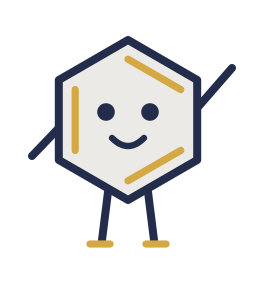
Hex is the hexagon from the site’s logo, with a face. It turns up when something happens: you finish a quiz, a search finds nothing, a page is missing. It stays out of the lessons themselves. Hex is an “it”.
Why a hexagon
The same shape shows up in every science the site teaches or plans to teach.
- Chemistry: a benzene ring, six carbons in a loop. The three gold lines inside Hex are its double bonds.
- Biology: a cell of honeycomb, and the facets of an insect’s eye.
- Physics: a sheet of graphene, and the six-fold symmetry of every snowflake.
- Math: the shape that tiles a flat surface with the least edge for the area it encloses.
- Engineering: the head of a bolt, made to be gripped from six sides.
Six poses
- stand The default. Holds a subject’s prop on course pages.
- wave A hello: the progress page, once you have started.
- lean Leaning on the site’s name in the header.
- think Something was not found: a 404, a search with no match.
- cheer You finished something: a quiz, a review session.
- sleep Nothing here yet: an empty progress page.
One prop per subject
On a course page Hex holds the tool of that course’s subject. Physics and math are drawn and waiting for their courses.
- Biology leaf
- Chemistry flask
- Physics pendulum
- Math compass
One Hex per course
Every course has its own Hex, beside the course title and on the course’s skim page, so you can tell the courses apart at a glance. Each holds something from its subject, drawn as a simple icon.
- Biology Together waving, holding a big magnifying glass
- Life Science (grade 7) carrying a potted seedling on its head
- Biology (high school) holding up a blue crab
- Organismal Biology crouching beside a snail on a leaf
- Cell Biology peering into a microscope
- Genetics and Molecular Biology holding a double helix like a staff
- Ecology and Evolution with binoculars and a finch on its head
- Biochemistry holding up a bubbling flask
- Neuroscience flying a neuron like a kite
- Physiology holding a stethoscope
- Cell Signaling with a receptor on its head, catching a signal
- Developmental Neuroscience walking an axon whose growth cone reaches for a cue
- Sensory Systems pointing at an eye chart
- MCAT practice with a pencil and a stopwatch
- Methods library holding a pipette
The rules
- Hex appears where something happens, never as wallpaper, and never in the reading column of a lesson.
- One Hex in view at a time (this page is the exception). A course’s own Hex goes beside its title, not on every card or row that names the course.
- Navy line, gold accents, nothing else. No shading, no other colours.
- Hex does not speak in speech bubbles. A short line of text beside it is enough.
- Movement is small and stops: a blink, a wave, a hop. None of it plays for readers who have asked their device for reduced motion.