Biology · Unit 2: Cells
Crossing the Membrane
Rewritten on : new text, flashcards and film. Your notes and highlights stay, but the text around them may have moved.
Why does a slice of cucumber left in salty water get lighter and go limp, while a slice in plain water gets heavier?
Pause when the reading reaches a film, and offer to play it. Saved on this device.
Watch the film now, or keep listening
Builds on:Water and LifeWhat Am I Made Of?Respiration and ATPWhy these?
Where this lesson sits
- Virginia SOL BIO.3d
- Practices BIO.1a, BIO.1b, BIO.1c, BIO.1d, BIO.1e
Essential question: How does a cell control what gets in and out, and why does salt water make lettuce wilt?
-
Life Science (grade 7) LS.2 e
Review it at grade 7 level
In Life Science you learned that every cell has a cell membrane, a thin boundary that controls what goes into and out of the cell. You saw that particles spread from where there are many of them to where there are few, which is diffusion, and that water can move across the membrane by osmosis. Grade 7 left out the details of how the membrane does this. Biology adds the membrane's structure, the proteins that help things across, and the transport that costs the cell energy.
-
Biology BIO.3d You are here
This lesson
-
Biology II Biology II: Advanced Survey of Biology Topics, BIOII.2 b
Preview where it goes next
In Biology II: Advanced Survey of Biology Topics you can look more closely at the membrane this lesson drew as a double layer. Biology II adds osmoregulation and how surface area-to-volume ratio limits cell size. Two ideas left out here are secondary active transport: a carrier uses the energy stored in an ion gradient, built earlier by an ATP pump, to drag another substance uphill without spending ATP itself. Another is that ions respond to electric charge as well as concentration, so a membrane voltage can push or pull them. You can also read the experiments behind the model, such as fused mouse and human cells whose surface proteins mixed, and frog eggs that swelled faster once they made a water channel protein.
-
College
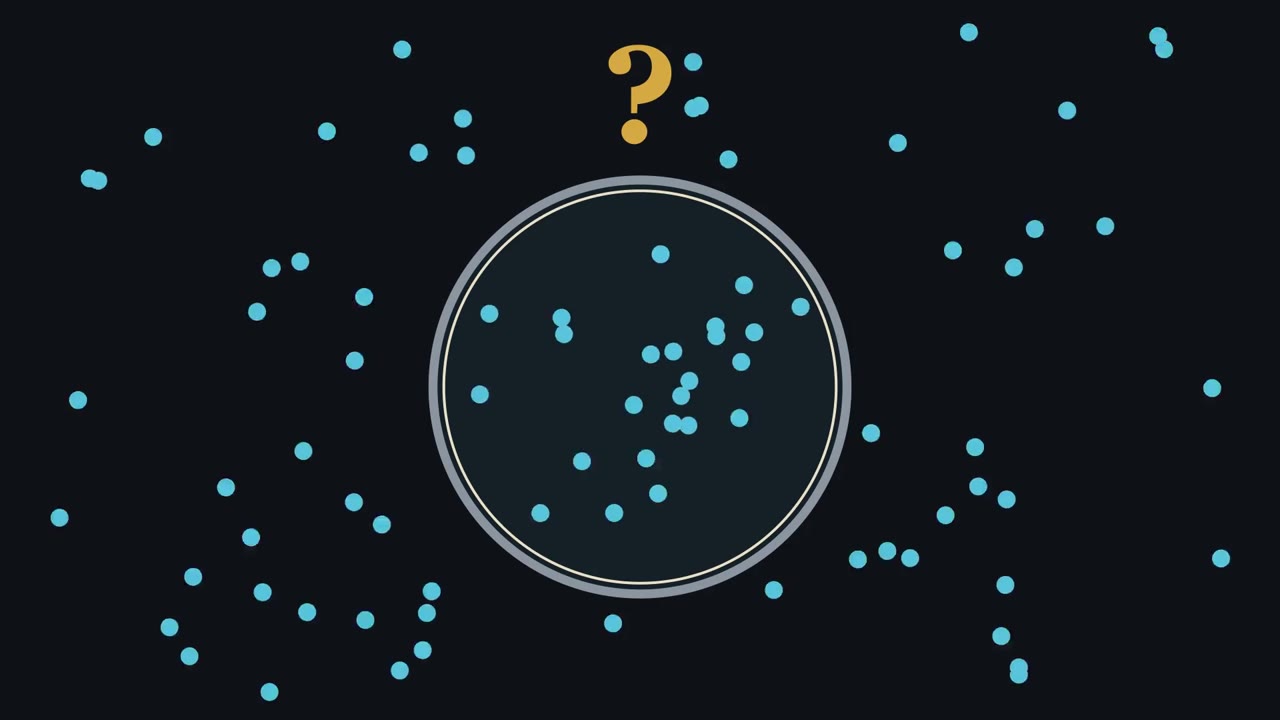 ▶ Watch Downhill for Free · 3:22
Read the transcript of “Downhill for Free”
Film transcript: Downhill for Free
There is water inside a cell and water all around it. So how does water know which way to go? To find out, start with something you can see: a drop of dye. Drop dye into still water. Each dye molecule jiggles and bumps at random. Now draw a line down the middle, and count the crossings each way. At first, far more cross from the crowded side, simply because more are there to cross. Later the dye is even. Crossings still happen, equally both ways. The molecules never stopped moving. There is just no net movement. A difference in concentration from one place to another is a concentration gradient. In open water, with no energy spent, a substance moves on balance down its gradient, from more concentrated to less.
That spreading is diffusion. Now put a cell membrane in the way. It is two rows of phospholipids, heads facing the water, oily tails tucked inside. Small oxygen molecules slip straight through the oily middle. Charged ions, such as sodium and chloride bounce off the oily middle. They cross mainly through proteins. Water crosses too, much of it through protein water channels. A membrane like this is selectively permeable. Now join two tanks with this membrane. Both hold pure water, at the same level. Water crosses both ways, equally. Then stir salt into the left tank only. The salt cannot cross. Water can cross. Salt cannot. Which tank's water level will rise, the salty one or the pure one?
Pause the film and decide. The left tank rises, the salty side. Look closely at one drop from each side. On the left, some particles in each drop are salt, not water. So each drop holds fewer water molecules. So more water molecules reach the membrane from the right each second, and more cross to the left. Water is running down its own gradient. That net movement of water is osmosis. Does the left tank rise forever? No. The taller column of water presses back on the membrane. The rise stops when that push balances the difference in water. Nothing in this film spent any energy.
Dye, oxygen and water all ran downhill on their own. The salt never crossed at all. Moving anything uphill would cost energy, and that is the second film's story. So here is the rule. With no energy spent, whatever can cross runs down its own gradient. And water runs toward the dissolved particles that cannot cross.
From the film
- Molecules move at random all the time; once they are spread evenly they still move, but there is no net movement.
- In open water, with no energy spent, a substance moves on balance down its concentration gradient, from where it is more concentrated to where it is less.
- The membrane's oily middle lets small molecules such as oxygen through, while charged ions such as sodium and chloride cross mainly through proteins.
- Whatever can cross runs downhill for free, and water runs toward the side with more dissolved particles that cannot cross. That net movement of water is osmosis.
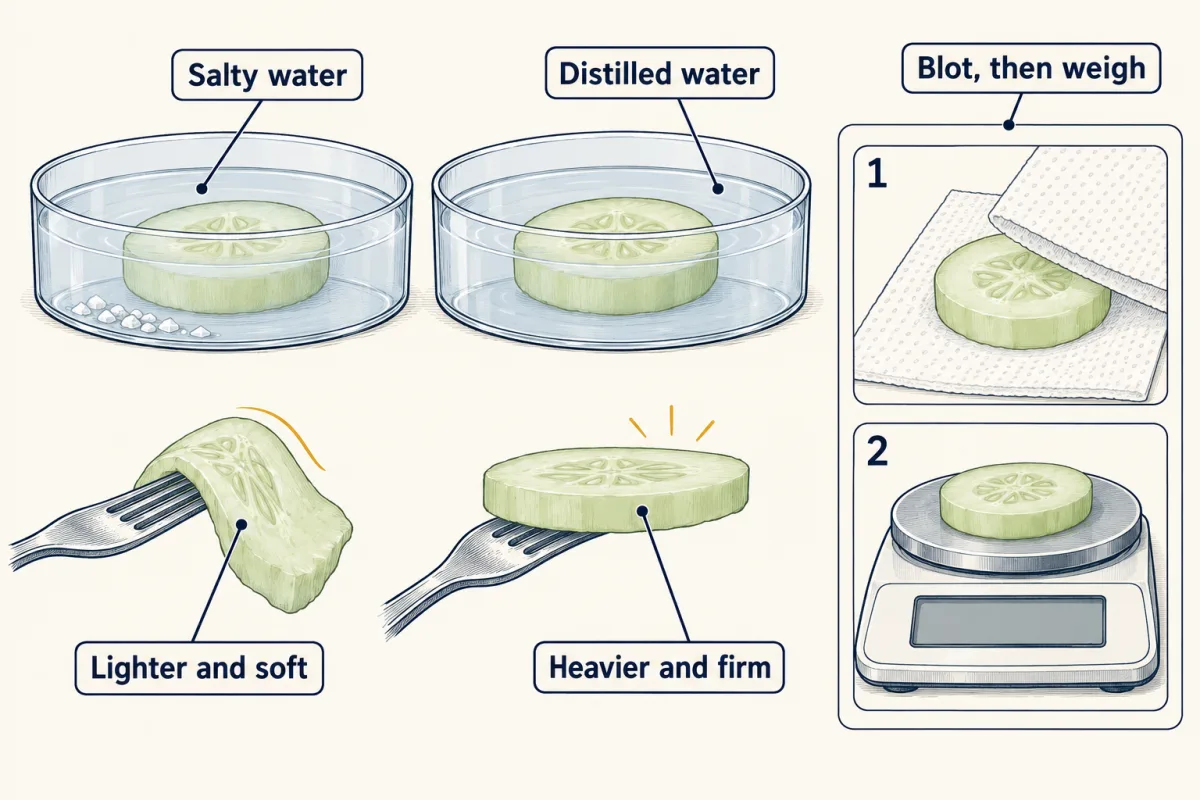
Now take the first film’s rule into real cells. Leave one slice of cucumber in salty water and another in plain distilled water overnight. The salty slice gets lighter and turns soft and floppy, while the other slice gets heavier. That happened in a filmed Open University demonstration. The same idea explains a stranger fact: drinking seawater leaves a person more dehydrated, not less.
The one idea. With no energy spent, a substance that can cross a membrane moves on balance down its own gradient, from more concentrated to less. Water is no exception: it moves toward the side with more dissolved particles that cannot cross, because each drop there holds fewer water molecules. Moving a substance uphill, or carrying a big load in a bubble of membrane, costs the cell energy, often from ATP.
Scope: water and uncharged substances crossing a cell membrane in dilute solutions like body fluids. A solute is any substance dissolved in water, such as salt or sugar. Charged ions also feel the membrane’s voltage; Biology II covers that.
Check what the first film showed, then one new idea. Agree or disagree?
-
Scientists disagree: They keep jiggling. As the film’s tally showed, crossings go on equally both ways: no net movement.
What scientists think
Scientists disagree: They keep jiggling. As the film’s tally showed, crossings go on equally both ways: no net movement.
-
Scientists disagree: Water moves on balance toward the side with more dissolved stuff that cannot cross, such as salt. The cucumber data below test that.
What scientists think
Scientists disagree: Water moves on balance toward the side with more dissolved stuff that cannot cross, such as salt. The cucumber data below test that.
-
Scientists disagree: The membrane is a thin double layer of fatty molecules with proteins in it, and its parts move. In a 1970 experiment, scientists fused a mouse cell with a human cell and tagged each one’s surface proteins with glowing labels. In most fused cells the two sets of labels mixed within about 40 minutes at body temperature.
What scientists think
Scientists disagree: The membrane is a thin double layer of fatty molecules with proteins in it, and its parts move. In a 1970 experiment, scientists fused a mouse cell with a human cell and tagged each one’s surface proteins with glowing labels. In most fused cells the two sets of labels mixed within about 40 minutes at body temperature.
Explore: put a cell in salt water
In the osmosis chamber you set how salty the solution is around a plant cell or a red blood cell. Arrows show net water movement, and the cell swells, holds its size or shrinks. A second control switches on a protein pump that moves a substance from lower to higher concentration and counts the ATP it spends. The speeds in the model are for display, not measured rates.
- Solution outside
- isotonic
- Net water movement
- none
- The cell
- keeps its shape
- Pump cycles (each spends ATP)
- 0
In this sketch: the inside of the cell stays at 100; the dots, arrows, cell sizes and pump speed are for display; every number is in relative units, not a measurement. Dots show dissolved salt; blue arrows show net water movement.
Rule to keep: water moves on balance toward the side with more dissolved solute, with no energy from the cell. A pump needs ATP to move a substance against its gradient.
Try this.
- Start with a red blood cell in a solution exactly as salty as the cell. Find how the arrows show crossings that go on with no net movement.
- Make the outside much less salty. Predict what the red blood cell will do. Then switch to a plant cell, keep the same solution, and compare.
- Make the outside much saltier than the cell. Predict which way the arrows point and what happens to each kind of cell.
- Turn on the pump. Note which way it moves its substance, compared with the water, and what the ATP counter does.
Explain: a thin, choosy boundary
- selectively permeable
- concentration gradient
- diffusion
- osmosis
- facilitated diffusion
- passive transport
- active transport
- hypertonic
- hypotonic
- isotonic
- endocytosis
- exocytosis
Every cell has a cell membrane, a thin boundary between the cell and its surroundings. The first film drew it as two rows of phospholipids, fat-like molecules with a water-loving head and two fatty tails that avoid water.
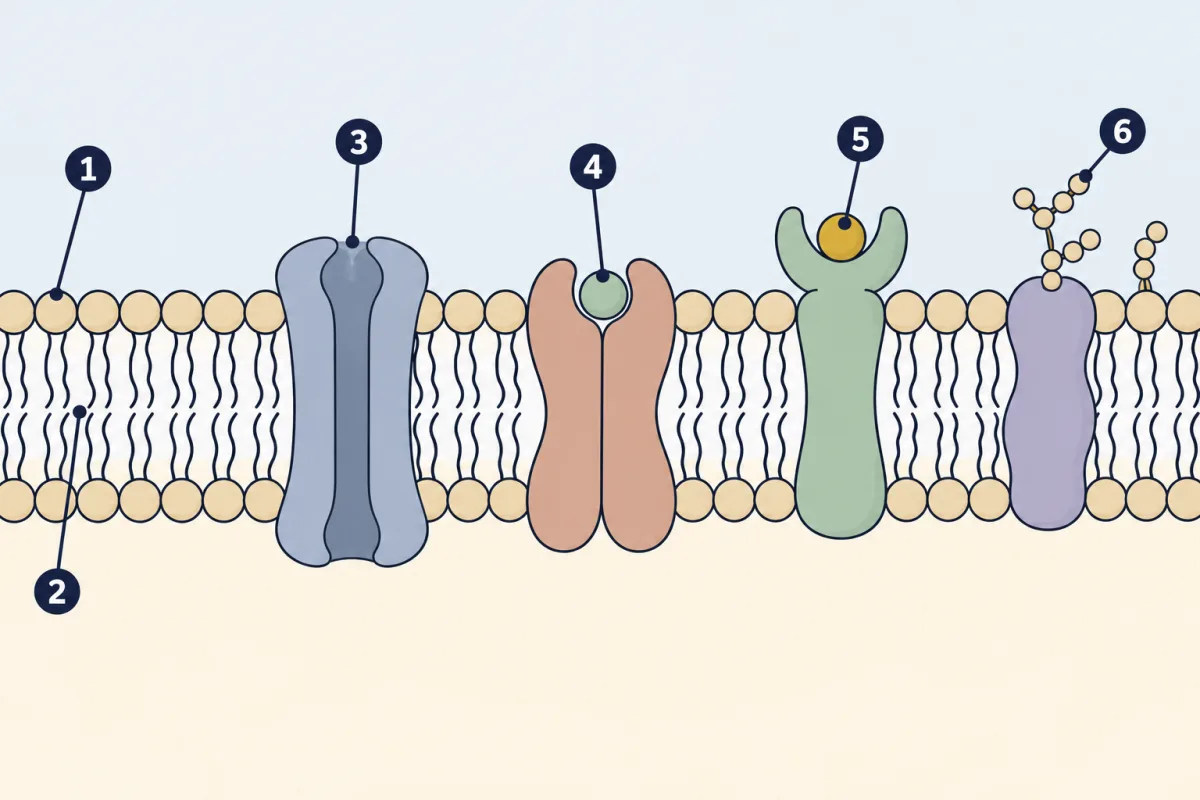
- phospholipid heads
- fatty tails
- channel protein
- carrier protein
- receptor protein
- sugar chains
- phospholipid heads
- fatty tails
- blank
- blank
- blank
- blank
Word bank: carrier protein, channel protein, receptor protein, sugar chains
- blank
- blank
- blank
- blank
- blank
- blank
Check your labels
- phospholipid heads
- fatty tails
- channel protein
- carrier protein
- receptor protein
- sugar chains
Proteins sit in this double layer, and many span it. The parts drift sideways, as the fused mouse and human cells showed, so the membrane is flexible, not a wall. It is selectively permeable: some substances cross easily and others hardly at all.
The membrane does three jobs.
- Transport. It controls which materials enter and leave the cell, and how.
- Communication. Receptor proteins on the surface bind signal molecules from outside, such as many hormones, and set off a response inside the cell.
- Recognition. Chains of sugar attached to surface proteins and lipids act like name tags. They help cells tell their own kind from others, which your immune system relies on.
A screen door is a fair analogy: it lets air in and keeps flies out. But a screen has fixed holes, while a membrane chooses by size, charge and its proteins.
Explain: moving downhill with no energy
Passive transport is movement across a membrane down a concentration gradient, the first film’s difference in concentration between two places, and it needs no energy from the cell. It has three forms.
- Diffusion is spreading down a gradient, like the first film’s dye and oxygen.
- Facilitated diffusion is diffusion through a membrane protein. Channel proteins form water-friendly tunnels, and carrier proteins grab a molecule and change shape to pass it across. Glucose enters many of your cells by carriers, still moving from high to low.
- Osmosis is the first film’s net movement of water across a selectively permeable membrane.
Which solutes count for osmosis
A solute that crosses freely spreads until it is even on both sides and leaves no lasting difference in water. So mainly solutes that cannot easily cross count, such as salt, which mostly cannot cross the lipid layer.
Three words describe the solution outside a cell compared with the inside, counting only trapped solutes: hyper- means more, hypo- means less, iso- means the same.
Predict. A plant cell and a red blood cell both sit in distilled water, and both are saltier inside. Water enters each one. What, if anything, stops it?
Check your prediction
A plant cell has a stiff cell wall outside its membrane. As water enters, the cell presses on the wall and the wall presses back. That push is turgor pressure. It stops net water entry although the cell is still saltier inside (water still crosses both ways), and it holds up the leaves and stems of soft, nonwoody plants. A red blood cell has no wall, so it swells until it may burst.
| Solution outside the cell | Plain meaning | Net water movement | Plant cell | Red blood cell |
|---|---|---|---|---|
| Hypertonic: more trapped solute than inside | Saltier outside | Out of the cell | Loses turgor and wilts, like salted lettuce; in strong salt the membrane pulls away from the wall | Shrinks |
| Isotonic: same as inside | Balanced | None; water crosses both ways equally | Limp, with no push on its wall | Keeps its shape |
| Hypotonic: less trapped solute than inside | Less salty outside | Into the cell, until something stops it | Swells until its wall pushes back; firm | Swells, may burst |
Worked case: drinking seawater. Seawater holds about 35 grams of dissolved salts in each kilogram, according to NOAA. That is far saltier than your body fluids, which pull on water about as much as a 0.9% salt solution. Swallowed seawater sits in your gut, not next to most of your cells. Once its salt is absorbed, the fluid around your cells gets saltier, which can draw water out of them by osmosis. NOAA explains that your kidneys can only make urine less salty than seawater, so getting rid of the extra salt takes more water than you drank. The body loses water overall.
A living animal cell, though, keeps sodium much higher outside and potassium much higher inside. The second film shows what holding those differences costs.
Read the transcript of “Paying to Go Uphill”
Film transcript: Paying to Go Uphill
In the first film, whatever could cross ran downhill for free. So how does a cell keep so much sodium outside, and so much potassium inside? Look at an animal cell's membrane. Sodium shown in orange, is much higher outside the cell. Potassium shown in purple, is much higher inside. Each ion sits at the top of its own hill. A few channels in the membrane leak.
Sodium trickles in, and potassium trickles out. Each ion runs downhill, and the two differences start to shrink. A leak channel is an open tunnel, so ions pass through it only downhill. For ions, the hill also depends on the membrane's voltage.
Biology II covers that part. A pump is different. It grabs ions, changes shape, and spends energy to carry them uphill. Watch one cycle of the sodium-potassium pump. First, three sodium ions bind to the pump on the inside of the cell. The pump spends one ATP, the molecule that carries usable energy around the cell. The pump changes shape and releases the three sodium ions outside. Now two potassium ions bind on the outside. The pump changes shape again and carries them in. Both trips went uphill, against each ion's gradient. Every cycle, one ATP spent, three sodium out, two potassium in. While the pump keeps running, the meters hold steady, even though the leaks never close.
Movement that uses the cell's energy, often from ATP, is active transport. It can move a substance against its gradient. Diffusion and osmosis are passive transport, and need no energy from the cell. Now the cell runs out of ATP. The leak channels stay open. Which way will sodium move now? And which way will potassium move? Pause and predict.
The pump freezes. Sodium leaks in and potassium leaks out, both downhill. The two differences slowly shrink. The first film's rule has taken over again. So holding a difference is not a one-time payment. The leaks undo the pump's work all the time. The pump must keep spending ATP, cycle after cycle. Stop paying, and the differences drain away. That gives you one test for a substance crossing on its own. Is it going downhill? Then it is passive and free. Is it going uphill? Then the cell is paying.
From the film
- Active transport uses energy from the cell, often from ATP, and it can move a substance against its gradient.
- Each cycle, the sodium-potassium pump uses one ATP to move three sodium ions out and two potassium ions in, both uphill.
- Sodium and potassium leak back down their gradients through channels all the time, so the pump must keep working to hold the differences.
- Without ATP the pump stops, and the sodium and potassium differences slowly shrink.
Explain: paying to move uphill
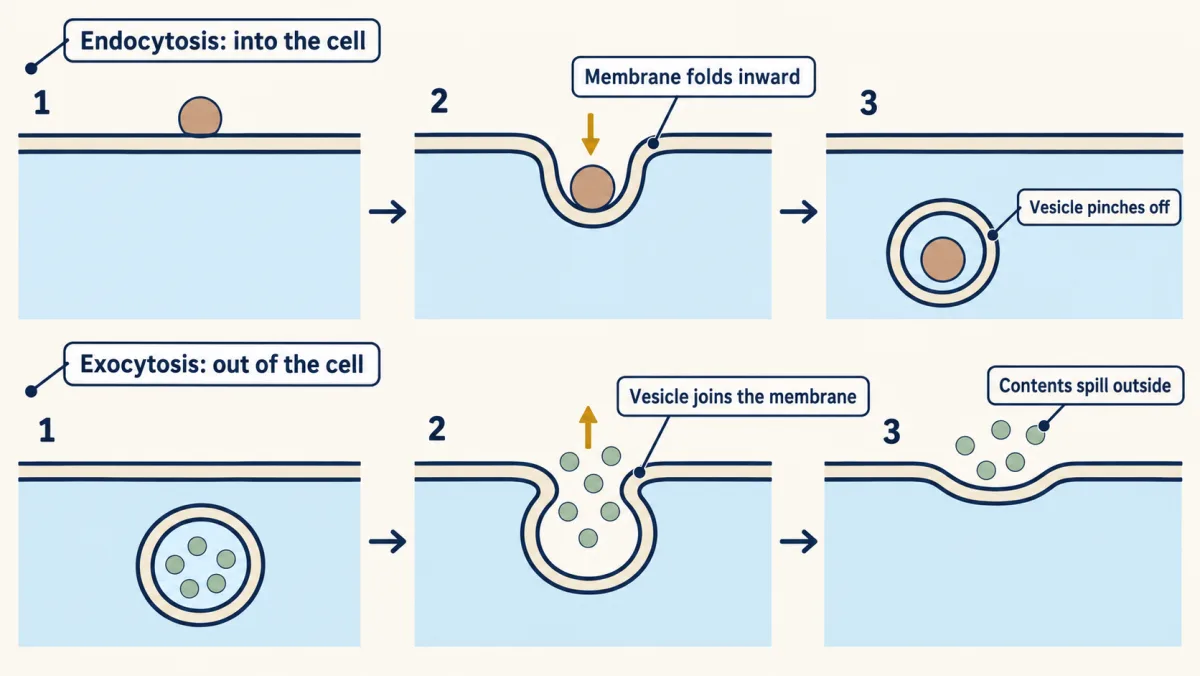
The second film’s pump moved single ions uphill. That is active transport, paid for with the cell’s energy, often from ATP (the respiration lesson). Loads far too big for any channel or pump travel in vesicles, small bubbles of membrane, and this also needs energy.
- Endocytosis brings material into the cell. The membrane folds inward around it, and the pocket pinches off as a vesicle inside the cell. Some white blood cells engulf bacteria this way.
- Exocytosis releases material from the cell. A vesicle joins the cell membrane and spills its contents outside. The organelles lesson follows these vesicles.
Elaborate: weighing cucumber slices
In the Open University demonstration, one peeled cucumber slice went into water with added kitchen salt and one into distilled water. Each was blotted and weighed over time.
| Slice | Time in the liquid | Starting mass (g) | Mass then (g) | Change in mass (%) |
|---|---|---|---|---|
| Salty water | 1 hour | 26 | 24 | −7.7 |
| Salty water | 2 hours | 26 | 23 | −11.5 |
| Salty water | Overnight | 26 | 21 | −19.2 |
| Distilled water | 1 hour | 22 | 23 | +4.5 |
| Distilled water | 2 hours | 22 | 24 | +9.1 |
| Distilled water | Overnight | 22 | 30 | +36.4 |
Source: Janet Sumner, Open University (OpenLearn) filmed demonstration and transcript, accessed October 2026; no date is given. Masses were read to the whole gram, the salt was added as two spoonfuls with no concentration reported, and there was one slice for each liquid. Mass is a stand-in for water: some liquid can also soak into the cut surface and the spaces between cells. Percent changes are calculated from the reported masses:
percent change in mass = 100 × (final mass − starting mass) ÷ starting mass
- Describe the trend for each slice over time.
- The distilled-water slice gained 8 grams overnight and the salty slice lost 5 grams. Why is percent change a fairer way to compare them than grams?
- Can these data tell you the salt concentration at which a slice would neither gain nor lose mass? Explain what is missing.
Claim, evidence, reasoning
Make a claim that answers this: why did the cucumber slice in salty water lose mass while the slice in distilled water gained it? Use the table.
Start with: The data show that water moved blank the slice in salty water and blank the slice in distilled water.
Start with: Overnight, the salty slice changed by blank% and the distilled-water slice changed by blank%.
Start with: This happens because water moves by osmosis toward the side with more blank, so the salty water was blank to the cucumber cells.
Compare with a model answer
Water left the slice in salty water and entered the slice in distilled water. Overnight, the salty slice went from 26 to 21 grams, a change of about −19%, while the distilled-water slice went from 22 to 30 grams, about +36%. In osmosis, water moves on balance toward the side with more dissolved solute. The salty water was hypertonic to the cucumber cells, so they lost water and turgor and the slice went soft. Distilled water was hypotonic, so water moved in. These data come from one slice in each liquid, with the salt concentration not stated, so they cannot show the balance point.
Saved in this browser only.
Design problem
Plan an investigation to find the sugar concentration at which potato pieces neither gain nor lose mass. Name your variables (what you change and what you measure), constants, control and sample size, and say how you will stay safe.
Saved in this browser only.
One way to do it
- Independent variable: sucrose concentration, for example 0.0, 0.1, 0.2, 0.3, 0.4, 0.6, 0.8 and 1.0 mol/L.
- Dependent variable: the percent change in mass of each piece.
- Constants: one potato, same-size pieces, the same volume of solution, temperature, soaking time and blotting method.
- Control: the 0.0 mol/L dish of distilled water, with no added sugar.
- Sample size and trials: at least three pieces in each solution, assigned at random. Find each piece’s percent change, then the mean and spread.
- Analysis: plot mean percent change against concentration and find where the line crosses zero, between a gain and a loss. If every piece gained or every piece lost, the balance point lies outside your range.
- Safety: care with the knife, labelled dishes, no tasting.
The zero point estimates where the potato cells neither gain nor lose water under your conditions. It does not measure exactly what is dissolved inside them, because their turgor pressure against their walls also affects how much water they take in.
Evaluate: check your thinking
One rule answers both opening questions: with no energy spent, water runs toward more trapped solute. Cucumber cells lose water straight into the salty water around them. Seawater works in two steps, as the worked case showed: absorbed salt can draw water from your cells, and getting rid of that salt costs more water than you drank. The cell spends energy only to move a substance uphill, as the pump does, or to carry a load in a vesicle.
Science practices you used: making predictions and testing them with a model, calculating percent change from measured masses, reading a data table and naming its limits, and planning a fair test with a control, repeated pieces and a mean.
Going deeper
How few water molecules are missing?
For the first film’s salty drop: in an idealized 0.9% salt solution, each unit of salt splits into a sodium and a chloride ion, and only about 5 or 6 of every 1,000 particles are those ions. So body fluid has only about half a percent less water than pure water, yet in pure water that small gap is enough to burst a red blood cell.
Salt in the Chesapeake Bay
The Chesapeake Bay Program describes its head and tidal rivers as below 0.5 parts per thousand of salt and its mouth as averaging 25 to 30 parts per thousand. A cell from the bay’s mouth, in balance with the water there, is placed in water from the bay’s head. Is it in a hypertonic, isotonic or hypotonic solution? (Hypotonic: the water outside now holds far less trapped solute than the cell.)
Your notes
Select any text in the lesson to highlight it or add a note to it. Your highlights and notes are saved in this browser and collected in your notebook.
This browser is not letting the site save anything (a private window or strict privacy settings), so highlights and notes will be lost when you leave the page.
How we measure it
Weighing tissue before and after soaking
A slice of plant tissue is blotted dry and weighed, soaked in a solution, then blotted and weighed again. The percent change in mass estimates whether water entered or left on balance.
Testing a membrane protein in frog eggs
Scientists put the instructions for one membrane protein into frog egg cells, then move the eggs into a less salty solution and measure how fast they swell. Faster swelling than in control eggs means the protein lets water cross more easily.
Where this lesson fits
Before thisReview first
- Water and LifeThis course · Lesson 1
You need water's polarity and why it dissolves salts to see why trapped solute pulls water toward it.
- What Am I Made Of?This course · Lesson 2
Knowing lipids and proteins as building blocks helps you read the membrane as a lipid layer with proteins.
- Respiration and ATPThis course · Lesson 5
Active transport spends ATP, and this lesson uses what ATP is and where the cell gets it.
After thisStudy next
- Homeostasis in ActionThis course · Lesson 9
Cells holding sodium and potassium differences and water balance is part of how the body keeps conditions steady.
- One Cell or ManyThis course · Lesson 11
A single-celled organism must manage water and exchange across its membrane, putting transport to work.
Elsewhere on the siteFilms, simulations and method films in other courses
- Two sides of a membraneSimulation · Life Science
It lets you watch water cross a membrane toward the side with more trapped solute.
- Random Moves, One-Way DriftFilm · Life Science
It shows random particle motion giving a one-way drift down a gradient.
- Build a cell for a jobSimulation · Life Science
It lets you see water move in and out of cells, as with the cucumber slice.
Suggested by an AI model from the lessons themselves, then checked. How we use AI
Finish line
Test yourself
8 questions
Practice and MCAT-style, with explained answers.
Next · Lesson 9
Homeostasis in Action
Why does your heart speed up when you run up the stairs, and then slow down again over the next few minutes?
Continue →