About
A free ladder through science, built in public.
Short version: this is a free site for learning science, one rung at a time. It starts with biology. Today it has 414 lessons in 13 courses. They run from hands-on activities a parent does with a five-year-old to courses that end at current research. Every lesson is free to read. You never need an account to learn, and there are no ads.
The idea
Picture everything people know as a circle. A small child stands at the center. Near the center the questions have answers. Moving outward, the answers thin. Past the edge there are more questions than answers, and that is where research happens.
To understand the open questions at the edge, you need every rung between the center and there. I am trying to build those rungs. Biology comes first. Chemistry, physics, math and engineering are meant to follow, and every rung will stay free.
You can start on any rung. Nobody needs a background to begin. Every lesson explains its central idea at more than one level, and most run from a child’s version to a graduate student’s, so you can drop down a level when you need to and climb back up.
One idea, six levels
Here is photosynthesis, from a small child’s version to a question researchers are still working on. Every lesson explains its idea at more than one level, so you can step down when you need to and up when you’re ready.
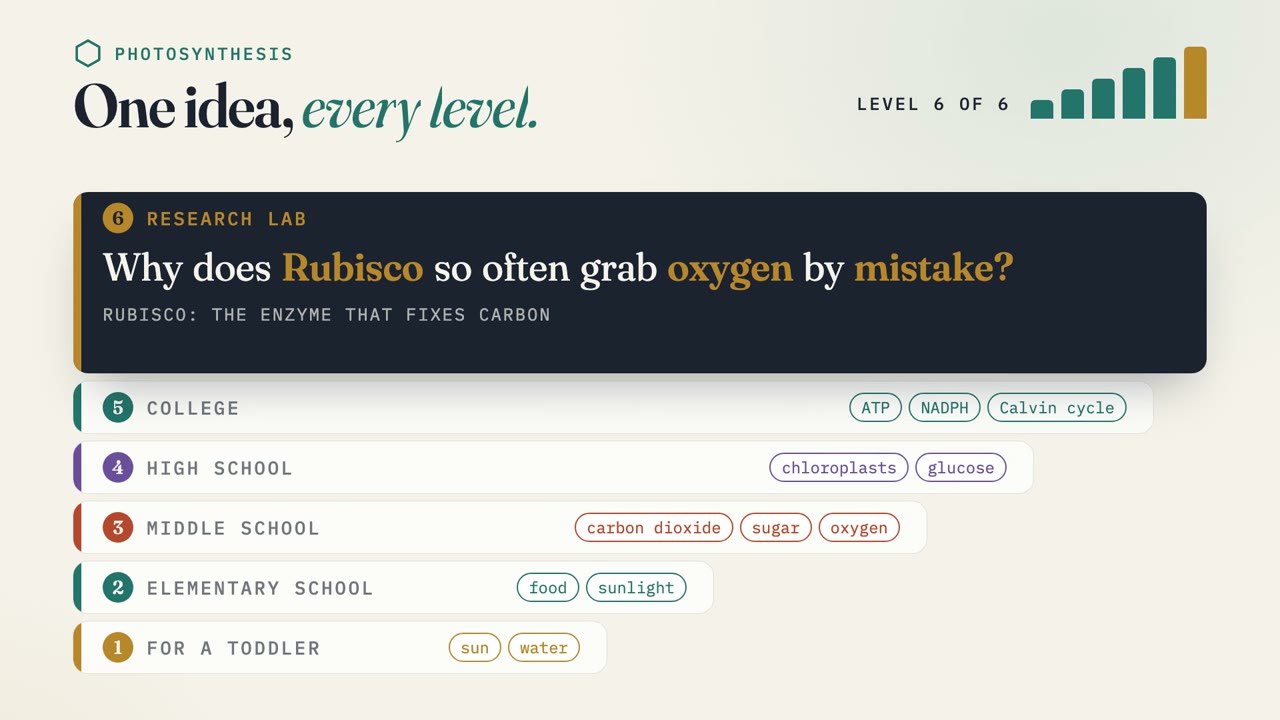
- A small childPlants need sun and water to grow.
- Elementary schoolPlants make their own food from sunlight.
- Middle schoolLeaves use light to turn carbon dioxide and water into sugar, and give off oxygen.
- High schoolIn chloroplasts, photosynthesis stores light energy as chemical energy in glucose.
- CollegeThe light reactions make ATP and NADPH, and the Calvin cycle uses them to turn carbon dioxide into sugar.
- A research labWhy does Rubisco so often grab oxygen by mistake?
Every level
Every lesson explains its idea at more than one level. Most run from a child’s version up to a graduate student’s.
Films and simulations
Nearly every lesson has a short film, and most have a simulation you can change.
Answers explained
Every practice question shows the answer and why.
Who makes it
I’m Chris Deppmann, Professor in the Departments of Biology, Biomedical Engineering, Cell Biology, and Neuroscience at the University of Virginia. I choose what goes in, direct the AI that makes it, and decide what gets fixed. Former trainees from my lab have volunteered to help. Students in my biochemistry course, BIOL 3030, made The Fun Stuff: the trading cards, memes, songs and podcast.
What is in a lesson
A lesson is a short reading. Nearly every one has a short film. Most have a simulation you can change. All have practice questions that show the answer and explain why. If you learn on your own, your progress stays on your own device, unless you choose an optional learner account (13 and older) to sync it between your devices. If a teacher adds you to a class, your answers in that class go to your teacher; the class privacy page has the details.
Where it came from
It began in June 2026 as an experiment in my lab at the University of Virginia: 30 lessons for my undergraduate biochemistry course, built from twenty years of my lectures and my book, The Molecule Hunters. Biochemistry is now 30 of the 414 lessons, and the site is growing into its own thing.
That first course gave the site its first name, Biochemistrypedia. In November 2026 it became STEMhop, because it is growing beyond biology into the rest of science, technology, engineering and math. Old links still work. It is still free, and still nonprofit.
A work in progress
I chose to put this up rough and improve it in public. You will find mistakes, and I want to hear about them.
Parts of some lessons are still being checked. Those lessons carry an Under review tag at the top, and the text stays up while the check is done. The under review page lists every one of them, with what is being checked. Some subjects are not here yet: chemistry, physics, math, engineering, and anything for children under five. The MCAT path lists the parts of the exam the site does not cover yet.
How AI is used
I use AI for most of the work, and here is where.
- Writing. The lessons, questions and film scripts are human-directed and AI-made. I decide what goes in and direct the work. AI models write it from my lectures, my book and the research literature. We will keep improving it as more people send feedback and as the models get better. We look hardest at three things: clarity, accuracy, and whether each idea gets the emphasis it deserves.
- Films. An AI draws the animations in code. An AI voice reads the narration. Every film has captions, and each lesson’s Sources & Integrity panel names the voice.
- Illustrations. A lesson can have up to five. An image model draws each one from a written description, and every detail in that description has to come from a sentence in the lesson. A second model, which did not write the description, then checks the image against the lesson, labels included. Images that fail are redrawn or dropped. Each one is marked “AI-generated illustration” in a tag under the figure, in its description for screen readers, and in the lesson’s Sources & Integrity panel. They never show a chemical structure or data.
- Where a lesson fits. The “Before this”, “After this” and “Elsewhere on the site” links at the end of each lesson, and the everyday phrases that help search find it, were drafted once by an AI model from the lessons themselves, then checked by rules, and a sample was read link by link by a second AI reader before they went live.
- Scientist portraits are AI-generated artwork, and they are labelled that way.
- Molecules are never drawn by AI. Every 3D structure loads live from a public database, RCSB PDB or PubChem, by its ID.
- No AI tutor talks to learners. A teacher can turn on AI feedback for their own class with their own key. It is off by default, and the class privacy page says exactly what is sent.
How it is checked
Made once
- I choose the idea and the sources: my lectures, my book, the research papers.
- AI writes the lesson, the film script and the questions from those sources.
- Other AI checks it claim by claim, using models from more than one company.
Fixed for as long as it is up
- It goes up with an Under review tag on any part still waiting for a person’s check.
- You report what looks wrong, with the button on every lesson.
- It gets fixed and the fix goes into the public change history.
- Cross-model checks. Every lesson has been checked by AI models from more than one company, claim by claim, against sources. Errors they find get corrected.
- Human review. We built these lessons fast, so a person has not yet checked every one by hand. We are working through them now. That is why your feedback matters: tell us what is wrong, and we will fix it fast.
- Questions. Every practice and MCAT-style question was written for this site. The MCAT-style questions are original. None is a real AAMC question.
- Corrections are public. Every fix goes into the site’s public change history on GitHub.
Report an error
Every lesson has a Report an error button in its side panel. It opens a short form with the lesson already filled in. You do not have to say who you are. Tell me where on the page the problem is and what looks wrong. The same form takes requests: a topic you want covered, or something the site is missing.
You can also email me at deppmann@gmail.com, which is the way to send a screenshot. I read every report. A confirmed error gets fixed, or the figure comes down.
The small print
The site’s own films are served from its own storage. Videos and podcasts made by other people (YouTube and Spotify) are embedded from their source. Visits are counted anonymously, with no cookies. Learners never need to sign in; readers 13 and older can choose a learner account to sync notes and progress (see Privacy). Teachers who make a class have a teacher account, and students in a class sign in with a nickname and a student code, with no learner account needed. Both are described on the class privacy page.