Life Science · Unit 6: Changing ecosystems
Big Changes: Dead Zones, Storms and Climate
Rewritten on : new text, flashcards and film. Your notes and highlights stay, but the text around them may have moved.
How can fertilizer that helps crops grow leave fish and crabs without enough oxygen in the deep water of the Chesapeake Bay?
Pause when the reading reaches a film, and offer to play it. Saved on this device.
Watch the film now, or keep listening
Builds on:Producers, Consumers and DecomposersPartners in EnergyThe Carbon and Water CyclesWhy these?
Where this lesson sits
- Virginia SOL LS.8 c
- Practices LS.1 a, LS.1 c, LS.1 d, LS.1 e
Essential question: How can too much fertilizer make part of the Bay run out of oxygen?
-
Life Science (grade 7) LS.8 c You are here
This lesson
-
Biology
Preview it at high school level
In Biology you follow the same eutrophication chain with more real Bay numbers: the volume of water with low oxygen (a condition scientists call hypoxia), the nitrogen coming from the whole watershed, and the area of underwater grass. You design and test a fix for a watershed, weighing what it must do against limits of money, land and time. You also learn a name for the way life returns after a fire, a flood or an abandoned farm: succession. In much of Virginia, an old field usually changes from weeds and grasses to pines to an oak-hickory forest, and you learn how each stage changes conditions for the plants that come next.
-
Biology II Biology II: Ecology, EC.2 d and f, EC.7 c; Advanced Topics, BIOII.6 f
Preview where it goes next
Virginia’s Biology II: Ecology course studies threats from people to biodiversity, and ways to fix each one. It asks how biodiversity helps an ecosystem resist a change or bounce back from it, which ecologists call resilience. It also studies invasive species in a local ecosystem. The Advanced Topics course adds tipping points, where a small extra push moves an ecosystem into a different state, and the idea that when several species do the same job, losing one matters less.
-
College
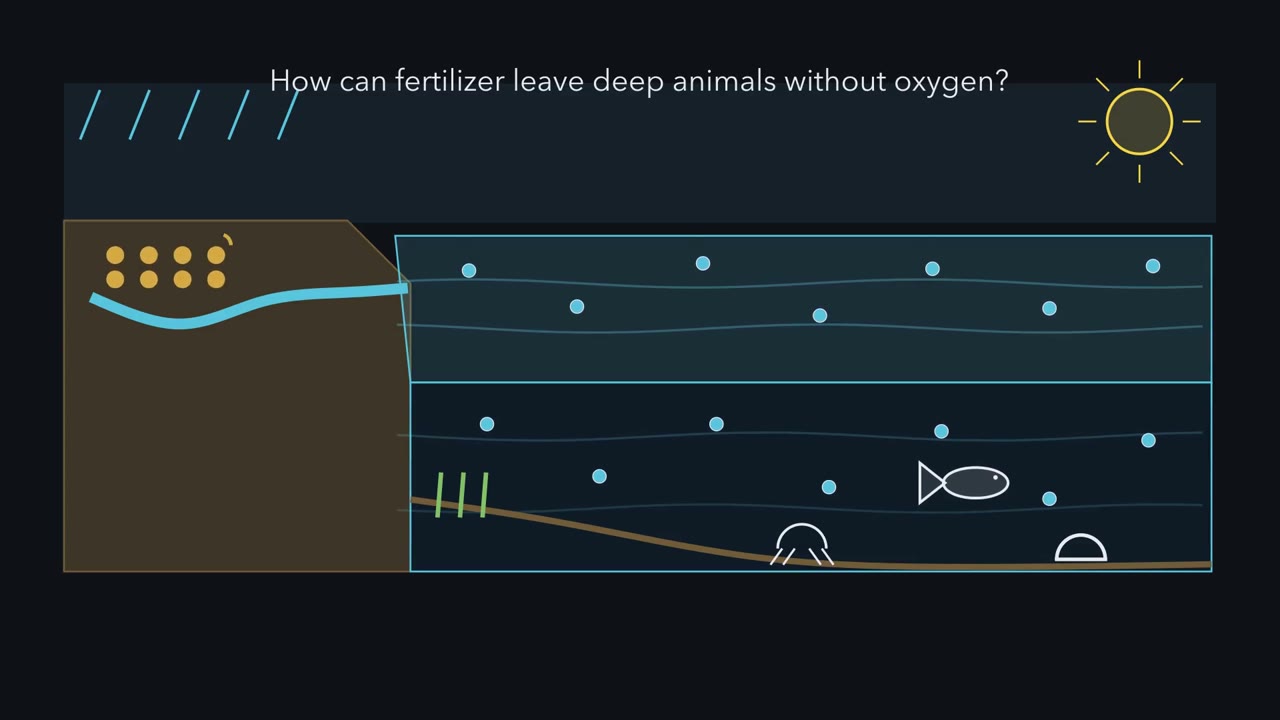 ▶ Watch Extra Nutrients, Less Deep Oxygen · 3:21
Read the transcript of “Extra Nutrients, Less Deep Oxygen”
Film transcript: Extra Nutrients, Less Deep Oxygen
How can fertilizer on land leave deep Bay animals without enough oxygen? Watch one Chesapeake Bay cross-section. The answer begins far from the deep water. The surface may look lively while animals below face a hidden shortage.
Rain carries some fertilizer into a creek, then a river. Fertilizer and manure contain nutrients that living things need. Wastewater and some air pollution add nutrients too. Nutrients help growth, but their effect depends on where they go and how much arrives. Pond water on a sunny windowsill can turn green as algae grow. In the Bay, extra nitrogen and phosphorus can feed fast growth. A thick growth is an algae bloom. More nutrients can support more algae, though conditions still matter. The green water can block sunlight from grasses below. Later, algae die and sink. The sinking material carries the next part of the story downward. Now predict: where will oxygen run low, near the surface or in deep water?
Deep water runs low on oxygen. Bacteria gather on the dead algae. These decomposers break down dead matter and use dissolved oxygen while they work. The algae are food for decomposers, not direct oxygen thieves. Change one ecosystem part, and effects can spread through the system. Here, nutrients change algae, decomposition, oxygen, and animal habitat. Each step changes the conditions faced by the next living part. Summer makes the deep loss harder to replace.
Fresher river water floats above saltier Bay water. The layers mix poorly. Warm water also holds less oxygen. Algae fed by spring nutrients can keep sinking and decaying into summer. Fish and crabs often move away from low oxygen. Adult oysters are fixed in place. Animals that cannot leave may become sick or die. Bacteria still live there. Low oxygen shrinks the deep habitat available to many animals. This process is eutrophication: extra nutrients feed too much algae growth, which can lead to low oxygen. Fertilizer does not take oxygen itself. The effects travel through living connections. The word names the nutrient-driven process, not every patch of green water.
A useful model follows the change from its starting point to each connected part. It also asks what could weaken, strengthen, or interrupt the path. That makes the model useful for evidence, not just memorizing arrows. Evidence can test each link instead of only the first and last.
From the film
- Change one ecosystem part, and effects can spread through the system.
- Extra nutrients can feed an algae bloom.
- Decomposers use oxygen as they break down dead algae.
- Poor mixing can leave deep water low on oxygen.
Each summer, part of the Chesapeake Bay’s deep water runs very low on oxygen. Scientists call this low-oxygen water a dead zone. Its size changes from year to year, and scientists compare it with how much nitrogen the rivers carried into the Bay that spring. The first film traced the path from fertilizer to that water. Here you test where the path breaks.
The one idea. Change one ecosystem part, and effects can spread through the system.
Scope: This rule helps explain linked changes within an ecosystem. It does not say every change reaches every part or that one cause acts alone.
What do you think? Decide before you read.
-
Scientists disagree: Scientists measure oxygen in the Bay every summer, and the amount of low-oxygen water changes a lot from year to year. Forests change too. In Yellowstone, researchers counted far fewer young trees where a forest burned twice in a short time.
What scientists think
Scientists disagree: Scientists measure oxygen in the Bay every summer, and the amount of low-oxygen water changes a lot from year to year. Forests change too. In Yellowstone, researchers counted far fewer young trees where a forest burned twice in a short time.
-
Scientists disagree: Rain can wash farm fertilizer and manure into streams, and some wastewater still carries nutrients. River stations measure the nitrogen flowing toward the Bay each spring, and scientists use those numbers to help predict the summer dead zone.
What scientists think
Scientists disagree: Rain can wash farm fertilizer and manure into streams, and some wastewater still carries nutrients. River stations measure the nitrogen flowing toward the Bay each spring, and scientists use those numbers to help predict the summer dead zone.
-
Scientists disagree: Algae need nitrogen and phosphorus to grow. In a lake experiment in Canada, both halves of a lake got nitrogen, but only one half also got phosphorus. That half became thick with algae. Too many algae can lead to trouble, as you will see.
What scientists think
Scientists disagree: Algae need nitrogen and phosphorus to grow. In a lake experiment in Canada, both halves of a lake got nitrogen, but only one half also got phosphorus. That half became thick with algae. Too many algae can lead to trouble, as you will see.
Explore: feed the Bay and watch the oxygen
The simulation shows the Bay from the side, with a surface layer and a deep layer. You set the nitrogen washing in from land (low, medium or high) and the summer water (cool or warm). A storm button mixes the layers for a few days.
Try this.
- Predict what happens to the algae and the deep-water oxygen when nitrogen goes from low to high. Test it.
- Keep nitrogen high. Predict whether warm or cool water leaves more deep oxygen. Switch and compare.
- When the deep layer is low on oxygen, predict what a big storm will do for fish and crabs. Press it.
Explain: how extra nutrients use up oxygen
- nutrient
- algae bloom
- decomposer
- eutrophication
- dissolved oxygen
- dead zone
- climate change
- catastrophic disturbance
- biodiversity
The first film’s terms, in words. A nutrient is a substance living things need to grow. Algae need nitrogen and phosphorus, which come from fertilizer, manure, wastewater and some air pollution. An algae bloom is a thick, fast growth of algae. A decomposer breaks down dead matter. Many bacteria are decomposers, and they use oxygen while breaking down dead algae (more on decomposers). Eutrophication is extra nutrients in water feeding too much algae growth, which can lead to low oxygen.
Dissolved oxygen is oxygen gas mixed into water. Scientists measure it in milligrams per liter (mg/L). In this lesson, a dead zone has less than 2 mg/L of dissolved oxygen.
Predict. Does water just below 2 mg/L count as a dead zone here? Is it lifeless?
Check your prediction
Yes to the first question; no to the second. A dead zone is not empty: bacteria live there, and the water may hold a little oxygen or almost none.
The first film showed why summer matters: warm water holds less oxygen, and the layers mix poorly while dead algae keep decaying. It left out wind, which can stir the layers and carry oxygen down.
Predict. A storm mixes low-oxygen deep water with surface water. What happens to deep oxygen?
Check your prediction
It rises for a time as surface oxygen moves down. The nutrients and dead algae remain.
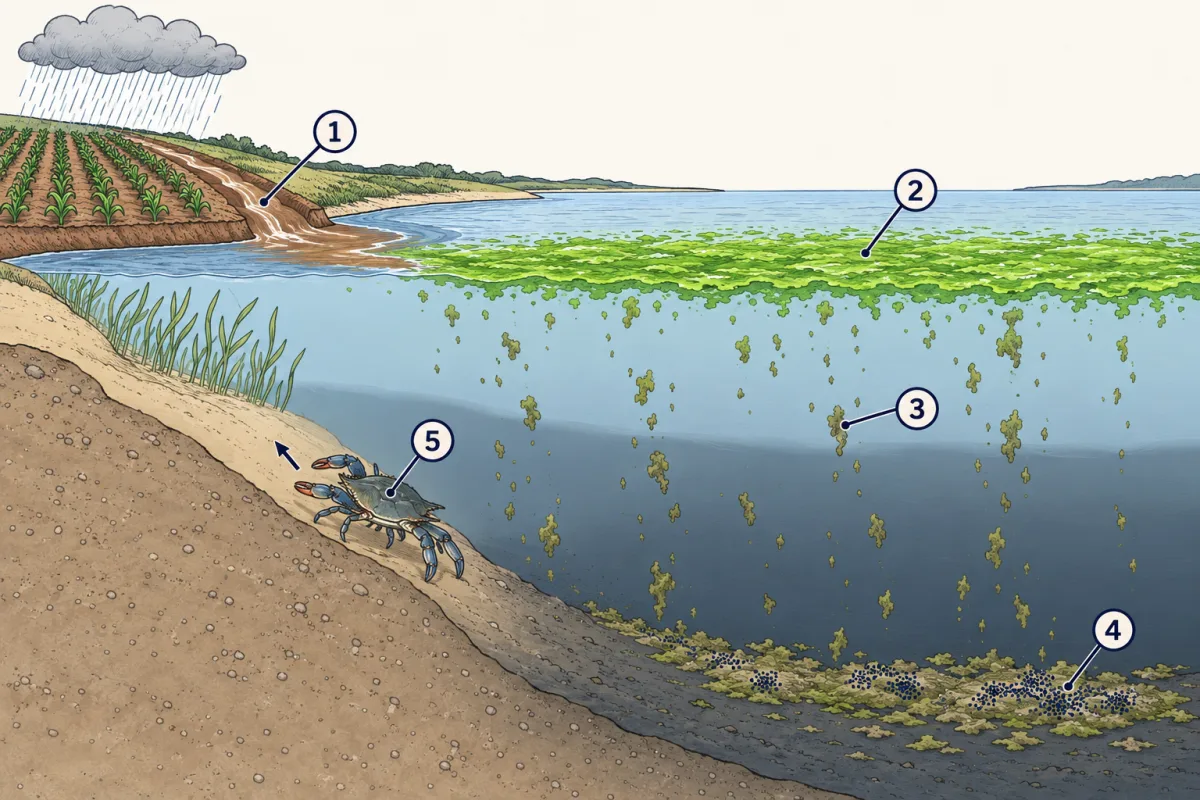
- nutrients washing from fields
- algae bloom
- dead algae sinking
- bacteria using oxygen
- crab leaving the deep water
- nutrients washing from fields
- algae bloom
- blank
- blank
- blank
Word bank: bacteria using oxygen, crab leaving the deep water, dead algae sinking
- blank
- blank
- blank
- blank
- blank
Check your labels
- nutrients washing from fields
- algae bloom
- dead algae sinking
- bacteria using oxygen
- crab leaving the deep water
A storm brings deep oxygen back only for a time. The second film asks, beyond the Bay: when does an ecosystem return after a change, and when does it stay changed?
Read the transcript of “When Ecosystems Change Course”
Film transcript: When Ecosystems Change Course
The first film followed one change through the Bay. Why do some ecosystems recover while others stay changed? Follow what happens to habitat and living things. The answer is not simply that every change causes permanent damage.
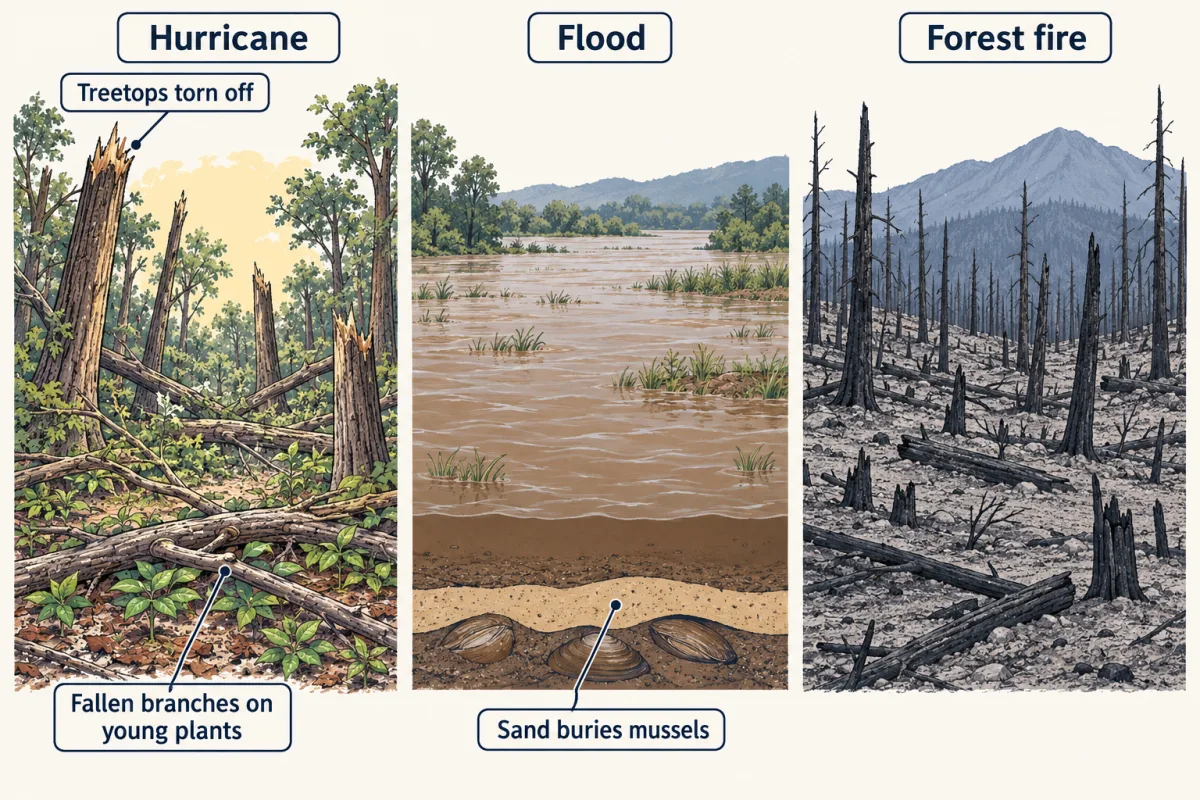
A climate change is a lasting shift in a place's usual temperature, rain, or weather. It builds over many years. Habitat can move or shrink as conditions shift. Some species may follow suitable conditions, while others may lose space. A catastrophic disturbance arrives suddenly and harms many living things at once. Hurricanes tear branches. Floods spread water and mud.
Forest fires burn plants. The event is brief compared with a climate trend, but effects can last. Either kind of change can alter habitat. Biodiversity means the variety of living things in an area. Some populations fall, while others may find new space. So one event can affect different groups in different directions. Picture a young pine forest growing after a severe fire. The first fire removed older trees, but young trees started returning. What may happen if it burns again before the young trees make many seeds?
Fewer young trees may grow after the second fire, because few seeds were ready. In Yellowstone, researchers found far fewer young trees after a quick second fire. They counted only the first year, so the long-term result is not known. Change one ecosystem part, and effects can spread through the system. The path depends on connections, timing, and the conditions already there. A change can weaken, strengthen, or stop before reaching every part. Recovery depends on how severe a change is, how long it lasts, and the conditions already there. Timing matters too. Cooler water and winds can remix the Bay in fall. Repeated damage can slow return. The supply of seeds can shape what happens next.
Recovery does not always mean an exact return. A changed ecosystem can still work, but in a different way. Different groups can also respond differently. Return can be fast, slow, partial, or hard to see at first. People cause many ecosystem changes, and people can also help recovery. A good plan traces connections, measures results, and changes course when evidence disagrees. Actions on land can change water downstream, so helpful actions can spread too. When an ecosystem changes, ask where the change began, which connections carried it, and what might help recovery. Those questions turn a disaster story into a testable model. Look for measurements that could support the model or show its limits.
From the film
- Change one ecosystem part, and effects can spread through the system.
- Climate changes build over many years; catastrophic disturbances strike suddenly.
- Big changes can alter habitat and biodiversity.
- Recovery depends on how severe a change is and how long it lasts.
Explain: climate changes and sudden disasters
The second film showed two kinds of change. A climate change is a shift in a place’s usual temperature, rain or weather that lasts for many years. A catastrophic disturbance is a sudden event, such as a hurricane, flood or forest fire, that harms many living things at once. What the film left out:
- A 2022 model study found that warming canceled out part of the oxygen gained by cutting nitrogen.
- Sea level is rising along Virginia’s coast. Salt water can now reach some low marshes and forests near the shore.
- A 2022 world report found that about half of the species studied had moved toward the poles or up mountains.
- Climate changes can make some disturbances, such as fires, more common.
In September 2003, Hurricane Isabel brought strong winds and flooding to eastern Virginia. Forest fires also burn in Virginia’s mountains.
Explain: losing variety, and coming back
Biodiversity is the variety of living things in an area. A big change can lower it: in a dead zone, fish and crabs leave the deep water, and animals that cannot leave, such as adult oysters, may get sick or die.
A disturbance does not lower every kind of life. In a Puerto Rico forest, researchers cut treetops to copy a hurricane. A review reported that more kinds of plants grew there, while several animal groups became less common.
Ecosystems change all the time, but many keep their main features or return to them after a disturbance:
- In fall, cooler water and winds usually mix the Bay, and oxygen returns to the deep water.
- High mountain pine forests in the northern Rocky Mountains have grown back after large fires that came 100 to 300 years apart. Forests that burn again before they recover, like the second film’s, may not grow back the same way.
An ecosystem is a bit like a rubber band: a small stretch may reverse, while a large one may leave a lasting change. Unlike a band, a changed ecosystem can still work, just differently.
People cause many changes (People Change Habitats), and people can help (Helping Ecosystems Recover).
- When blank washes into the Bay, algae blank, and later the deep water blank.
- In the year with more nitrogen, the dead zone was blank, but I cannot rule out blank.
Elaborate: read eight years of Bay numbers
| Year | Spring nitrogen from 9 rivers, January to May (million kg) | Summer dead-zone volume, June to September average (km³) |
|---|---|---|
| 2017 | 43.5 | 1.9 |
| 2018 | 58.5 | 4.8 |
| 2019 | 77.5 | 11.6 |
| 2020 | 46.8 | 3.5 |
| 2021 | 40.6 | 3.7 |
| 2022 | 47.9 | 5.1 |
| 2023 | 33.1 | 1.5 |
| 2024 | 59.2 | 3.9 |
Nitrogen: U.S. Geological Survey estimates (2024 River Input Monitoring data release), nine river stations added together, January 1 to May 31. Dead zone: computer-model estimates of water below 2 mg/L of oxygen, averaged June to September. They come from the historical table of the Virginia Institute of Marine Science (VIMS) Bay forecast system, read October 2026. VIMS may revise old estimates, and its tables can differ a lot: for 2023, another VIMS table gives 3.5 km³ instead of 1.5. The model also uses river flow and nutrients to make its estimates, so it is not a fully separate check on the nitrogen link. One km³ is a cube of water 1 kilometer on each side.
Predict. If one year had both the most nitrogen and the largest dead zone, would that prove nitrogen was the only cause?
Check your prediction
No. Wind, temperature and mixing matter too. Wet springs also add fresh water, which can strengthen the layers.
- Which year had the most nitrogen? The largest dead zone?
- Compare 2019 with 2023. How much more nitrogen came in, and how much larger was the dead zone?
- Find the mean dead-zone volume. Then find two years where more nitrogen did not come with a larger dead zone.
Claim, evidence, reasoning
Make a claim that answers the question: how can too much fertilizer make part of the Bay run out of oxygen? Use the table.
Start with: The data show that years with more spring nitrogen usually had blank summer dead zones.
Start with: In blank, the rivers carried blank million kg of nitrogen, and the dead zone averaged blank km³. In blank, they carried blank and it averaged blank.
Start with: More nitrogen feeds more blank. When they die, decomposers use up blank in the deep water.
Compare with a model answer
Years with more spring nitrogen usually had larger summer dead zones. In 2019, the rivers carried 77.5 million kg of nitrogen, and the dead zone averaged 11.6 km³. In 2023, they carried 33.1 million kg, and it averaged 1.5 km³. More nitrogen feeds more algae. When the algae die, decomposers use up oxygen in the deep water. One limit: a wet spring brings more river water as well as more nitrogen, and extra fresh water makes the layers mix less, so the table cannot separate the two. Also, 2017 had more nitrogen than 2021 but a smaller dead zone, so other things, such as wind, matter too. These are eight years of model estimates, not direct counts.
Saved in this browser only.
Design problem
Does adding more fertilizer to pond water change how much oxygen is left a few weeks later? Plan a fair test with clear jars.
Predict. Each fertilizer amount has one jar. What problem remains?
Saved in this browser only.
Check your prediction
One unusual jar could mislead you. Repeats show whether the pattern holds.
One way to do it
- Question: How does the amount of fertilizer in pond water affect algae and dissolved oxygen after three weeks?
- Independent variable: fertilizer added to each jar: 0, 1, 2 and 4 drops of liquid plant fertilizer per liter.
- Dependent variables: how green the water is (a color chart, every three days) and dissolved oxygen in mg/L (a test kit, at the end).
- Control: jars with no fertilizer.
- Constants: the same pond water, 1 liter per jar, window, temperature and time.
- Repeated trials: three jars per amount; find each mean.
- Safety: wear gloves and goggles, never taste the water, wash your hands, and dispose of it as your teacher says.
- Meaning: greener jars that later test lower in oxygen support the chain. Jars are a model with no layers or tides.
Going deeper: measured disturbance cases
| Disturbance | What it does | What scientists measured |
|---|---|---|
| Hurricane | Tears off treetops and drops branches | In Puerto Rico, researchers cut treetops and piled branches like a storm. Fallen branches killed young plants. Extra light on the forest floor lasted about 18 months. |
| Flood | Covers land with water and mud | In the 1993 Midwest flood, sand about 30 to 60 cm deep buried some freshwater mussels in the Upper Mississippi River. Many fish feed and lay eggs on flooded land. |
| Forest fire | Burns trees and plants | In Yellowstone, forests that burned twice in a short time had about one sixth as many young trees. |
Evaluate: check your thinking
Change one part, and effects can spread. Fertilizer does not take oxygen from the Bay by itself: its nutrients feed algae, and decomposers use the deep oxygen. Climate changes and disasters pass effects along too. Some ecosystems recover, and some stay changed.
Science practices you used: asking a question, testing a model and naming its limits, reading a data table and finding a mean, planning a fair test, and making a claim from evidence.
Your notes
Select any text in the lesson to highlight it or add a note to it. Your highlights and notes are saved in this browser and collected in your notebook.
This browser is not letting the site save anything (a private window or strict privacy settings), so highlights and notes will be lost when you leave the page.
How we measure it
Dissolved-oxygen profiling
A sensor lowered on a cable reads the oxygen in the water at each depth, from the surface to the bottom. Readings from many places and dates show where deep water runs low on oxygen.
River load monitoring
River stations measure how much water flows past and how much nitrogen the water carries. Together these give an estimate of the total nitrogen a river delivers to the Bay.
Computer model of the Bay
A computer model uses river flow, weather and nutrients to estimate how much low-oxygen water the Bay holds each day. Scientists average those daily estimates over the summer.
Where this lesson fits
Before thisReview first
- Producers, Consumers and DecomposersThis course · Lesson 13
You need to know that decomposers break down dead matter and use oxygen, which explains the dead-zone oxygen loss.
- Partners in EnergyThis course · Lesson 11
You need how algae make oxygen by day and respiration uses it up, to follow the oxygen swings here.
- The Carbon and Water CyclesThis course · Lesson 14
You need how matter moves between living things and air or water to follow how nutrients spread through a system.
After thisStudy next
- People Change HabitatsThis course · Lesson 25
It takes the idea of one change spreading through an ecosystem and applies it to people moving species and reshaping land.
- Helping Ecosystems RecoverThis course · Lesson 26
It uses the question of when an ecosystem recovers after a big change to show how people can help it recover.
- Extinction and SurvivalThis course · Lesson 34
It shows a sudden change, such as a fungus, spreading through a forest and threatening species survival.
Elsewhere on the siteFilms, simulations and method films in other courses
- Where the Bay's Oxygen GoesFilm · Biology
It follows fertilizer from far upstream to low oxygen at the Bay bottom with real data.
Suggested by an AI model from the lessons themselves, then checked. How we use AI
Finish line
Test yourself
8 questions
Practice and MCAT-style, with explained answers.
Next · Lesson 25
People Change Habitats
People put blue catfish into Virginia rivers for fishing, so what could that mean for the crabs and native fish already living there?
Continue →