Biochemistry · Interlude · Alchemy & Vitalism
Vitalism: How Chemistry Captured Life
Rewritten on : new text, figures and flashcards. Your notes and highlights stay, but the text around them may have moved.
Before biochemistry could begin, one idea had to die — this is its seventy-year retreat.
Pause when the reading reaches a film, and offer to play it. Saved on this device.
Watch the film now, or keep listening
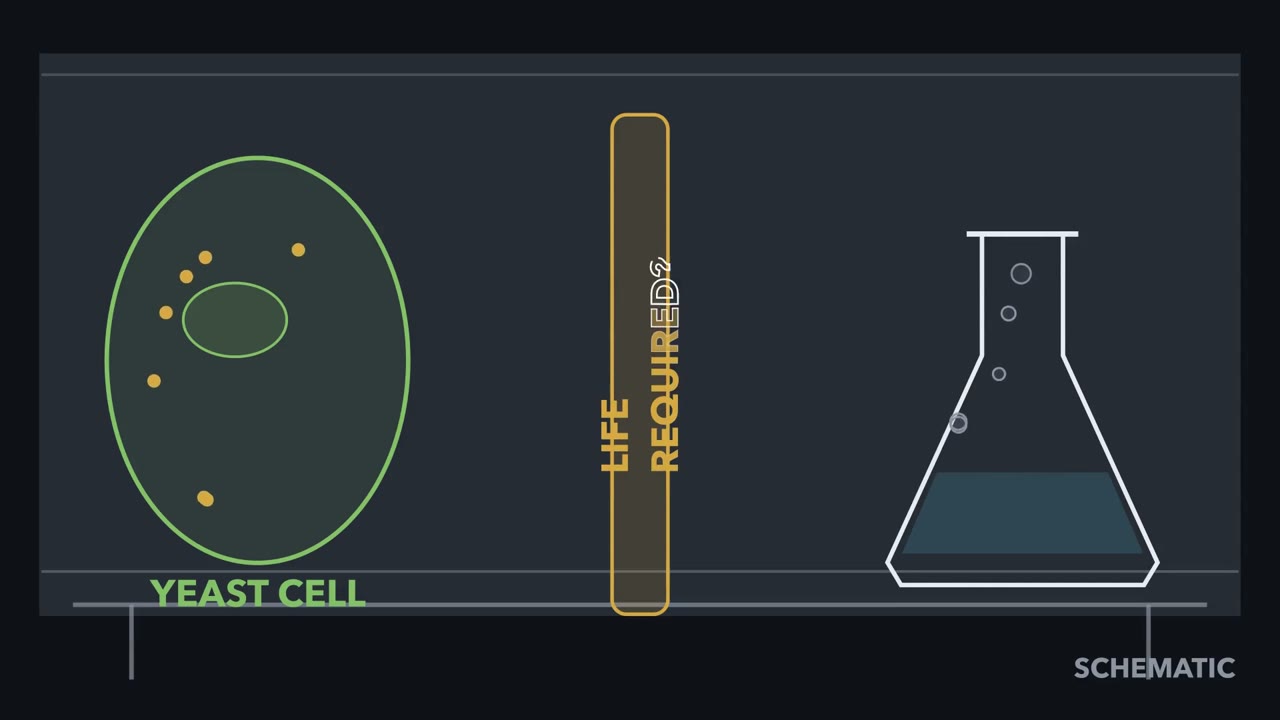 ▶ Watch Where Could Life Hide? · 3:15
Read the transcript of “Where Could Life Hide?”
Film transcript: Where Could Life Hide?
Did life's chemistry need a special force that no laboratory flask could replace? Many early nineteenth-century chemists thought so. They called it a vital force. Berzelius drew that wall sharply. Rocks and salts belonged to inorganic chemistry. Sugar, fat, and urea belonged to living bodies. Only life, he held, could make the second group. Then, in 1828, Friedrich Wöhler tried to make the inorganic salt ammonium cyanate. Urea crystallized instead. On its face, he had made a body molecule without a body. The wall cracked. But Wöhler had not proved that every trace of life was absent. His cyanate could be traced to animal materials. A skeptic could say life still hid in the starting material.
Here is the guiding rule. To test a claim that chemistry needs life, remove life and prove it is gone. A test counts only as far as its evidence reaches. Kolbe pushed the evidence farther in 1845. He built acetic acid from carbon disulfide made from charcoal and sulfur. Chemists then counted those starting materials as lifeless. The second segment lit up.
One refuge remained: perhaps a whole process still needed an intact cell. Pasteur showed fermentation appeared with living yeast. He argued that sugar-to-alcohol fermentation could not be separated from the living cell. In 1896, Eduard Buchner ground yeast with sand and pressed out a juice with almost no intact cells. He added sugar.
Carbon dioxide bubbles rose anyway. Had living scraps survived? Predict: which tests could tell living survivors from a dissolved chemical? Warming, a cell-trapping filter, or an antiseptic that kills cells? Gentle warming stopped fermentation, but heat could stop either cells or a fragile chemical. It could not decide.
Filtered juice still fermented. So did juice treated with chloroform, an antiseptic. Together those controls showed no living cells or scraps were needed. Buchner had removed the cell and tested whether it survived. The final segment lit up. Across seventy years, the vital force became unnecessary, one molecule and process at a time. Living cells obey the same chemistry as everything else. Their reactions can be isolated, measured, and explained.
Testing a claim that chemistry needs life requires proving life is gone.
From the film
- Vitalists claimed that life's chemistry required a special vital force.
- Wöhler made urea without a body, but his starting materials left a loophole.
- Kolbe narrowed that loophole using materials chemists counted as lifeless.
- Buchner's filter and antiseptic showed yeast fermentation needed no living cell.
- Testing a claim that chemistry needs life requires proving life is gone.
In 1896 a flask of pressed yeast juice, with almost no intact cells in it, turned sugar into alcohol. That experiment, rather than Wöhler’s urea nearly seventy years earlier, is often credited with launching modern biochemistry.
That sounds backwards if you learned that Friedrich Wöhler killed the vital force in 1828 by making urea from a lifeless salt. The film above shows why his flask was only the first test in a seventy-year retreat. Many chemists then held that the molecules of living things (sugar, fat, urea, the acids of blood and muscle) carried a vital force that ordinary matter lacked, so only life could make them.
The film frames that retreat as a rule for testing a claim: remove life, then prove it is gone. This is not a law of chemistry, and “gone” means gone by evidence the opponents of the day accepted.
The wall
By the early nineteenth century the most respected chemist in Europe was Jöns Jacob Berzelius, who gave the science the letter symbols it still uses (H, O, C), replacing older pictorial signs with a compact shared notation. He also drew the era’s sharpest line: inorganic matter, the chemistry of rocks and salts and gases, which chemists could make at will, against organic matter, the chemistry of living bodies.
In Berzelius’s day, organic meant obtained from a living thing: sugar from cane, urea from urine, fat from tallow. The category was defined chiefly by where a substance came from, not by its formula. (Today organic chemistry is the chemistry of carbon compounds whatever their source, though simple ones such as CO₂, carbonates and CS₂ are conventionally filed under inorganic.) Keep that in mind; every argument in this lesson turns on it. Berzelius analysed both kinds with the same methods, but the wall between them rested on the conviction that only life could make them.
The student who would walk across it had trained in Berzelius’s own kitchen laboratory in Stockholm, and had once been told, after rushing an analysis, that the work was “quickly and badly done.” His name was Friedrich Wöhler.
Wöhler’s flask, 1828
In February 1828 Wöhler, then twenty-seven, reported that he had tried to make an inorganic salt, ammonium cyanate, from a cyanate salt and ammonia. When he evaporated the solution, the crystals were not the salt but urea, the very molecule your body makes to get rid of nitrogen. There was no kidney in the room. He wrote to Berzelius: “I can no longer, as it were, hold back my chemical urine; and I have to let out that I can make urea without needing a kidney.”
Look closely at what happened, because it is subtler than “he made life from non-life.”
Same atoms, different connections.
- Ammonium cyanate is a salt, two ions held together by charge: NH₄⁺ (ammonium) and OCN⁻ (cyanate).
- Urea is one neutral molecule held together by covalent bonds: a carbon double-bonded to an oxygen, with an NH₂ group on each side, H₂N–C(=O)–NH₂.
Both come to one carbon, four hydrogens, two nitrogens and one oxygen: CH₄N₂O. Compounds with the same formula and different connections are isomers. Berzelius soon named the idea isomerism, and Wöhler’s urea was one of its founding cases.
This is an isomerization: same formula (CH₄N₂O), atoms simply rearranged. No new matter, no missing matter — and yet an inorganic salt became a hallmark of animal metabolism. It was the first crack, not the end: a skeptic could still point to where the cyanate came from.
How the atoms move (chemistry worked out later; optional on a first read). Chemists found two steps, by way of ammonia and cyanic acid:
- The ammonium ion hands a proton (H⁺) to the cyanate. That leaves ammonia (NH₃) and cyanic acid (HNCO).
- The nitrogen of ammonia uses its lone pair to attack the carbon of cyanic acid, and a proton shifts. The result is urea.
Which side wins? Urea, the more stable form by a wide margin: at equilibrium a solution like Wöhler’s is almost all urea. Warming did not force the change; it sped up one already downhill, and evaporation pushed it further: crowding the ions together favors the side with fewer particles, and two ions become one molecule (Going deeper, “Why urea wins”).
Wöhler could not have said any of this; there was no theory of molecular structure in 1828. But his result carries the idea this whole course depends on: what a molecule is depends on how its atoms are connected, not just on which atoms it contains.
Predict. You are a chemist in 1828, and organic, to you, means “obtained from a living thing.” How could you refuse to count Wöhler’s flask as a refutation?
Check your prediction
Ask where his cyanate came from. In 1828, cyanides and cyanates were made from a salt (potassium ferrocyanide) produced by heating blood, horn or hoof with potash and iron. So a skeptic could say Wöhler had only turned one substance of animal origin into another. Most chemists, Berzelius included, read the result as a striking case of two substances with one composition, not as a refutation.
So Wöhler’s flask did not kill vitalism that afternoon, whatever the textbooks imply. It took life out of the making of one molecule but left it standing in the starting materials.
Kolbe narrows the loophole, 1845
Predict. What would a synthesis have to start from to answer the skeptic’s objection?
Check your prediction
From the elements, or from something no one could call organic.
In 1845 Hermann Kolbe, trained under Wöhler, built acetic acid by a route that left the loophole very little room. He started from carbon disulfide, made by heating charcoal with sulfur to red heat:
carbon disulfide → carbon tetrachloride → tetrachloroethylene → trichloroacetic acid → acetic acid
You need not remember the chain; what matters is where it starts. He ran the final step not with a cell or a seed but with an ordinary battery, a reduction: its current supplied the electrons that swapped the last three chlorines for hydrogens. Charcoal is usually made from wood, but once charred to carbon it counted, for chemists of the day, as an element: mineral matter with only a distant tie to life. Nothing in the chain still carried life.
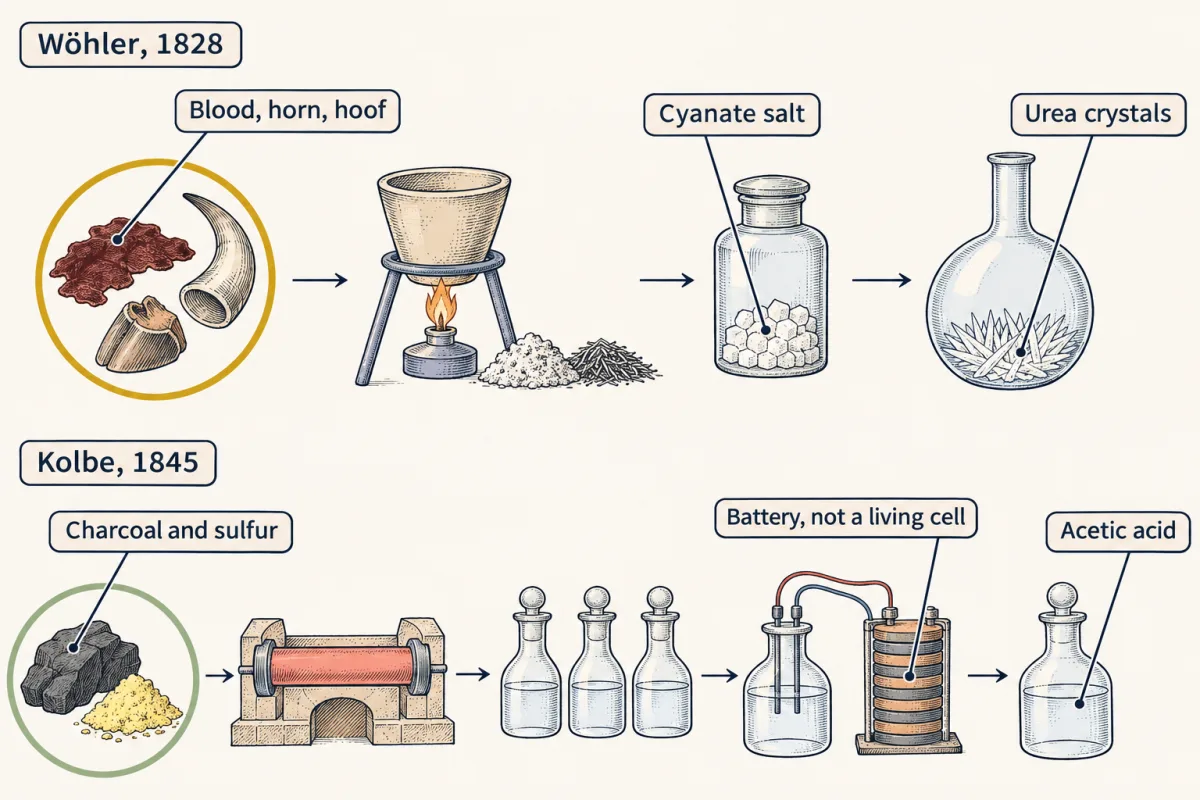
Kolbe’s own aim was to prove a theory of how molecules are assembled, but the effect outran his intent. It did not end vitalism on its own, but it made the provenance objection (where the starting materials came from) hard to sustain. His two-carbon acetyl group, carried as acetyl-CoA into the citric acid cycle in every cell of yours that has mitochondria, is the hub of metabolism.
Berthelot’s fats, 1854
A decade later Marcellin Berthelot took a different step, rejoining glycerol and fatty acids to remake natural fats:
glycerol + 3 fatty acids ⇌ fat (a triglyceride) + 3 H₂O
Each fatty acid joins the glycerol by an ester bond and releases one water. Add water and the reaction runs back: that is hydrolysis. This is the same reversible, equilibrium chemistry that governs reactions in the mineral world, with no special law for the body’s molecules. Berthelot also made new fats that nature does not.
Predict. By the rule, where was life removed in Berthelot’s work, and where was it still standing?
Check your prediction
Life was out of the joining step, but his glycerol and fatty acids came from natural fats, so life was still in the parts. A partial test, then.
Molecule by molecule, the ground was disappearing. One redoubt remained, defended by the most formidable scientist of the age.
The last redoubt: fermentation
Louis Pasteur had proved that fermentation depended on living yeast: sterile grape juice kept free of yeast stayed inert, while juice that yeast could reach foamed into alcohol, with or without air. The film above shows his stronger claim, beyond what those data required: fermentation could not be separated from the intact living cell. He wrote of fermentation as a chemical act tied to a vital, living process, but argued from experiments, not from a mystical force.
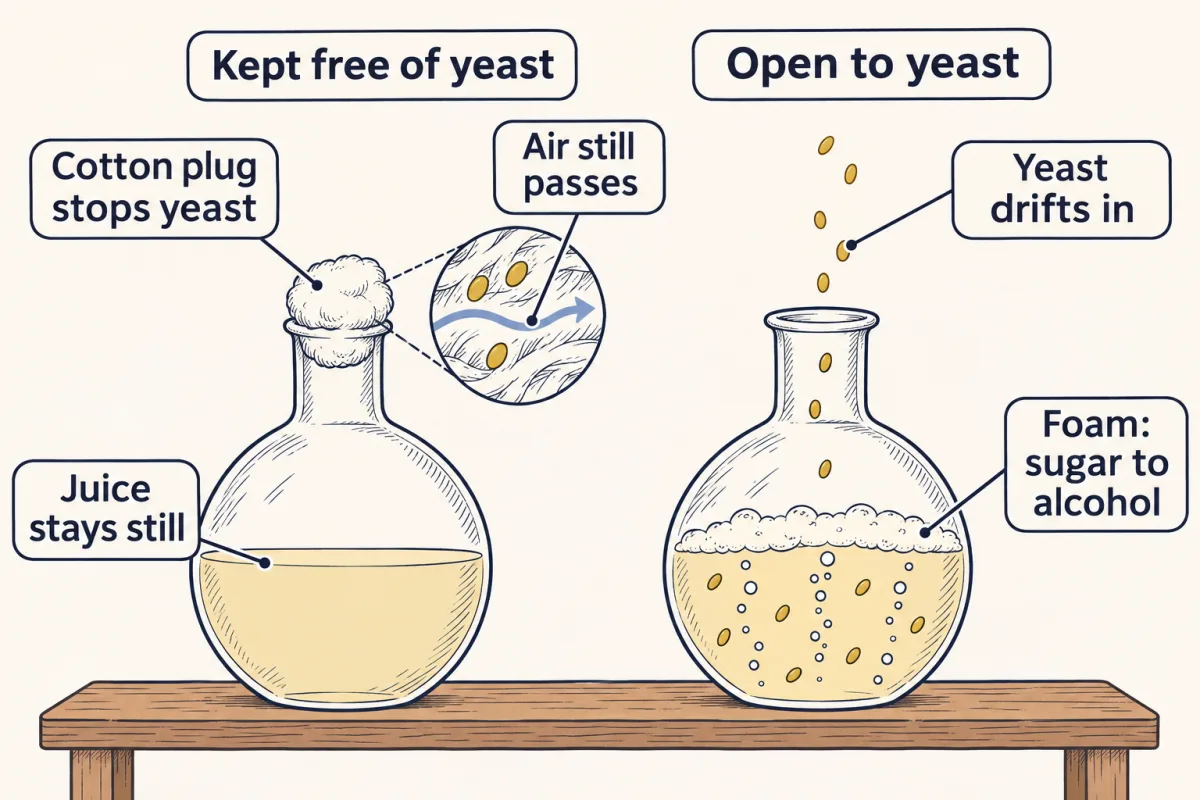
The “needs life” intuition had retreated from single molecules to whole processes. Some ferments, such as pepsin and the invertase of yeast, already worked outside cells, and in 1877 Wilhelm Kühne named them enzymes, from the Greek for “in leaven”. The open question was narrower and harder: could sugar-to-alcohol fermentation, the one Pasteur had tied to life, be pulled out of the cell too? For decades no one could make it run without cells.
Buchner’s flask, 1896–97
The film above shows the experiment: in late 1896 (published in January 1897), Buchner’s press juice fermented after he added sugar to preserve it. This was little more than a year after Pasteur’s death.
Could scraps of living yeast have survived?
Predict. Buchner tried three tests on the juice: a sterile filter that holds back every yeast cell, saturation with chloroform (an antiseptic that kills cells), and gentle warming. Which of them can tell surviving cells from a dissolved chemical?
Check your prediction
| Test | If surviving cells did it | If a dissolved chemical did it | Buchner saw | Decides? |
|---|---|---|---|---|
| Sterile filter | Stops | Continues | Continued | Yes, for whole cells |
| Chloroform | Stops | Continues (unless chloroform also harms the chemical) | Continued | Yes |
| Gentle warming | Stops (heat kills cells) | Stops (heat destroys a fragile dissolved substance) | Stopped | No: both predict the same result |
A test decides only if the two answers predict different results, so the filter and the antiseptic decide it; chloroform, which kills living protoplasm, also speaks to any fragment small enough to slip through the filter. Warming fails because both predict the same result.
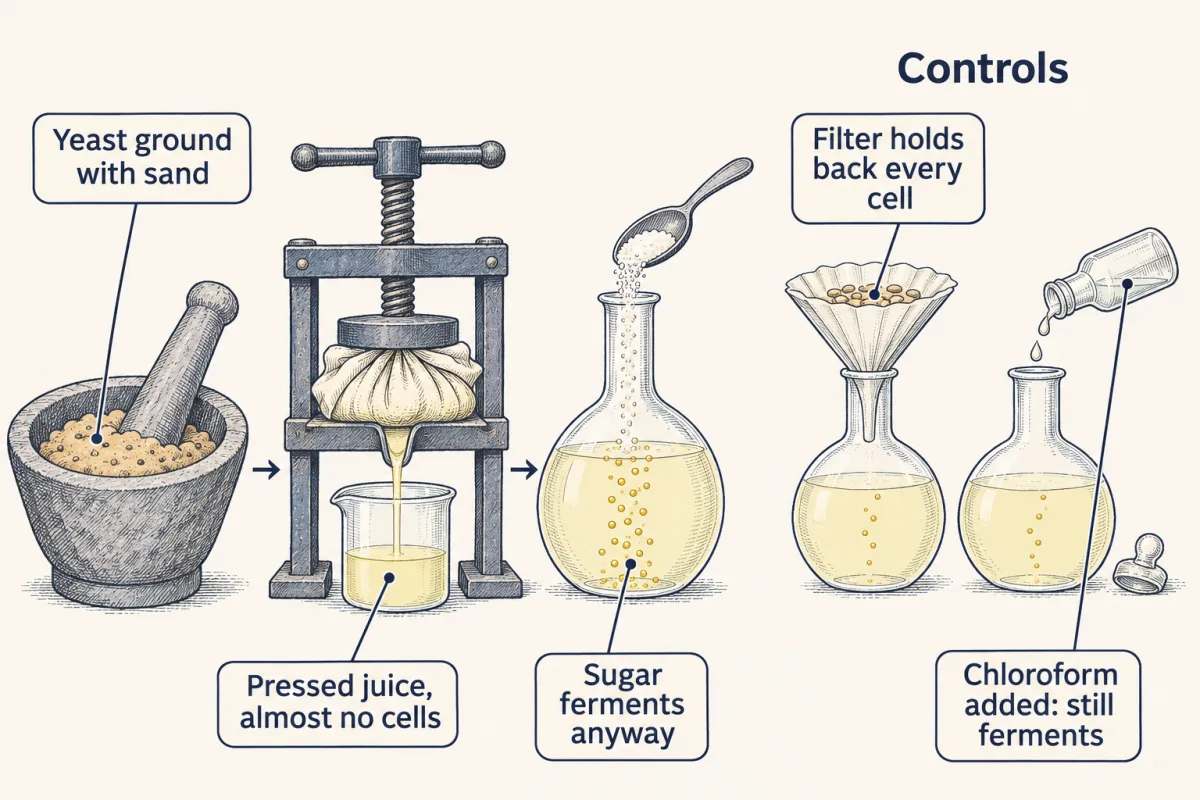
The carrier of the fermenting activity, Buchner wrote, “must be regarded to be a dissolved substance, undoubtedly a protein.” He named it zymase and took the 1907 Nobel Prize, often called the first ever given for a fundamentally biochemical discovery. Zymase turned out to be not one substance but a team: Harden and Young later split it into enzymes plus small heat-stable cofactors, chief among them cozymase, now known as NAD. That team is glycolysis plus the two steps that make ethanol, a later chapter of this course.
In the chemistry of the cell, the vital force was out of places to hide. (Outside chemistry, in theories of how embryos develop and in philosophy, it lived on for a while.)
The retreat in one table
| Year | Experiment | Where life was taken out | Escape hatch left | Who closed it |
|---|---|---|---|---|
| 1828 | Wöhler: urea | Making one molecule | ”Your cyanate came from blood and horn” | Kolbe, largely |
| 1845 | Kolbe: acetic acid | The starting materials too | ”A process still needs a living cell” | Buchner |
| 1854 | Berthelot: fats | The joining step (parts still from fat) | “Your glycerol and fatty acids came from fat” | Kolbe, in principle (organic compounds can be built from the elements); for fats themselves, only later syntheses |
| 1896–97 | Buchner: cell-free fermentation | A whole process, with controls | ”The zymase was made by yeast” | See the last predict |
Predict. After Buchner, what experiment would close the last hatch in the table?
Check your prediction
Build an enzyme from amino acids, with no cell involved in the assembly, and show it works. That was first done in 1969, for ribonuclease A, an enzyme that cuts RNA (Going deeper, “The rule’s last test”). The assembly was cell-free, but the amino acids were of biological origin, a Berthelot-style caveat.
- making a moleculeyes
- its starting materialsno
- a whole processno
Vitalism was not refuted in one afternoon. It was a fighting retreat across seventy years — each synthesis pried the vital force out of one more hiding place, until Buchner's cell-free ferment left it nowhere to stand in the chemistry of the cell. Once you grant that life is chemistry, the rest of biochemistry becomes possible: you can lift the machinery out of the cell and study it one reaction at a time.
Why this is Chapter Zero
The film above arrives at the premise this course now assumes: living cells obey the same chemistry as everything else. Their reactions can be pulled out and explained through structure, equilibrium and energy, with no separate law.
The catalysts Kühne named and Buchner freed are, nearly all of them, proteins. And urea itself, the molecule Wöhler conjured from a salt, is built in your liver right now by five enzymes working in a loop called the urea cycle, the subject of one of the last chapters in this course. Life is chemistry, and chemistry can be measured, mapped, and understood.
Going deeper
Why urea wins
Standard free energies of formation put the conversion well downhill: at room temperature a 0.1 M solution comes to roughly 98–99% urea at equilibrium. The conversion releases heat, so warming lowers the equilibrium constant, about twenty- to thirtyfold by 100 °C, yet a boiling 0.1 M solution is still over 90% urea. These are approximate, ideal-solution estimates.
The primeval forest, and a later myth
Wöhler himself found the field daunting. In 1835 he wrote to Berzelius that organic chemistry seemed to him “a primeval forest, a monstrous and boundless thicket,” one a chemist might well dread to enter. Historians argue that the tidy story in which his flask ended vitalism was assembled decades later.
Pasteur’s critics, and Kühne’s word
Pasteur’s view was not unopposed. Chemists such as Moritz Traube held that yeast worked through soluble ferments. Wilhelm Kühne studied the chemistry of digestion and of vision, and believed that both, like fermentation, were chemistry waiting to be lifted out of the cell. His word enzyme, which also covered trypsin, named not the cell and not the tissue but the chemical worker within. It classified a kind of ferment; it did not settle whether yeast fermentation could leave the cell.
Sumner’s crystals
In 1926 James Sumner crystallized urease, the enzyme that takes urea back apart, and held a catalyst of life in his hand as a pile of crystals. He argued it was a protein. Others doubted the crystals were the enzyme until more enzymes, Northrop’s among them, were crystallized in the early 1930s.
The rule’s last test
In 1969 Gutte and Merrifield assembled active ribonuclease A from amino acids in the laboratory; at the same time a group at Merck synthesized the large S-protein fragment of the enzyme, which became active when joined to its S-peptide partner.
Your notes
Select any text in the lesson to highlight it or add a note to it. Your highlights and notes are saved in this browser and collected in your notebook.
This browser is not letting the site save anything (a private window or strict privacy settings), so highlights and notes will be lost when you leave the page.
How we measure it
Organic synthesis
Building a compound of the living body from simpler, lifeless starting materials. Each successful synthesis removed one more molecule from the list that supposedly required a vital force.
Cell-free extract
Grinding and pressing living cells into a lifeless juice that still carries out their chemistry. Buchner's press-juice proved metabolism could be lifted out of the cell, which opened the way to studying it one reaction at a time.
Controls (antiseptic and filtered)
Buchner's answer to the idea that living cells survived in his juice: it still fermented when saturated with chloroform, an antiseptic, and after passing through a sterile filter that holds back every cell. Warming destroyed the activity, but heat kills cells too, so the filter and the antiseptic carried the argument.
Practice questions on this lesson (2) → MCAT-style, original, each with an explanation
Where this lesson fits
After thisStudy next
- Introduction to Biochemistry and Cell Biology: Compartments Create ControlThis course · Lesson 2
It starts from the premise that a cell obeys ordinary chemistry and shows how compartments give that chemistry control.
- Basic Concepts of Enzyme ActionThis course · Lesson 7
Buchner's zymase was an enzyme, and this lesson explains how enzymes speed up reactions without changing what is possible.
- Glycolysis: The Investment-and-Payoff PathwayThis course · Lesson 16
The fermentation Buchner freed from the cell is glycolysis plus the steps that make ethanol.
Elsewhere on the siteFilms, simulations and method films in other courses
- Radioactive and stable isotope tracersMethod film
Tracing atoms through a reaction is how an isomerization like urea's can be shown to keep the same atoms.
- Count the Working SitesFilm · Biology
It shows enzymes as ordinary catalysts, the kind of molecules Buchner found working in dead yeast juice.
Suggested by an AI model from the lessons themselves, then checked. How we use AI
Finish line
Test yourself
6 questions
Practice and MCAT-style, with explained answers.
Next · Lesson 2
Introduction to Biochemistry and Cell Biology: Compartments Create Control
Why can one missing enzyme kill a child, when her parents, with half as much, are fine? The answer is a room with no way out.
Continue →