Biology · Unit 1: The chemistry of life
Water and Life
Rewritten on : new text, flashcards and film. Your notes and highlights stay, but the text around them may have moved.
On a hot July day in the Chesapeake Bay, why did the air swing by about 8 degrees Celsius while the water changed by less than 1.5?
Pause when the reading reaches a film, and offer to play it. Saved on this device.
Watch the film now, or keep listening
Where this lesson sits
- Virginia SOL BIO.2a
- Practices BIO.1a, BIO.1c, BIO.1d, BIO.1e
Essential question: Why does water behave so strangely, and how do those oddities keep living things alive?
-
Life Science (grade 7)
Review it at grade 7 level
In grade 7 you met water in two places. In the water cycle, water evaporates, forms clouds, falls as rain and runs back to rivers and the ocean. In photosynthesis, plants take in water and carbon dioxide and use light energy to make sugar. You learned that living things need water, but not why water is so useful. Biology adds the reason: the tiny charged ends of each water molecule make it dissolve nutrients, stick together and warm up slowly.
-
Biology BIO.2a You are here
This lesson
-
Biology II Biology II: Advanced Survey of Biology Topics, BIOII.2 b
Preview where it goes next
Virginia’s Biology II: Advanced Survey of Biology Topics course uses water’s polarity to explain the cell membrane. A phospholipid has a polar, charged head that is attracted to water and two long nonpolar tails that are not. In water, phospholipids line up in a double layer with the heads facing the water on both sides and the tails hidden in the middle. That arrangement comes from the same rule that keeps oil and water apart. This lesson left out why nonpolar tails cluster: water molecules hydrogen bond with each other more easily when the tails are tucked away. Biology II also studies how pH changes enzyme activity, and pH depends on water itself splitting into charged pieces.
-
College
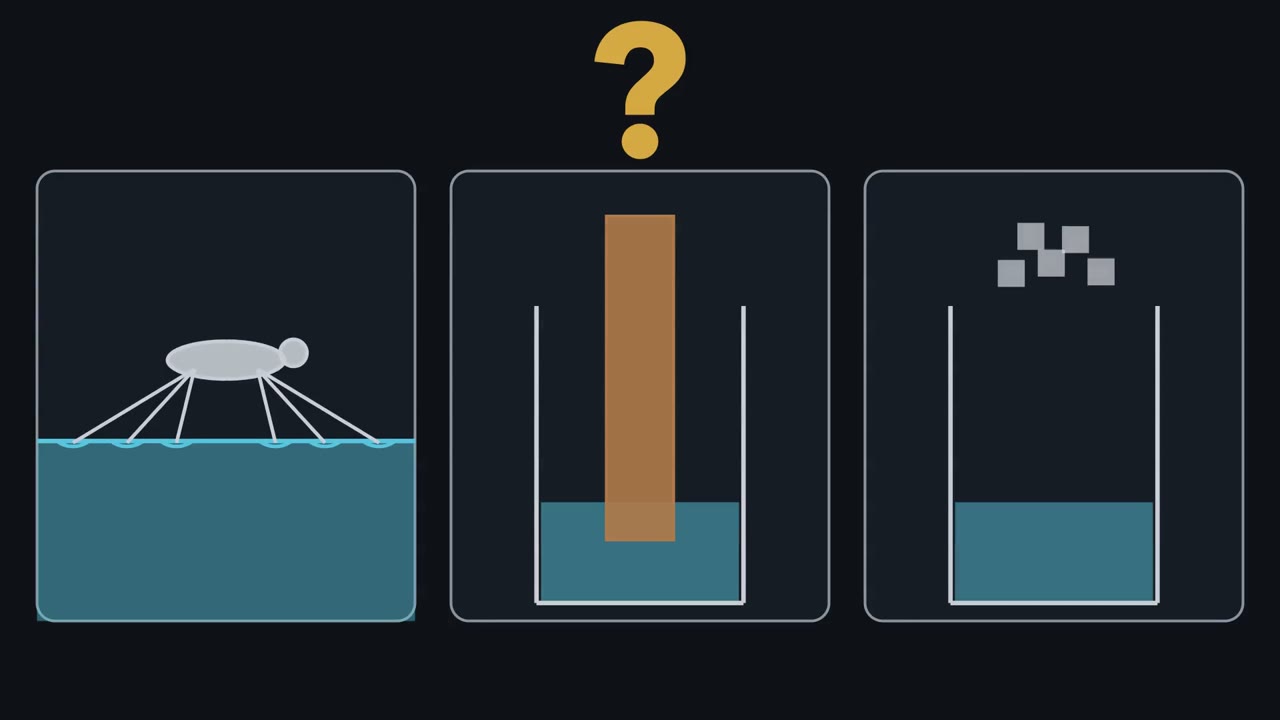 ▶ Watch One Tug, Many Jobs · 3:30
Read the transcript of “One Tug, Many Jobs”
Film transcript: One Tug, Many Jobs
Could one fact about one tiny molecule explain three puzzles? An insect stands on a pond, a paper towel drinks water upward, and salt vanishes into a glass. Start with one water molecule: one oxygen atom and two hydrogen atoms. Each hydrogen shares electrons with the oxygen in a covalent bond. The molecule is bent, like a wide letter V.
Oxygen pulls the shared electrons closer. So the oxygen end becomes slightly negative shown in red. Each hydrogen end becomes slightly positive shown in blue. A molecule with charged ends is polar. Bring in a neighbor. Opposite charges attract, so the blue end of one molecule is drawn to the red end of the next. That weak pull between molecules is a hydrogen bond, drawn as a dashed gold line. Liquid water holds countless jostling molecules.
Gold lines snap on, break, and form again with new partners. The grey bonds inside each molecule stay put, because they are much stronger. Here is the one idea. Water's charged ends tug on its neighbors, on ions, and on other polar molecules. Now watch it do three jobs. Job one is dissolving. Salt is made of charged particles called ions, positive sodium and negative chloride. Water's red ends face each sodium, and its blue ends face each chloride. That pull of opposite charges lifts each ion off the crystal. So water is a solvent. Now add some oil. Oil molecules are mostly nonpolar, with few charged spots to grab. Water molecules tug on each other more than on oil, so the oil stays in its own drop.
Job two is sticking to itself, called cohesion. At the surface, neighbors pull each molecule sideways and down. So the surface resists being stretched. That is surface tension, and it is still liquid water, not a skin. Job three is sticking to other things. Paper is made of cellulose fibers, with many polar parts. Water clings to them, and that is adhesion. Each climbing molecule pulls its neighbors up by cohesion. Together they give capillary action. Back to the strider. Its legs are covered in tiny water-repellent hairs. Will water climb those hairs like it climbs the towel? Pause and decide.
No. Water clings only weakly to water-repellent hairs, so it pulls itself into beads. Surface tension, plus those hairs, lets a small strider stand. So one molecule's bent shape and charged ends help explain all three jobs. The same tug helps make water slow to warm, as film two shows.
From the film
- A water molecule is bent and polar: its oxygen end is slightly negative and its hydrogen ends slightly positive.
- A hydrogen bond is the weak pull between the hydrogen of one water molecule and the oxygen of a neighbor; these keep breaking and re-forming, while the covalent bonds inside each molecule stay put.
- Water's charged ends pull the ions of salt off the crystal, but leave mostly nonpolar oil in its own drop.
- Water sticks to itself (cohesion); at the surface this gives surface tension, and the surface is still liquid, not a skin.
- Water sticks strongly to polar surfaces such as paper (adhesion) but only weakly to water-repellent ones; adhesion plus cohesion give capillary action.
On July 9, 2025, a buoy in the Chesapeake Bay at Stingray Point, Virginia, recorded the air swinging by about 8 °C over the day. The water just under the buoy changed by less than 1.5 °C all day. Watch the first film, at the top of the page, before reading on; this lesson tests its rule against the buoy.
The guiding idea. A water molecule is bent and polar, so water’s charged ends tug on its neighbors, on ions and on other polar molecules. Between water and water, or water and a polar molecule such as sugar, the tug is a hydrogen bond; on an ion such as sodium it is the plain pull of opposite charges. These attractions keep breaking and re-forming, and they help explain why water dissolves salt and sugar, sticks to itself and to other surfaces, and is slow to warm.
Scope: liquid water at everyday temperatures. Hydrogen bonds are a big part of why each gram of water warms slowly; how slowly a whole lake or bay warms also depends on its mass, mixing and evaporation.
What do you think? Decide before you read.
-
Scientists disagree: Water carries dissolved sugars, salts and minerals through plants and animals, and it warms and cools slowly. Chemists trace both to the charged ends of water molecules and the attractions between them. One clue is that hydrogen sulfide, a similar small molecule, boils at about −60 °C, far below room temperature, while water boils at 100 °C. Something extra, the pull between water molecules, holds liquid water together.
What scientists think
Scientists disagree: Water carries dissolved sugars, salts and minerals through plants and animals, and it warms and cools slowly. Chemists trace both to the charged ends of water molecules and the attractions between them. One clue is that hydrogen sulfide, a similar small molecule, boils at about −60 °C, far below room temperature, while water boils at 100 °C. Something extra, the pull between water molecules, holds liquid water together.
-
Scientists disagree: Inside one molecule, the atoms are held by covalent bonds, where they share electrons. A hydrogen bond is a weaker attraction between two neighboring molecules. Boiling water breaks hydrogen bonds and turns liquid to vapor, but the steam is still water, so the bonds inside each molecule survive.
What scientists think
Scientists disagree: Inside one molecule, the atoms are held by covalent bonds, where they share electrons. A hydrogen bond is a weaker attraction between two neighboring molecules. Boiling water breaks hydrogen bonds and turns liquid to vapor, but the steam is still water, so the bonds inside each molecule survive.
-
Scientists disagree: Most oil is lighter than water. That is why spilled oil spreads as a film on top of rivers and the ocean. Oil stays separate for a different reason: how its molecules attract water molecules, or fail to. See below.
What scientists think
Scientists disagree: Most oil is lighter than water. That is why spilled oil spreads as a film on top of rivers and the ocean. Oil stays separate for a different reason: how its molecules attract water molecules, or fail to. See below.
Explore: heat water and sand side by side
The simulation heats equal masses of water and dry sand on the same heater. You choose the heating time; a thermometer in each shows the rise.
Thermometers read 20 to 90 °C. The dashed mark on the water thermometer shows the rise the sand showed after 1 minute: +10.5 °C.
Both beakers start at 20 °C. Move the heating-time slider to switch the heater on.
Water
specific heat: about 4.18 J per g per °C
rise = heat added ÷ (mass × specific heat)
Dry sand
specific heat: about 0.8 J per g per °C
rise = heat added ÷ (mass × specific heat)
Heat added so far: 0 J.
In this sketch: temperature of each beaker over time
In this sketch: 100 g of each material starts at 20 °C. The heater adds 836.8 joules each minute to each beaker, the same for both. After the heater is off, each beaker loses 836.8 joules each minute until it is back at 20 °C. The numbers are a model, not a measurement.
Rule to keep: heat added = mass × specific heat × temperature change. The same heat makes a smaller temperature change in the material with the higher specific heat, so water warms and cools slowly. This picture is a sketch of the logic.
Try this.
- Predict which beaker will get hotter after 5 minutes of heating, write your guess down, then run it.
- Double the heating time. Predict whether each temperature rise will also double, then test it.
- Note the sand’s rise after 1 minute, then lengthen the water’s heating until its rise matches. How many times longer did the water need?
- Turn the heater off and watch both beakers cool. Predict which one cools faster before you look.
Explain: a molecule with charged ends
- polar
- covalent bond
- hydrogen bond
- solvent
- ion
- nonpolar
- cohesion
- surface tension
- adhesion
- capillary action
- transpiration
- temperature
- specific heat
- heat capacity
A water molecule has covalent bonds (shared electrons) inside it, partial charges that make it polar, and hydrogen bonds, the weak pulls between the slightly positive hydrogen of one molecule and the slightly negative oxygen of a neighbor. The charges are partial, smaller than the full charge on a particle of salt, and the molecule as a whole has no net charge.
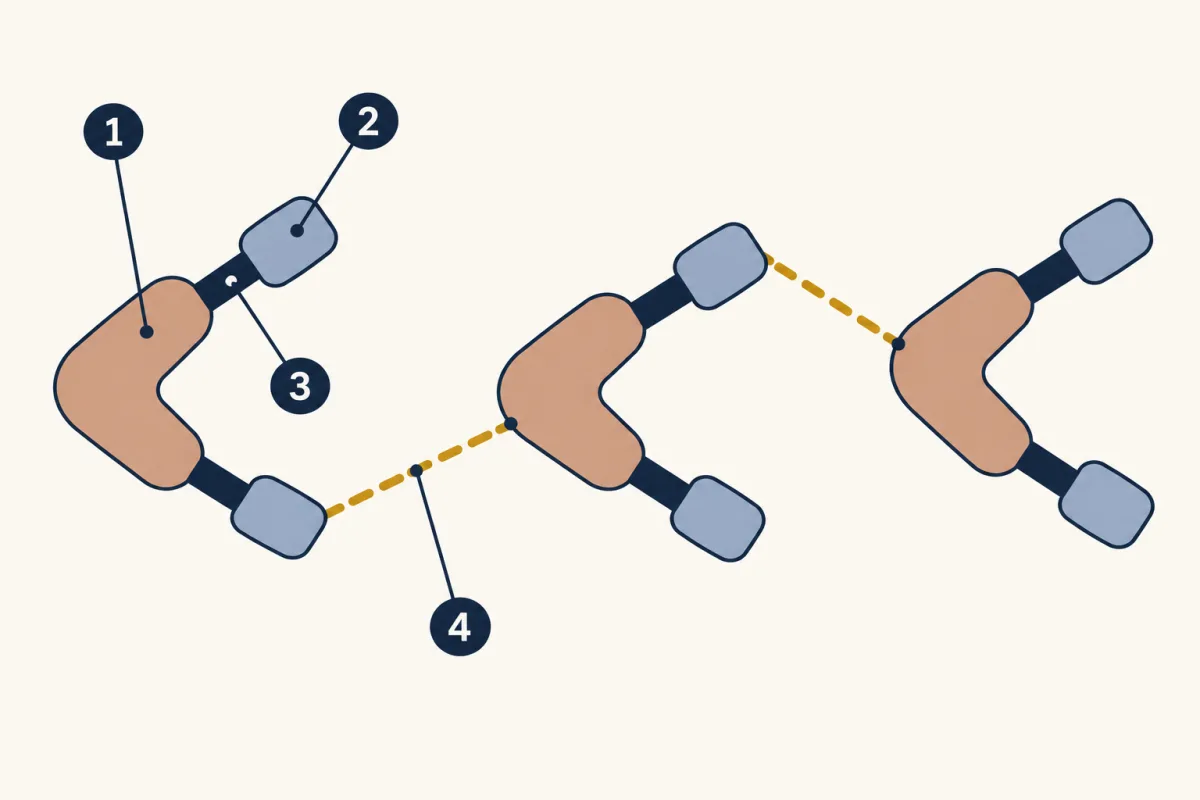
- oxygen end
- hydrogen end
- covalent bond
- hydrogen bond
- oxygen end
- hydrogen end
- blank
- blank
Word bank: covalent bond, hydrogen bond
- blank
- blank
- blank
- blank
Check your labels
- oxygen end
- hydrogen end
- covalent bond
- hydrogen bond
Explain: dissolving, sticking and climbing
Why cells care: dissolved substances meet and react in water, the setting for the chemical reactions of metabolism that keep cells alive.
Water as a solvent
A solvent is a liquid that dissolves other substances. The first film’s salt ions, charged particles, are held by the pull of opposite charges, not by hydrogen bonds. Sugar has no ions, but its molecules carry slightly charged hydrogens and oxygens like water’s, so water hydrogen-bonds to sugar and dissolves it. The film’s oil is nonpolar: its molecules share their electrons about evenly. Water is sometimes called the universal solvent, but it does not dissolve everything.
Cohesion, adhesion and capillary action
Cohesion is the attraction of water molecules to each other; at the surface it gives surface tension, the surface’s resistance to being stretched.
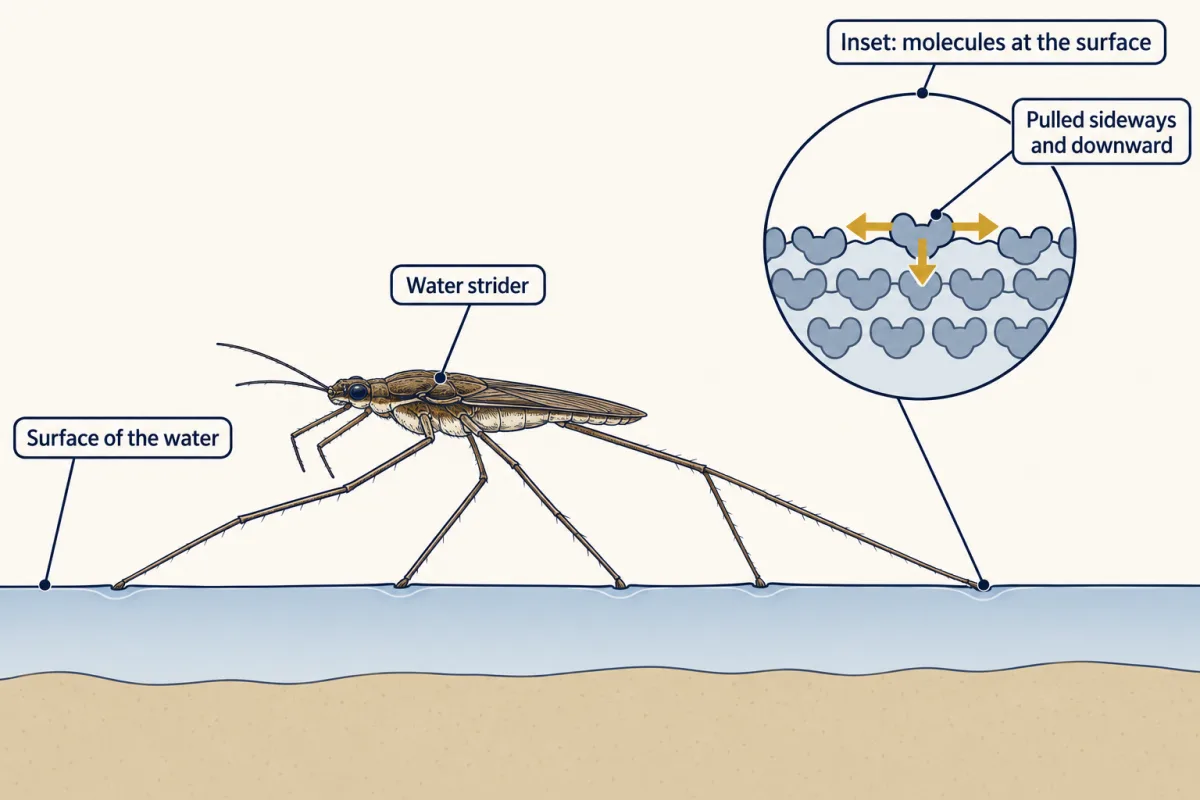
Adhesion is the attraction of water to a different substance. It is strong on polar surfaces such as cellulose, in plant cell walls and paper, and weak on water-repellent ones such as the strider’s leg hairs, where water beads up. When adhesion and cohesion together pull water up a narrow space or a fiber, that is capillary action.
Predict. When water freezes, hydrogen bonds lock each molecule in place. Will ice float or sink in liquid water? Why would a fish in a pond care?
Check your prediction
It floats. In ice, hydrogen bonds hold the molecules in an open pattern, like people holding hands at arm’s length instead of crowding together. The same mass takes up more space, so ice is less dense, with less mass in each cubic centimetre, than liquid water. A frozen pond that is deep enough keeps liquid water underneath, where fish can survive the winter.
| Property | What causes it | Living example |
|---|---|---|
| Solvent | Charged ends surround ions and polar particles | Plants carry dissolved sugar in the sap of their phloem, the sugar-carrying tubes |
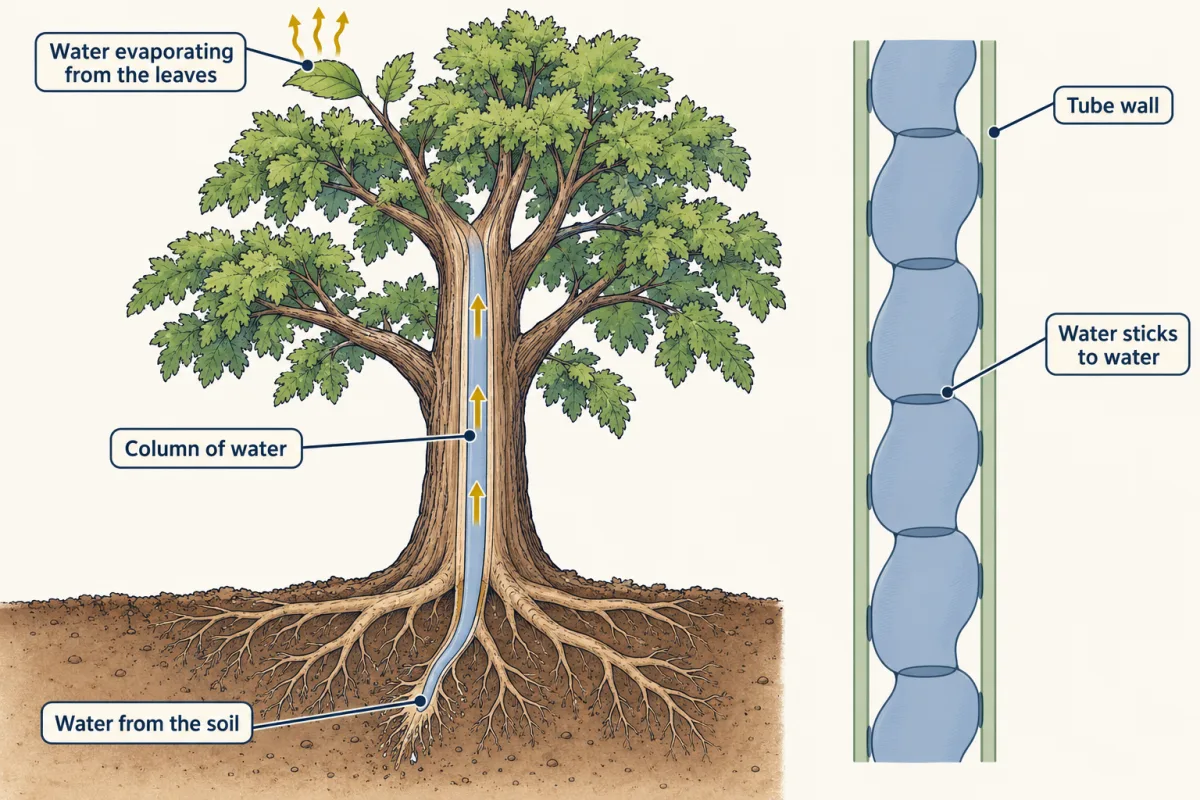
| Cohesion | Hydrogen bonds between water molecules | A column of water holds together inside a plant’s xylem, the tubes that carry water up from the roots |
| Surface tension | Cohesion at the water’s surface | A water strider stands on a pond |
| Adhesion | Attraction of water to other polar materials | Water clings to the cellulose in the walls of plant cells |
In a tall tree, most of the lift comes from water evaporating at the leaves (transpiration), which pulls the column up; cohesion keeps it whole, and adhesion to the tube walls helps hold it in place.
The same hydrogen bonds bear on the buoy’s puzzle: under the same sun, why did the water hardly warm? Watch the second film.
Read the transcript of “Where the Sunshine Goes”
Film transcript: Where the Sunshine Goes
Same sun, same afternoon. Why is the beach sand too hot to stand on, while the water beside it still feels cool? The first film showed water molecules tugging on each other through hydrogen bonds. Now we follow the sunshine's energy into that web. First, what does a thermometer read?
Temperature tracks the average energy of motion of a substance's particles. Faster jiggling means a higher temperature, and slower jiggling means a lower one. Take equal masses of dry sand and water, side by side. Give each exactly the same amount of energy. Then watch where that energy goes. In the sand, the particles vibrate harder, and the pulls between them stretch a little. Its thermometer climbs about ten degrees. In the water, the molecules speed up too. But the web of hydrogen bonds also stretches, bends and rearranges, and that takes extra energy. So each degree costs water more, and its thermometer climbs only about two degrees. This is specific heat, the energy needed to warm one gram by one degree.
Per gram, water needs about five times as much energy as dry sand. Its specific heat is high. Night falls, and both blocks cool. Say each loses energy at the same steady rate. Will the water's temperature fall faster or slower than the sand's? Pause and decide.
Slower. Each degree of cooling must release about five times as much energy from the water. As its hydrogen bonds re-form, they give energy back. So the water stays warm longer, while the sand cools quickly. But a bay is not one gram. Heat capacity is the energy needed to warm a whole object by one degree. For one substance, it is the mass times the specific heat. A cup and a bathtub of water share the same specific heat. Yet the bathtub has far more heat capacity. Under the same heater, it warms far more slowly. Now picture the Bay.
Waves and currents mix the warm surface water downward. So the day's sunshine spreads through a huge mass of water. Some energy also leaves the surface, as water evaporates. So three things keep a bay steady. Each gram is slow to warm, thanks largely to hydrogen bonds. There is a huge mass of mixing water. And evaporation carries some heat away. So fish, crabs and grasses in the Bay face gentler daily swings than the air above them. A buoy in the Bay measured both, and the lesson shows what it recorded.
From the film
- Temperature reflects the average energy of motion of a substance's particles.
- Per gram, water needs about five times as much energy as dry sand to warm by one degree: its specific heat is high.
- Warming water also stretches and rearranges its web of hydrogen bonds, which takes extra energy, so each degree costs water more.
- Heat capacity is mass times specific heat: under the same heater, a bathtub of water warms far more slowly than a cup.
- Each gram of water warms slowly; a whole bay, which also mixes its warmth downward and loses some by evaporation, warms slower still.
Explain: why the Bay barely warmed
The second film defined temperature (the average energy of motion of a substance’s particles), specific heat (the energy to warm one gram by 1 °C: about 4.18 joules per gram per degree for liquid water, about 0.8 for dry sand) and heat capacity (the energy to warm a whole object by 1 °C; for one substance, mass times specific heat). One equation ties them:
heat added (joules) = mass (grams) × specific heat × temperature change (°C)
Read it two ways. Swap the substance: equal energy warms water about one fifth as much as an equal mass of dry sand, as in your simulation. Grow the mass: the same energy in more grams gives a proportionally smaller rise.
Predict. Two ponds of the same area get the same sunshine all day. One is 10 cm deep and one is 2 m deep, and each mixes its warmth through its whole depth. Which warms more, and about how many times more?
Check your prediction
The shallow pond, about twenty times as much: the same energy goes into a twentieth of the mass (10 cm against 200 cm), as long as neither pond loses much heat to the ground or air.
Those conditions matter on the Bay, where the buoy cannot separate the second film’s three causes, so specific heat is a necessary part of the story, not the whole of it. Your body, largely water, is steadied the same way (see Going deeper).
Elaborate: air and water at a Bay buoy
Each row pairs the air temperature a few meters above the water with the water temperature just below the surface, taken at the same moment.
| Local time, July 9, 2025 | Air temperature (°C) | Water temperature (°C) |
|---|---|---|
| 12:00 a.m. | 26.4 | 28.6 |
| 3:00 a.m. | 23.0 | 28.7 |
| 6:00 a.m. | 24.9 | 28.7 |
| 9:00 a.m. | 25.9 | 28.6 |
| 12:00 p.m. | 28.4 | 28.9 |
| 3:00 p.m. | 29.9 | 29.6 |
| 6:00 p.m. | 30.1 | 29.8 |
| 9:00 p.m. | 26.8 | 29.0 |
Source: NOAA National Data Buoy Center, station 44058 (Chesapeake Bay Interpretive Buoy System, Stingray Point, Virginia), 2025 historical standard meteorological archive, every third hour on July 9, 2025, Eastern Daylight Time. The hook’s ranges come from all 190 readings that day, so they differ slightly from the ranges in these eight rows; see Going deeper.
One caution: just after 2 a.m., and again just before 9 p.m., a sudden gust of cooler wind hit the buoy, and the air dropped by 3 to 5 °C within about an hour. So weather, not only the sun, set part of the air’s swing; the water barely changed through both gusts.
- Find the range of the air temperatures in the table (highest minus lowest). Then find the range of the water temperatures. Give units.
- At which times was the air warmer than the water? What was true at every other time?
- How many times larger is the air’s range than the water’s range?
- Your answer to question 3 may sit close to the ratio of water’s specific heat to dry sand’s. Is the air over the Bay like the sand in the simulation? Hint: ask whether the two ratios measure the same thing.
Check your answer to question 4
No. Land, wind and the two gusts helped set the air’s swing, and the water’s steadiness depends on the Bay’s mass, mixing and evaporation too. The ratios measure different things, so their closeness is a coincidence.
Claim, evidence, reasoning
Make a claim that answers the essential question for this Bay habitat: how does water’s heat capacity affect the temperature that living things in the water experience? Use the buoy data.
Start with: At this buoy on this day, the water temperature blank than the air temperature.
Start with: Across the eight readings, the air ranged from blank °C to blank °C, a change of blank °C, while the water ranged from blank °C to blank °C, a change of blank °C.
Start with: Water has a high specific heat because blank, so the same energy from the sun blank. This matters for animals in the Bay because blank.
Compare with a model answer
At Stingray Point on July 9, 2025, the water temperature changed much less than the air temperature. In the eight readings, the air ranged from 23.0 °C to 30.1 °C, a change of 7.1 °C, while the water ranged from 28.6 °C to 29.8 °C, a change of only 1.2 °C. Water has a high specific heat because warming it also stretches and rearranges its web of hydrogen bonds, which takes extra energy, so each gram warms slowly; the Bay also holds a huge mass of water that mixes and loses heat by evaporation, so the day’s sunshine raises its temperature only a little. Fish and crabs in the Bay therefore face steadier daily temperatures than the air around them, at least on a day like this. This is one buoy on one day, and two gusts of cool wind lowered the air temperature, so the data fit the idea but do not prove heat capacity is the only cause.
Saved in this browser only.
Evaluate: check your thinking
Test the guiding idea on what you met: which attraction (water to water, to a polar surface, or to an ion) is at work in the strider, the towel, the salt and the Bay?
Science practices you used: making a prediction before testing, reading a data table and calculating a range, making a claim from evidence, planning a fair test with constants and repeated trials, and naming the limits of a single buoy’s data.
Design problem
A paper towel wicks water upward. Does the width of a strip of paper change how high the water climbs? Plan a fair test you could do with paper, a ruler, a tray of water and a timer.
Saved in this browser only.
One way to do it
- Question and hypothesis: If strips are wider, then water will climb higher in 10 minutes, because the edges of a narrow strip may slow the water more.
- Independent variable: strip width, for example 5, 10 and 20 millimeters.
- Dependent variable: height the water reaches after 10 minutes, measured in millimeters from the water line.
- Constants: paper cut from one sheet, strip length, dipping depth, the water and its temperature, and the timer.
- Comparison: the 5 mm strip is the baseline for the wider strips.
- Repeated trials: test at least five strips of each width and calculate the mean height for each.
- Safety: wipe up spills so no one slips.
A 2020 study did a version of this with laboratory filter paper. It ran five repeats at each of three widths, 5, 10 and 20 mm, and the wider strips showed greater rise in the range tested. A simple formula did not predict every measured height, which is a reminder that paper is more complicated than a model of tiny tubes.
Going deeper
The heat calculation, step by step
Temperature change = heat ÷ (mass × specific heat). For example, 100 grams of water that takes in 836.8 joules warms by 836.8 ÷ (100 × 4.184) = 2 °C. The same energy would warm 100 grams of dry sand by about 10 °C.
Where the energy really goes
The second film’s orange dots are a sketch, not separate packets of energy. In liquid water and solid sand at this lesson’s temperatures, added energy both makes particles move or vibrate faster and changes the energy stored in how they are arranged; in water, rearranging the web of hydrogen bonds is a big part of the high specific heat. The film’s cooling answer assumes both lose energy at the same rate; outdoors, wind, surface area and evaporation set those rates.
Water in your body
Water makes up roughly half of your body’s weight, a bit more or less depending on age and body build. Blood, which is mostly water, carries heat from warm working muscles to cooler parts of the body, and the water in your tissues helps slow changes in your temperature, along with sweating and other ways your body controls it.
How the buoy numbers were gathered
The table shows eight readings, every third hour. The full day had 190 paired readings; across all of them the air ranged by 8.1 °C and the water by 1.4 °C.
Your notes
Select any text in the lesson to highlight it or add a note to it. Your highlights and notes are saved in this browser and collected in your notebook.
This browser is not letting the site save anything (a private window or strict privacy settings), so highlights and notes will be lost when you leave the page.
How we measure it
Temperature logging on a buoy
A buoy anchored in the Bay carries one thermometer in the air above the water and another just under the surface, and it records both on a schedule. Because both readings are taken at the same moment, you can compare how much the air and the water changed over the same hours.
Calorimetry
Calorimetry measures the heat that flows into or out of a substance. Knowing the heat added, the mass and the temperature change lets you calculate a substance's specific heat, which is how water's value of about 4.18 joules per gram per degree Celsius was found.
High-speed video
A camera that takes hundreds of pictures each second slows down a fast motion, such as a water strider jumping. One 2020 study filmed striders at 500 frames per second to see how their legs pushed on the water surface.
Where this lesson fits
After thisStudy next
- What Am I Made Of?This course · Lesson 2
Polarity and water's pull on polar molecules explain how small building blocks join and how big molecules behave in water.
- Crossing the MembraneThis course · Lesson 8
Water as a solvent and its pull on polar and charged particles explain why osmosis and membrane crossing work as they do.
Suggested by an AI model from the lessons themselves, then checked. How we use AI
Finish line
Test yourself
8 questions
Practice and MCAT-style, with explained answers.
Next · Lesson 2
What Am I Made Of?
How can a turkey sandwich on whole-wheat bread end up as part of your own body?
Continue →