Organismal Biology · Unit 1: Organisms and their diversity
What an Organism Has to Do
Rewritten on : new text, flashcards and film. Your notes and highlights stay, but the text around them may have moved.
A barley leaf cannot take in carbon dioxide without letting water out of the same pores. How much water does each bite of carbon cost, and can a plant pay less?
Pause when the reading reaches a film, and offer to play it. Saved on this device.
Watch the film now, or keep listening
Builds on:Crossing the MembraneCapturing SunlightVariation and SurvivalWhy these?
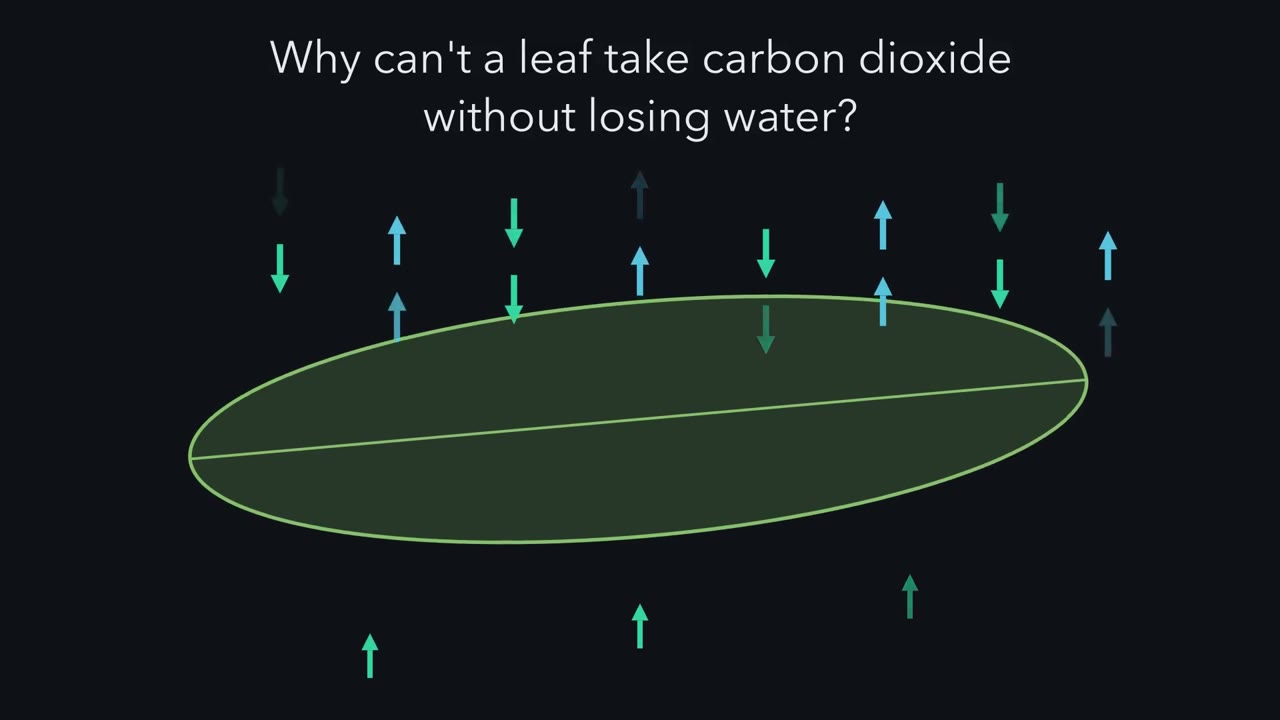 ▶ Watch The Price of a Breath · 3:23
Read the transcript of “The Price of a Breath”
Film transcript: The Price of a Breath
Why can't a leaf take carbon dioxide from the air without losing water? Taking something in often carries a cost somewhere else. A leaf makes that cost easy to see. Every multicellular organism faces the same five problems. Get energy and materials. Exchange and move them, wastes included. Keep its inside relatively stable.
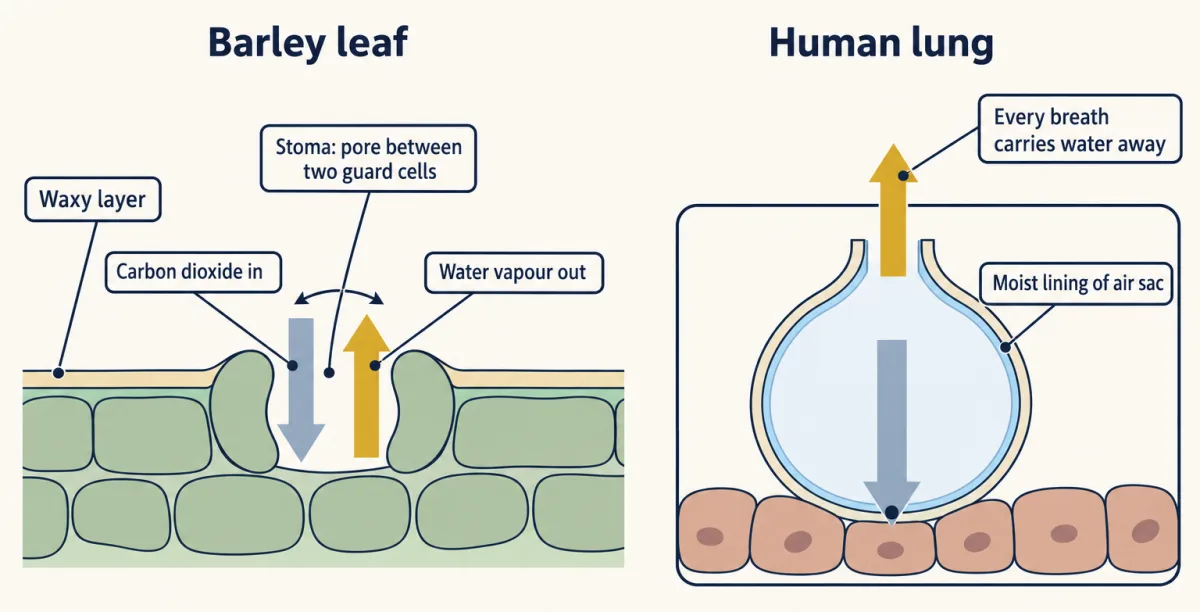
Resist damage and invasion. Leave descendants. Barley, honeybee or human, each body solves all five. Many solutions carry a cost, paid somewhere else. The exchange problem shows that cost most clearly. Zoom into a barley leaf. A waxy layer covers the surface, and water crosses it poorly. So gas moves mainly through pores called stomata. Two guard cells flank each pore and open or close the gap.
Inside the leaf, cell walls line air spaces, and those walls are wet. Carbon dioxide must dissolve in that water film to reach the cells. But a wet surface open to air loses water. So water vapour leaves through the same pore that lets carbon dioxide in. Both gases take one path. What, then, sets the price, the water lost for each carbon gained? Look at two gaps across the pore. First, the carbon dioxide gap. Carbon dioxide is a tiny share of air, and the leaf draws it down only part of the way. Now the water gap. Air inside a leaf is saturated with water vapour, while outside air is drier. That gap is far bigger. So the leaf pays hundreds of water molecules for each carbon dioxide.
Now let the guard cells narrow the pore, with both gaps held fixed. Both streams shrink together. The pores set how fast gas moves. The two gaps set the price. Your lung also moves a gas across a wet surface. It takes in oxygen. Will it pay more water for each molecule of gas, or less?
Far less. Oxygen is plentiful in air, so each breath can hand over a lot of it. The breath out carries away about as much water vapour. So the lung pays about one water molecule for each oxygen. But the lung cannot close the way a stoma can. It sits sheltered deep in the chest. In ordinary unsaturated air, narrowing or sheltering a path can cut the water cost. But while gas keeps flowing in, some water still leaves. Back to the checklist. For every row, ask what a solution costs, and where that cost is paid. Then ask how you would test it.
From the film
- Every multicellular organism faces five problems: energy and materials, exchange and transport, a stable inside, defense, and reproduction.
- A leaf takes in carbon dioxide and loses water vapour through the same pores, the stomata.
- As a first approximation for a leaf in air not saturated with water vapour, the pores set how fast gas moves; the two concentration gaps across them set the price, water lost per carbon dioxide gained.
- A leaf pays hundreds of water molecules for each carbon dioxide; a lung pays about one for each oxygen, because each breath gives up about as much water vapour as the oxygen it takes in.
- Stomata can close; the lung, sheltered in the chest, cannot.
To grow, a barley leaf must take in carbon dioxide, and the main way in is through tiny pores that also let water vapour out. How much water does each bite of carbon cost, and can a plant pay less?
The one idea. A leaf’s carbon dioxide comes in, and its water vapour goes out, through the same pores. The price, water lost per carbon dioxide gained, is set by the two concentration gaps across the pores; each gap is the difference between the air inside the leaf and the air outside. The pores set how fast gas moves; fewer or narrower pores change the price only by changing a gap, and cannot make it zero.
Scope: a first approximation for a leaf in air not saturated with water vapour, with the pores as the main path (Going deeper lists what it leaves out). A lung also pays water for oxygen, but breathing sets its price. This is the course’s first example of a solution paid for somewhere else; for any other solution, find and test the cost rather than assume it.
Five problems, one checklist for the course
A multicellular organism, a body of many cells that depend on one another, faces five problems. The first film named them; this course uses them as a checklist for every organ system. The list is a teaching frame; other books divide the ground differently.
- Energy and materials. All organisms use an energy source to run their chemistry; animals get theirs from food they ingest or absorb. Plants capture light energy in their leaves and use it to fix carbon from the air; splitting water along the way gives off oxygen as a by-product (the light reactions, the Calvin cycle). The roots of seed plants absorb water and minerals from the soil.
- Exchange and transport, including wastes. Materials must cross a surface and reach every cell, and wastes must leave. Diffusion, the net movement of molecules from higher to lower concentration, can do much of this in a small organism. In a large one, transport systems carry the load: blood vessels in animals; in plants the xylem, which carries water and minerals up from the roots, and the phloem, which carries sugars from where they are made to where they are used (size, scale and surface, gas exchange, moving water and sugar in plants).
- Control and relative internal stability. Homeostasis is the maintenance of a relatively stable internal environment. Adult humans hold their core temperature near 37 degrees C; a plant closes its leaf pores when its leaves run short of water (tissues, organs and homeostasis).
- Defense. Animals have skin, mucus and immune cells (innate immunity); in the small plant Arabidopsis, closing the stomata can be part of the defense against bacteria that enter through those pores.
- Reproduction, as continuation of a lineage. Reproduction passes DNA, and the genes it carries, to offspring. It is a problem for the lineage, a line of ancestors and descendants, not for every individual: honeybee workers rarely reproduce while a queen is present, yet the colony goes on producing queens and males (more in Going deeper).
Where the price comes from: one leaf, one lung
The first film showed a barley (Hordeum vulgare) leaf passing carbon dioxide in and water vapour out through its stomata (singular stoma), the pores between pairs of guard cells; that water loss is transpiration, water evaporating from the wet cell walls inside. Here is the arithmetic the film left out.
The leaf. Both gases take the same path, so one stomatal conductance, how freely gas passes through the stomata (measured for carbon dioxide), sets both flows:
carbon in = conductance × carbon dioxide gap
water out = 1.6 × conductance × water vapour gap
Water vapour, a lighter molecule, diffuses about 1.6 times faster than carbon dioxide. Divide the second line by the first and the conductance cancels:
water lost per carbon gained = 1.6 × water vapour gap / carbon dioxide gap
In moderately dry air, with carbon dioxide scarce and the air inside the leaf close to saturated, the water gap is about a hundred times the carbon dioxide gap, so the leaf pays about 1.6 × 100 = 160 water molecules per carbon dioxide, roughly 150 to 300 as the carbon dioxide inside the leaf runs a little higher or lower. Humid air shrinks the water gap and the price; hot, dry air raises both.
The lung. Breathing moves air in bulk, and the airways wet incoming air and recover some water on the way out, so the two-gap rule does not apply; work from one breath. Air breathed in at about 21% oxygen leaves at about 16%: about 5% of its volume is taken up as oxygen. Room air at 20 degrees C and half humidity holds about 1% water vapour; the breath out, nearly saturated near body temperature, holds about 4 to 5% more. So the lung pays about one water molecule per oxygen, a rough size that breathing rate, oxygen extraction and the air’s temperature and humidity move (cold, dry air raises it).
Worked problem: what a leaf pays
water-use efficiency = carbon gained / water lost, the price turned upside down
These numbers are illustrative, not barley data. Leaf A assimilates (takes up and fixes) 20 umol CO2 per m2 per s and transpires 5 mmol H2O per m2 per s. Leaf B, with fewer stomata under the same light and temperature, assimilates 16 umol CO2 per m2 per s while transpiring 3 mmol H2O per m2 per s. Assume both rates stay constant.
- Efficiency. Leaf A: 20 / 5 = 4.0 umol CO2 per mmol H2O. Leaf B: 16 / 3 = 5.3 umol CO2 per mmol H2O.
- Read it as molecules. A mmol is 1,000 umol, so 4.0 umol per mmol means 4 carbon dioxide for every 1,000 water molecules: one for every 1,000 / 4 = 250. Leaf B pays 1,000 / 5.33, about 190.
- Compare. Leaf B gains 16 / 20 = 0.8 of A’s carbon, 20% less. It loses 3 / 5 = 0.6 of A’s water, 40% less. Its efficiency is 5.33 / 4.0 = 1.33 times A’s.
Predict. Leaf B’s water loss fell twice as far as its carbon gain. The pores set how fast gas moves; the gaps set the price. So how can fewer pores lower the price?
Check your prediction
Through a gap. With fewer open pores, carbon dioxide arrives more slowly while the cells go on fixing it, so its concentration inside the leaf falls and the carbon dioxide gap widens, propping up carbon gain while water loss falls with conductance. One caution for a real leaf: with less water evaporating it can run warmer, depending on sun and wind, which would widen the water gap and give back part of the saving.
Neither leaf is better everywhere: when water is scarce, leaf B keeps more of it per unit of carbon gained; when water is plentiful and carbon limits growth, leaf A gains more.
Bar scales: carbon gained 0 to 20 umol CO2 per m2 per s; water lost 0 to 5 mmol H2O per m2 per s; efficiency 0 to 20 umol CO2 per mmol H2O. Arrow widths follow the rates (schematic). The outline marks the bar the chosen condition is about, on the leaf that is ahead; none if tied.
In this sketch: illustrative numbers, not barley data; constant rates; same light and temperature for both leaves; 18 g of water per mol.
Water-use efficiency = carbon gained / water lost. In the lesson’s example neither leaf is better everywhere; which is better depends on whether water is scarce or carbon limits growth.
Leaf B was made up. Can a real crop be built with fewer pores without paying in grain? The second film follows the experiment.
Read the transcript of “Fewer Pores”
Film transcript: Fewer Pores
If you remove most of a barley leaf's pores, does the plant go hungry? Or can it save water and still fill its grain? On paper, a leaf with fewer pores can pay less water for its carbon. A real experiment tested what fewer pores do to a crop. Julie Gray's team, with Hughes as first author, worked in barley. They made plants overexpress a barley gene, HvEPF1. That means making extra of the gene's product. This gene limits leaf cells from entering stomatal development and moving through it. So extra product should mean fewer stomata. They compared these plants with empty-vector controls. Leaf surface impressions told the story. Two engineered lines kept only about a quarter and an eighth of the controls' stomata.
Why the controls, and why two lines? The procedure itself might change a leaf. And the inserted gene lands somewhere in the genome. Two independent lines make a landing-spot effect less likely. Next, a leaf was clamped in a small chamber that measures gas exchange. In well-watered plants, leaves with fewer stomata exchanged much less gas with the air. Gas exchange fell steeply. So what happened to the carbon taken in, and to the grain? Did they fall just as steeply?
In general, if fewer pores slow gas flow while photosynthesis continues, carbon dioxide inside the leaf falls. Its gap widens, and that props up carbon gain. So a leaf can save more water than it loses carbon. In this study, one efficiency measure rose in both lines under water restriction. The measures did not all agree. the grain? In a greenhouse trial, neither line showed a statistically significant drop in yield, well watered or water restricted. No drop was detected. But each group held only five plants. A small loss could still hide below what the trial could see. No drop detected is not proof of equal yield. So what kind of answer is this?
It shows how one gene limits stomata, and what fewer stomata do to gas, water and grain. It says nothing about why wild barley evolved its stomatal density. That second question is about lineages and their history, not one plant. Answering it needs different evidence, and it is where the lesson goes next.
From the film
- Barley made to overexpress HvEPF1 formed far fewer stomata: two lines had about a quarter and an eighth of the control density.
- Well-watered plants with fewer stomata exchanged much less gas with the air.
- With fewer pores, a leaf can save more water than it loses carbon, so carbon gained per water lost can rise.
- In a small greenhouse trial, no drop in grain yield was detected, which is not proof that yields were equal.
- The experiment shows how HvEPF1 limits stomata and what fewer stomata do, not why wild barley evolved its stomatal density.
A test in barley: what the film left out
The second film showed barley that overexpresses HvEPF1 (makes extra of its product): far fewer stomata, much less gas exchange, no grain loss detected. It left out three things.
- Which efficiency. Leaf A and leaf B used assimilation divided by transpiration; the study’s measures, and where they disagreed, are in Going deeper.
- A drought test. In a separate test where water was withheld, the engineered lines kept photosystem II, part of the light-capturing machinery, working about four days longer than controls.
- Not the field. None of these tests was run in a field.
Why structure fits function, and why never perfectly
Structures usually fit what they do because of history, not intention. Individuals differ, some differences are inherited, and some inherited differences change how many offspring an individual leaves; over generations, those variants can become more common. That process is natural selection, and a heritable trait it shaped because it helped survival and reproduction is an adaptation. A trait can also be useful now without having been selected for that use; such a co-opted trait is sometimes called an exaptation.
So an evolutionary claim about stomata has this shape: “in dry places, barley lineages with fewer stomata lost less water and left more descendants.” The shorthand “barley has fewer stomata to save water” skips that history and can read as if the plant had a goal.
Predict. Suppose a single barley plant whose soil dries out makes fewer stomata on its new leaves. Is that plant evolving?
Check your prediction
No. One plant changing its leaves within its own lifetime is a developmental response, a proximate question for the last section; populations evolve across generations. Testing an evolutionary claim is the subject of testing evolutionary explanations and selection in ecological context.
The fit is never perfect, for at least three reasons.
Trade-offs. A trade-off is a link between two traits such that improving one worsens the other. More stomata raise a leaf’s capacity to take in carbon and also to lose water, though actual rates depend on stomatal size, how wide the pores open and the conditions. Water loss is not only a cost: the flow of water through the plant helps carry minerals up from the roots and cools the leaf. Lifetime trade-offs, such as reproducing early against growing larger, appear in life histories.
History. The human arm, the bat wing and the whale flipper share one pattern: an upper arm bone, two forearm bones, wrist bones and digits. They are homologous, inherited from a common ancestor and modified in each lineage (reading phylogenetic trees). Selection on a whale’s ancestors could reshape those bones, but it began from them. Evolution does not move a population toward a preconceived ideal.
Chance and by-products. Not all evolutionary change is adaptive. Some traits spread by chance, especially in small populations, and some are by-products of other features, not selected for themselves. Gould and Lewontin called such by-products spandrels, after the leftover spaces between a Venetian cathedral’s arches, later decorated but not built for decoration.
So “perfectly adapted” is never the right phrase. No living organism is “more evolved” than another, either: a honeybee and a human have both had the same length of time since their common ancestor, and each lineage has its own solutions to the same five problems.
How questions and why questions
“Why does a barley leaf have the stomatal density it has?” can mean two different things. In 1961 Ernst Mayr distinguished proximate causes, which act within an organism’s lifetime, from ultimate causes, which lie in the lineage’s evolutionary history. “Ultimate” does not mean purpose: an ultimate answer is a history of what happened to a lineage, such as which variants left more descendants. In 1963 Niko Tinbergen set out four questions, and biologists now usually group them two to each kind:
| Kind | Question | Barley stomata |
|---|---|---|
| Proximate | Mechanism: how does it work now? | How guard cells open and close the pore |
| Proximate | Development: how does it form? | How genes such as HvEPF1 set how many stomata a leaf makes |
| Ultimate | Adaptive significance: what effect on survival and reproduction? | Whether density changes reproductive success in a given field environment |
| Ultimate | History: how did it change over the lineage? | How stomatal density changed across grasses on a tree |
The barley experiment answers proximate questions in engineered lines: the development row, and what fewer stomata do to gas exchange, water use and grain. It does not test how guard cells open and close. A full account needs both kinds of answer.
Design problem
Guppies (Poecilia reticulata) in Trinidad streams live with many predators below some waterfalls and few above them. Reznick, Shaw, Rodd and Shaw (Science, 1997) reported on fish moved from high-predation sites into low-predation streams above waterfalls. At one site, El Cedro, males from the introduced population matured later than males from the source population within about four years. How would you show that this difference is inherited rather than a direct effect of food or water, and is that a proximate or an ultimate question?
Saved in this browser only.
One way to do it
Collect fish from the introduced population and, at the same time, from the source population as a control, and rear their descendants side by side in one laboratory environment (a common-environment, or common-garden, design), with the same food, temperature and density, for at least two generations; the study used second-generation laboratory fish. Two generations dilute effects passed on through the mother’s condition. In that assay the adjusted mean male maturation ages were 60.6 days for source fish and 72.7 days for introduced fish; measured female traits had not changed significantly at four years (by 7.5 years females were larger at first birth and tended to be older, a difference that fell just short of significance).
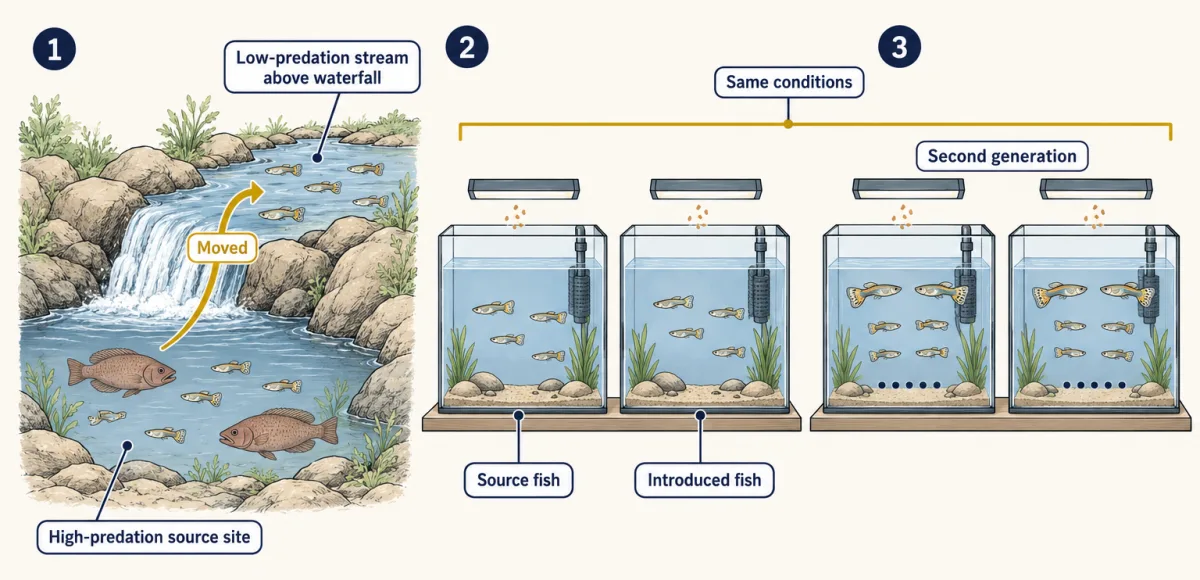
An inherited, probably genetic, basis still does not show what caused the change. Moving fish above a waterfall may change density and food as well as predation, so to link the change to predation, compare several high- and low-predation streams and measure density and food at each.
Why later maturation spread where predators are few is an ultimate question, about adaptive significance and history; how a guppy’s body times its maturation is a separate, proximate one.
Going deeper
Reproduction without every individual reproducing
In many eusocial species (animals that live in colonies with a division of reproductive labour) the workers reproduce little or not at all. A worker that does not reproduce still passes on copies of its genes indirectly, by helping raise close relatives.
The barley test: lines, watering levels and efficiency measures
In the mature sixth leaf, the two lines kept about 24% and 12% of the control stomatal density. In making them, the team inserted the barley gene HvEPF1 behind a promoter, a DNA switch, that keeps it turned on.
In a greenhouse, plants were grown at 60% or 25% on the authors’ calibrated soil-water scale. Under water restriction, carbon assimilation and stomatal conductance did not differ significantly from controls. Water-use efficiency integrated over the life of the flag leaf (the uppermost leaf, just below the grain head), estimated from carbon isotopes in the leaf, rose in both lines under water restriction and in one line when well watered. The intrinsic efficiency measure from gas exchange, assimilation divided by stomatal conductance, rose in one line when well watered but in neither line under water restriction; the measures are not interchangeable.
What the gap rule leaves out
The two flow equations hold at steady state when the pores are the main resistance: the still layer of air over the leaf (its boundary layer) is thin, water lost through the waxy layer is small, and the air inside the leaf is treated as saturated. Otherwise the boundary layer, the waxy layer, leaf temperature and photosynthesis itself also shift the ratio; in saturated air the water gap, and the price, fall to about zero, and with the stomata shut both flows fall toward zero.
Worked problem: a 10-hour day
Over a 10-hour day (36,000 s), Leaf A loses 5 mmol x 36,000 = 180,000 mmol = 180 mol H2O per m2, or 180 x 18 g per mol = 3,240 g, about 3.24 kg. Leaf B loses 3 x 36,000 = 108 mol, or 1,944 g, about 1.94 kg.
Your notes
Select any text in the lesson to highlight it or add a note to it. Your highlights and notes are saved in this browser and collected in your notebook.
This browser is not letting the site save anything (a private window or strict privacy settings), so highlights and notes will be lost when you leave the page.
How we measure it
Gene overexpression with an empty-vector control
Insert a gene into a plant behind a promoter that keeps it turned on, so that its product is made in larger amounts than usual, and compare those plants with controls that went through the same procedure with the same vector minus the gene being tested. The control accounts for the vector and the transformation process. Two or more independent lines, and a check that the gene really is overexpressed, make it more likely that a difference comes from the gene and not from where it landed in the genome.
Epidermal impressions and light microscopy
Take an impression of a leaf surface (Hughes and colleagues pressed dental resin on the leaf, then painted clear nail varnish on the resin), peel off the varnish copy, and count the imprinted stomata in a known area under a light microscope. It gives stomatal density per square millimetre without destroying the plant.
Infrared gas analysis
Clamp an attached leaf in a small chamber and measure how much carbon dioxide and water vapour the air gains or loses as it flows past. From these you calculate the leaf's carbon assimilation, its transpiration and its stomatal conductance.
Common-environment rearing
Raise the descendants of two wild populations side by side under the same conditions, ideally for more than one generation. A difference that persists is likely to be inherited, because the environments that might have caused it directly are now the same.
Practice questions on this lesson (3) → MCAT-style, original, each with an explanation
Where this lesson fits
Before thisReview first
- Crossing the MembraneBiology · High school
You need diffusion down a concentration gap from there to follow how the leaf's two gaps set the price.
- Capturing SunlightBiology · High school
The leaf's need to take in carbon dioxide for sugar-making comes from the carbon fixation taught there.
- Variation and SurvivalBiology · High school
The section on why structure fits function uses heritable variation and differing survival, which that lesson teaches.
After thisStudy next
- Moving Water and Sugar in PlantsThis course · Lesson 23
It follows the water a leaf loses through its pores back down to the roots and soil.
- Gas Exchange and BreathingThis course · Lesson 12
It works out the price of breathing for lungs and gills, which this lesson only sketches for one lung.
- How to Test an Evolutionary ExplanationOne level up · Ecology and Evolution
It takes further the split between how and why questions, showing how to test an adaptive explanation.
Suggested by an AI model from the lessons themselves, then checked. How we use AI
Finish line
Test yourself
9 questions
Practice and MCAT-style, with explained answers.
Next · Lesson 2
Size, Scale and Surface
A flatworm has no lungs and no heart. Why can't a mouse manage the same way?
Continue →