Physiology · Unit 1: The internal environment and its control
Body Water and Its Compartments
Rewritten on : new text, figures and flashcards. Your notes and highlights stay, but the text around them may have moved.
In the textbook model, retain a litre of solute-free water and about two-thirds ends up inside your cells; retain a litre of isotonic saline and none does. Why, and what does the first do to plasma sodium?
Pause when the reading reaches a film, and offer to play it. Saved on this device.
Watch the film now, or keep listening
Builds on:Osmoregulation and Nitrogenous WasteCrossing the MembraneTissues, Organs and HomeostasisWhy these?
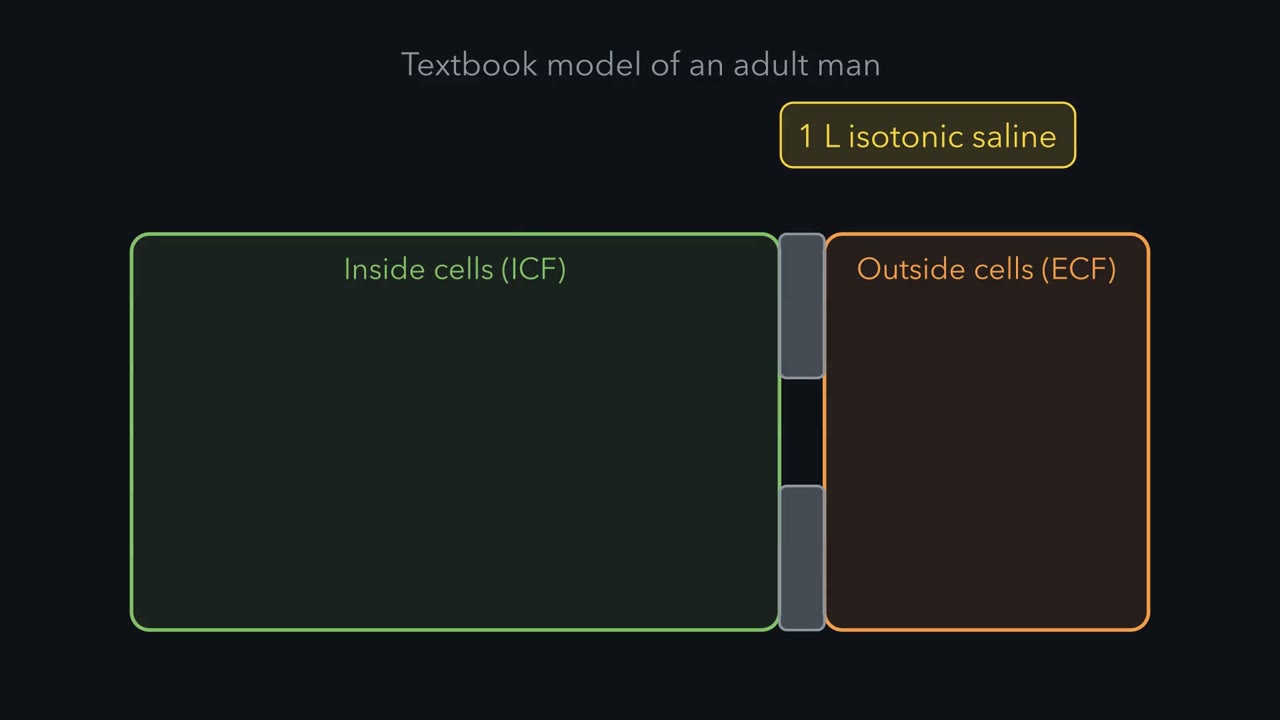 ▶ Watch Water Goes Where the Solute Stays · 2:59
Read the transcript of “Water Goes Where the Solute Stays”
Film transcript: Water Goes Where the Solute Stays
Here is a puzzle. In the textbook model of an adult man, retain one litre of pure water, with no solute in it. About two thirds of that litre ends up inside cells. Now retain one litre of isotonic saline instead. Once it has spread, none of it ends up inside cells. Same body, same volume. Why does the water go to different places? First, the tanks. Physiology texts use a 70 kilogram reference man, whose body is 60 % water. That is a convention for arithmetic, not a measurement of anyone. Total body water is about 42 litres. About two thirds of it, 28 litres, is intracellular fluid, the water inside cells. About one third, 14 litres, is extracellular fluid, the water outside them.
Water crosses most cell membranes quickly. So picture two rooms joined by a door that only water can pass. The guests stuck in each room decide how much water it holds. Inside cells, the stuck guests are anions that cannot leave, and the potassium that balances their charge. Outside, they are sodium, with chloride and bicarbonate. Sodium leaks into cells, but the sodium-potassium pump moves it back out. So sodium salts are the effective solute of the extracellular fluid. Now count the guests. In the model, both rooms sit at 300 milliosmoles per kilogram. These numbers are made up, and rounded. Measured adult values run a little lower. 28 litres of cells hold 8,400 milliosmoles.
14 litres of extracellular fluid hold 4,200 mOsm. The model is a closed body, with no urine, sweat or breath losses, and added sodium chloride stays outside cells. Retain 1 litre of isotonic saline. Its particles stay outside, so the concentration does not change. Cells stay at 28 litres. Extracellular fluid grows to 15. Now retain 1 litre of solute-free water. In the model, it first sits outside cells, so extracellular fluid also reads 15. Then water crosses until both rooms match. They end at about 293 milliosmoles per kilogram. Cells gain two thirds of a litre. Extracellular fluid gains one third. The rule to keep: water follows effective solute.
Each compartment holds water in proportion to its effective osmoles. In the model, retained saline stays in the extracellular fluid, because its sodium stays outside. Retained pure water is shared, two thirds to cells. This is equilibrium arithmetic. It predicts where a retained load goes, not how long it stays.
Two men each retain one litre. One keeps a litre of solute-free water, with no dissolved particles at all; the other a litre of isotonic saline, salt water with about the same particle concentration as body fluid. Same body, same volume, yet in the textbook model of an adult man the two litres end up in very different places.
To retain a load means to keep it in the body rather than excrete it.
Predict. Where does each litre go: into cells, outside cells, or some to each? And which one dilutes the sodium in plasma?
Check your prediction
About two-thirds of the water ends up inside cells and one-third outside. Once the saline has spread, none of it is inside cells. The water dilutes plasma sodium, even though the body has lost no sodium.
The difference is the solute, not the volume: water crosses cell membranes freely and settles wherever the solute that cannot cross is. The same rule explains why a low plasma sodium does not by itself show how much sodium the body holds.
Where the water is
Physiology texts use a 70-kg reference man whose body is 60 percent water: total body water (TBW) of about 42 L. That is a convention for arithmetic, not a measurement of anyone. It divides like this:
- Intracellular fluid (ICF), the water inside cells: about two-thirds of TBW, 28 L.
- Extracellular fluid (ECF), all the water outside cells: about one-third of TBW, 14 L. This is Claude Bernard’s internal environment (tissues and homeostasis). About three-quarters of it is interstitial fluid (ISF), the fluid that bathes cells (10.5 L), and one-quarter is plasma, the fluid part of blood (3.5 L).
These are fractions of water, not of body mass: two-thirds of 70 kg would be 47 L, more than all the body’s water. Transcellular fluid (cerebrospinal, synovial and pleural fluid) is usually counted with the ECF. The 3.5 L of plasma is a convention too; many measured adult plasma volumes are lower, so do not derive a blood volume from it (blood cells and hemostasis).
People differ, mostly because of fat: lean tissue is roughly 73 percent water and adipose tissue far less, so more fat means a lower water fraction. Infants are about 75 percent water by one textbook estimate, and the fraction can fall to about 45 percent in old age. The Institute of Medicine’s 2005 water report, citing earlier measurements, gives young-adult averages of about 59 percent for men and 50 percent for women, who carry more fat on average, with wide individual ranges. Treat 60 percent as the middle of a range.
Two barriers
Two different walls separate the three spaces, and most mistakes about fluid shifts come from mixing them up.
- The cell membrane separates ICF from ECF. Water crosses most cell membranes quickly (membrane transport); sodium, potassium and the cell’s large anions do not cross freely.
- The capillary wall separates plasma from ISF. Across most capillaries outside the brain, small solutes cross freely and do not divide plasma from ISF; the blood-brain barrier is an exception. Plasma proteins, mainly albumin, cross slowly and exert a colloid osmotic (oncotic) pressure that holds fluid in the vessels against capillary blood pressure. Starling’s 1896 balance of these forces is in blood and vessels; the revised view, with the glycocalyx and slight net filtration in most tissues, is in capillary exchange and lymph.
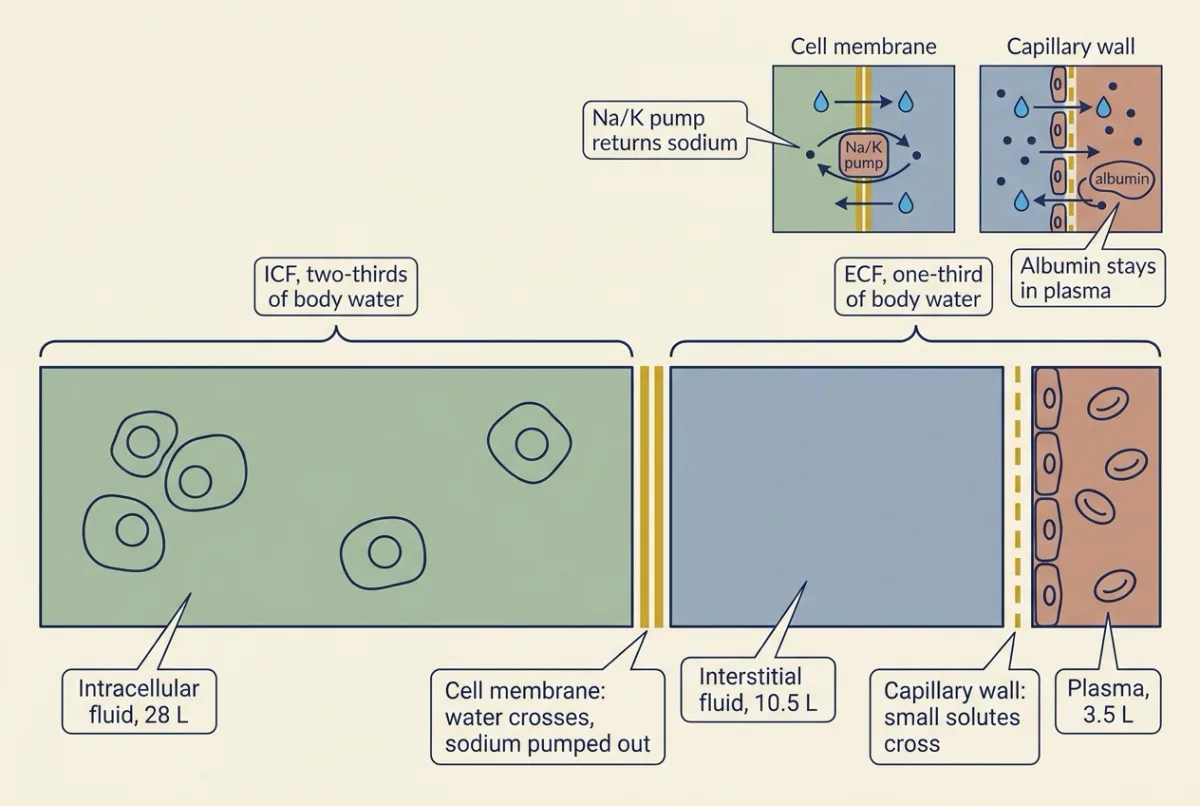
So the cell membrane divides water by small solutes such as sodium salts, and the capillary wall by protein.
Why water follows effective solute
Picture two rooms joined by a door. Water passes through it freely; the guests in each room are stuck there. Water moves through the door toward the more crowded room, and stops when every litre on both sides holds the same number of guests.
Inside cells, the stuck guests are anions that cannot leave (proteins, nucleotides, organic phosphates) and the potassium that balances their charge. Outside, they are sodium with chloride and bicarbonate. Sodium leaks in, but the sodium-potassium pump moves it back out, so it behaves as if it could not enter: sodium salts are the ECF’s effective solute. Potassium leaks out through potassium channels, but the same pump brings it back in, so in effect it stays put too.
Add guests to one room and water follows them in. Add water alone and it spreads until the crowding is equal again, in proportion to the water already in each room. Those two cases are the whole idea:
The one idea to carry through this lesson. Water crosses cell membranes until every litre of body water holds the same concentration of effective solute, so each compartment holds water in proportion to the effective osmoles trapped in it: the osmoles that cannot cross its boundary. To predict a gain or loss of water and sodium salts, split it into two parts. The isotonic part stays where its solute stays: for sodium salts, outside cells. The free-water part, gained or lost, is then shared by all body water in proportion to the volumes once the isotonic part is in place: for a small load in the reference man, about two-thirds by cells.
The rule has a scope:
- A closed body, end state only. Nothing leaves in urine, sweat or breath. The rule says where a load goes, not how long it stays; the kidney sets that (“The kidney adds a clock”).
- Cells neither gain nor lose solute. That is a fair approximation over minutes, although many cells start adjusting their solute within minutes. Brain cells shed solute over hours to days in sustained low sodium, and cells that lose potassium change the answer; the plasma-sodium section uses this on purpose.
- “Effective” depends on the barrier and the time. Sodium salts are effective at the cell membrane because the pump returns sodium; urea is not. Glucose counts for cells that take it up slowly. At the capillary wall small solutes are not effective at all, so this rule does not split extracellular fluid (ECF) into plasma and interstitial fluid (ISF). That split needs Starling forces or the reference 1:3 fractions.
- “Two-thirds” is not a constant of the body. It is the cells’ share of body water at that moment, 28 of 42 parts in the reference man. In a person whose ECF is expanded (edema) or whose cell mass is small, the share differs.
The film at the top of the page says “two-thirds to cells” and asks you to picture a door only water can pass. Read both as statements about the reference man.
Osmolality counts particles; tonicity counts the ones that stay on one side
Osmoregulation defined osmolality: osmoles of dissolved particles per kilogram of water. Adult plasma osmolality is typically about 275 to 295 mOsm per kg. Osmolarity is the same count per litre of solution.
Not every particle holds water on one side. Two examples:
- A red cell in urea. Put a red cell in a urea solution with the same osmolality as plasma. Urea crosses the cell membrane, so it moves into the cell and water follows. The cell swells, although the solution was isosmotic.
- A bag of 5% dextrose. It holds 50 g of dextrose per litre. Dextrose is glucose supplied as the monohydrate (molar mass about 198), so the label gives about 252 mOsm per L (50 ÷ 198), a little below plasma. But once the body takes up and uses the glucose, what is left behaves as solute-free water.
Tonicity, or effective osmolality, counts only solutes that cannot cross the membrane in question over the time considered, because only those hold water on one side. Urea raises osmolality but not tonicity.
Where does the litre go? Three trials
Use the reference man in the model, with made-up, rounded numbers: Intracellular fluid (ICF) 28 L and extracellular fluid (ECF) 14 L, both at 300 mOsm per kg (measured adult values are about 275 to 295). The rule’s scope applies, and added sodium chloride stays outside cells. Assume ideal behaviour and take 1 kg of water as 1 L.
The method has three moves, the guiding idea written as arithmetic.
- Count the stuck guests. Osmoles = volume × osmolality. Cells hold 28 × 300 = 8,400 mOsm. The ECF holds 14 × 300 = 4,200 mOsm. Together, 12,600.
- Share them over all the water. Water moves until both rooms are equally crowded, so the body ends at one osmolality, C: all the effective osmoles divided by all the water.
- Give each room its water back. Each compartment’s volume is its own osmoles divided by C. Cells still hold their 8,400 mOsm, so ICF = 8,400 / C. The ECF gets the rest.
Trial A: 1 L of isotonic saline. It adds 300 mOsm and 1 L, all outside cells. C = 12,900 / 43 = 300, unchanged. ICF = 8,400 / 300 = 28 L, unchanged. The ECF holds the whole litre and becomes 15 L. Nothing made the rooms unequally crowded, so no water crossed a cell membrane.
Trial B: 1 L of solute-free water (the model for 5% dextrose once its glucose has been taken up and used). Follow it in two stages. First it lands outside cells: the ECF reads 15 L, and its 4,200 mOsm are now spread over 15 L, about 280 per litre. Cells, still at 300, are the more crowded room, so water moves in. Then the rooms even out: C = 12,600 / 43 = 293. ICF = 8,400 / 293 = 28.67 L, a gain of two-thirds of a litre. The ECF keeps 14.33 L, a gain of one-third. No solute was added, so the litre was shared in proportion to the water already there: 28 of 42 parts to cells. Plasma sodium is diluted in the same proportion, 140 × 42 / 43, to about 136.7 mmol per L.
Predict. Trial C: he retains 1 L of sodium chloride at 900 mOsm per L, three times isotonic. Does his ECF gain more than 1 L, exactly 1 L, or less? Do his cells gain or lose water?
Check your prediction
The ECF gains more than the litre given, and the cells pay for it. The 900 mOsm stay outside cells: C = 13,500 / 43 = 313.95, about 314. ICF = 8,400 / 313.95 = 26.76 L, a loss of 1.24 L. The ECF holds 4,200 + 900 = 5,100 mOsm, so ECF = 5,100 / 313.95 = 16.24 L, a gain of 2.24 L. The salt made the outside room more crowded, and water left the cells until the crowding matched.
| Retained litre | Final C (mOsm per kg) | ICF | ECF |
|---|---|---|---|
| A, isotonic saline | 300 | 28.00 L (no change) | 15.00 L (+1.00) |
| B, solute-free water | 293 | 28.67 L (+0.67) | 14.33 L (+0.33) |
| C, NaCl at 900 mOsm per L | 314 | 26.76 L (−1.24) | 16.24 L (+2.24) |
Check each row: ICF + ECF = 43 L, and volume × C gives back the osmoles (26.76 × 313.95 ≈ 8,400).
A shortcut: split any load into isotonic saline and water
This is the rule’s two-part split: place the isotonic part first, as in Trial A, then share the water part over the volumes at that point, as in Trial B. In that order it gives exactly the same answer as the three moves.
Try it on Trial C. One litre at 900 mOsm holds as many osmoles as 3 L of isotonic saline, so treat it as 3 L of isotonic saline minus 2 L of water. Add the 3 L to the ECF: ECF 17 L, ICF 28 L, 45 L in all. Now remove 2 L of water, shared 28/45 from cells (1.24 L) and 17/45 from the ECF (0.76 L). ICF = 26.76 L and ECF = 16.24 L, as before. The cells’ share here was 28/45, not 28/42.
The method does not split the ECF between plasma and interstitial fluid (ISF) (see the rule’s scope). With plasma taken as one-quarter of the ECF, Trial A puts 0.25 L in plasma and 0.75 L in ISF, and Trial B puts only about 0.08 L in plasma.
- Split of the load
- ECF (ISF + plasma), before → after
- Final osmolality, all solutes (mOsm per kg)
- Tonicity, effective osmolality (mOsm per kg)
- Plasma sodium estimate (mmol per L)
- Sodium in the ECF (mmol), before → after
In this sketch (all of this is made up for the sketch unless the lesson gives it): start at 300 mOsm per kg, the lesson’s rounded value (measured adult values are about 275 to 295), with plasma sodium 140 mmol per L; a 70-kg body, so total body water is the water fraction × 70 kg (60 percent gives the textbook 42 L; the 0.45 and 0.75 figures are the lesson’s textbook estimates for old age and infants); cells hold about two-thirds of body water; the ECF is about three-quarters ISF and one-quarter plasma (3:1), an added assumption that is also used to split any ECF change; urea is treated as equilibrating across all water (the lesson works no urea load); 154 mOsm per L is the half-normal saline of the lesson’s question and 900 mOsm per L is a model value; ideal behaviour, 1 kg of water = 1 L; plasma sodium after a sodium chloride gain is found by sodium balance, (140 × ECF before + sodium added) / ECF after, with sodium added = osmoles added / 2 (sodium chloride gives two osmoles per mole); fluid lost is taken to carry sodium at 140 × its osmolarity / 300 mmol per L, like the ECF it leaves; with urea plasma sodium is a sketch estimate, 140 × effective osmolality / 300.
Closed model at equilibrium: no excretion, and cells gain or lose no solute (no cell solute adaptation).
Rule to keep: split any load into an isotonic part, which stays where its solute stays (outside cells for sodium salts), and a free-water part, which all body water shares in proportion to its volumes.
Plasma sodium reports water, not body sodium
If water follows effective solute, plasma sodium should report solute per litre of water, not the body’s sodium stock. Two cases, then the test in patients.
Predict. The reference man retains 3 L of solute-free water, as in hypotonic hyponatremia (low plasma sodium with low tonicity) from water retention (water, sodium and potassium covers the causes). What happens to his plasma sodium, to his body sodium, and to his cells?
Check your prediction
C = 12,600 / 45 = 280 mOsm per kg. ICF = 8,400 / 280 = 30.0 L, a gain of 2.0 L, so cells swell about 7 percent. ECF = 4,200 / 280 = 15.0 L, a gain of 1.0 L. Plasma sodium falls to about 140 × 42 / 45 = 130.7 mmol per L. Body sodium did not fall; the ratio of cation to water did, the relation Edelman’s data describe (below).
Swelling matters most in the brain, inside a rigid skull: acute severe hyponatremia can cause dangerous cerebral edema. Over hours to days brain cells lose potassium and chloride, then organic osmolytes more slowly, which limits swelling. That is why, once they have adapted, a fast rise in plasma sodium can shrink them.
Potassium inside cells sets sodium outside them. Potassium salts are the cells’ stuck guests. Fewer of them, and cells hold less water; that water moves out and dilutes the extracellular fluid (ECF). As bookkeeping, take 600 mOsm of effective solute out of the cells and out of the body (say 300 mmol of potassium with an accompanying anion), and nothing else. C falls to 12,000 / 42 = 285.7 mOsm per kg, intracellular fluid (ICF) to 7,800 / 285.7 = 27.3 L, and the ECF rises to 14.7 L. Plasma sodium falls from 140 to about 140 × 14 / 14.7 = 133 mmol per L, with no sodium lost. (Real potassium depletion is messier: potassium leaves the body mostly with chloride from the ECF, and cells take up some sodium and hydrogen ions in exchange. The body still loses effective solute, so plasma sodium still falls.) So plasma sodium tracks all the exchangeable cation, sodium and potassium, per litre of body water.
The test in patients. Isidore Edelman and colleagues tested this in San Francisco (1958) in 98 chronically ill patients with many different diseases, measuring, in most of them, exchangeable sodium, exchangeable potassium and total body water by isotope dilution. (Exchangeable means the part of each store that mixes with an injected isotope.) Earlier studies, including Moore’s, had found that body sodium did not predict serum sodium. Here too, serum sodium correlated poorly with any single store, and closely with exchangeable sodium plus potassium per litre of body water. Nae and Ke are exchangeable sodium and potassium (mEq), and TBW is total body water (L):
Serum-water [Na+] (mEq per L) = 1.11 x (Nae + Ke) / TBW - 25.6, with r = 0.83
The more exchangeable cation per litre of body water, the higher the serum sodium. That fits passive water distribution in proportion to osmotically active solute, with cell potassium counting about as much as extracellular sodium, as the potassium case predicts. Edematous patients with excess body sodium could be hyponatremic. Limits: it is a correlation in sick patients, not an intervention; exchangeable cation is not total cation (much bone sodium does not exchange); and the line is for serum-water sodium.
Reading the lab values
When no osmometer reading is at hand, a common estimate adds up the main particles in plasma from three routine blood values:
In words Estimated osmolality equals twice the sodium concentration, plus glucose divided by 18, plus blood urea nitrogen divided by 2.8.
- Estimated osmolality“estimated osmolality”
- the calculated particle count of plasmamOsm per kg
- [Na+]“sodium concentration”
- plasma sodium. Doubling it counts its accompanying anions.mmol per L
- glucose“glucose”
- plasma glucose. Dividing by 18 converts mg/dL to mmol per L (molar mass 180).mg/dL
- BUN“B U N, blood urea nitrogen”
- counts only urea’s nitrogen, 28 g per mol, hence 2.8. For whole urea in mg/dL divide by 6.mg/dL
Sanity check Sodium dominates: with the ordinary glucose and BUN of the example below, the last two terms add only 10, so the estimate is close to twice the sodium. If glucose climbs very high, its term grows and the estimate rises with it. The inputs use different units; the divisors make every term come out in mOsm per kg. In mmol per L the estimate is simply 2[Na+] + glucose + urea; use the form that matches the units you are given.
Try one number
Sodium 140 mmol per L, glucose 90 mg/dL and BUN 14 mg/dL.
2 × 140 = 280; 90 / 18 = 5; 14 / 2.8 = 5.
280 + 5 + 5 = 290 mOsm per kg.
Need a refresher? units and prefixes
Estimated tonicity leaves urea out: 2[Na+] + glucose / 18, so for the example above, 280 + 5 = 285 mOsm per kg. Urea is dropped because it crosses most cell membranes and equilibrates. Glucose is kept because it enters many cells, such as muscle, only slowly, and more slowly when insulin action is low. At normal levels its term is only about 5; it matters when glucose is very high.
Predict. A patient has sodium 130 mmol per L, glucose 630 mg/dL and BUN 14 mg/dL. His sodium is low. Are his cells swollen or shrunken?
Check your prediction
Shrunken. Osmolality is 260 + 35 + 5 = 300 mOsm per kg, and tonicity 260 + 35 = 295. Normal tonicity is about 285, so cells have shrunk a little, not swollen. The sodium is low because glucose drew water out of cells and that water diluted the sodium. Low sodium does not always mean swollen cells: establish tonicity first.
Losses: bleeding and pure water loss
The split also runs backwards. Lose isotonic fluid from outside cells, such as plasma, and only the extracellular fluid (ECF) shrinks; lose pure water and all body water shares the loss.
Predict. A man bleeds quickly. In the first minutes, does his plasma sodium change? Does water leave his cells?
Check your prediction
Neither. Acute hemorrhage removes isotonic whole blood: plasma, and red cells that take their own cell water with them. So plasma sodium does not change at first, and there is no net water shift across cell membranes. Across the other barrier, the capillary wall, ISF moves into plasma as capillary pressure falls, starting within minutes and continuing over hours, so hematocrit falls later.
Pure water loss, such as water lost in breath, is all free-water part. In the model, losing 2 L takes about 1.33 L (two-thirds) from cells and 0.67 L from the ECF, and osmolality rises to 315 mOsm per kg.
Measuring the tanks
Where do the 42, 28 and 14 litres come from? To size a tank you cannot see into, add a known amount of dye, let it mix and measure its concentration. Indicator dilution does this in a person:
In words The volume equals the marker that stayed in the body, divided by the rise in its concentration once it has mixed.
- V“V”
- the volume of the space the marker spreads throughL
- amount given“amount given”
- the dose of marker injectedmg (or g)
- amount lost“amount lost”
- marker that left the space before sampling, such as marker in the urinemg (or g)
- equilibrated concentration“equilibrated concentration”
- the marker’s concentration once it has mixed evenlymg (or g) per L
- baseline concentration“baseline concentration”
- any marker already present before the dose (often zero)mg (or g) per L
Sanity check Double the volume and the same dose ends up half as concentrated. Forget the marker that was lost and the numerator is too big, so the volume comes out too large. Units: g divided by g per L leaves L.
Try one number
Round values to keep the arithmetic easy: 100 mg of dye, none lost, no dye before the dose, and a mixed concentration of 10 mg per L.
V = (100 − 0) / (10 − 0) = 10 L.
Check by counting back: 10 L at 10 mg per L holds 100 mg, the whole dose.
Need a refresher? rates and “per” · units and prefixes
This assumes the marker mixes evenly through its space and no further, is not metabolized, and its urinary loss is measured. Each marker reports the space bounded by the barriers it cannot cross. Heavy water (deuterium oxide) crosses capillary walls and cell membranes: Total body water (TBW). Inulin or bromide crosses capillary walls but mostly not cell membranes: Extracellular fluid (ECF). Evans blue, a dye that binds albumin, or labelled albumin stays mostly in the vessels: plasma.
Intracellular fluid (ICF) and interstitial fluid (ISF) have no marker of their own, so they come by subtraction: ICF = TBW − ECF and ISF = ECF − plasma. Any error in either measurement ends up in the difference. Each marker measures the water it can reach in the time allowed, an operational space rather than exactly an anatomical one. Two corrections are routine. Deuterium exchanges with hydrogen on proteins and other non-water molecules, so raw heavy-water space overestimates TBW, by about 4 percent in the usual correction. Albumin markers leak slowly out of plasma, so samples taken after mixing are extrapolated back to the time of injection.
A worked example, with invented numbers. An adult man receives 1.50 g of inulin; 0.10 g is in his urine by the time of sampling, and equilibrated plasma inulin is 0.100 g per L (baseline zero). ECF = (1.50 − 0.10) / 0.100 = 14.0 L. He receives 14 mg of Evans blue, and plasma concentration extrapolated back to injection time is 4.0 mg per L: plasma = 14 / 4.0 = 3.5 L. His raw heavy-water space is 43.7 L; dividing by an exchange factor of 1.04 gives TBW = 42.0 L. So ICF = 42.0 − 14.0 = 28.0 L and ISF = 14.0 − 3.5 = 10.5 L. Forget the inulin in urine and ECF comes out 15.0 L.
The kidney adds a clock
Dileep Lobo and colleagues in Nottingham (2001) gave ten healthy men 2 L of 0.9% saline or 2 L of 5% dextrose over one hour on separate occasions. The kidneys added a time course to the static model: all the dextrose water had been excreted by two hours after the infusion ended, but only about one-third of the saline’s sodium and water by six hours. Robert Hahn’s reviews of volume kinetics report that, for infused crystalloid, plasma expansion is about half of the infused volume while the infusion runs and falls to about a fifth within 30 minutes of its end. So the one-quarter plasma share is an end-state assumption, not what plasma shows at every moment. Lobo’s study did not measure compartment volumes with dilution markers, and ten healthy men say little about women, older adults or illness.
Design problem
You want to test, in healthy adult volunteers, whether 1 L of isotonic saline infused over 30 minutes ends up one-quarter in plasma and three-quarters in interstitial fluid (ISF), as a simple model that divides extracellular fluid (ECF) by its reference volumes predicts, and how fast the kidney removes it. Design the measurements and say what each possible result would mean.
Saved in this browser only.
One way to do it
Use a crossover: each volunteer has an infusion session and a control session (no infusion or a tiny volume), in random order. Measure plasma volume with a plasma marker, such as labelled albumin or indocyanine green, before and at several times after the infusion, and ECF with bromide. Hemoglobin dilution also works if red-cell mass is assumed constant. Collect all urine for volume and sodium, so that retained = infused − excreted.
Predict first. At equilibrium with no excretion, and with plasma taken as one-quarter of the ECF, plasma rises by about 0.25 L, from 3.5 to 3.75 L (a 7 percent albumin dilution if albumin stays in plasma), and ISF by about 0.75 L. A plasma gain near one-quarter of the retained volume supports the model. A larger gain may mean distribution is still under way, or that vessels and tissues are not filling in proportion to their volumes; the time course and the bromide space separate the two.
Do not rely on albumin alone. For Lobo’s 2 L, with nothing excreted, the model predicts a 12.5 percent fall (3.5/4.0); he saw about 20 percent, which could mean the load had not yet left the plasma or that albumin itself left.
Limits: marker spaces are operational, markers leak, excretion overlaps distribution, and young healthy adults are not patients.
That is the lesson in one line: water goes where effective solute stays, and plasma sodium reports cation per litre of that water.
Going deeper
The main line above does not depend on these details.
Counting particles
Plasma is about 93 percent water, so its osmolality and osmolarity differ slightly. Laboratories measure osmolality by freezing-point depression. Each osmole per kilogram lowers the freezing point about 1.86 degrees C, so plasma at 290 mOsm per kg freezes near −0.54 degrees C.
The osmolal gap is measured osmolality minus estimated osmolality; a wide gap points to an unmeasured solute, such as an alcohol (not the anion gap of acid-base balance).
Why cells do not swell on their own
Cells hold anions that can never leave. Without the pump, sodium leaking in would add to the particles inside, water would follow, and cells would swell. By returning sodium, the pump keeps the outside as crowded as the inside, so cell volume holds steady.
Sodium after hypertonic saline
In Trial C, plasma sodium follows sodium balance: the 900 mOsm of sodium chloride bring 450 mmol of sodium, so sodium = (140 × 14 + 450) / 16.24, about 148.4 mmol per L. Scaling 140 by the rise in osmolality would give 146.5, but the added salt raises sodium’s share of the particles. Splitting the extracellular fluid (ECF) gain between plasma and interstitial fluid (ISF) needs an added assumption.
Marker spaces are operational
Because each marker reports the water it reaches, different ECF markers give somewhat different volumes: bromide enters red cells and some other cells, and inulin reaches dense connective tissue slowly.
The Edelman study in detail
The patients were chosen for variety (heart, liver, kidney, lung, gut, neurological and endocrine disease; 66 had edema) and were on an analyzed low-sodium diet. The tracers were sodium-24, potassium-42 and heavy water (six-hour equilibration). The single measures that correlated poorly with serum sodium included exchangeable sodium, potassium or water per kilogram, and sodium/water or potassium/water alone.
Read the fitted line as a straight line: 1.11 is the slope and −25.6 the intercept. Applied as written to a model patient with 6,000 mEq of exchangeable cation whose body water rises from 40 to 44 L by water retention, it predicts serum-water sodium falling from about 141 to about 126 mEq per L. Scaling 141 by 40/44, simple dilution, gives about 128, and so does a fixed pool of osmotically inactive cation. The equation as written keeps the intercept constant per litre of body water, as Edelman did when he derived therapy formulas from it, so it predicts a larger fall than a fixed inactive pool. The anecdote “Sodium that does not count” gives the authors’ reading of the intercept.
Lobo’s crossover: the secondary results
The study was a double-blind randomized crossover. Besides the roughly 20 percent albumin fall after saline (design problem above), serum albumin fell about 16 percent after dextrose, in both cases more than dilution alone explained, and bioimpedance seemed to track the infusate’s electrolyte content more than its volume.
Your notes
Select any text in the lesson to highlight it or add a note to it. Your highlights and notes are saved in this browser and collected in your notebook.
This browser is not letting the site save anything (a private window or strict privacy settings), so highlights and notes will be lost when you leave the page.
How we measure it
Indicator dilution
Give a known amount of a marker, let it mix, and measure its concentration in plasma. The amount retained divided by the concentration gives the volume of the space the marker reaches: heavy water for total body water, inulin or bromide for extracellular fluid, Evans blue or labelled albumin for plasma.
Radioisotope dilution of exchangeable cations
Inject sodium-24 or potassium-42, wait for it to exchange with the body's pool, and divide the retained dose by the plasma specific activity. The result is exchangeable sodium or potassium, the part of the body's store that mixes with the tracer in that time, which leaves out much of the sodium in bone.
Freezing-point osmometry
Measure how far below 0 degrees C a sample freezes. Each osmole per kilogram of water lowers the freezing point by about 1.86 degrees C, so the reading measures osmolality directly instead of estimating it from three analytes.
Bioelectrical impedance
Pass a small alternating current through the body and measure its resistance and reactance, from which fluid volumes are estimated. Because the reading depends on electrolyte content as well as volume, it can mislead after infusions of different fluids.
Practice questions on this lesson (3) → MCAT-style, original, each with an explanation
Where this lesson fits
Before thisReview first
- Osmoregulation and Nitrogenous WasteOrganismal Biology · Starting college
It defines osmolality and shows how water follows solute across membranes, which this lesson uses to divide body water.
- Crossing the MembraneBiology · High school
You need osmosis across a cell membrane from there to see why water settles where trapped solute sits.
- Tissues, Organs and HomeostasisOrganismal Biology · Starting college
It introduces the extracellular fluid as the body's internal environment, which this lesson divides into plasma and interstitial fluid.
After thisStudy next
- Capillary Exchange, Lymph and EdemaThis course · Lesson 9
It splits the extracellular fluid between plasma and interstitial fluid, the division the solute rule here leaves open.
- Water, Sodium and Potassium BalanceThis course · Lesson 17
It takes the low-plasma-sodium idea further, linking water balance to body sodium and the kidney's control.
- Glomerular Filtration and Renal Blood FlowThis course · Lesson 15
The kidney that sets how long a retained load stays begins with filtration of plasma.
Suggested by an AI model from the lessons themselves, then checked. How we use AI
Finish line
Test yourself
10 questions
Practice and MCAT-style, with explained answers.
Next · Lesson 2
Endocrine Axes and How to Test Them
Two people have the same low morning cortisol. In one the adrenal has failed; in the other it is healthy but unsignalled. Which second number tells them apart?
Continue →