Organismal Biology · Unit 2: Control and constancy
Hormones and the Endocrine System
Rewritten on : new text, flashcards and film. Your notes and highlights stay, but the text around them may have moved.
A young cockerel's testis, moved to his belly and cut off from its original nerves, still made him grow into a crowing rooster. What was it sending?
The main idea, the figures and what the films show. Under each heading, "Read this part" opens it.
Both films in order, 7 minutes. Each one ends with what to take from it.
The whole lesson: about 20 minutes of reading and 7 of film.
Pause when the reading reaches a film, and offer to play it. Saved on this device.
Watch the film now, or keep listening
That is the end of the reading
This idea at other levels
This lesson teaches pituitary hormone chains in Organismal Biology, a first college course. Simpler: read a short high school version here. Deeper: Autonomic Control and the Hypothalamus (upper-level college).
The high school version · about 1 minute to read
A hormone is a chemical released into the blood by one group of cells that changes cells elsewhere that have receptors for it. In mammals the hypothalamus in the brain controls the pituitary gland just below it, and the pituitary controls glands such as the thyroid, the adrenals and the gonads. When a downstream hormone such as cortisol rises, it turns down the hypothalamus and pituitary, which is negative feedback. After a meal, rising blood sugar makes the pancreas release insulin, which helps muscle take up glucose and makes the liver release less of it, so blood sugar falls back. Insects and frogs use hormones too, for moulting and metamorphosis.
See every levelHide the levels
This lesson also teaches two more ideas; their ladders are below.
Hormone chains from the hypothalamus and pituitary
The brain signals the pituitary, the pituitary signals a gland, and that gland's hormone feeds back to turn the chain down.
Taught at two levels: a first college course and upper-level college.
College, upper level · the level you chose
Autonomic Control and the Hypothalamus
Posterior pituitary by axons, anterior by portal blood: CRH, ACTH, cortisol.
Neuroscience · about 31 min · film 3:03 · 3 practice questions
Slow route: a steady CRH drip in rats still gave hourly pulses.
Neuroscience · about 30 min · film 2:32 · 3 practice questions
Endocrine Axes and How to Test Them
Read target and trophic hormone together: opposite moves mean the gland failed.
Physiology · about 28 min · 3 practice questions
College, a first course · the level you chose
Hormones and the Endocrine System · this lesson
CRH to ACTH to cortisol with feedback; half-life sets how fast a level follows.
Organismal Biology · about 20 min · film 3:20 · 3 practice questions
Play the ladder · 4 films, about 12 min, from a first college course to upper-level college. Each film waits for you to press play.
Next door to pituitary hormone chains
- Thyroid hormone (T4 and T3)The thyroid is one gland at the end of the chain, and its hormone sets metabolic rate.Nearest lesson: Thyroid Hormone: Tissues Decide What T4 Becomes (upper-level college)
- The adrenal glandsStress hormones come from a gland told what to do by the pituitary, with feedback to turn it down.Nearest lesson: The Adrenal Cortex and Medulla (upper-level college)
Metamorphosis
Some animals change body form completely as they grow up, like a mealworm becoming a beetle.
Taught at two levels: ages 5 to 10 and a first college course.
College, a first course · the level you chose
Hormones and the Endocrine System · this lesson
The hormones in charge of a bug's moult and a tadpole's change.
Organismal Biology · about 20 min · 3 practice questions
No lesson on metamorphosis at grade 7 or at high school yet.
Ages 5 to 10 · the level you chose
Raise mealworms and record each stage: larva, pupa, beetle.
A grown-up runs this one; its safety notes are in the guide.
Biology Together · about 25 min · film 3:44 · Virginia 2.4 a, 4.3 c, K.7 b
Next door to metamorphosis
- Programmed cell deathRebuilding a body means removing old cells as well as adding new ones.Nearest lesson: Cell Death and Clearance (college core)
- AdaptationsEach stage of the life cycle has its own body for its own job.Nearest lesson: Adaptations for Survival (grade 7)
Blood sugar control
Insulin and glucagon keep the sugar in your blood steady between meals and after them.
Taught at three levels: a first college course, upper-level college and graduate level.
Graduate · the level you chose
Insulin never enters the cell: Akt moves glucose transporters and stores glycogen.
Cell Signaling · about 15 min · film 3:21 · 3 practice questions
College, upper level · the level you chose
Integration of Metabolism: How the Body Switches Fuels
One insulin-to-glucagon ratio, read differently by liver, muscle and fat.
Biochemistry · about 22 min · film 2:32 · 5 practice questions
Insulin, Glucagon and Blood Glucose
Beta cells burn glucose to sense it; oral glucose releases more insulin than intravenous.
Physiology · about 29 min · film 2:45 · 5 practice questions
College, a first course · the level you chose
Hormones and the Endocrine System · this lesson
Glucose as a loop: beta cells, insulin, and glucagon between meals.
Organismal Biology · about 20 min · film 3:20 · 3 practice questions
Play the ladder · 4 films, about 12 min, from a first college course to graduate level. Each film waits for you to press play.
Next door to blood sugar control
- Homeostasis and feedbackBlood sugar is held steady by negative feedback.Nearest lesson: Tissues, Organs and Homeostasis (a first college course)
- Cellular respirationOnce glucose is inside a cell, this is how the energy comes out.Nearest lesson: Respiration and ATP (high school)
Short versions inside this lesson
The graduate version · about 1 minute to read
With secretion stopped, a hormone cleared by first-order kinetics falls as C(t) = C0 x 2^(-t / t-half), or C0 x e^(-kt) with k = ln 2 / t-half. The half-life sets how quickly plasma level can follow a change in secretion. In a linear one-compartment model, the level follows secretion most closely when its half-life is short relative to both the duration of each pulse and the interval between pulses, and smooths the pattern when the half-life is comparable to or longer than those timescales. With pulsed secretion at periodic steady state, the average level equals average secretion divided by (k times the effective distribution volume), so the half-life sets the mean as well as the swings. Carrier binding lengthens half-life and buffers the free fraction, which on the free-hormone view is the fraction available to cells. Comparative endocrinology adds that the same logic of gland, carrier, receptor and feedback runs on different molecules: ecdysteroids and juvenile hormone in insects, thyroid hormone in amphibian metamorphosis. An open question is how cells read a hormone's pattern rather than its mean. In 15 healthy men, block-and-replace experiments with 20 mg of hydrocortisone a day showed that a pulsatile, circadian schedule changed neural responses to emotional stimuli compared with other schedules of the same dose; how target tissues decode such pulses is not settled.
The plainest version · about 1 minute to read
Your body has little factories that drip messages into your blood. The blood carries the messages everywhere, but only cells with the right lock can read them. When there is enough of a message, the factory slows down. That is how your body keeps things like sugar from getting too high or too low.
Find an idea: every idea, searchable
Which lessons teach an idea, and the notes on each level, were written by AI models from the lessons and checked by a second model. A person has not yet read every one. How we use AI
About this lesson goals, parts
What you'll learn
- Define a hormone and compare peptide and steroid hormones in how they travel, where their receptors sit and how fast they usually act, including the exceptions.
- Trace a hypothalamus-pituitary axis from releasing hormone to target gland, explain the portal vessels and the posterior pituitary, and predict the effect of negative feedback when a level is raised or lowered.
- Work through blood glucose (insulin and glucagon) and the stress axis (CRH, ACTH and cortisol) as feedback loops, naming the gland, hormone and main targets at each step.
- Compare hormonal control of moulting in the bug Rhodnius prolixus and of metamorphosis in frog tadpoles with mammalian axes, and calculate a hormone level from its half-life.
Builds on:Tissues, Organs and Homeostasis (read)Why these?
Rewritten on : new text, flashcards and film. Notes and highlights stay, but the text around them may have moved.
The main idea. A hormone's level in the blood is a balance between what its gland secretes and what the body clears; negative feedback adjusts the secretion, and the half-life sets how fast the level can follow.
The films
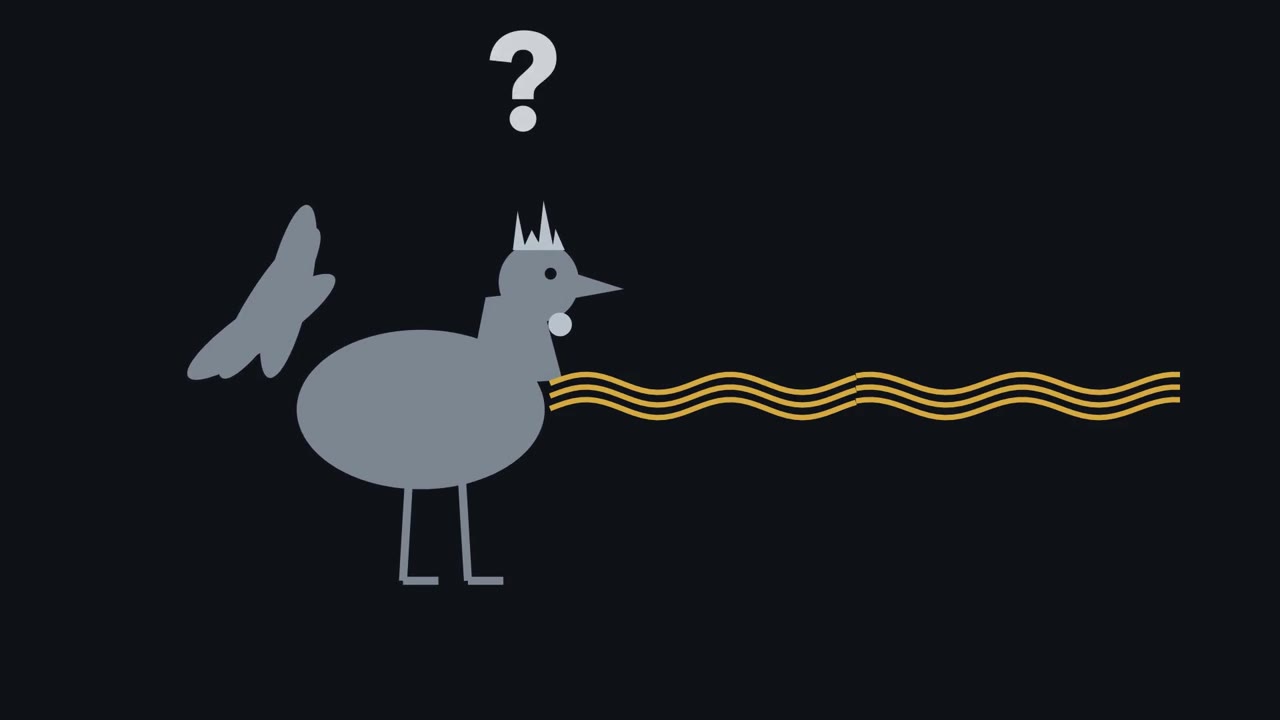 ▶ Watch Tap, Drain and a Sensor · 3:20
Read the transcript of “Tap, Drain and a Sensor”
Film transcript: Tap, Drain and a Sensor
What can an organ send through the body without any nerves? And what decides how much of it is in the blood? A physician in Göttingen asked the first question with young cockerels. He castrated them. Without testes, the birds grew small combs, and they crowed little. In some birds he put a testis back into the belly. It was cut off from its original nerves. Those birds still grew combs and crowed. So the graft must have sent something through the blood. That something is a hormone. A hormone is a chemical released by one group of cells into the blood. The blood carries it to distant cells. Only cells with a receptor for it respond. Now picture the blood as a tank.
The gland is a tap, pouring hormone in. A drain stands for every way the body removes or breaks down the hormone. The water line is the hormone's level in the blood. It settles where what drains out matches what pours in. In tank terms, castration shut a tap, and the male traits faded. The graft opened a tap again, and the traits came back. Berthold never measured the hormone itself. In mammals, one tap can drive another. Take the human stress axis. The hypothalamus releases CRH. Short veins called portal vessels carry it straight to the anterior pituitary. The pituitary then releases ACTH. And ACTH makes the adrenal cortex release cortisol. Now add a sensor. Cortisol acts back on the hypothalamus and the pituitary, turning their taps down. When cortisol rises, the drive to make it falls.
When it drops, the drive rises. This is negative feedback, a response that opposes the change that caused it. Suppose the adrenal glands are removed. Cortisol falls, because nothing secretes it. What happens to ACTH? ACTH rises. With no cortisol feeding back, a key brake is gone. The hypothalamus and pituitary drive harder, but no adrenal can answer. Taking a gland away shows how the rest of the loop responds. Feedback does not freeze the level at one value. In humans, cortisol rises and falls over the day. It also comes in pulses, roughly every sixty to ninety minutes. Feedback adjusts the tap. It shapes a pattern rather than fixing a number.
So a hormone's level is a balance of secretion in and clearance out. Feedback works on the secretion. How fast the level can follow is a question about the drain.
From the film: five take-homes
- A hormone is a chemical released by one group of cells into the blood, which carries it to distant cells that have a receptor for it.
- A hormone's level in the blood is a balance between what the gland secretes and what the body clears.
- In the human stress axis, CRH releases ACTH, ACTH releases cortisol, and cortisol turns CRH and ACTH down.
- Remove the adrenal glands and ACTH rises, because cortisol no longer feeds back.
- Negative feedback adjusts the secretion; it does not hold the level at one fixed value. Cortisol rises and falls over the day and comes in pulses roughly every 60 to 90 minutes.
In experiments published in 1849, a Göttingen physician put a testis back into the belly of castrated young cockerels, cut off from its original nerves. The birds still grew combs and crowed. How can an organ change the whole body without its own nerves?
The first film, above, answers with a tap pouring into a tank of blood and a drain emptying it; the drain stands for clearance, every way the body removes or breaks down the hormone.
The one idea. A hormone’s level in the blood is a balance between secretion in and clearance out. Negative feedback adjusts the secretion; the half-life sets how fast the level can follow.
Scope: this is a simple model for reasoning about loops, not a description of any one patient. Its assumptions (one well-mixed compartment, first-order clearance, brief pulses) are stated where the numbers start, in the half-life section, and every rule about half-life in this lesson holds inside them.
What makes a hormone
The first film defined a hormone; the cells it reaches are target cells, and their receptors are proteins that bind the hormone and change what the cell does. Like a radio broadcast, it reaches every house but only tuned sets hear it. Glands that release hormones into the blood are endocrine glands, and together they make up the endocrine system. Unlike the point-to-point signals of nervous control, hormones usually act more slowly and reach the whole body.
The first film left out how thin the evidence was. Berthold used very few birds and did not identify the substance, which we now know includes testosterone, and the graft’s new blood supply and lost nerve connection come from later accounts of his examination. The result rules in a blood-borne product of the testis, in this bird, and no more. What outlived it is the design: remove a gland, then restore the gland or its product and see the loss reversed.
Next steps: how a receptor signals inside the cell is in nuclear receptors and G-protein-coupled receptors; secretin, a gut hormone found by Bayliss and Starling in a dog, is in signals and distance.
Peptides and steroids: two chemistries, two speeds
Most hormones fall into two chemical groups. Peptide hormones, such as insulin, glucagon and adrenocorticotropic hormone (ACTH), are chains of amino acids. They dissolve in plasma (the liquid part of blood), so most circulate free, and because they cannot cross the fatty cell membrane, they mostly bind receptors on the cell surface. Their effects usually start within seconds to minutes. Steroid hormones, such as cortisol, aldosterone, testosterone and estrogens, are made from cholesterol. They dissolve poorly in water, so most of the circulating hormone, about 90 percent or more for cortisol and testosterone in humans, rides on carrier proteins. Because they are fat-soluble, they cross membranes, and their classical receptors sit inside the cell, where the bound receptor changes which genes are transcribed. Transcription can begin to change within minutes, but effects that depend on new proteins usually take much longer, often hours.
Carrier binding also slows the drain: it is one reason steroids such as cortisol have long half-lives. On the usual free-hormone view, the small free fraction is what reaches cells and feeds back.
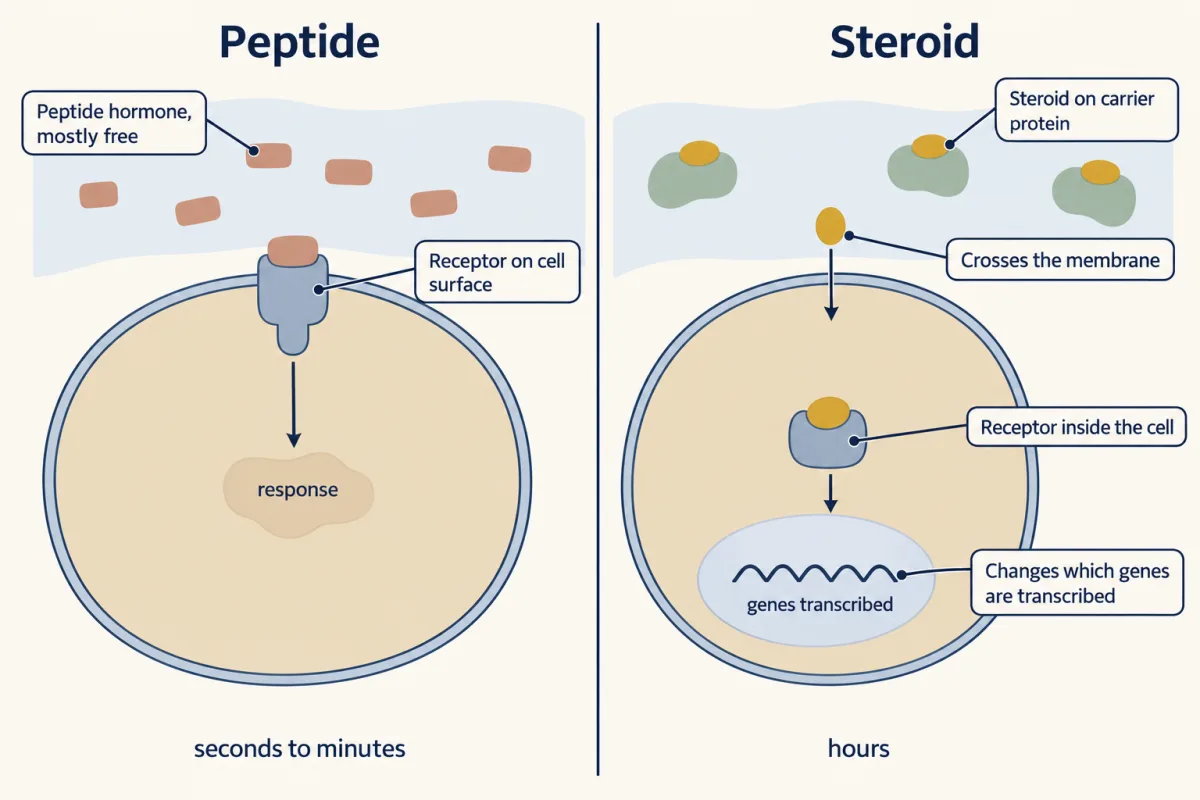
Not every peptide works the same way: glucagon’s receptor is a G-protein-coupled receptor, but insulin’s receptor is itself an enzyme, a tyrosine kinase (see receptor tyrosine kinases). And not every steroid action is slow: some begin within minutes and appear to start at the cell membrane (see Going deeper). A third group, the amine hormones made from single amino acids, splits between the two. Epinephrine dissolves in plasma and binds surface receptors, like a peptide. Thyroid hormone travels mostly on carrier proteins, enters cells with the help of transporters and binds a receptor inside, like a steroid.
Hypothalamus and pituitary: a chain with feedback
In mammals the hypothalamus, at the base of the brain, controls the pituitary gland beneath it, and the pituitary controls several other glands. The first film drew one chain; here are the others.
The anterior pituitary is a gland in its own right. Hypothalamic neurons release releasing hormones into capillaries, and portal vessels, short veins that carry blood from one capillary bed straight to a second one instead of back to the heart, take that blood directly to the anterior pituitary. The hormones arrive concentrated, without passing through the rest of the body. Each releasing hormone has a pituitary partner:
- CRH (corticotropin-releasing hormone) triggers ACTH (adrenocorticotropic hormone), which drives the adrenal cortex.
- Thyrotropin-releasing hormone (TRH) triggers TSH (thyroid-stimulating hormone), which drives the thyroid.
- Gonadotropin-releasing hormone (GnRH) triggers luteinizing hormone (LH) and FSH (luteinizing and follicle-stimulating hormones), which drive the gonads.
The anterior pituitary also makes growth hormone and prolactin. Prolactin is the exception: dopamine from the hypothalamus, carried in the same portal vessels, mainly holds its release down. How the portal link was shown is in hypothalamus and autonomic control.
The posterior pituitary does not make the hormones it releases. ADH (antidiuretic hormone) and oxytocin are made by neurons whose cell bodies sit in the hypothalamus, and those axons end in the posterior pituitary, which stores and releases the hormones into the blood. ADH increases water reabsorption in the kidney; oxytocin contracts the uterus during birth.
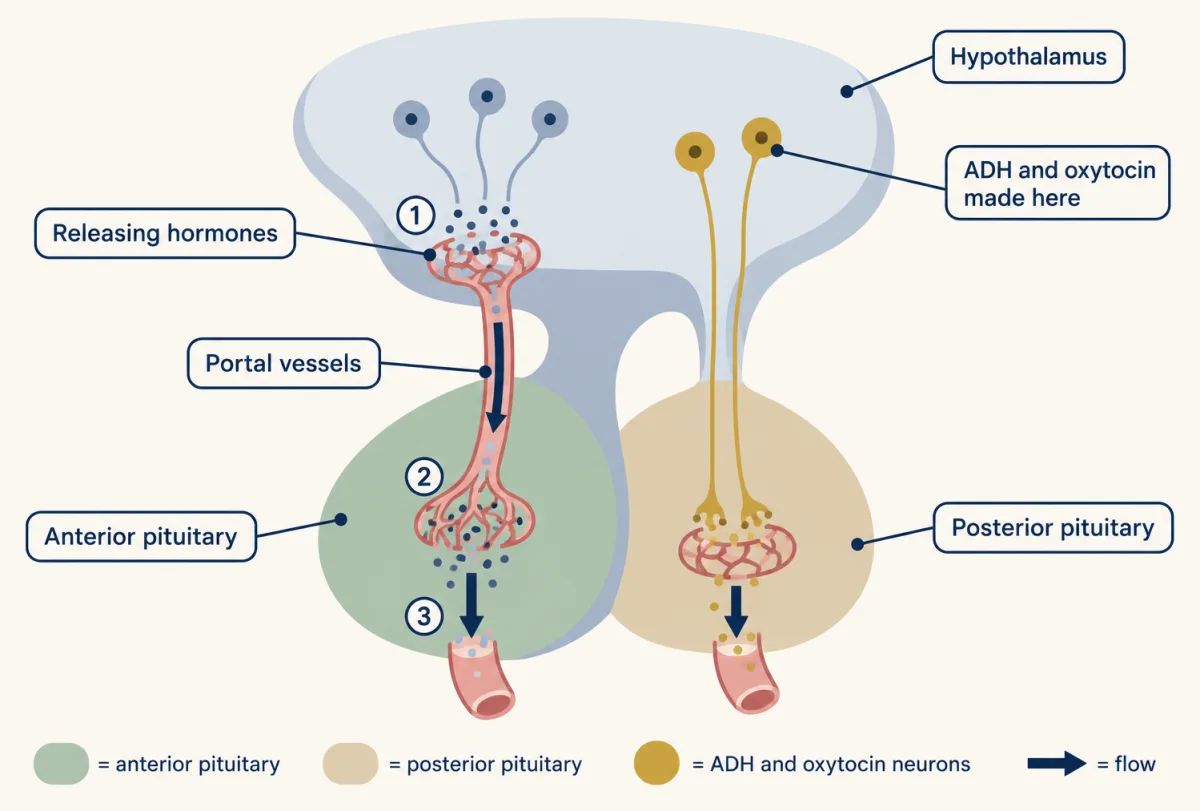
Each chain is held in check the way the first film’s stress axis was, by negative feedback: the final hormone turns down the glands above it. In the human thyroid chain, thyroid hormone (T4, and the more active T3) lowers TRH and TSH release, acting at both the hypothalamus and the pituitary.
Predict. A person with a healthy thyroid takes thyroid hormone tablets every day. What happens to TSH, and to the person’s own thyroid secretion?
Check your prediction
The tablets add a second tap. As the level rises, feedback lowers TRH and TSH, and with less TSH the person’s own thyroid secretes less. Feedback can turn down only the secretion it reaches; it cannot turn off the tablets.
Not every loop is negative: before ovulation, rising estradiol triggers a surge of LH, a positive feedback that amplifies a change.
Glucose and cortisol as loops
Blood glucose. In a healthy adult human after a meal, glucose rises. Beta cells in the pancreatic islets respond by releasing insulin. Insulin increases glucose uptake by skeletal muscle and fat, and it reduces the liver’s glucose output by slowing glycogen breakdown and new glucose synthesis. Glucose falls, and so does the stimulus for insulin. Between meals, alpha cells release glucagon, which makes the liver break down glycogen and release glucose. The chemistry of the liver’s response belongs to integration of metabolism and gluconeogenesis.
The stress axis. What the first film left out is where cortisol meets the glucose loop. Cortisol raises the liver’s glucose production, though the evidence is from high-dose infusions in human volunteers, not an ordinary stressful day (see Going deeper). For the brain’s side of stress, see emotion and stress.
Can cortisol’s blood level follow an adrenal that releases it in pulses? The second film times the drain.
Read the transcript of “How Fast a Level Follows”
Film transcript: How Fast a Level Follows
Cortisol tells the liver to make more glucose. The adrenal releases it in pulses, roughly every sixty to ninety minutes. Does its level in the blood pulse too? The first film built a tank, with a gland's tap pouring in and a drain clearing out. The level settles where the two match. Now we time the drain.
You Shut the tap. The level falls, but not in a straight line. The drain removes a constant fraction each minute. So the level halves, then halves again, in equal steps of time. Wherever it starts, each halving takes the same time. The time for one halving is the hormone's half-life. In this example, a small peptide hormone has a half-life of five minutes. For cortisol, textbooks give about sixty to ninety minutes. Now open the tap again and leave it open. The level climbs toward a new steady value, where the drain matches the tap. It gets halfway there in one half-life. It is nearly there after about four. So the half-life sets the speed in both directions.
A slow drain means a slow fall, and also a slow rise. The level always lags behind the tap. A short half-life lets a level answer its gland within minutes. A long one takes hours. Now give two hormones the same tap. It opens in equal short bursts, like cortisol's pulses. One hormone has a fast drain. The other has cortisol's slow drain. Same bursts, two drains. Before they run, make your call. Compared with its own average, which level will swing more with each burst?
Each burst adds the same amount to both tanks. The fast-draining level then empties before the next burst. So each burst lifts it far above its tiny average. The slow-draining level never empties. It ripples gently around a much higher middle. So with brief bursts, what matters is the half-life compared with the gap between them. Much shorter, and the level tracks each pulse. As long as the gap, and the level smooths them. In this model, cortisol's level still ripples with each pulse, but it never empties. One rule still holds over many bursts. On average, the drain removes what the tap adds. A slow drain removes a smaller fraction each minute.
So it needs a fuller tank to keep up. That is why the slow-draining level sits higher. These curves come from a simple model with invented numbers. Real secretion varies over time. It is rarely one steady rate, or switched off outright.
From the film
- A hormone's half-life is the time for its level in the blood to fall by half once secretion stops.
- When secretion steps up and stays up, the level covers half the distance to its new steady value in one half-life.
- With brief pulses, a level tracks them when its half-life is much shorter than the gap between them; when the half-life is as long as the gap, it smooths them.
- Over many pulses the drain removes what the tap adds, so a longer half-life gives a higher average level and smaller swings relative to it.
- These curves come from a simple model with invented numbers; real secretion varies and often comes in pulses.
How fast a level follows: half-life
Worked problem. These are the numbers behind the second film’s falling curve. This is a model, not an intact axis. Take an adult human with plasma cortisol of 400 nmol per L at time zero, and suppose secretion stops completely. Assume constant blood volume and first-order elimination (a constant fraction lost per minute), with a half-life (t-half, the time for the plasma concentration to fall by half once secretion stops) of 75 minutes, chosen within the textbook range of about 60 to 90 minutes.
What the numbers stand for. The level is total plasma cortisol (free plus carrier-bound) in one well-mixed compartment, and the half-life is an effective one that folds carrier binding and tissue uptake into a single drain; real free and bound cortisol behave in more complicated ways. The concentration C(t) at t minutes, starting from C0, is
C(t) = C0 x 2−t / t−half
- After 150 minutes. t / t-half = 150 / 75 = 2 half-lives, so C = 400 x 1/4 = 100 nmol per L.
- When does it reach 50 nmol per L? 400 to 200 to 100 to 50 is three halvings, so 3 x 75 = 225 minutes.
- Compare a peptide. Suppose, for illustration, a peptide hormone with a half-life of 5 minutes also starts at 400 nmol per L. In 30 minutes, which is 6 half-lives, it falls to 400 x 2−6 = 400 / 64 = 6.25 nmol per L. Cortisol in the same 30 minutes falls only to 400 x 2−0.4 (30 / 75 = 0.4 half-lives), about 303 nmol per L.
These numbers are invented, as the second film warned of its curves.
Stopping secretion is the special case. With the tap on, the higher the level, the more drains out:
change in level per minute = secretion per minute ÷ V − k × level
V is the volume the hormone spreads through. k = ln 2 / t-half (ln 2 is about 0.69); for cortisol that is close to 1 percent cleared each minute. The level holds steady when the two terms match: steady level = secretion ÷ (k × V).
- Half-lives elapsed, t / thalf
- Concentration at the cursor
- Time to fall to 50 nmol per L (3 halvings)
- 5 min peptide at the cursor
In this sketch: adult human plasma cortisol (or an invented peptide), C0 = 400 nmol per L, secretion stopped completely at time zero, constant blood volume, first-order elimination; invented numbers.
Each half-life halves the level: C(t) = C0 × 2−t / t-half. A short half-life lets the plasma level track secretion within minutes; a long one smooths out pulses.
Change the drain itself, and feedback enters.
Predict. In the model, suppose something halves the rate at which cortisol is cleared (k halves), while the loop stays intact. Does the cortisol level double?
Check your prediction
With secretion held fixed it would: by the steady-level equation, halving k doubles the level. But the rising cortisol feeds back and lowers CRH and ACTH, so the adrenal secretes less, and the new level is less than double. How much less depends on how strong the feedback is. Feedback works on the tap, so it can partly cancel a change at the drain.
Hormones across animals: moulting insects, metamorphosing frogs
Other animals run the same logic on different molecules, so name the animal each time.
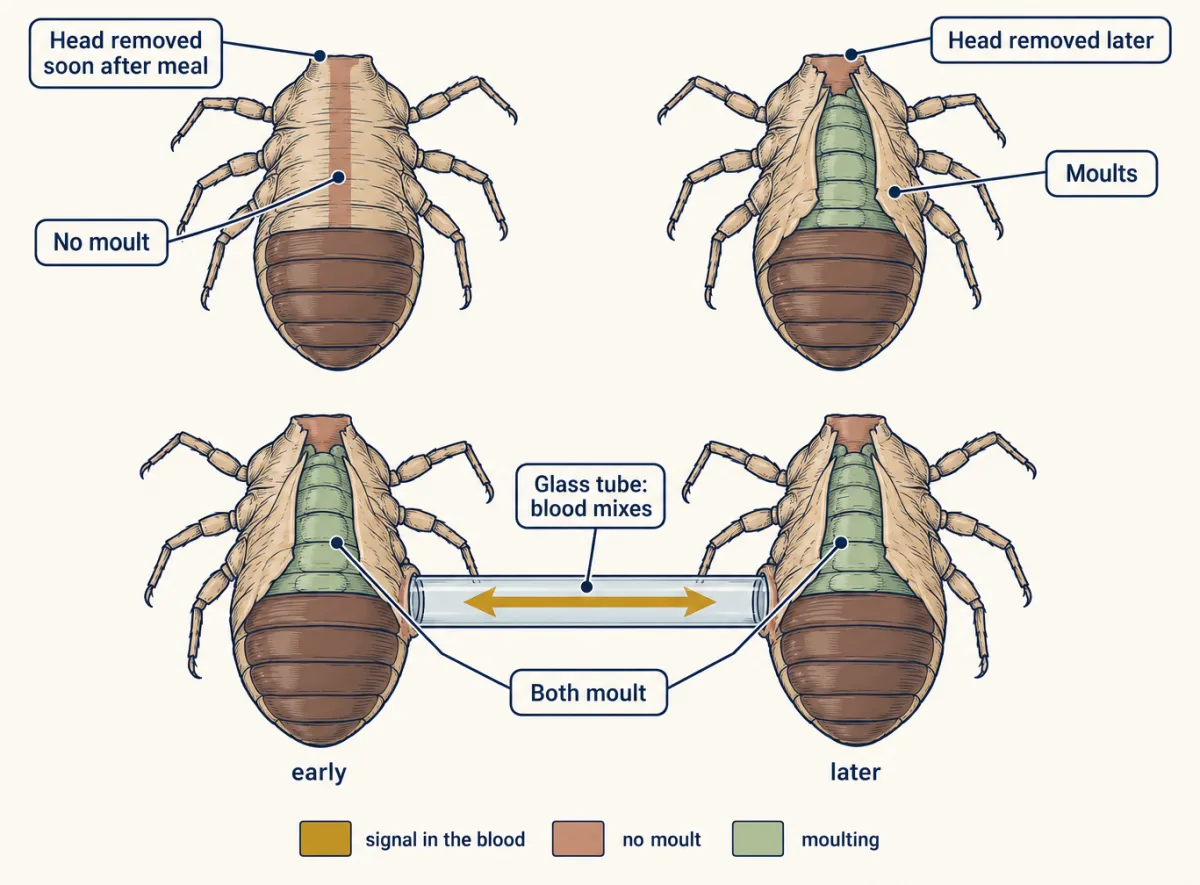
The bug Rhodnius prolixus takes one large blood meal per larval stage and moults some days later. Vincent Wigglesworth found that larvae decapitated soon after the meal did not moult, while those decapitated later did, so a signal from the head was needed for a limited time. Joined by a glass tube so that their blood mixed (parabiosis), an early- and a later-decapitated larva both moulted: a moult-promoting signal travelled in the blood. It is Berthold’s remove-and-restore logic in another animal.
We now know the chain behind it:
- Neurosecretory cells in the brain release prothoracicotropic hormone (PTTH).
- PTTH makes the prothoracic glands secrete ecdysteroids, steroid hormones of arthropods that drive the moult.
- A second hormone, juvenile hormone from a small gland behind the brain called the corpus allatum, keeps each moult a larval one; only when it falls does the bug moult into an adult.
The shared blood could have carried either the brain hormone or the ecdysteroid it had already triggered in the partner. A brain hormone driving a gland that makes a steroid parallels corticotropin-releasing hormone (CRH) and adrenocorticotropic hormone (ACTH) driving cortisol in mammals, though the insect chain has one tier fewer.
In frogs, tadpoles become froglets by metamorphosis, a body remodelling in which limbs grow and the tail is resorbed, driven by thyroid hormone. In an early report usually credited to J. F. Gudernatsch (1912), tadpoles fed mammalian thyroid tissue metamorphosed early. The reverse test also holds: blocking a tadpole’s own thyroid hormone synthesis prevents metamorphosis, and the animal grows into a giant tadpole. As in mammals, the brain and pituitary drive the thyroid, and corticosteroids, the frog’s stress hormones, work together with thyroid hormone during metamorphosis. Mammals use thyroid hormone to set metabolic rate, among other roles; the response depends on the tissue, the life stage and the animal.
Plants have hormones too, such as auxin, but no blood; they move signals through tissues and vascular tissue, covered in plant hormones and responses.
Design problem
An adult human loses all the insulin-making beta cells of the pancreas. Predict what happens to blood glucose after a meal, and name the two actions of insulin that explain it. Then design a test that would show the change comes from missing insulin.
Saved in this browser only.
One way to do it
Start with the loop: insulin increases glucose uptake by skeletal muscle and fat and slows the liver’s glycogen breakdown and new glucose synthesis. With neither action, glucose rises higher after a meal and falls more slowly.
Next, put the hormone back. If insulin is the missing step, giving insulin should bring the post-meal rise down: Berthold’s design again.
Then rule out the other side of the loop: glucagon, released between meals to make the liver release glucose, opposes insulin and does not take over its job after a meal.
Conclusion: without insulin the loop cannot bring glucose back down. This is a prediction from the loop, not a measured result, and a real patient’s course depends on many other factors.
Reference: the main glands
In human physiology:
| Gland | Hormone | Main effect |
|---|---|---|
| Anterior pituitary | ACTH, TSH, LH and FSH, growth hormone, prolactin | Drive adrenal cortex, thyroid, gonads; growth; milk production |
| Thyroid | T4 and T3 | Raise basal metabolic rate |
| Parathyroid | Parathyroid hormone | Raise blood calcium |
| Adrenal cortex | Cortisol, aldosterone | Glucose production and stress response; sodium retention |
| Adrenal medulla | Epinephrine, norepinephrine | Raise heart rate in a stress response |
| Pancreatic islets | Insulin (beta cells), glucagon (alpha cells) | Lower and raise blood glucose |
| Gonads | Testosterone, estrogens, progesterone | Sex characteristics, reproductive cycles |
| Pineal | Melatonin | Daily rhythms |
Going deeper
Rapid steroid action in hypothalamic slices
In slices of hypothalamus from young male rats, the synthetic glucocorticoid dexamethasone reduced excitatory synaptic input to recorded neurons within 3 to 5 minutes (Di, Malcher-Lopes, Halmos and Tasker, 2003). Is this the classical genomic action, through an intracellular receptor that changes transcription? Design the tests, and say what each result would mean.
One way to do it
Start with timing. Effects that need new transcription and protein synthesis usually take longer than 3 to 5 minutes, so the onset alone makes a genomic action unlikely.
Next, keep the steroid outside the cell. Dexamethasone chemically linked to albumin, a large protein, cannot cross the membrane (a permanent conjugate, not loose carrier binding). In this study the conjugate still reduced synaptic input. Add albumin alone as a control.
Then put the steroid only inside. Delivered into the neuron through the recording pipette, dexamethasone did not reproduce the effect. Together these point to a site reached from outside the membrane.
A transcription blocker is a further test: if the rapid effect does not need new transcription, blocking transcription should leave it intact. This tests transcription, not where the receptor sits, and it is a prediction, not a result from this paper as given here.
Finally, look for what carries the signal. Blockers of the CB1 cannabinoid receptor (AM251 and AM281) abolished the effect, so it depended on endocannabinoid signalling in this preparation.
Conclusion: a rapid, membrane-initiated steroid action in rat hypothalamic slices. The membrane receptor was not identified, and the result does not show how cortisol feedback works in a living human.
Experiments behind the glucose and stress loops
In mice, deleting the insulin receptor only in liver cells stopped insulin from suppressing the liver’s glucose output normally. Cortisol raises glucose production: in normal human volunteers given high doses of hydrocortisone while their insulin, glucagon and growth hormone were held in fasting ranges, glucose production rose through new glucose synthesis.
Your notes
Select any text in the lesson to highlight it or add a note to it. Your highlights and notes are saved in this browser and collected in your notebook.
This browser is not letting the site save anything (a private window or strict privacy settings), so highlights and notes will be lost when you leave the page.
Try the Predict questions again
Two Predict questions from this lesson, on their own. Answer each one first, then open its check.
A person with a healthy thyroid takes thyroid hormone tablets every day. What happens to TSH, and to the person’s own thyroid secretion?
From: Hypothalamus and pituitary: a chain with feedback
Check your prediction
The tablets add a second tap. As the level rises, feedback lowers TRH and TSH, and with less TSH the person’s own thyroid secretes less. Feedback can turn down only the secretion it reaches; it cannot turn off the tablets.
In the model, suppose something halves the rate at which cortisol is cleared (k halves), while the loop stays intact. Does the cortisol level double?
From: How fast a level follows: half-life
Check your prediction
With secretion held fixed it would: by the steady-level equation, halving k doubles the level. But the rising cortisol feeds back and lowers CRH and ACTH, so the adrenal secretes less, and the new level is less than double. How much less depends on how strong the feedback is. Feedback works on the tap, so it can partly cancel a change at the drain.
How we measure it
Gland removal and replacement
Remove a gland (ablation) and record what changes, then restore it by a graft or by an extract or a purified hormone. If the replacement reverses the change, the gland acts through that material; a graft with no nerve supply tests whether nerves are needed.
Parabiosis and decapitation in insects
Join two animals so that their blood mixes, or cut off the head at chosen times after a trigger such as a meal. Timing shows when a signal from the head is needed, and a shared blood supply shows whether that signal travels in the blood.
Radioimmunoassay
Let the hormone in a sample compete with a radioactively labelled copy for a limited amount of antibody. The bound label falls as the sample's hormone rises, and a standard curve gives the concentration, even at the low levels at which hormones circulate in blood.
Hyperinsulinemic-euglycemic clamp
Infuse insulin at a fixed rate and infuse glucose at whatever rate holds blood glucose steady. The glucose infusion needed measures how strongly the body responds to insulin, and tracers can split that into uptake by tissues and output by the liver.
Practice questions on this lesson (3) → MCAT-style, original, each with an explanation
Where this lesson fits
Before thisReview first
- Tissues, Organs and HomeostasisThis course · Lesson 6
You need negative feedback and control loops from there to follow how hormone levels are adjusted here.
After thisStudy next
- Heat Balance and Body TemperatureThis course · Lesson 9
Thyroid hormone and feedback loops return here as the body sets heat production and holds temperature.
- The KidneyThis course · Lesson 16
ADH and aldosterone act on the kidney, so you can see hormone targets at work.
- Animal ReproductionThis course · Lesson 20
It takes the hypothalamus-pituitary-gonad axis and its feedback further, including steady versus pulsed hormone delivery.
Suggested by an AI model from the lessons themselves, then checked. How we use AI
That is the skim: you have the shape of it.
That is both films: the lesson in pictures.
The rest of the lesson is here when you want it.
Finish line
Test yourself
8 questions
Practice and MCAT-style, with explained answers.
Next · Lesson 9
Heat Balance and Body Temperature
How can a lizard basking on a desert rock end up warmer than you are, without making much heat of its own?
Continue →Rewritten on : new text, flashcards and film. Notes and highlights stay, but the text around them may have moved.