Organismal Biology · Skim version
Hormones and the Endocrine System
Read the full lesson → Skim the whole course →
The guiding idea
A young cockerel's testis, moved to his belly and cut off from its original nerves, still made him grow into a crowing rooster. What was it sending?
A hormone's level in the blood is a balance between what its gland secretes and what the body clears; negative feedback adjusts the secretion, and the half-life sets how fast the level can follow.
From the film: Tap, Drain and a Sensor
- A hormone is a chemical released by one group of cells into the blood, which carries it to distant cells that have a receptor for it.
- A hormone's level in the blood is a balance between what the gland secretes and what the body clears.
- In the human stress axis, CRH releases ACTH, ACTH releases cortisol, and cortisol turns CRH and ACTH down.
- Remove the adrenal glands and ACTH rises, because cortisol no longer feeds back.
- Negative feedback adjusts the secretion; it does not hold the level at one fixed value. Cortisol rises and falls over the day and comes in pulses roughly every 60 to 90 minutes.
From the film: How Fast a Level Follows
- A hormone's half-life is the time for its level in the blood to fall by half once secretion stops.
- When secretion steps up and stays up, the level covers half the distance to its new steady value in one half-life.
- With brief pulses, a level tracks them when its half-life is much shorter than the gap between them; when the half-life is as long as the gap, it smooths them.
- Over many pulses the drain removes what the tap adds, so a longer half-life gives a higher average level and smaller swings relative to it.
- These curves come from a simple model with invented numbers; real secretion varies and often comes in pulses.
-
What makes a hormone
-
Peptides and steroids: two chemistries, two speeds
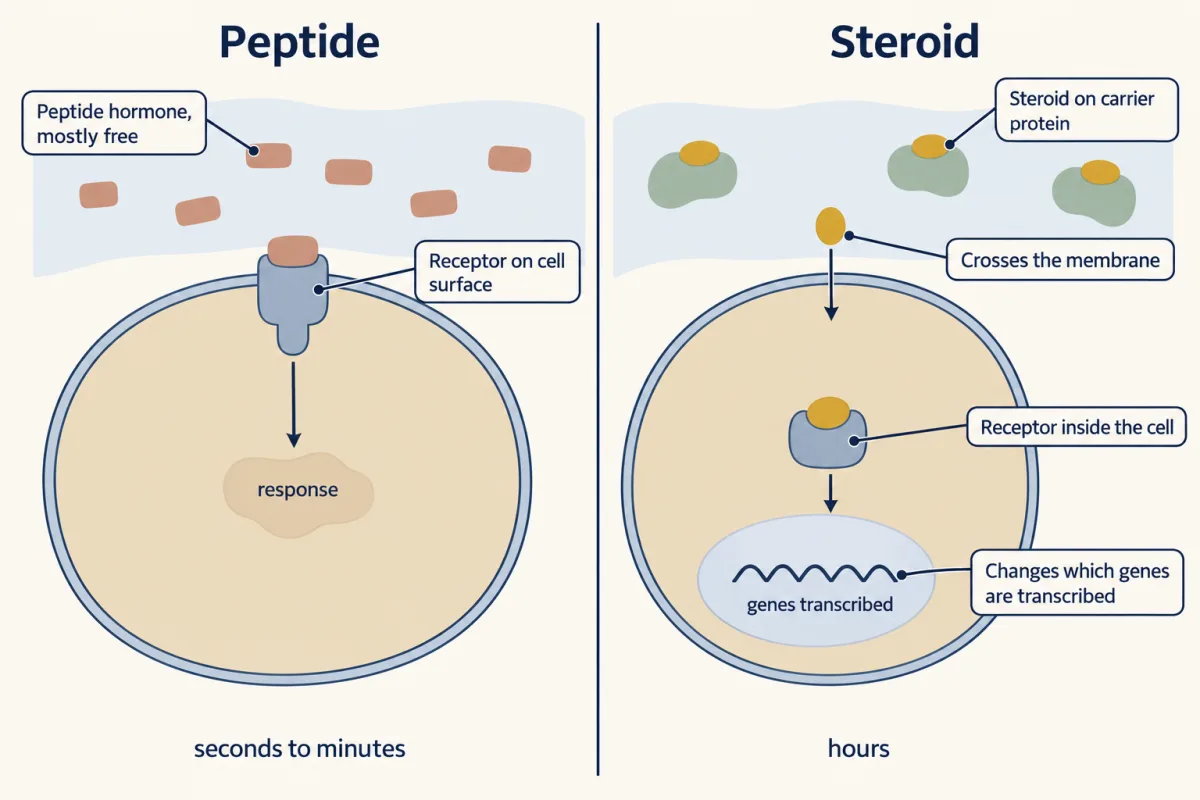
A typical peptide hormone circulates free and binds a surface receptor, acting within seconds to minutes; a typical steroid rides on carrier proteins, crosses the membrane, and its receptor inside the cell changes transcription, with effects that usually build over hours. AI-generated illustration -
Hypothalamus and pituitary: a chain with feedback
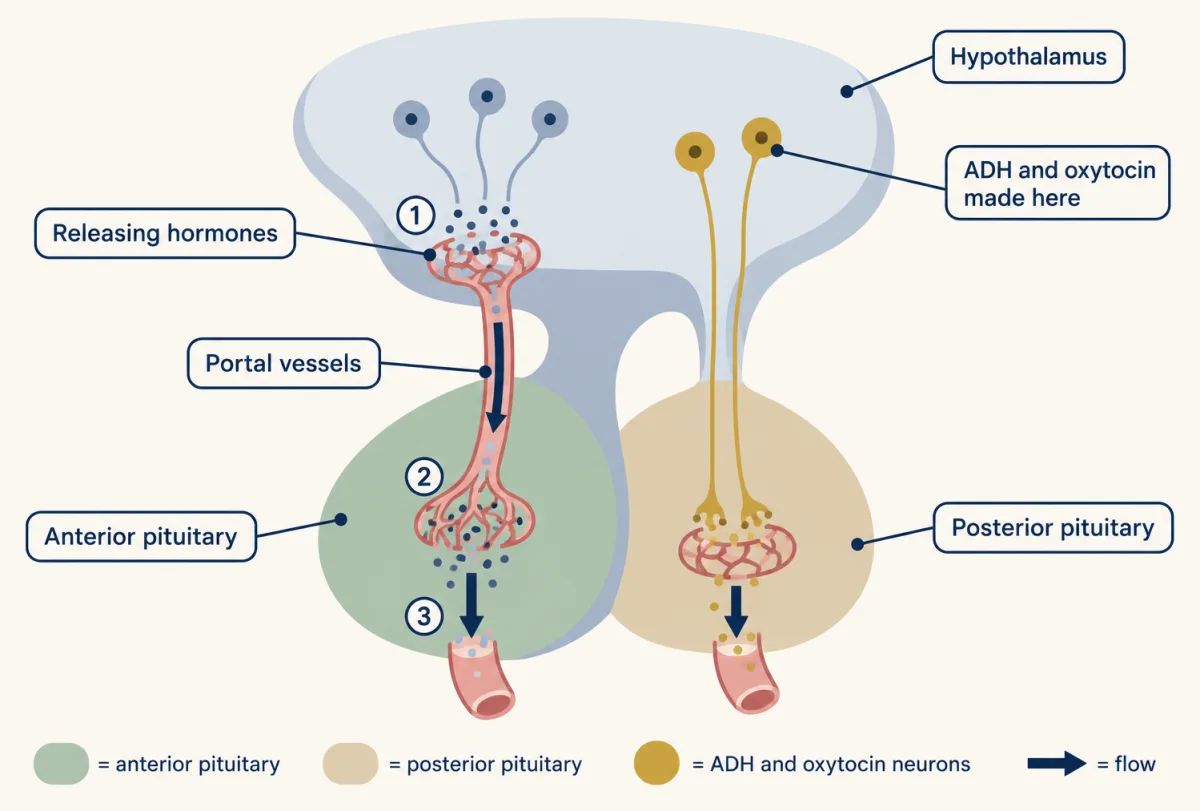
Two routes from hypothalamus to pituitary: releasing hormones travel in portal vessels to the anterior pituitary, while ADH and oxytocin are made in the hypothalamus and released from the axon endings in the posterior pituitary. AI-generated illustration -
Glucose and cortisol as loops
-
How fast a level follows: half-life
-
Hormones across animals: moulting insects, metamorphosing frogs
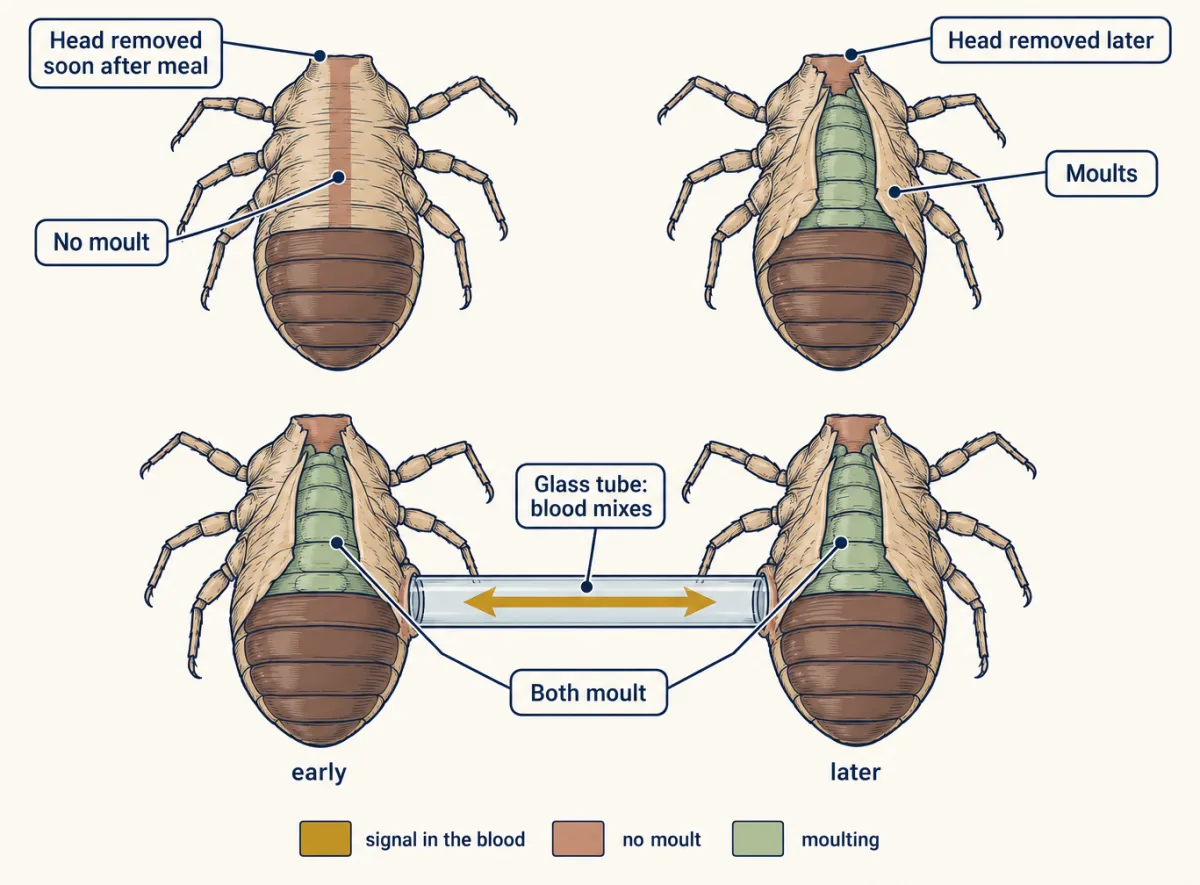
A moult-promoting signal travels in the blood: a Rhodnius prolixus larva decapitated too early does not moult alone, but moults when its blood mixes with that of a larva decapitated later. AI-generated illustration -
Reference: the main glands
-
Going deeper
Where this lesson fits
Before thisReview first
- Tissues, Organs and HomeostasisThis course · Lesson 6
You need negative feedback and control loops from there to follow how hormone levels are adjusted here.
After thisStudy next
- Heat Balance and Body TemperatureThis course · Lesson 9
Thyroid hormone and feedback loops return here as the body sets heat production and holds temperature.
- The KidneyThis course · Lesson 16
ADH and aldosterone act on the kidney, so you can see hormone targets at work.
- Animal ReproductionThis course · Lesson 20
It takes the hypothalamus-pituitary-gonad axis and its feedback further, including steady versus pulsed hormone delivery.
Suggested by an AI model from the lessons themselves, then checked. How we use AI