Two Ways Out: Blood and Wires
Read the transcript of “Two Ways Out: Blood and Wires”
Film transcript: Two Ways Out: Blood and Wires
The hypothalamus has a correction to send. How does it leave the brain, and how fast? Nerves often act within seconds. Hormone effects usually build more slowly, over minutes to hours. Start with vasopressin. Large neurons in the supraoptic and paraventricular nuclei make it. Their axons release it in the posterior pituitary, straight into the blood. So the posterior lobe stores and releases vasopressin. It does not make it. The anterior lobe is reached by blood instead. Neurons release peptides into capillaries at the median eminence. Portal veins carry them down the stalk to a second capillary bed. They arrive concentrated, before the general circulation dilutes them.
Take the stress axis. The paraventricular nucleus releases corticotropin-releasing hormone, CRH. That drives adrenocorticotropic hormone, ACTH, from the pituitary. ACTH drives cortisol from the adrenal cortex. Cortisol feeds back on the hypothalamus and pituitary, and turns the axis down. Same loop, different variable: here, a hormone. Now the wires. The usual autonomic chain has two neurons and two synapses: one in a ganglion, one on the target. Rule one. The first synapse is the same everywhere: acetylcholine, acting mainly on nicotinic receptors. Rule two. The second synapse usually names the division. Parasympathetic: acetylcholine on muscarinic receptors.
Most sympathetic: noradrenaline on adrenergic receptors. Atropine blocks muscarinic receptors. Give a large dose. What happens to the heart rate? And to sweating? At a large dose, the heart rate rises. The vagal brake on the heart's own pacemaker was on all the time, even at rest. Sweating stops. The sympathetic fibres to sweat glands release acetylcholine onto muscarinic receptors. That is the first exception. Separate tests show steady sympathetic drive too. So the heart sits at a balance, like a sink filled from two taps. The second exception is the adrenal medulla. There, the second neuron has become a gland that releases adrenaline and noradrenaline into the blood.
The paraventricular nucleus uses every route: portal blood, the posterior lobe, and descending autonomic pathways. Two routes out. Nerves often work in seconds. Hormone effects usually build over minutes to hours.
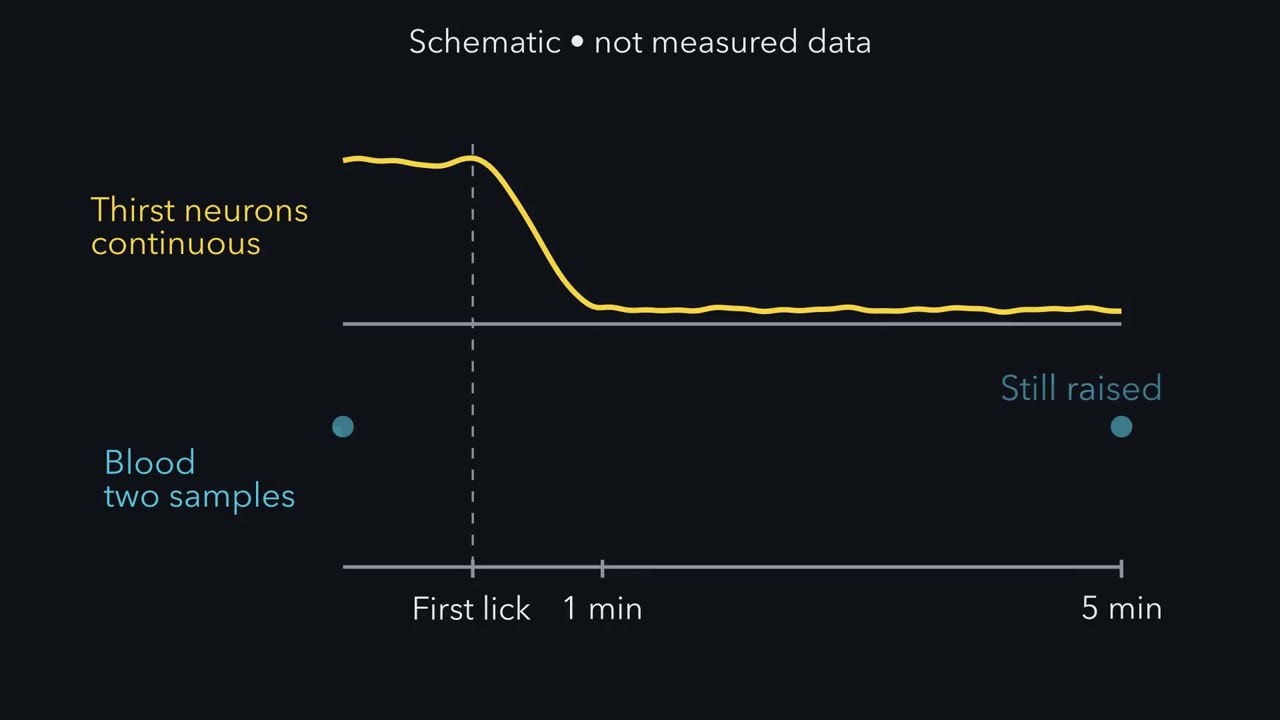
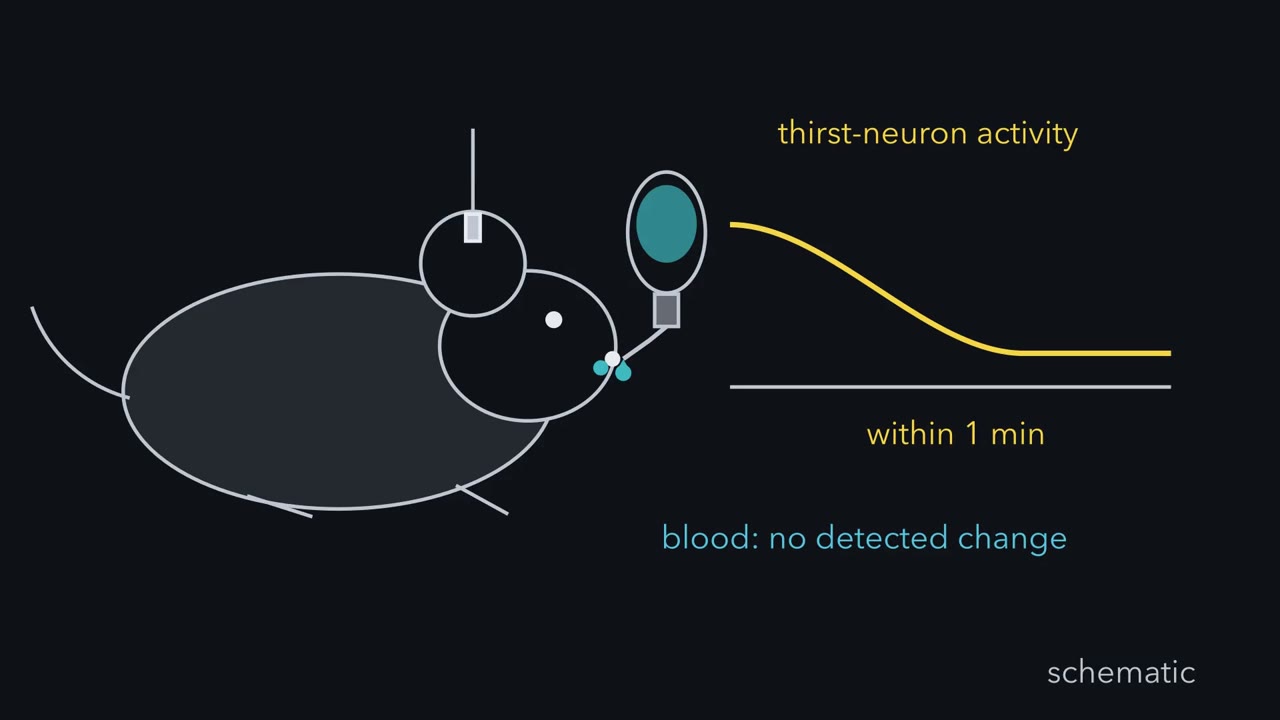
A thirsty mouse quiets its thirst neurons within a minute of drinking, while its blood osmolality is still raised five minutes later.
Continue in the lesson: Autonomic Control and the Hypothalamus →
3:03 · Free, with captions and a transcript. The lesson has the full text, the questions and the sources.
More films from this lesson
How this film was made. Narration: an AI narrator voice (Kokoro, af_heart) reading narration written from this lesson's text. Animation: AI-generated in code (Manim) by Claude, a schematic with no drawn molecular structures. Captions come from the narration script. See something wrong? Report it.