Organismal Biology · Unit 2: Control and constancy
New to this? Review it at high school level: Homeostasis in Action
Heat Balance and Body Temperature
Rewritten on : new text, flashcards and film. Your notes and highlights stay, but the text around them may have moved.
How can a lizard basking on a desert rock end up warmer than you are, without making much heat of its own?
Pause when the reading reaches a film, and offer to play it. Saved on this device.
Watch the film now, or keep listening
Builds on:Tissues, Organs and HomeostasisSize, Scale and SurfaceWhat an Organism Has to DoWhy these?
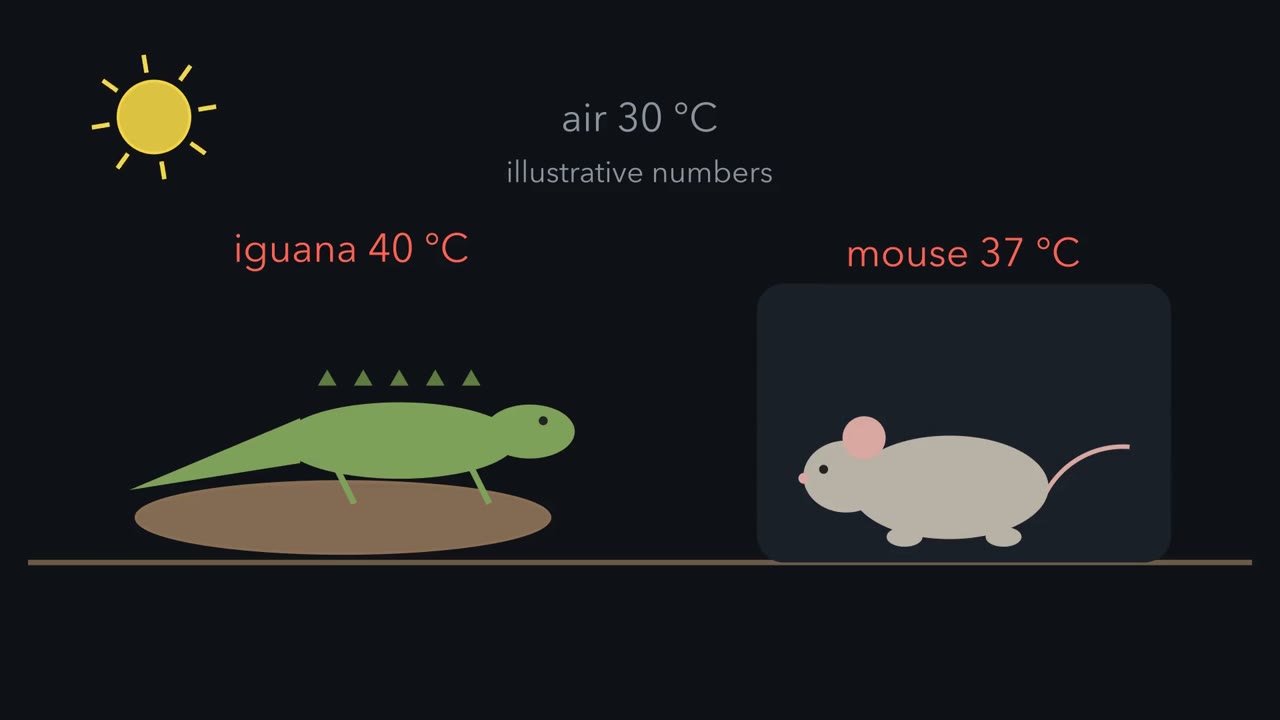 ▶ Watch Where the Balance Sits · 3:13
Read the transcript of “Where the Balance Sits”
Film transcript: Where the Balance Sits
On a desert morning, a basking iguana is warmer than the air. So is a mouse nearby. Yet the iguana makes far less heat of its own than the mouse. How can both be warmer than the air? Picture each body as a tank of warmth. The level in the tank is body temperature. Heat flows in, heat leaks out, and the level settles where the two match. Two taps fill the tank. The orange tap is heat made by the body's own metabolism. The yellow tap is heat gained from outside, from sunlight or a warm rock. The blue outlet is the dry leak. Its width is conductance, how readily heat escapes for each degree of difference. The flow also grows with the gap between body and air.
Three routes make up that leak. Radiation, conduction, and convection by moving air or water. Each can run in or out, so the leak is their net. Sunlight and a warm rock count once, in the yellow tap, not the leak. A fourth outlet is evaporation. Water turning to vapour carries heat away, as in sweating or panting. In practice it only removes heat, and it costs water. So the level sits where heat in equals heat out. Body temperature rises above the air by the heat coming in, minus evaporation, divided by conductance. The iguana's orange tap runs small. Its yellow tap pours, from the sun above and the rock below. That inflow alone lifts it well above the air.
The mouse has almost no yellow tap. Its orange tap runs strong, and fur keeps its blue outlet narrow. Its own metabolism holds it above the air. That is the real difference between an ectotherm and an endotherm. The words name where the heat comes from, not how warm the animal is. Now move the mouse into colder air, with the same fur. The gap widens, and heat leaks faster. Name two ways it can hold its level.
Make more heat, by opening the orange tap. Or narrow the leak, by closing skin blood vessels and fluffing the fur. Every dial an animal has changes one of these terms. Who turns the taps? Sensors in the skin and deep in the body report to a controller in the brain. In mammals it sits in the preoptic area of the hypothalamus. It chooses the target temperature. Skin sensors give early warning. Cold air on the skin can start heat-saving responses before the core has cooled at all.
From the film
- Body temperature holds steady when heat made plus heat gained equals heat lost.
- Radiation, conduction and convection form a dry leak that grows with conductance and with the gap between body and air.
- An iguana warms mainly from sun and rock; a mouse warms mainly from its own metabolism.
- Animals hold their temperature by changing heat made, heat gained, conductance or evaporation.
- A controller in the brain chooses the temperature to defend, and skin sensors can warn it before the core cools.
Here is the first film’s tank rule in a form you can calculate with.
The one idea. At a steady body temperature, heat in equals heat out: heat made (M) + heat gained (G) = conductance (C) × (body temperature − air temperature) + heat evaporated (E), where conductance is how readily heat leaks out per degree of body-to-air difference. So body temperature sits above the air by (M + G − E) ÷ C. An animal steers its temperature by changing one of those terms, and a controller in the brain decides which temperature to aim for.
Scope, for the whole lesson: a simple model. Steady state means body temperature is not changing, so no heat is stored. Radiation, conduction and convection are lumped into one dry leak, C × (Tb − Ta): Tb is body temperature, and Ta, “the air” for short, is one effective temperature for the surroundings the animal exchanges dry heat with. Each heat load counts once: absorbed sunlight goes in G, and in this lesson so does a warm rock underfoot, so Ta stands for the rest of the surroundings. A chamber has one temperature only if its air and walls are held at the same temperature. Real conductance changes with posture, fur and blood flow; where later numbers hold C, Tb or E fixed, that is the model, not a measurement.
C is in watts per kelvin (a kelvin of difference equals a degree Celsius). Metabolic rate is the energy an animal uses per unit time, in watts (joules per second) or kilojoules per day; nearly all of it ends up as heat, so at rest it is M.
Routes and dials the first film left out
Of the four routes the first film named, radiation (electromagnetic energy), conduction (surfaces in contact), convection (moving air or water) and evaporation, it left out that each one’s share depends on species, size, posture and weather; evaporation’s water cost is in osmoregulation.
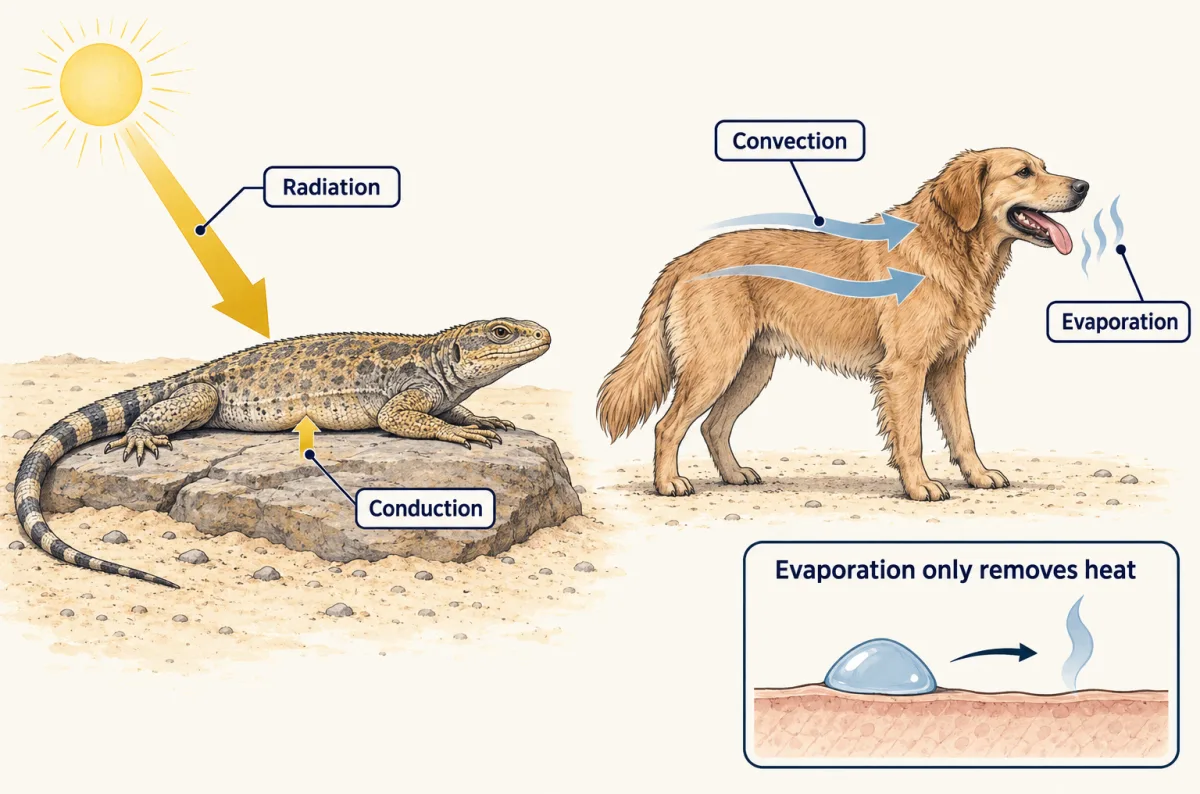
Three dials the first film did not show:
- Skin blood flow. Narrowing the small arteries to the skin (vasoconstriction) keeps warm blood in the core; widening them (vasodilation) delivers heat to the surface (see blood vessels, blood and lymph). Both change C, as do posture, huddling, fur and feathers, which trap a layer of still air, and blubber in many marine mammals.
- Countercurrent exchange. In a bird’s leg, or a whale’s or seal’s flipper, warm blood going out passes its heat to cold blood coming back, so the heat returns to the core instead of leaking from the foot (figure).
- Moving. Seeking shade or burrowing changes Ta and G at once.
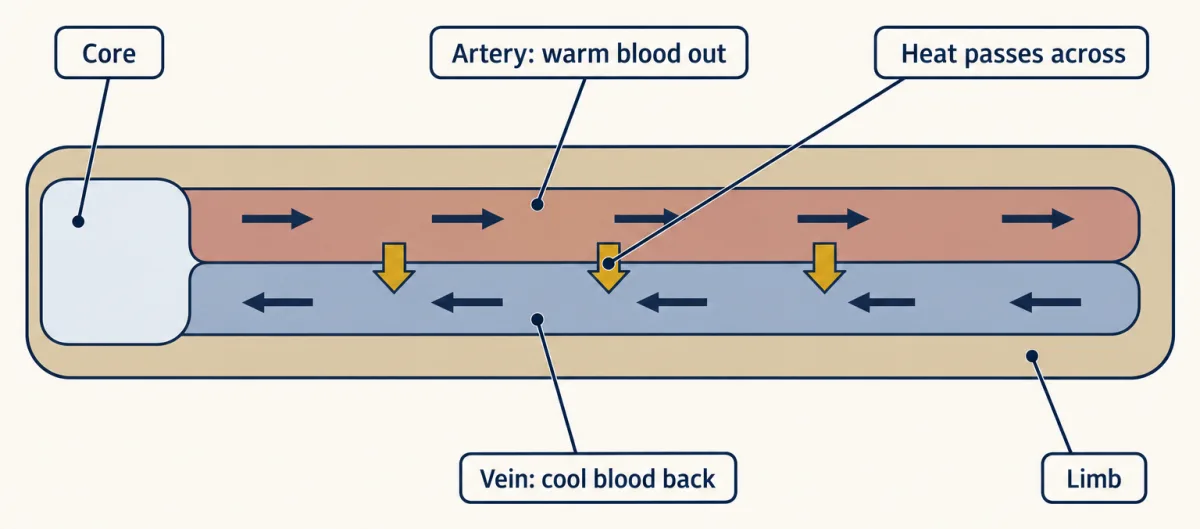
Endotherms, ectotherms and a second axis
An endotherm, such as a mammal or bird, warms itself mainly with M, held in by a low C; an ectotherm, like most fish, amphibians, reptiles and invertebrates, takes its temperature mainly from Ta and G. Either can use both sources, and the mix shifts with activity and weather.
Constancy is a separate axis. A homeotherm holds a nearly constant body temperature, and a heterotherm lets it vary widely. A deep-sea fish in steady cold is a nearly constant ectotherm; a hibernating ground squirrel, whose temperature can fall to near freezing, is a heterothermic endotherm.
The desert iguana, Dipsosaurus dorsalis, lives in the deserts of the southwestern United States and northwestern Mexico. It regulates its temperature by behaviour, shuttling between sun and shade or retreating into a burrow, and when active it can hold a body temperature near or above 37 degrees C, often near 40 degrees C. The laboratory mouse, Mus musculus, is a small endotherm that loses heat fast for its mass.
Predict. Night falls and the sun is gone. An iguana and a mouse sit in the same 30 degree C air. Using the balance, which stays well above the air, and why?
Check your prediction
The mouse. With G gone, the iguana’s only inflow is its small M, so (M + G − E) ÷ C shrinks to almost nothing. In invented numbers, with E = 0, C = 0.05 W per K and M = 0.02 W, sunshine worth G = 0.48 W holds it at 40 degrees C in 30 degree surroundings; with no sun it settles toward 30.4 degrees C. The mouse’s large M, held in by fur, keeps it near 37 degrees C.
Not every fish is an ectotherm. Tunas and lamnid sharks keep some muscles warm, and the opah, Lampris guttatus, a disc-shaped ocean fish, warms its whole body (figure; Going deeper).
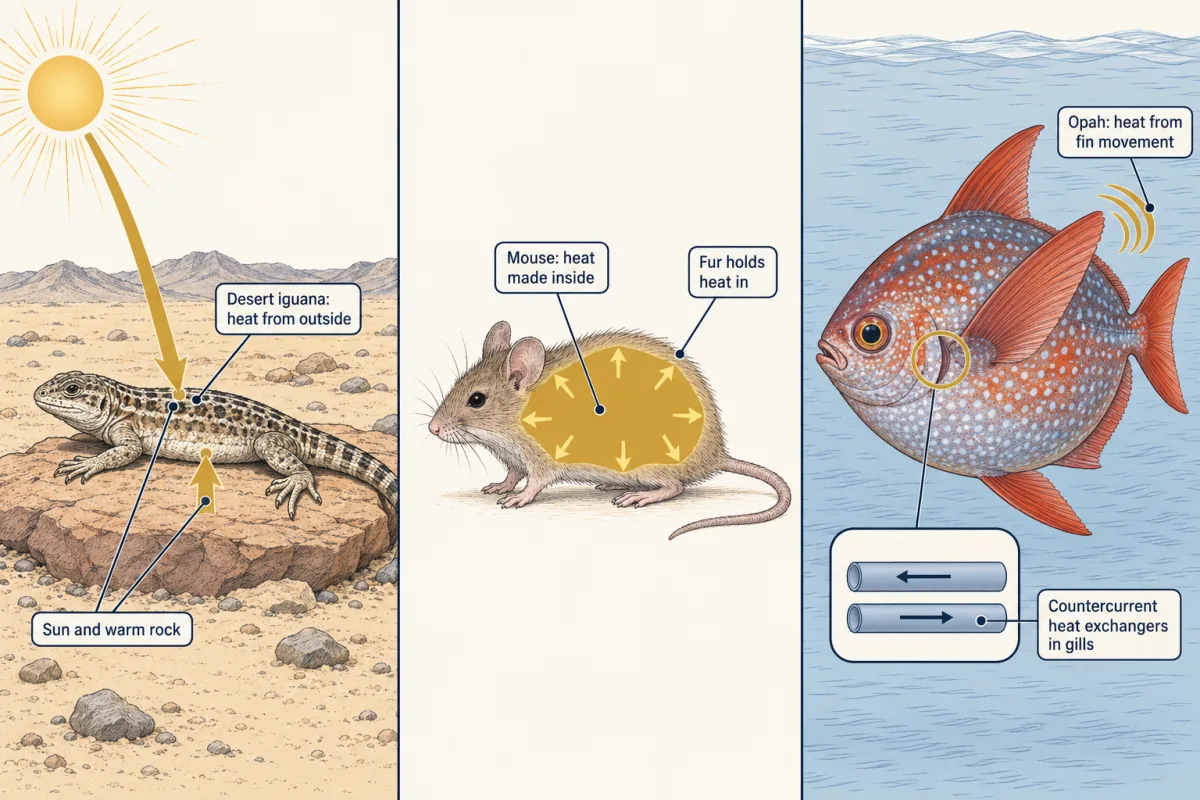
Some insects are partly endothermic too: bumblebees and many moths warm their flight muscles before take-off by a kind of shivering.
Sensing and control: what the controller does
Behind the first film’s controller: in mammals, temperature-sensing nerve cells in the skin report the surroundings, and those in the brain, spinal cord and abdominal organs report the core, the part whose temperature is defended. The controller, centred in the preoptic area of the hypothalamus, weighs these signals against its set point, the temperature it aims for (tissues, organs and homeostasis introduced set points).
Feedback responses start when the core moves away from its defended range, as when exercise heats the body. Feed-forward responses start from the skin before the core has changed, like pulling your sleeves down the moment cold air touches your arms.
Behaviour tends to come before the costlier physiological responses. In the cold, a mammal seeks warmth or huddles, then narrows its skin arteries and makes more heat. In the warm, it widens its skin vessels, then turns heat production down and evaporates water: humans and horses sweat, dogs and many birds pant, and rodents spread saliva on their fur.
Two responses raise M. Shivering is involuntary, rhythmic contraction of opposing muscles at the same time, so little external work is done and the energy appears as heat. Many mammals also have brown adipose tissue, whose mitochondria carry the protein UCP1, which lets protons leak back across the inner membrane so food energy becomes heat instead of ATP (see the proton-motive force). The same controller switches on both. Ectotherms run the same kind of loop mainly through behaviour, changing G.
Shivering and brown fat burn fuel. As the air cools, when does a mouse start paying, and how much? The second film measures it.
Read the transcript of “The Price of Cold”
Film transcript: The Price of Cold
Put a mouse in a chamber and cool the air, one step at a time. What happens to the heat it makes? And why does nothing happen at first? The first film drew the body as a tank. Heat made flows in through the orange tap. Heat leaks out through a blue outlet whose width can change. Now we watch what holding the level costs. In this model, we leave out sun and evaporation. So heat made must match the blue leak. We read heat made from the oxygen the mouse uses. At each step, we plot one orange point.
At first, the orange points stay flat. The mouse holds its temperature without making extra heat. Instead, it narrows the blue outlet. Skin vessels close, and fur lifts. This flat stretch is the thermoneutral zone. The resting rate along it is the basal metabolic rate, measured at rest and not digesting. But the outlet can only get so narrow. At the lower critical temperature, our model mouse reaches its narrowest outlet. Its conductance is at its minimum. Below that, the model holds the outlet at its minimum. Now only the orange tap can answer. Each degree colder adds the same extra heat. So the points climb in a straight line. Extend that line toward warmer air, and it reaches zero at body temperature.
That zero is only arithmetic. A living animal always makes some heat. Per Scholander, Laurence Irving and colleagues measured curves like this. They plotted resting heat made against air temperature, for mammals from the arctic and from the tropics. Now give an animal thicker fur, with the same basal rate and body temperature. Does the bend move to colder air, or to warmer air?
Colder. A narrower outlet can carry the basal heat away only across a bigger gap. And below the bend, the climb is shallower. That is the pattern they found. Thick-furred arctic mammals stayed on their flat line into far colder air than tropical ones. The difference lay mainly in insulation, not in a higher basal rate. So the curve is the heat balance, plotted against the air. Conductance sets where the bend falls, and how steeply the cost climbs below it.
From the film
- In the textbook thermoneutral zone, a resting endotherm stays at its basal rate and holds its temperature by changing conductance.
- In the chamber model, with conductance at its minimum and body temperature steady, each degree below the lower critical temperature costs the same extra heat.
- Thicker insulation moves the bend to colder air and makes the climb below it shallower.
- In Scholander and Irving's comparison, arctic and tropical mammals differed mainly in insulation, not in basal rate.
The cost of keeping warm: numbers on the curve
The second film drew the curve; here are its numbers, the hot end and how real conductance drifts. One reminder of the rule: with no sun (G = 0) and evaporation neglected, though breath and skin always lose some water, heat made = C × (Tb − Ta).
The second film’s oxygen gauge is indirect calorimetry: each litre of oxygen corresponds to roughly 20 kJ, depending on the fuel (see integration of metabolism). The flat level is the basal metabolic rate (BMR), measured in an endotherm that is awake, resting, postabsorptive (not digesting a meal) and within its thermoneutral zone, the range of air temperatures over which it spends no extra energy on heating or cooling. That flat zone is the textbook picture; mouse measurements complicate it (Going deeper).
Take an invented mouse-like endotherm: body 37 degrees C, BMR 0.25 W, and a conductance it can set anywhere from 0.10 W per K (vessels open, fur flat) down to a minimum of 0.035 W per K. For each air temperature, ask: what conductance would leak exactly the basal heat, BMR ÷ (Tb − Ta)? Inside the animal’s range, it stays basal; below its minimum, it must make more heat.
| Air (degrees C) | Conductance that would shed exactly BMR (W per K) | Heat made (W) |
|---|---|---|
| 35 | 0.125, more than its widest 0.10 | 0.25 if evaporating cost nothing; evaporation must remove at least 0.05 W |
| 33 | 0.063 | 0.25, basal |
| 30 | 0.036, just inside its range | 0.25, basal |
| 25 | 0.021, below its minimum | 0.42 |
| 21 | 0.016, below its minimum | 0.56, about 2.2 × BMR |
The bend falls where the needed conductance reaches the minimum: lower critical temperature = Tb − BMR ÷ Cmin = 37 − 0.25 ÷ 0.035, about 29.9 degrees C, close to the measured mouse thermoneutral point of 29 to 33 degrees C (see Going deeper), so animal rooms near 20 to 22 degrees C are cool for a mouse. At the warm end, even the widest C, 0.10 W per K, can shed BMR only across a gap of 2.5 K, so above about 34.5 degrees C dry loss alone falls short: evaporation must grow, or body temperature must rise. That is a threshold of the dry model, not the upper critical temperature, where active heat loss such as panting starts to raise metabolic rate; the model leaves out that cost.
Predict. The second film showed that thicker fur moves the bend to colder air. By how much? Suppose, in round illustrative numbers, an arctic fox and a tropical mammal have the same basal rate and a body temperature near 37 degrees C, and the fox’s curve bends near −40 degrees C while the tropical animal’s bends near +27 degrees C. How many times lower must the fox’s minimum conductance be?
Check your prediction
The bend sits where the smallest C can just carry away the basal heat: BMR = Cmin × (Tb − lower critical temperature). The gaps are about 77 K and 10 K, so the fox’s Cmin is roughly 7 to 8 times lower.
The second film’s straight cold limb, steepness C, aimed at zero at Tb, is the model; exam problems use it unless told otherwise. Real animals keep lowering conductance a little as the air cools, by curling up, fluffing fur and narrowing skin vessels, and body temperature can drift, so measured cold limbs are often shallower and need not reach zero exactly at Tb. Steepness equals conductance only if both stay roughly constant.
Predict. In a shaded chamber, the air and walls reach 40 degrees C, warmer than the mouse’s 37. Which terms of the balance can still carry heat out?
Check your prediction
Only evaporation. With the whole surroundings at 40 degrees C, the dry leak has turned negative: radiation, conduction and convection bring heat in, so E must remove the metabolic heat plus everything the surroundings add. (If only the air were hot, the animal could still lose heat to a cooler sky or ground.) Above the upper critical temperature, metabolic rate rises again, partly because panting takes work and probably because a warmer body runs its chemistry faster.
Worked problem. The numbers here are invented for practice. A small endotherm holds its body temperature at 37 degrees C with a constant conductance C = 0.020 W per K. Assume steady state (no heat stored), no external work, and air temperatures below its lower critical temperature, so heat production equals heat loss:
heat production (W) = C (W per K) x (body temperature - air temperature) (K)
- At 27 degrees C the difference is 10 K. Heat production = 0.020 W per K x 10 K = 0.20 W.
- At 17 degrees C the difference is 20 K. Heat production = 0.020 W per K x 20 K = 0.40 W.
- Extra power: 0.40 W - 0.20 W = 0.20 W. Check: 0.020 W per K x (27 - 17) K = 0.20 W.
- Extra energy in a day: 0.20 J per s x 86,400 s = 17,280 J, or 17.28 kJ.
- Assume fat yields about 39 kJ per g. Then 17.28 kJ / 39 kJ per g = about 0.44 g of fat per day.
The cost doubled only because, with C fixed, these numbers double the gap; 10 degrees of cooling does not generally double metabolism. Fluff the fur so C falls to 0.010 W per K, and the cost at 17 degrees C drops back to 0.20 W.
- Heat production at air 1
- Heat production at air 2
- Extra power (air 2 minus air 1)
- Extra energy per day
- Fat for that energy, assuming fat yields about 39 kJ per g
In this sketch (invented numbers for a small endotherm): steady state, no heat stored, no external work, constant conductance, body held at 37 °C, air below the lower critical temperature.
Below the lower critical temperature the size of the slope (steepness) of the line is the conductance; with C fixed, a bigger gap between body and air means more heat to make.
Fever, torpor and hibernation: changing the target
Predict. At the start of a fever the target rises, say from 37 to 39 degrees C, but the body is still at 37. Does the patient feel hot or cold, and what does the body do?
Check your prediction
Cold. Body temperature is now below the target, so the controller acts as if the body were chilled: it conserves heat and makes more, for example by shivering, until it reaches the new level.
Fever is regulation of body temperature at a raised level. In mammals, signals from an infection lead the cells lining brain blood vessels to make prostaglandin, which acts on the brain’s temperature-control region and raises the temperature it defends. Innate immunity follows the immune side.
Ectotherms have fever too, by behaviour: infected desert iguanas offered a choice of temperatures settled about 2 degrees C warmer. Does that help? In 1975 Matthew Kluger and colleagues held infected iguanas each at one fixed temperature, so they could not choose, and survival was greater at the higher temperatures than at the lowest: a benefit of warmth in this lizard with this infection, though survival alone does not show what the warmth changed.
Torpor is a controlled drop in metabolic rate and body temperature in a bird or mammal. Daily torpor conventionally lasts under 24 hours; fasted laboratory mice housed at 22 degrees C enter it, cooling for hours and then rewarming. Hibernation is prolonged, usually seasonal torpor. In small hibernators such as ground squirrels it is a series of torpor bouts, each lasting days to several weeks, broken by periodic arousals that are costly in energy, and body temperature can fall to near freezing. Black bears hibernate differently: body temperature stays at roughly 30 to 36 degrees C for months, with no periodic arousals.
Siniša Hrvatin and colleagues (2020) found that reactivating neurons in the hypothalamic preoptic area brought on key features of torpor in mice that were not food-restricted, and that inhibiting an identified group of them disrupted natural torpor. In black bears, metabolism falls to about a quarter of basal at those temperatures, far more of a fall than that modest cooling explains, and it stays low after body temperature recovers (worked through in Going deeper). That points to active metabolic suppression.
Design problem
Does the body wait for its core to cool? A mouse is moved from warm air into cool air. Within minutes its skin blood vessels narrow and it starts making extra heat, before a thermometer deep in its body shows any fall. Which sensors could have started the response? Design an experiment that would tell sensing in the skin apart from sensing in the core and brain.
Saved in this browser only.
One way to do it
The skin. The core had not changed, so core feedback cannot have started the response; skin sensors drove a feed-forward response through the preoptic area.
To test it, change the temperature of one site while holding the others steady, and record skin blood flow and heat production. Cool the skin while keeping the core warm: if skin sensing drives the response, the skin vessels narrow and heat production rises anyway. Then warm or cool a small region of the preoptic area alone while the skin and air stay steady. Experiments of this kind have shown that local cooling or warming of the preoptic area brings on coordinated cold-defence or heat-defence responses, and that the skin, spinal cord, abdominal organs and brain all provide input that the controller sums.
One caution. Removing a single kind of sensor may not stop regulation. Mice with the gene for the cold sensor TRPM8 disrupted largely compensate and keep core temperature in a broadly normal range, because the system has several overlapping inputs. A normal body temperature after a knockout does not show that the sensor plays no part.
Going deeper
Measuring metabolic rate: conditions and scaling
Standard metabolic rate (SMR) is the ectotherm’s equivalent of basal metabolic rate (BMR): resting, postabsorptive, and at a stated temperature, because its rate changes with temperature. In threespine sticklebacks acclimated to 5, 12 or 20 degrees C for 7 to 21 weeks, SMR rose with acclimation temperature. Daily energy expenditure is everything over 24 hours: activity, digestion, heating, growth. The work of exercise adds to it but is not part of BMR, which by definition is measured at rest. Daily expenditure can be far above the resting rate: 3.1 times the thermoneutral resting rate, on average, in single-housed male mice kept at 21 degrees C (Fischer, Cannon and Nedergaard, 2018).
Across mammals and birds, whole-body BMR rises more slowly than body mass, so a gram of mouse spends far more than a gram of elephant. The rise is often written as roughly the 3/4 power of mass (Kleiber’s relation). That exponent is a fitted value, some analyses find nearer 2/3, and its cause is unsettled; see size and scaling.
The mouse’s thermoneutral point
Škop and colleagues (2020), recording metabolic rate and body temperature together in laboratory mice, found no range of air temperature where both stayed constant, as the textbook flat zone assumes, and placed the mouse’s thermoneutral point near 29 degrees C in the light phase and 33 degrees C in the dark.
Where the balance stops: stored heat
A lizard warming on a morning rock is storing heat, so the steady-state balance gives only where its warming curve levels off, not how fast it gets there.
Who described the opah
In 2015 Nicholas Wegner and colleagues showed that heat from its pectoral-fin muscles is kept by countercurrent exchangers in its gills, so blood leaving the gills is not cooled all the way to water temperature as in most fish. There the heat passes between the arteries carrying blood into and out of the gills.
Fever: the evidence in detail
The vessel-lining source of the prostaglandin was traced in mice given bacterial lipopolysaccharide into a vein.
In the 1975 lizard study, Matthew Kluger, D. H. Ringler and M. R. Anver held each infected iguana at one of five air temperatures, 34, 36, 38, 40 or 42 degrees C. The result does not transfer automatically to mammals or other infections. The paper’s own test of bacterial growth in culture found it similar from 34 to 40 degrees C, which pointed to the host’s defences rather than direct harm to the bacteria, but the host change was not identified.
Is hibernation just cooling? A worked estimate
Use illustrative numbers in the pattern of Tøien and colleagues (2011): a black bear’s metabolic rate falls to 25% of basal while its body temperature falls from 37 to 33 degrees C. Assume a Q10 (the factor by which a rate changes per 10 degree C change in temperature) of 2.5. How much of the fall could cooling explain, and what measurement would separate cooling from active suppression?
One way to do it
Passive cooling predicts:
predicted fraction of basal = Q10 ^ ((T - T0) / 10) = 2.5 ^ (-4 / 10) = 2.5 ^ (-0.4)
ln 2.5 = 0.916; times -0.4 gives -0.367; e ^ (-0.367) = 0.69. Cooling alone predicts 69% of basal. The bear is at 25%, so a further factor of 0.25 / 0.69 = 0.36 is left unexplained by temperature: most of the suppression is something other than cooling.
To separate the two, record oxygen consumption and body temperature together, continuously, through hibernation and emergence. If metabolism simply followed temperature, it would recover with it. In the real bears it stayed low for up to three weeks after body temperature had returned to normal and they had emerged, which separates the two in time.
The Q10 of 2.5 is an assumption; there is no universal Q10. And a bear’s answer does not transfer to a ground squirrel that cools near 0 degrees C, where the much larger temperature fall may account for more of the drop, though small hibernators also suppress metabolism actively.
Your notes
Select any text in the lesson to highlight it or add a note to it. Your highlights and notes are saved in this browser and collected in your notebook.
This browser is not letting the site save anything (a private window or strict privacy settings), so highlights and notes will be lost when you leave the page.
How we measure it
Indirect calorimetry (respirometry)
Place the animal in a chamber with a known airflow and measure how much oxygen it takes up and how much carbon dioxide it gives off. Oxygen use converts to energy use, about 20 kJ per litre of oxygen depending on the fuel, so this gives metabolic rate without measuring heat directly.
Implanted temperature telemetry
Implant a small transmitter that reports internal body temperature by radio while the animal moves freely. Recorded at the same time as calorimetry, it shows whether metabolism and body temperature change together or apart, the evidence behind the mouse thermoneutral-point and bear hibernation studies.
Holding infected animals at fixed temperatures
Infect animals in the same way, then hold groups at different constant temperatures so they cannot choose their own, and compare survival. It tests whether a raised temperature changes the outcome, though by itself it does not show which process in host or microbe changed.
Whole-body thermal conductance from calorimetry
Divide an endotherm's measured heat production by the difference between its body and air temperatures, below its thermoneutral zone and with body temperature steady. The result, in watts per kelvin, is how readily heat leaks out, and it lets you compare insulation across animals or predict the cost of colder air.
Practice questions on this lesson (3) → MCAT-style, original, each with an explanation
Where this lesson fits
Before thisReview first
- Tissues, Organs and HomeostasisThis course · Lesson 6
It introduces set points and feedback control, which the temperature controller here uses.
- Size, Scale and SurfaceThis course · Lesson 2
It explains why small bodies lose heat fast for their mass, which sets the mouse's high conductance per gram.
- What an Organism Has to DoThis course · Lesson 1
It sets up the idea of an organism balancing exchanges with its surroundings, which this lesson applies to heat.
After thisStudy next
- Innate Immunity: Recognize and RespondThis course · Lesson 17
It follows the immune signals behind fever, which here raise the temperature the controller defends.
- Circulation and the HeartThis course · Lesson 10
It extends skin blood flow and countercurrent heat exchange into the circulatory system.
Elsewhere on the siteFilms, simulations and method films in other courses
- When the Body Pushes BackFilm · Biology
It shows how opposing responses push a body variable back toward its range, as the temperature controller does.
- Step through a feedback loopSimulation · Biology
Stepping through a feedback loop lets you see a sensor and effector hold a set value like body temperature.
Suggested by an AI model from the lessons themselves, then checked. How we use AI
Finish line
Test yourself
8 questions
Practice and MCAT-style, with explained answers.
Next · Lesson 10
Circulation and the Heart
An adult human holds about 5 litres of blood, yet at rest each side of the heart pumps about that much every minute. Where does it all go?
Continue →