Organismal Biology · Unit 6: How plants work
Auxin and Plant Hormones: How Plants Steer Growth
Rewritten on : new text, flashcards and film. Your notes and highlights stay, but the text around them may have moved.
Light an oat seedling from one side and it bends toward the lamp. The tip senses the light, yet the bend forms lower down. What told it?
Pause when the reading reaches a film, and offer to play it. Saved on this device.
Watch the film now, or keep listening
Builds on:Plant Body and GrowthHormones and the Endocrine SystemMoving Water and Sugar in PlantsWhy these?
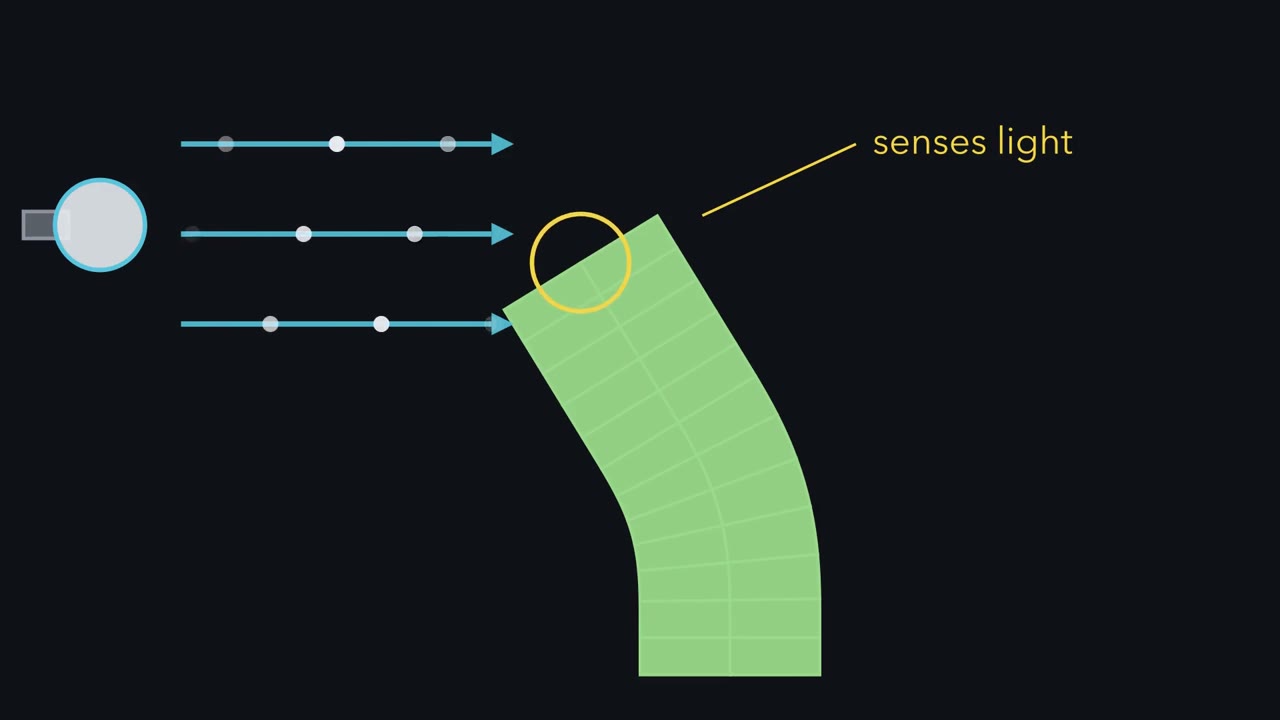 ▶ Watch Which Side Grows Faster? · 3:10
Read the transcript of “Which Side Grows Faster?”
Film transcript: Which Side Grows Faster?
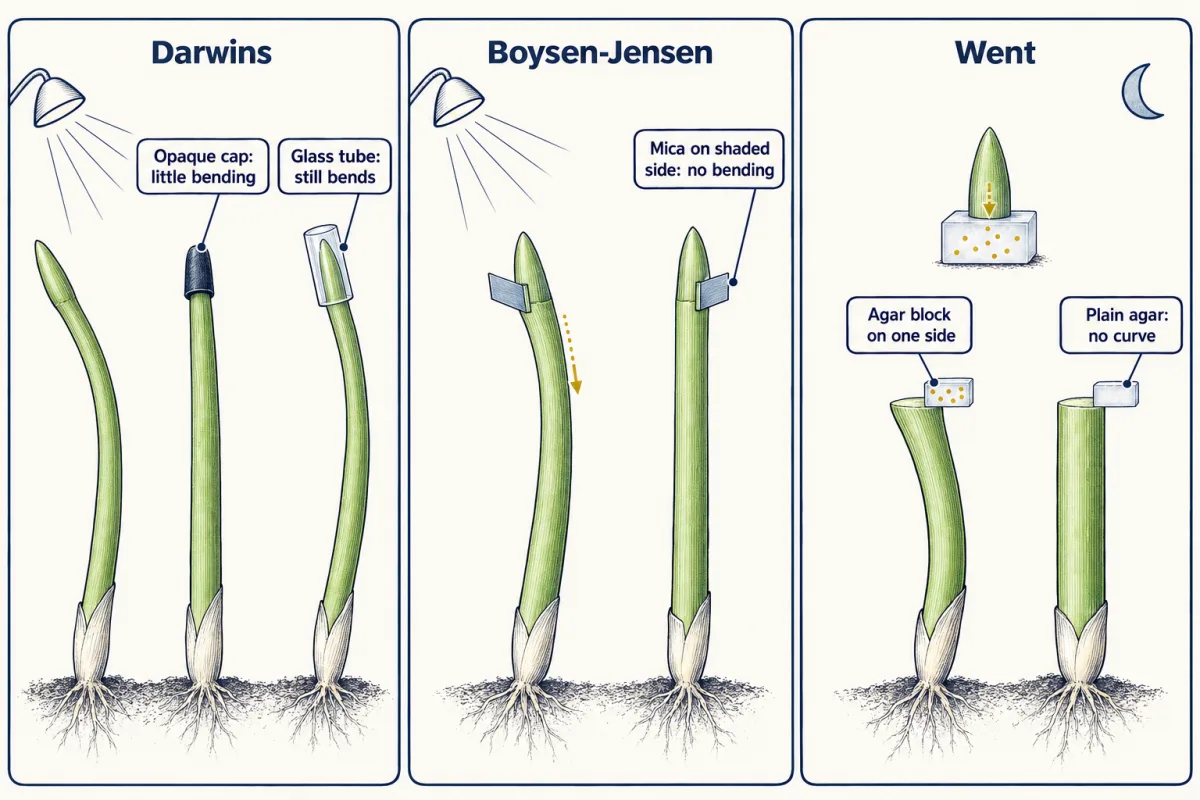
Light an oat seedling from one side, and it bends toward the lamp. The tip senses the light, yet the bend forms lower down. What carries the message? Picture the young shoot as two columns of cells, one on each side. Each side is called a flank. If both flanks lengthen by the same amount, the shoot grows taller. But it stays perfectly straight, however much it grows. Now let the shaded flank lengthen a little more than the lit flank. The shoot curves toward the light. A bend is simply a difference in growth. So what speeds the shaded flank? Charles Darwin and his son Francis lit canary-grass seedlings from one side. An opaque cap over the tip greatly reduced the bending.
The lower part was still lit. So light is sensed mainly near the tip, and something passes down to where bending happens. Peter Boysen-Jensen used oat coleoptiles, the sheath over a grass seedling's first leaf. He slipped thin mica, which dissolved chemicals cannot cross, into a cut below the tip. With mica on the shaded side, the coleoptile stayed straight. With mica on the lit side, it still bent. Boysen-Jensen concluded that the signal runs down the shaded side. Frits Went then stood cut tips on small blocks of agar, a gel. In darkness, he set one block on one side of a coleoptile whose own tip was cut off. The coleoptile curved away from the block.
Something from the tips had sped growth beneath it. We now call that activity auxin. Why does the shaded flank end up with more auxin? Light could destroy auxin on the lit side. Or light could move auxin across to the shaded side. Here is the test. Collect all the auxin from tips lit on one side, and from tips kept dark. If light only moves auxin, how should the totals compare?
Briggs and colleagues split tips with a thin barrier and caught each half in its own block. Lit tips gave the same total as dark tips. But more came from the shaded half. So in these grass tips, the unchanged total supports auxin moving to the shaded side, rather than being destroyed. The auxin-rich shaded flank grew faster, and the shoot bent toward the light. Growth follows the auxin level, but not in strict proportion. It rises to a peak. Past that peak, more auxin slows growth. So a bend is a difference in growth. Light makes that difference by moving auxin to the shaded flank.
From the film
- A shoot bends because its two flanks grow at different rates: the shaded flank lengthens more than the lit flank.
- The Darwins showed that light is sensed near the tip; Boysen-Jensen concluded that a substance from the tip passes down the shaded side; Went collected it in agar.
- Split grass coleoptile tips gave the same total recovered auxin activity in light and in the dark, but more came from the shaded half: the unchanged total supports auxin moving to the shaded side rather than being destroyed.
- Growth is not proportional to auxin: over a wide range it rises to a peak, and past the peak more auxin slows growth.
The first film answers the hook; the text adds the controls, the steering and the limits.
The one idea. A shoot or root bends because its two flanks, its opposite sides, grow at different rates. Light or gravity sends more of the hormone auxin to one flank. Over the range of auxin these seedlings use, the auxin-rich flank grows faster in a shoot and slower in a root.
Scope: tropisms of young seedlings in the species tested (oat and other grasses, and Arabidopsis). The evidence that light moves auxin rather than destroying it comes from grass coleoptile tips and supports, rather than proves, that reading; for some broad-leaved seedling stems it is still argued over. Growth is not proportional to auxin: past a peak, more auxin slows growth.
Bending toward light: what the controls ruled out
A hormone is a chemical made in small amounts that changes what cells do, in the cell that made it or elsewhere in the body. Vertebrates make most of theirs in glands and carry them in blood (the endocrine system); in plants, many kinds of cell make hormones, and the response is often a change in growth. A tropism is growth toward or away from a one-sided stimulus, and phototropism is one in response to light. The classic experiments used grass coleoptiles, the sheath that covers the first leaf of a grass seedling as it pushes up through the soil.
Each of the film’s results is only as strong as its control:
- The Darwins. An opaque cap might stop bending just by covering the tip. Transparent glass tubes also covered the tips, yet bending continued, and the lower part was lit throughout. Only with both controls does the cap place sensing at the tip.
- Boysen-Jensen. Tips cut off and set back in place still produced bending below the cut, so the influence crossed a wound. Mica (a mineral sheet that dissolved chemicals cannot cross) on the lit side controls for the shaded-side mica: both cuts wounded, but only the shaded-side barrier blocked bending.
- Went. Darkness ruled out one-sided light, and cutting off the coleoptile’s own tip ruled out that tip. Plain agar (a seaweed gel) caused no curve, ruling out the gel.
Went’s angle could be measured, making a bioassay: a measurement of a chemical through the response of living tissue. Within a calibrated range (the concentrations a standard line covers), more curvature means more auxin activity. Went measured activity, not the chemical; indole-3-acetic acid (IAA), the main natural auxin, was identified later by others.
Moved or destroyed?
The film’s split tips (Briggs and colleagues, 1957) hide one design detail: the barrier ran up from the base but stopped short of the top, so each half drained into its own agar block while auxin could still cross above.
Predict. Push the barrier all the way through the tip, so the halves cannot exchange anything, and light it from one side. What happens to the difference between the two blocks?
Check your prediction
It disappears. Auxin has to cross the top of the tip to reach the shaded side, which is what “moved” means.
Sideways movement of auxin toward the shaded flank is the Cholodny-Went hypothesis, named for the two botanists who proposed it.
How is auxin steered? It leaves a cell through carriers called PIN proteins, and many sit mainly on one face, so their placement sets auxin’s direction. In Arabidopsis thaliana, a small weed that is the standard lab plant, light from one side changes where the carrier PIN3 sits on the cell membrane in the hypocotyl, the seedling stem below the seed leaves, helping steer auxin toward the shaded side. The light is detected by a blue-light receptor, phototropin (first studied as NPH1).
Up and down: gravitropism in roots and shoots
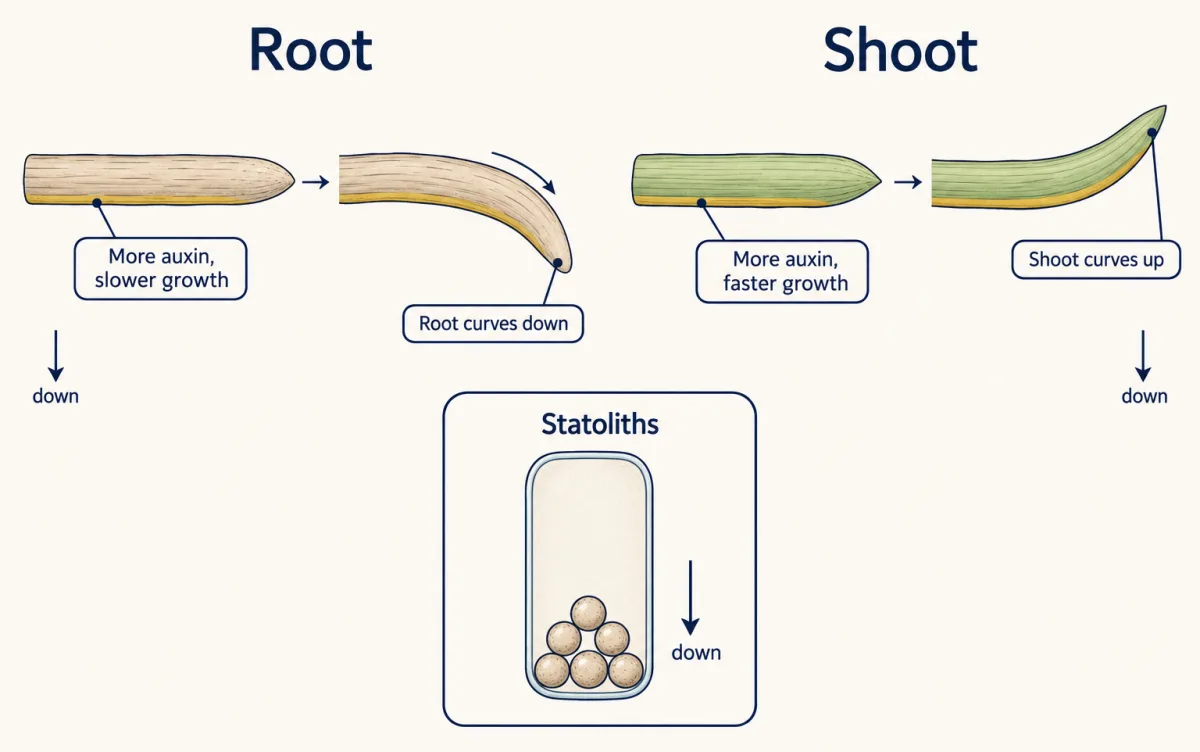
Gravitropism is a growth response to gravity. Laid on its side, a seedling’s shoot turns up and its root turns down, though both gather auxin below. The second film works out how, using the growth peak from the first film.
Read the transcript of “Same Auxin, Opposite Bends”
Film transcript: Same Auxin, Opposite Bends
Lay a seedling on its side. Its shoot turns up, and its root turns down. Yet both gather auxin on their lower side. How can one signal give opposite bends? The first film showed light moving auxin to the shaded flank, which grew faster.
Gravity moves auxin too. Same gold dots, new direction. This time, though, the shoot and the root disagree. First, the plant must sense which way is down. In the root cap, central cells called columella cells hold plastids packed with dense starch. Turn the root on its side, and these heavy plastids sink to the new floor of each cell. They act as statoliths, one of the root's gravity sensors. Auxin leaves cells through carriers called PIN proteins. In Arabidopsis root-cap cells, one carrier, PIN3, moves quickly to the new lower face. So auxin flows toward the lower side of the root. In the shoot, extra auxin gathers along the lower flank too.
You met the rule at the start of the lesson. Now apply it to the root. Auxin piles up on its lower flank. Does that flank grow faster or slower than the top? Slower. In the root, this auxin inhibits elongation of the lower epidermal cells. The upper flank outgrows it, and the root curves down. In the shoot, extra auxin speeds elongation of the lower flank. So the shoot curves up. Why opposite answers? Plot growth against auxin level for each organ. Each curve rises to a peak, then falls. Roots respond to much lower auxin levels than shoots. So the root's curve sits far to the left. Where does each organ work on its curve? In the classic picture, a shoot works on its rising slope.
There, more auxin means faster growth. A root works past its peak. There, more auxin means slower growth. So the same kind of signal gives opposite bends. But these curves give the sign of each bend, not its cause. Each tissue turns auxin into growth in its own way. Why roots are so sensitive is still not fully explained. The plant is not reaching for anything. Light or gravity, the rule is the same. The plant moves auxin to one flank. That flank grows faster in a shoot, and slower in a root.
From the film
- Dense starch-filled plastids settle to the lower side of root-cap cells and act as one gravity sensor.
- In Arabidopsis root-cap cells, PIN3 carriers move to the new lower face and send auxin toward the lower side.
- Roots respond to much lower auxin levels than shoots. Over the range involved, more auxin on the lower flank slows a root there and speeds a shoot, so the root curves down and the shoot up.
- The dose curves give the sign of each bend, not its cause: each tissue turns auxin into growth in its own way, and why roots are so sensitive is not fully explained.
The film stayed in the root cap, where PIN3 moves quickly to the new lower face (Friml and colleagues, 2002). Shoots have statoliths too, in the endodermis, a starch sheath around the stem’s central tissue, and are thought to sense by weight too, though the evidence comes from roots: when Caspar and Pickard (1989) inverted wild-type Arabidopsis seedlings, the plastids in the root-cap columella sank toward the new lower side. Vertebrates use the same physics: in the inner ear, dense crystals shift with gravity and bend sensory hair cells (sensory coding).
Predict. Starchless Arabidopsis mutants have no dense statoliths. Grown in light and laid on their side, do their roots still turn down?
Check your prediction
Largely, yes: starchless mutants grown in light kept substantial root gravitropism. Statoliths are one gravity sensor, not the only one, and the other route is not settled.
The film’s curves are schematic. Real root and shoot flanks have not been placed on one shared auxin axis, and the two organs need not gain the same amount. For light and gravity alike, the auxin-rich flank grows faster in a shoot and slower in a root.
The other hormones
Predict. Cut the growing tip off a shoot. What happens to the side buds below it?
Check your prediction
In a shoot with strong apical dominance, they usually start to grow. Losing the tip’s auxin is part of the release, with cytokinins and strigolactones (below).
The main plant hormones, each with one effect and the organism it was shown in:
- Auxin speeds elongation of shoot cells (in Arabidopsis, on the shaded side of the hypocotyl), drives tropisms, and helps maintain apical dominance, the suppression of side buds by the growing shoot tip. It does this together with cytokinins and strigolactones, a further hormone class that holds side buds back.
- Cytokinins promote cell division and slow leaf ageing. In transgenic tobacco that made extra cytokinin in ageing leaves, leaf senescence, the programmed yellowing and death of a leaf, was delayed.
- Gibberellins promote stem elongation and seed germination, the opposite of abscisic acid’s role in keeping seeds dormant. In the grain’s outer living layer, isolated from barley, gibberellic acid increased synthesis of a starch-digesting enzyme (Going deeper).
- Abscisic acid (ABA) induces stomatal closure in Arabidopsis (plant transport has the guard cells) and maintains dormancy, a state of arrested growth in seeds and buds.
- Ethylene, a gas, promotes fruit ripening. Tomatoes engineered to make little ethylene failed to ripen normally, and supplied ethylene restored ripening.
- Brassinosteroids, steroid hormones, promote cell elongation. Supplied brassinosteroids could make up for the short, poorly elongated cells of several Arabidopsis mutants.
- Jasmonates signal defence against plant-eating animals, and salicylic acid against some pathogens (end of the lesson).
Light as information: phytochrome, night length and a travelling signal
Phytochrome is a pigment protein that switches between two forms. The Pr form absorbs red light and converts to Pfr; Pfr absorbs far-red light and converts back to Pr. In an assay of Arabidopsis phytochrome B, 660 nm light drove Pr to Pfr and 740 nm the reverse (neither gives a pure form; Going deeper). In the simple model, Pfr is the active form. Pfr can also revert to Pr slowly in darkness. The lettuce-seed experiment that revealed this switch is the design problem.
Photoperiodism is a response to the relative lengths of day and night. A short-day plant flowers when nights are longer than a critical length; a long-day plant flowers when nights are shorter. Karl Hamner and James Bonner (1938) varied light and dark periods separately in cocklebur, Xanthium, a short-day plant. They reported that flowering depended mainly on the length of the dark period, and that the leaves perceived the inductive treatment. A brief flash of red light in the middle of a long night can stop a short-day plant from flowering. In the model taught here, phytochrome detects that flash but does not time the night: a daily clock does, and the plant’s sensitivity to such a flash rises and falls with that clock. Flowers form at the shoot apex, so a signal must travel there from the leaf.
In Arabidopsis, a facultative long-day plant (long days speed its flowering, but it still flowers in short days), part of the signal is known. The daily clock makes the RNA for the protein CONSTANS rise late in the day. The protein is stabilized by light in the evening and degraded in the morning or in darkness, so it builds up only when days are long enough for that late rise to happen in light. CONSTANS then promotes transcription of the gene FT in the leaf phloem. Corbesier and colleagues (2007) showed that FT protein made in phloem moves to the shoot apex, including across grafts. For the clock see sleep and rhythms; for flowering, plant reproduction. Do not assume it applies to cocklebur.
Signals of attack
Unlike vertebrates, plants have no circulating immune cells; each cell defends itself, and hormones spread the alarm. In Arabidopsis, a triple mutant with almost no jasmonate was attacked by larvae of the fungus gnat Bradysia impatiens, and applied methyl jasmonate substantially protected it. In tomato, insects that merely broke leaf hairs switched on jasmonate-regulated defence genes before any chewing.
Salicylic acid works in systemic acquired resistance, in which an infection in one part of a plant leaves uninfected parts more resistant to later attack. In tobacco infected with tobacco mosaic virus, salicylic acid was necessary for this response in the transgenic plants tested. Grafting experiments in tobacco showed that it is needed in the distant, protected leaves but is not itself the signal that travels there.
“Jasmonate for insects, salicylic acid for pathogens” is a tendency from tested systems, not a rule. The receptors that first detect a pathogen share logic with animals; innate immunity covers them.
Design problem
Lettuce seeds soaked in the dark get brief flashes of light, return to the dark, and germination is scored. Illustrative results, one seed batch, equal flash doses: dark only, 10%; red, 90%; red then far-red, 15%; red, far-red, red, 88%; red, far-red, red, far-red, 18%. What do they tell you, and what do they not?
Saved in this browser only.
One way to do it
Look at the last flash. Sequences ending in red give 88 to 90% germination; sequences ending in far-red give 15 to 18%, close to the dark control. Total light does not decide it: four flashes ending in far-red germinate less than one red flash.
The simplest explanation is one pigment that switches reversibly: red light converts it to a form that promotes germination, and far-red converts it back. This is the logic of Borthwick, Hendricks and colleagues’ 1952 Grand Rapids lettuce experiments.
The dark control, equal doses and a single batch point the differences at the order of flashes rather than the seeds; replicate groups would show how reliable they are.
The data neither identify the pigment chemically nor show that other seeds respond alike; many need no light to germinate.
Going deeper
The early experiments in more detail
The title page of The Power of Movement in Plants credits Darwin’s son Francis for assistance. Boysen-Jensen’s conclusion was disputed at the time: van der Wolk argued the influence could pass through any living cells, not only down the shaded side. Later barrier experiments were needed to settle it.
Worked problem: reading a curvature bioassay
These numbers are illustrative. Assume all agar blocks are the same size and collect for the same time, no auxin is lost during collection, and curvature is proportional to auxin concentration in this range.
auxin concentration (mg per L) = curvature (degrees) / 200 degrees per mg per L
- Calibrate. Standard blocks with 0.02, 0.04 and 0.08 mg per L of auxin give 4, 8 and 16 degrees. In each, curvature divided by concentration is 200 degrees per mg per L.
- Split tips. Tips lit from one side stand on two blocks, split partway up by a thin barrier as in Briggs’s design. The lit-half block gives 6 degrees: 6 / 200 = 0.03 mg per L. The shaded-half block gives 12 degrees: 12 / 200 = 0.06 mg per L.
- Shares. With block volume V litres, amounts are concentration times V: total = 0.03V + 0.06V = 0.09V mg. Shaded share = 0.06V / 0.09V = 67%; lit share = 33%. The ratio is 2 to 1.
- Dark control. A block of the same size from whole tips kept in the dark gives 18 degrees: 18 / 200 = 0.09 mg per L, so 0.09V mg, the same total amount.
- Block on the coleoptile
- Cursor reading
- Shares of the split tip
- Split total against dark total
- Hypothesis overlay
Rule to keep: auxin concentration (mg per L) = curvature (degrees) / 200 degrees per mg per L. In this sketch: illustrative numbers in the linear range, not data from a real experiment; equal block size and collection time; no auxin lost; the picture is a sketch of the logic, not to scale.
The total did not fall, so the result supports moving auxin to the shaded side rather than destroying it on the lit side, as the Cholodny-Went idea predicts. That reading assumes the blocks caught all the auxin and light did not also change how much the tip made. Real split-tip experiments exist; these numbers are not theirs, and a 2 to 1 split of auxin does not mean a 2 to 1 split of growth.
Inside the cell and inside the root
Inside cells, auxin binds a receptor that triggers destruction of repressor proteins (ubiquitin and proteolysis; the receptor field guide). The second film’s curves are the classic textbook picture, drawn against auxin on a log scale, with the root’s peak at far lower auxin; where a real flank sits on its curve has not been measured.
Why neither colour gives a pure form
The absorption spectra of Pr and Pfr overlap, so red light leaves a mixture that is mostly Pfr and far-red light leaves a small fraction of Pfr; neither treatment produces a pure form. The design-problem values are illustrative and have no replicate variation, so do not read anything into the small gap between the far-red-last groups and the dark control.
Gibberellin in barley aleurone
In isolated aleurone layers (the living outer layer of a cereal grain’s food store) of Himalaya barley, gibberellic acid increased synthesis of alpha-amylase, a starch-digesting enzyme, after a lag of 6 to 8 hours.
Pattern-triggered and effector-triggered immunity
Surface receptors start pattern-triggered immunity, mostly intracellular receptors start effector-triggered immunity, and in Arabidopsis tested with the bacterium Pseudomonas syringae, the two arms strengthened each other and neither alone gave effective resistance.
Your notes
Select any text in the lesson to highlight it or add a note to it. Your highlights and notes are saved in this browser and collected in your notebook.
This browser is not letting the site save anything (a private window or strict privacy settings), so highlights and notes will be lost when you leave the page.
How we measure it
Tip covering and barrier experiments
Cover a seedling tip with an opaque cap or a transparent tube, or insert an impermeable sheet such as mica into a cut on one side, then light the seedling from one side. Comparing the treatments shows where light is sensed and which route the signal takes, provided a control shows the covering or cut alone does not stop growth.
Oat coleoptile curvature bioassay
Let excised tips release their growth substance into agar, then place the block on one side of a decapitated coleoptile in the dark and measure the angle of curvature. Within a calibrated range, more curvature means more auxin activity in the block.
Sequential red and far-red light treatments
Give imbibed seeds or plants brief flashes of red or far-red light in different orders, with dark controls, and score germination or flowering. A response set by the last flash points to a pigment that switches reversibly between two forms.
Grafting with tagged proteins
Join the shoot of one plant to another, or make a protein carrying a visible tag only in certain cells, and look for the tag elsewhere. Finding a phloem-made FT protein at the shoot apex shows that the protein itself can travel.
Method films · the methods library
Practice questions on this lesson (3) → MCAT-style, original, each with an explanation
Where this lesson fits
Before thisReview first
- Plant Body and GrowthThis course · Lesson 22
You need the idea of cell elongation and growing tips from there to follow how flanks grow at different rates.
- Hormones and the Endocrine SystemThis course · Lesson 8
You need the definition of a hormone and how it differs from a nerve signal to contrast plant hormones with those.
- Moving Water and Sugar in PlantsThis course · Lesson 23
Stomatal closure by abscisic acid and phloem movement of the flowering signal rely on how water and sugar move in plants.
After thisStudy next
- Double Fertilization: How a Flower Makes a SeedThis course · Lesson 26
It builds on the flowering signal travelling from leaf to apex and shows how a flower makes a seed.
Elsewhere on the siteFilms, simulations and method films in other courses
- Set Up: Hidden Leaf ColorsFilm · Biology Together
A plant's changing leaf colour in autumn is a plant response to the shortening days that this lesson explains.
- RadioimmunoassayMethod film
Measuring tiny amounts of hormone by competition with a labelled copy is how auxin-like levels can be quantified.
Suggested by an AI model from the lessons themselves, then checked. How we use AI
Finish line
Test yourself
8 questions
Practice and MCAT-style, with explained answers.
Next · Lesson 26
Double Fertilization: How a Flower Makes a Seed
Dust a white-kernelled maize plant with pollen from a true-breeding yellow one, and its own ear fills with yellow kernels this season. How can the pollen parent change seeds on the mother's plant?
Continue →