Tap, Drain and a Sensor
Read the transcript of “Tap, Drain and a Sensor”
Film transcript: Tap, Drain and a Sensor
What can an organ send through the body without any nerves? And what decides how much of it is in the blood? A physician in Göttingen asked the first question with young cockerels. He castrated them. Without testes, the birds grew small combs, and they crowed little. In some birds he put a testis back into the belly. It was cut off from its original nerves. Those birds still grew combs and crowed. So the graft must have sent something through the blood. That something is a hormone. A hormone is a chemical released by one group of cells into the blood. The blood carries it to distant cells. Only cells with a receptor for it respond. Now picture the blood as a tank.
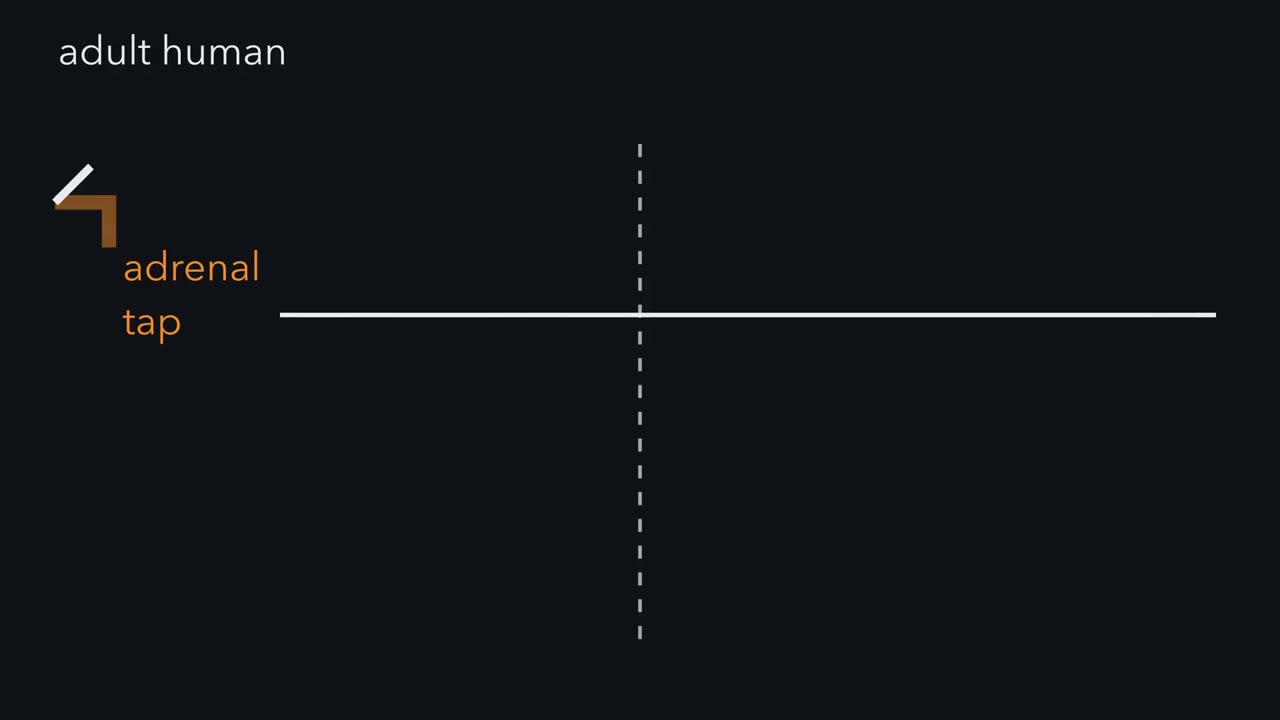
The gland is a tap, pouring hormone in. A drain stands for every way the body removes or breaks down the hormone. The water line is the hormone's level in the blood. It settles where what drains out matches what pours in. In tank terms, castration shut a tap, and the male traits faded. The graft opened a tap again, and the traits came back. Berthold never measured the hormone itself. In mammals, one tap can drive another. Take the human stress axis. The hypothalamus releases CRH. Short veins called portal vessels carry it straight to the anterior pituitary. The pituitary then releases ACTH. And ACTH makes the adrenal cortex release cortisol. Now add a sensor. Cortisol acts back on the hypothalamus and the pituitary, turning their taps down. When cortisol rises, the drive to make it falls.
When it drops, the drive rises. This is negative feedback, a response that opposes the change that caused it. Suppose the adrenal glands are removed. Cortisol falls, because nothing secretes it. What happens to ACTH? ACTH rises. With no cortisol feeding back, a key brake is gone. The hypothalamus and pituitary drive harder, but no adrenal can answer. Taking a gland away shows how the rest of the loop responds. Feedback does not freeze the level at one value. In humans, cortisol rises and falls over the day. It also comes in pulses, roughly every sixty to ninety minutes. Feedback adjusts the tap. It shapes a pattern rather than fixing a number.
So a hormone's level is a balance of secretion in and clearance out. Feedback works on the secretion. How fast the level can follow is a question about the drain.
A young cockerel's testis, moved to his belly and cut off from its original nerves, still made him grow into a crowing rooster. What was it sending?
Continue in the lesson: Hormones and the Endocrine System →
3:20 · Free, with captions and a transcript. The lesson has the full text, the questions and the sources.
More films from this lesson
How this film was made. Narration: written from this lesson's text and read by an AI narrator voice (Kokoro, af_heart). Animation: AI-generated in code (Manim) by Claude, a schematic with no drawn molecular structures. Captions come from the narration script. See something wrong? Report it.