Organismal Biology · Unit 1: Organisms and their diversity
New to this? Review it at high school level: Domains and Kingdoms
Animal Body Plans: Similar Bodies, Different Branches
Rewritten on : new text, flashcards and film. Your notes and highlights stay, but the text around them may have moved.
A nematode and an earthworm are both soft, tube-shaped worms with a gut from mouth to anus. Genes put the nematode with insects and other moulting animals, and the earthworm with snails and flatworms. What does a body plan tell you, and what does it not?
Pause when the reading reaches a film, and offer to play it. Saved on this device.
Watch the film now, or keep listening
Builds on:Size, Scale and SurfaceWhat an Organism Has to DoBuilding a Tree of LifeWhy these?
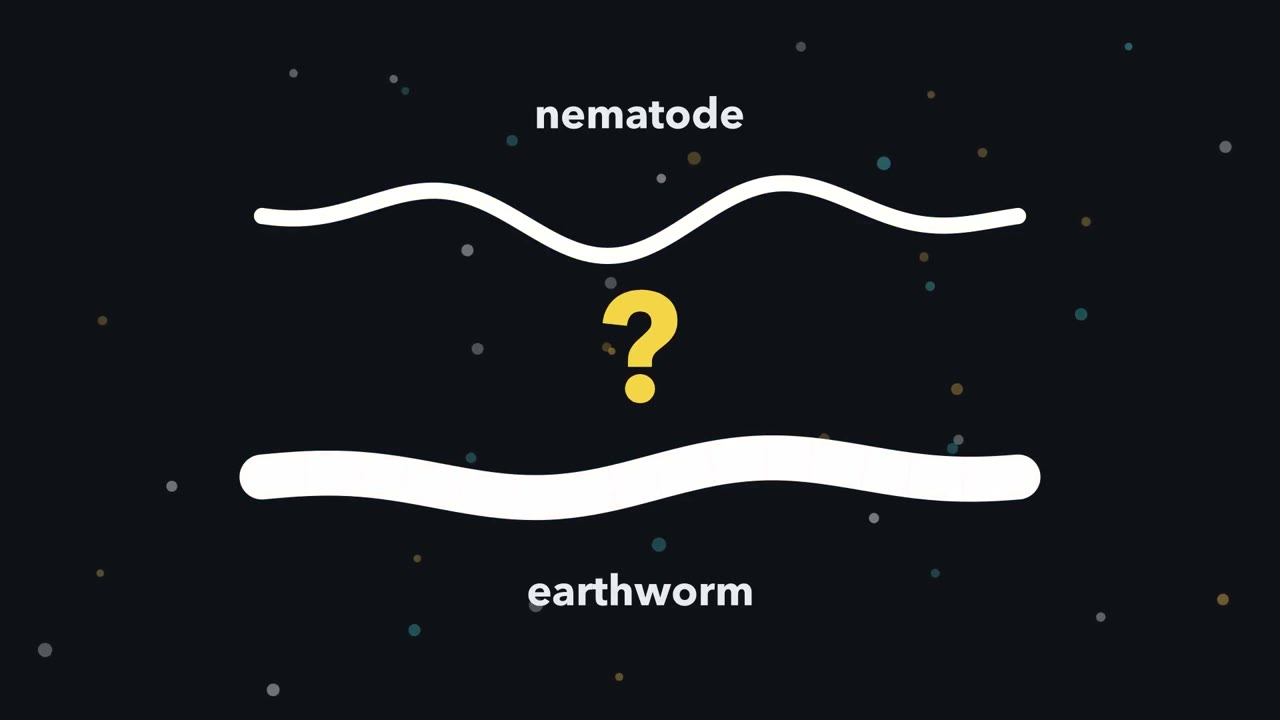 ▶ Watch Similar Bodies, Different Branches · 3:16
Read the transcript of “Similar Bodies, Different Branches”
Film transcript: Similar Bodies, Different Branches
A nematode and an earthworm look almost the same. Are they close relatives? Both are soft, tube-shaped worms. Each has a gut that runs from mouth to anus. Slice each worm across the middle. Add a third worm, a flat planarian. Now colour the tissue layers. The outer layer is blue. The middle layer, mesoderm, is orange. It makes muscle. The gut lining is yellow. The small white space in each centre is the gut lumen, where food goes. It is not the body cavity. The body cavity, if there is one, lies between gut and body wall. In the planarian, tissue fills that space. There is no body cavity. In the nematode, a fluid space is lined by mesoderm only on the outside.
That is a pseudocoelom. In the earthworm, the fluid space is lined by mesoderm on both sides. That is a true coelom. Three worms, three ways to fill the same space. Libbie Hyman's great survey of the invertebrates ordered animals this way. No cavity, then a partial lining, then a full one. It looks like a staircase, from simple to complex. Now compare genes from many animals instead. If the staircase were a family tree, where should the nematode land?
Between the flatworm and the earthworm, or somewhere else? Somewhere else. The genes put the nematode with the arthropods, such as insects. Both shed a tough outer cuticle as they grow. That moulting names the group, Ecdysozoa. The planarian moves too. It lands beside the earthworm and a snail, in a group called Spiralia. Its relatives have a coelom. So the flatworm is not an early, simple branch. Now mark each tip with its body cavity. The cavity marks are scattered across the tree. The moulting mark sits on one branch only. Animals that share a level of organization, like a body-cavity type, form a grade. A clade is something else. It is an ancestor and all of its descendants.
A shared, derived character can mark a clade. It is a new state that arose in a common ancestor. Moulting fits one origin on this tree. Cavity type changes several times. To test any character, lay it on a tree built from other evidence. Many genes are one such source. So keep two jobs apart. A body plan describes how an animal is built. Independent evidence tests whom it descends from.
From the film
- Body-plan characters, such as tissue layers and body cavity, are how biologists describe an animal.
- Animals that share a level of organization, such as a body-cavity type, form a grade; a clade is an ancestor and all of its descendants.
- Gene comparisons put nematodes with arthropods in Ecdysozoa, the moulting animals, and flatworms with earthworms and snails in Spiralia.
- A shared derived character, such as moulting, can mark a clade; body-cavity type changes several times on the gene tree, so it describes a grade.
- So a body plan describes an animal; independent evidence tests its ancestry.
The first film showed gene comparisons breaking Hyman’s staircase of body cavities. It left out the exact definitions, a way to decide which characters to trust, and the phyla in one place. The lesson builds on what an organism has to do and size, scale and surface, which explained why a flatworm can manage with no heart.
Characters you can see: symmetry, layers, cavities
A body plan is the basic layout an animal shares with its relatives: its symmetry, tissue layers, body cavity, gut and embryonic development.
Symmetry. Most sponges have no consistent symmetry. Radial symmetry arranges body parts around a central axis, like slices of a pie; several cuts through that axis give similar halves. Bilateral symmetry allows only one plane that divides the body into roughly equivalent left and right halves, usually with a front end where sense organs cluster.
Germ layers. A germ layer is one of the sheets of cells in the early embryo from which tissues form. A diploblastic animal has two, an outer ectoderm and an inner endoderm. A triploblastic animal adds a middle mesoderm, which forms muscle and much of the body wall.
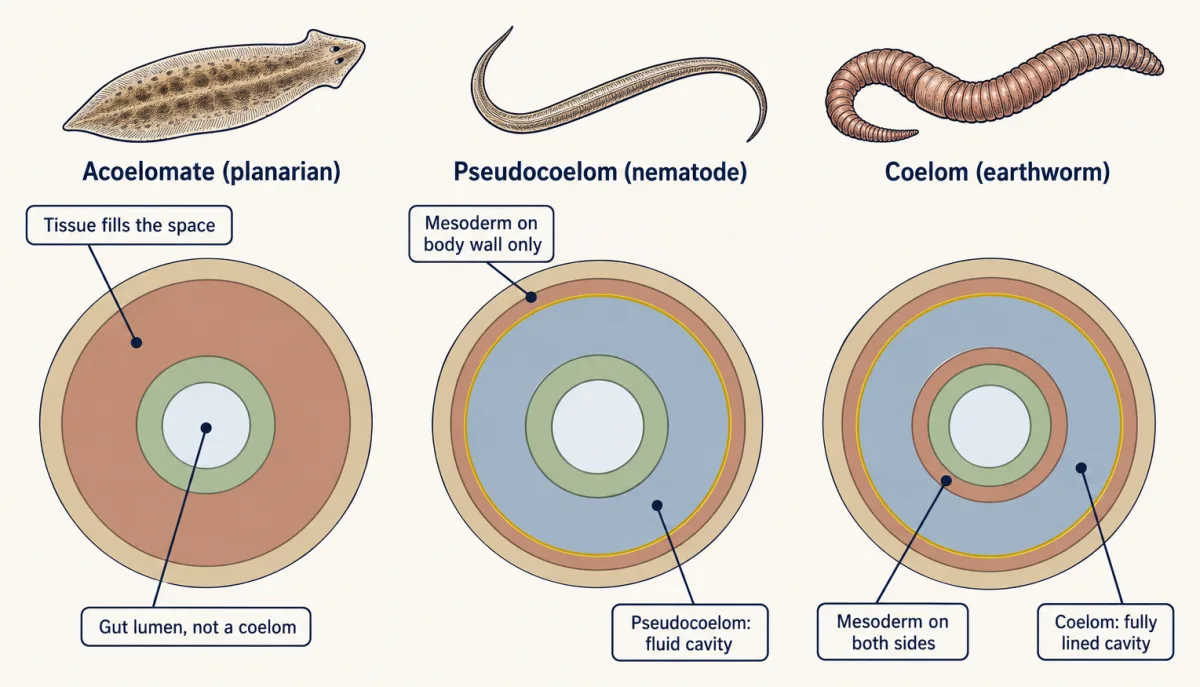
Body cavity. The film’s three cross-sections, defined: a coelom is a fluid-filled body cavity lined entirely by mesoderm; a pseudocoelom is a fluid-filled cavity that lacks a complete mesodermal lining around the gut; an acoelomate animal has tissue filling the region between gut and body wall. None is the gut lumen, where food goes: an acoelomate planarian still has a gut.
Applied to five animals: a sponge has no organs; the sea anemone Nematostella vectensis, usually described as diploblastic, has a one-opening gut and catches prey with cnidocytes, stinging cells; a planarian flatworm is bilateral and acoelomate, with a one-opening gut; the nematode Caenorhabditis elegans (pseudocoelom) and the earthworm Lumbricus terrestris (coelom) each have a through gut, from mouth to anus. Whether sponge cell sheets are true tissues, and why the anemone is not simply radial, are in Going deeper.
Grades, clades and the tree
The film called Hyman’s staircase a grade, animals that share a level of organization, and set it against a clade, an ancestor and all of its descendants (reading phylogenetic trees), but did not say which characters can mark one.
A shared, derived character, a new state that arose in a common ancestor and passed to its descendants, can mark a clade, as the moulted cuticle does. A few descendants may later lose it; annelids that have lost their segments are still annelids. A missing coelom cannot mark a clade by itself, though: the absence may be the ancestral state, or the same loss may have happened more than once.
How would anyone know whether a character arose once? Build the tree from other evidence (many other anatomical characters, many genes or chromosome linkage), then lay the character on it. In 1997 Anna Marie Aguinaldo, James Lake and colleagues compared 18S ribosomal RNA genes and grouped nematodes with arthropods and other moulting animals, not with annelids; analyses of many genes since broadly support this and place flatworms inside Spiralia. The table counts the fewest changes each character needs on that tree, for eight phyla coded by textbook states.
| Branch on the gene tree | Phylum | Body cavity | Segments | Moulted cuticle |
|---|---|---|---|---|
| Outside Bilateria | Cnidaria | none | no | no |
| Spiralia | Platyhelminthes (flatworms) | none (acoelomate) | no | no |
| Spiralia | Annelida | coelom | yes | no |
| Spiralia | Mollusca | coelom | no | no |
| Ecdysozoa | Nematoda | pseudocoelom | no | yes |
| Ecdysozoa | Arthropoda | coelom (reduced in adults) | yes | yes |
| Deuterostomia | Echinodermata | coelom | no | no |
| Deuterostomia | Chordata | coelom | yes (vertebrates coded as segmented) | no |
| Fewest changes on this tree | 3 | 3 | 1 | |
| Fewest any tree could need | 2 | 1 | 1 |
On the gene tree, body cavity needs one change more than any tree must, segments need three where one would do, and the moulted cuticle needs only one. So the body-cavity groups are grades, the segmented animals do not form a clade, and the moulted cuticle fits a single origin that marks Ecdysozoa, named after ecdysis, the moulting of a cuticle (a tough, non-living outer layer). This is a worked count on a coarse coding, not a published analysis, and not a history: three segment changes could be three origins or one origin and later losses (Design problem). It also shows why Hyman’s staircase looked right: built from cavity type, it needs only two cavity changes, the fewest possible.
The one idea. A body plan tells you how an animal is built and how it can live; on its own it does not tell you whom the animal descends from. A shared derived character can mark a clade, but the same state can arise twice or be lost, so test each character on a tree built from other evidence.
Scope: animal body-plan characters (symmetry, germ layers, body cavity, gut openings, segments, blastopore fate). Some do mark clades: the notochord marks Chordata and the moulted cuticle Ecdysozoa. Whether bilateral symmetry has a single origin is still debated (Going deeper), and no single character is an infallible clade test.
Outside Bilateria, a clade named for its left and right sides (some members, such as adult sea stars, have since modified them), sit sponges, comb jellies, placozoans and cnidarians; which of these split off first is unsettled (Going deeper). Inside, Protostomia splits into Spiralia (flatworms, annelids, molluscs, nemerteans and rotifers) and Ecdysozoa (nematodes and arthropods). Deuterostomia (echinoderms, hemichordates and chordates) is the traditional third group, but one recent analysis found its support equivocal (Going deeper). No living phylum is an ancestor of another: sponges and cnidarians are branches with as long a history as ours, not steps on a ladder.
Predict. An adult sea star is radial, like a jellyfish. Does it sit with the cnidarians or inside Bilateria, and what would you look at to decide?
Check your prediction
Inside Bilateria, but no single character decides it: trees built from many other anatomical and molecular characters place echinoderms there. The larva then explains the shape: it is bilateral, and the five-part radial adult develops from it later, a change within a bilaterian lineage.
Testing an old rule: the blastopore
The names Protostomia and Deuterostomia come from an embryonic character long used as a clade test. Does it pass?
In cleavage, the first cell divisions of the embryo, many annelids, molluscs and other spiralians divide in a tilted, spiral pattern; echinoderms and many other deuterostomes divide in a radial pattern, with cells stacked directly above one another. During gastrulation the embryo folds or spreads to form its germ layers and a primitive gut, and the blastopore is the opening that connects that forming gut to the outside.
The old rule splits bilaterian animals by the fate of the blastopore. In protostomes (“mouth first”) the blastopore becomes the mouth. In deuterostomes (“mouth second”) the mouth forms separately, and the blastopore often becomes the anus. Textbooks pair protostomes with spiral cleavage and deuterostomes with radial cleavage, plus a pairing for how the coelom forms (Going deeper).
The rule can be checked one species at a time with a fate map, a record of what each early cell becomes. In 2015 Deirdre Lyons, Kimberly Perry and Jonathan Henry traced labelled cells in embryos of the slipper snail Crepidula fornicata, a marine gastropod and a spiralian whose early cells can be identified one by one.
Predict. If the textbook protostome picture holds, what should the snail’s blastopore become? And Conklin’s classic study of this snail named two early cells the “anal cells”. Should they make the anus?
Check your prediction
The blastopore did become the mouth, as the rule predicts, so this snail is protostomic by fate map. The anus formed separately and late, at about 12 days of development, from descendants of the 2d2 cell. The so-called anal cells did not form the anus.
One species is not a clade test: blastopore fate varies even among close relatives, and Lyons and colleagues note that it is not a reliable test of the major bilaterian clades (method in Going deeper).
Phyla in one line each
Read these as thumbnail descriptions: each line gives a characteristic feature or combination, but identifying an unknown animal usually takes several characters.
- Porifera: choanocytes, collar cells that line the feeding chambers, drive water through the body and catch food; no organs, only simple cell layers.
- Ctenophora: swim with eight rows of ciliary combs.
- Placozoa: Trichoplax is a flat plate of cells that digests algae outside its body, at its lower surface.
- Cnidaria: cnidocytes, the stinging cells.
- Platyhelminthes: flat, acoelomate; free-living forms such as planarians have a gut with one opening.
- Rotifera: a ciliated crown, the corona, that draws in food.
- Nemertea: an eversible proboscis, one that turns inside out and shoots forward, housed in its own cavity, the rhynchocoel.
- Mollusca: a mantle, a fold of tissue over the visceral mass (the soft body that holds most organs), which in many species secretes a shell.
- Annelida: a body of repeated segments, though a few lineages have lost them.
- Nematoda: unsegmented roundworms with a pseudocoelom and a cuticle that is moulted.
- Arthropoda: jointed appendages and a chitinous exoskeleton that is moulted.
- Echinodermata: a water vascular system that works the tube feet; radial adults, bilateral larvae.
- Hemichordata: adult acorn worms have a body divided into proboscis, collar and trunk.
- Chordata: a notochord, a flexible rod along the back, during at least part of development; a mouse embryo forms one beneath the developing nerve cord, a step covered in the organizer and neurulation.
A body plan may not track ancestry, but it shapes what an animal can do and how it can live. The second film builds one earthworm segment and squeezes it.
Read the transcript of “One Segment, Constant Volume”
Film transcript: One Segment, Constant Volume
An earthworm has no bones. What does it push against to drive through soil? The first film showed that a body plan does not reveal ancestry. This film asks what a body plan is for. Zoom in on one segment of the earthworm. Its coelom holds fluid. Thin walls called septa largely separate it from the segments on either side. Two muscle layers wrap the body wall. Circular muscles run around it, like rings.
Longitudinal muscles run along the body. Fluid cannot be squeezed into a smaller volume. So fluid held in by a muscular wall gives muscles something to push against. This is a hydrostatic skeleton, like water in a balloon. Here we treat one segment as sealed. The coelom does a second job. Organs inside it, such as the gut, can grow and move with some independence from the body wall. Now the circular muscles contract, and the segment gets narrower. The fluid has nowhere to go. Does the segment get longer, shorter, or stay the same?
It gets longer. The volume must stay the same, so a narrower segment has to stretch. The septa move apart as the end faces shrink. Now the longitudinal muscles contract. The segment gets shorter, so at the same volume it must get fatter. Tiny bristles called setae poke out and grip the soil. Because septa partition the coelom, neighbours can take different shapes. In textbook accounts, each segment works largely on its own. One is long and thin, reaching forward. Its neighbour is short, fat and anchored. Pass these shapes down the body as a wave. Long, thin segments reach ahead. Short, fat segments hold the ground behind them. And the worm moves forward through the soil.
The same body plan has a second payoff. The gut runs through, from mouth to anus. Food moves one way, so successive regions can specialize in different jobs. A muscular pharynx takes food in. A crop stores it. A gizzard grinds it. A long intestine digests and absorbs it. So the earthworm needs no bones. Fluid held in by muscle is its skeleton. The volume stays the same. Narrow a segment, and it lengthens. Shorten it, and it widens.
From the film
- Coelomic fluid, held in by the muscular body wall and largely partitioned by septa, works as a hydrostatic skeleton.
- Fluid cannot be compressed, so at constant volume a segment that circular muscles make narrower gets longer.
- When longitudinal muscles shorten a segment, it gets fatter, and bristles called setae anchor it in the soil.
- Waves of long, thin and short, fat segments move the earthworm forward.
- A through gut lets food move one way through specialized regions: the pharynx takes food in, the crop stores it, the gizzard grinds it, and the intestine digests and absorbs it.
What a coelom, a through gut and segments allow
The second film showed which way a segment changes shape; it left out by how much, how literal the sealed segment is, and what an unsegmented worm does instead.
In Lumbricus terrestris the film’s septa are not perfect seals (the gut runs through them), so its sealed, constant-volume segment is only a model, and the organs’ independence from the body wall is limited by their attachments.
Predict. Circular muscles halve a segment’s diameter, and its volume does not change. Is the segment now twice as long, or more?
Check your prediction
Four times as long. Volume is cross-section times length, and the cross-section goes with the radius squared: halve the diameter and it falls to a quarter, so the length rises four-fold.
In words Volume equals pi, times the radius squared, times the length.
- V“V”
- volume of fluid in the segment, fixed in the sealed-segment modelmm3
- r“r”
- radius of the segment, half its diametermm
- L“L”
- length of the segmentmm
Sanity check Narrower must come out longer, and shorter must come out wider.
Try one number
One segment: 4.0 mm in diameter, 2.0 mm long. V = π × 2.02 × 2.0 = 8π, about 25.1 mm3.
Circular muscles narrow it to 3.0 mm: r = 1.5 mm, cross-section π × 1.52 = 2.25π, about 7.07 mm2.
L = 25.1 / 7.07 = 3.56 mm, 1.78 times as long, which is (4/3)2: narrowing by 4/3 lengthens by its square.
Reverse: longitudinal muscles shorten it to 1.5 mm, so r2 = 25.1 / (π × 1.5) = 5.33 mm2, r = 2.31 mm, diameter about 4.6 mm.
Need a refresher? powers and roots · units and prefixes
A nematode is also a fluid-filled tube, but with one shared cavity, its pseudocoelom, and no circular muscle.
Predict. Can a nematode crawl the way an earthworm does?
Check your prediction
No. A squeeze anywhere raises pressure along the whole cavity, so no compartment can lengthen on its own the way an earthworm segment does, and there is no circular muscle to narrow one region anyway. C. elegans moves instead by bending, using longitudinal muscles against its pressurized body and cuticle. More in muscle and movement.
A contrast the second film did not draw: a planarian takes in food and expels waste through one opening (digestive systems).
- Volume (constant while sealed)
- Cross-section
- Length
- Length factor
In this sketch: each segment is treated as sealed by septa (textbooks describe segments as largely independent), a cylinder of incompressible fluid at constant volume; illustrative sizes, not a measured worm; not to scale.
Rule to keep: in a sealed segment V = π r² L stays constant, so L is proportional to 1/r²: narrowing by a factor k lengthens by k².
Design problem
Annelids and arthropods both have segments, and older schemes grouped them together as the Articulata. (Arthropods are counted as coelomates, but in adults the coelom is reduced and the main body cavity is a blood-filled haemocoel.) The 18S rRNA trees of Aguinaldo and colleagues (1997) instead grouped unsegmented, pseudocoelomate nematodes with arthropods and found no support for annelids with arthropods. What does this mean for classifying animals by body cavity and segments, and how would you test which grouping is right?
Saved in this browser only.
One way to do it
If the molecular tree is right, segmentation either arose more than once (in annelids and in arthropods) or was present in a common ancestor and lost in many lineages. Whether segmentation has one origin or several is still debated. The same reasoning applies to the coelom: a nematode’s pseudocoelom could be a change from a coelomate ancestor. Either way, groups built on cavity or segments are grades, not clades.
Then test with independent data. A single gene can mislead when some lineages’ sequences change fast; sample hundreds of genes from many species with models that allow for uneven rates, and add a different kind of evidence, such as which genes share chromosomes. If the sources agree, keep Ecdysozoa.
Going deeper
Two more textbook pairings
Textbooks also pair protostomes with schizocoely, a coelom opening within masses of mesoderm, and deuterostomes with enterocoely, pouches budding off the gut wall.
Are sponge cell layers true tissues?
A sponge’s cell sheets were long said not to be true tissues, although many biologists now count them as simple epithelia.
The slipper snail fate map
Lyons, Perry and Henry raised Crepidula fornicata embryos at about 20 degrees C, injected fluorescent lineage tracers into chosen cells, such as the one named 2d2, and followed each cell’s descendants by live imaging. Gastrulation happened by epiboly, a sheet of small cells spreading over the large, yolky ones. The study does not tell you what happens in other spiralians, or how the gut of the first bilaterian formed.
Where the old schemes came from
In 1908 the Austrian zoologist Karl Grobben proposed splitting bilaterian animals by the fate of the blastopore, the origin of the names protostome and deuterostome. Hyman’s body-cavity ordering followed in The Invertebrates (first volume 1940; second and third volumes 1951).
The deepest branches: sponges or comb jellies?
Chromosome-linkage evidence from Darrin Schultz, Steven Haddock, Daniel Rokhsar and colleagues (2023) supports comb jellies as the sister group of all other animals, one line of evidence among several. They compared which gene sets share a chromosome in animals and their unicellular relatives; gene sets that fuse and then mix are very unlikely to separate again, so a shared fused, mixed state marks shared ancestry.
Names and uncertain nodes
In one major analysis (Laumer and colleagues, 2019), the name Lophotrochozoa refers to a subclade inside Spiralia, so do not use the two names as synonyms. For Deuterostomia, a 2021 analysis by Paschalia Kapli and colleagues found equivocal support and showed that systematic error in the methods could produce the support that is seen.
Was the first bilaterian coelomate?
Because flatworms sit among coelomate relatives, their acoelomate body may well be a secondary simplification. Some analyses suggest the first spiralians had no coelom, though, and the ancestral bilaterian state is still debated.
A second axis in a sea anemone
Nematostella vectensis is not simply radial: it has a second body axis at right angles to its mouth-to-foot axis, patterned by the signalling molecules Chordin and bone morphogenetic protein (BMP). Whether that axis means bilaterality has one origin or arose by convergence is still open. The story is taken up in evolution of development.
Your notes
Select any text in the lesson to highlight it or add a note to it. Your highlights and notes are saved in this browser and collected in your notebook.
This browser is not letting the site save anything (a private window or strict privacy settings), so highlights and notes will be lost when you leave the page.
How we measure it
Comparative morphology
Record the same characters (symmetry, germ layers, body cavity, gut openings, segments) in many species and compare them. It describes body plans well, but a character that is gained or lost more than once will group animals by grade rather than by ancestry.
Fluorescent lineage tracing with live imaging
Inject a fluorescent tracer into one identified early cell and follow its descendants as the embryo develops. It shows what a cell actually becomes, which is stronger evidence than where structures happen to lie next to each other.
Molecular phylogenetics
Compare the sequences of the same gene, or of hundreds of genes, across species and build the tree that best explains the differences. Results depend on sampling and on the model of sequence change, so fast-changing sequences can mislead.
Chromosome-scale synteny comparison
Compare which genes share a chromosome across whole genomes, using outgroups to tell an ancestral linkage from a derived fusion. Because gene sets that fuse and mix rarely separate again, a shared fusion with mixing is strong evidence of shared ancestry.
Practice questions on this lesson (3) → MCAT-style, original, each with an explanation
Where this lesson fits
Before thisReview first
- Size, Scale and SurfaceThis course · Lesson 2
The lesson builds on why surface and size limit a flatworm's body design, which explains what a body plan allows.
- What an Organism Has to DoThis course · Lesson 1
The lesson treats body plans as answers to what an organism has to do, using the problems set out there.
- Building a Tree of LifeBiology · High school
You need to read a tree and tell a clade from a grade before judging which characters show ancestry.
After thisStudy next
- Plants on LandThis course · Lesson 5
It continues the survey of organism diversity on a tree, asking which characters mark real clades in plants.
- Animal DevelopmentThis course · Lesson 21
It takes cleavage, germ layers and the blastopore from this lesson and follows how embryos set each cell's fate.
- Digestive Systems and NutritionThis course · Lesson 14
It builds on the through gut and its specialized regions, showing how gut designs differ across animals.
Elsewhere on the siteFilms, simulations and method films in other courses
- A working dichotomous keySimulation · Life Science
A working dichotomous key shows how grouping animals by visible characters differs from tracing their ancestry.
- The Molecule Behind the TreeFilm · Biology
It shows how molecular evidence revised groupings based on looks, as it did for body-cavity grades.
Suggested by an AI model from the lessons themselves, then checked. How we use AI
Finish line
Test yourself
8 questions
Practice and MCAT-style, with explained answers.
Next · Lesson 5
Plants on Land
The green cushion of moss on a wall is haploid, like a human egg. So where is the diploid moss?
Continue →