Organismal Biology · Skim version
Animal Body Plans: Similar Bodies, Different Branches
Read the full lesson → Skim the whole course →
The guiding idea
A nematode and an earthworm are both soft, tube-shaped worms with a gut from mouth to anus. Genes put the nematode with insects and other moulting animals, and the earthworm with snails and flatworms. What does a body plan tell you, and what does it not?
A body plan tells you how an animal is built and how it can live; on its own it does not tell you whom the animal descends from.
From the film: Similar Bodies, Different Branches
- Body-plan characters, such as tissue layers and body cavity, are how biologists describe an animal.
- Animals that share a level of organization, such as a body-cavity type, form a grade; a clade is an ancestor and all of its descendants.
- Gene comparisons put nematodes with arthropods in Ecdysozoa, the moulting animals, and flatworms with earthworms and snails in Spiralia.
- A shared derived character, such as moulting, can mark a clade; body-cavity type changes several times on the gene tree, so it describes a grade.
- So a body plan describes an animal; independent evidence tests its ancestry.
From the film: One Segment, Constant Volume
- Coelomic fluid, held in by the muscular body wall and largely partitioned by septa, works as a hydrostatic skeleton.
- Fluid cannot be compressed, so at constant volume a segment that circular muscles make narrower gets longer.
- When longitudinal muscles shorten a segment, it gets fatter, and bristles called setae anchor it in the soil.
- Waves of long, thin and short, fat segments move the earthworm forward.
- A through gut lets food move one way through specialized regions: the pharynx takes food in, the crop stores it, the gizzard grinds it, and the intestine digests and absorbs it.
-
Characters you can see: symmetry, layers, cavities
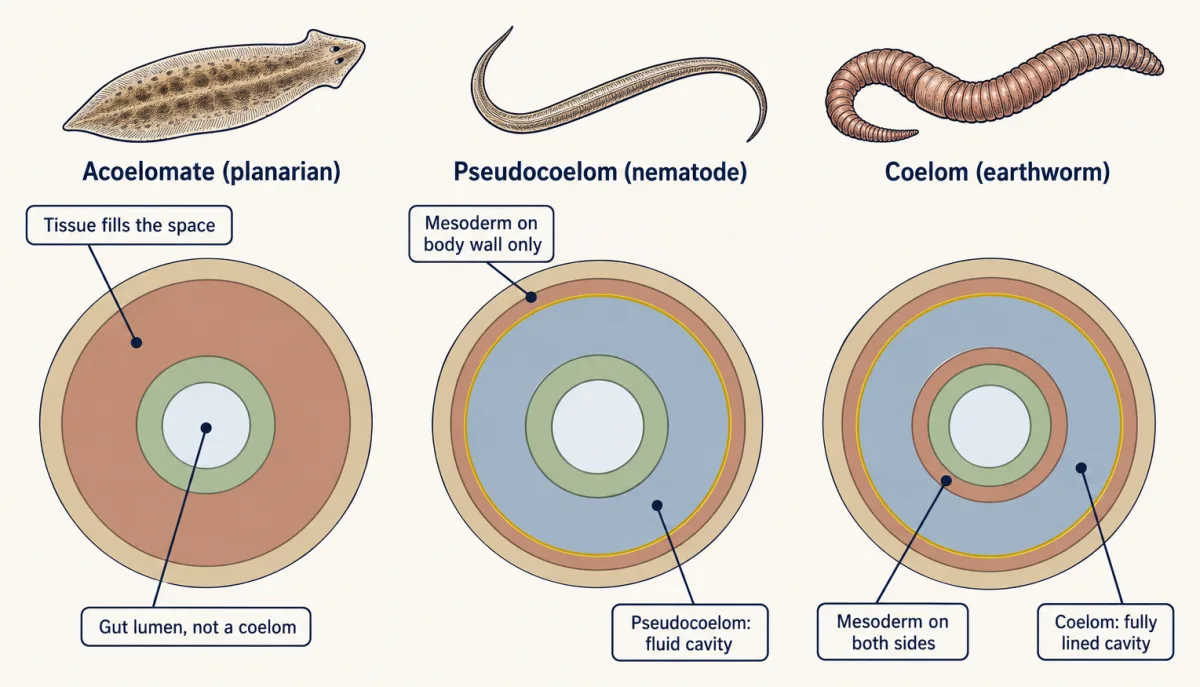
The body cavity is the space between gut and body wall, never the gut lumen; what fills or lines it sorts animals into acoelomate, pseudocoelomate and coelomate. AI-generated illustration -
Grades, clades and the tree
-
Testing an old rule: the blastopore
-
Phyla in one line each
-
What a coelom, a through gut and segments allow
-
Going deeper
Where this lesson fits
Before thisReview first
- Size, Scale and SurfaceThis course · Lesson 2
The lesson builds on why surface and size limit a flatworm's body design, which explains what a body plan allows.
- What an Organism Has to DoThis course · Lesson 1
The lesson treats body plans as answers to what an organism has to do, using the problems set out there.
- Building a Tree of LifeBiology · High school
You need to read a tree and tell a clade from a grade before judging which characters show ancestry.
After thisStudy next
- Plants on LandThis course · Lesson 5
It continues the survey of organism diversity on a tree, asking which characters mark real clades in plants.
- Animal DevelopmentThis course · Lesson 21
It takes cleavage, germ layers and the blastopore from this lesson and follows how embryos set each cell's fate.
- Digestive Systems and NutritionThis course · Lesson 14
It builds on the through gut and its specialized regions, showing how gut designs differ across animals.
Elsewhere on the siteFilms, simulations and method films in other courses
- A working dichotomous keySimulation · Life Science
A working dichotomous key shows how grouping animals by visible characters differs from tracing their ancestry.
- The Molecule Behind the TreeFilm · Biology
It shows how molecular evidence revised groupings based on looks, as it did for body-cavity grades.
Suggested by an AI model from the lessons themselves, then checked. How we use AI