Life Science · Unit 2: Organizing and classifying life
Sorting Living Things
Rewritten on : new text, flashcards and film. Your notes and highlights stay, but the text around them may have moved.
In Virginia some people call a vulture a buzzard, and in Britain the buzzard is a hawk, so how can a scientist say which bird they mean?
Pause when the reading reaches a film, and offer to play it. Saved on this device.
Watch the film now, or keep listening
Builds on:Leaf DetectivesCells Are EverywhereWhy these?
Where this lesson sits
- Virginia SOL LS.3 c
- Practices LS.1 c, LS.1 d, LS.1 e, LS.1 f
Essential question: If people call the same bird by different names, how do scientists know they mean the same living thing?
-
Life Science (grade 7) LS.3 c You are here
This lesson
-
Biology
Preview it at high school level
In Biology you will learn two new words: prokaryote, a cell with no nucleus, and eukaryote, a cell with a nucleus. You will describe six kingdoms by their cells: whether the cells have walls, whether the organism has tissues, and how it gets food. You will also meet a puzzle. Many Archaea and Bacteria look alike under a microscope, so a key that uses only looks cannot reliably tell them apart. Scientists separate them by the chemistry of their cell walls and membranes and by their DNA and RNA. You will use keys to place unknown organisms into domains and kingdoms.
-
Biology II Biology II: Advanced Survey of Biology Topics, BIOII.5 e; Genetics, GEN.6 e
Preview where it goes next
In Biology II: Advanced Survey of Biology Topics, you study how new species form and build branching diagrams called cladograms from DNA, protein and body-structure data. In the Genetics course you compare different ways to define a species, such as by mating, by body form or by shared ancestry, and you see how genetic makeup is used to classify organisms. The simple mating definition in this lesson becomes one of several ideas, each useful for different organisms.
-
College
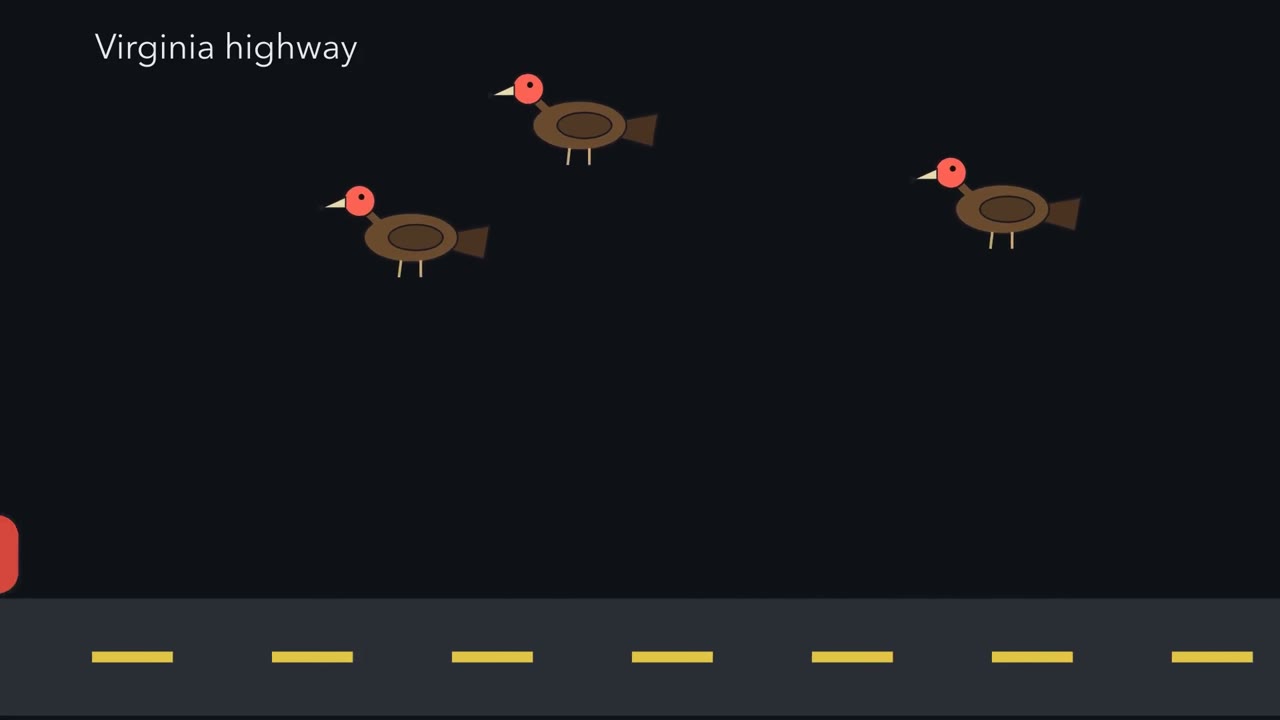 ▶ Watch Eight Boxes and a Name · 3:21
Read the transcript of “Eight Boxes and a Name”
Film transcript: Eight Boxes and a Name
Who is right when someone calls a vulture a buzzard? Dark birds circle over a Virginia highway. Someone in the car says, look, buzzards! A visitor from Britain looks up for a hawk. Scientists solve this with one name for each kind of living thing. To see where that name comes from, we build boxes, one inside the next.
Start with one huge box, the domain Eukarya. It holds living things whose cells have a nucleus. All seven fit inside. The bacteria stay outside, because their cells have no nucleus. A smaller box closes inside. This is the kingdom Animalia, the animals. The pine twig is left outside, because plants are another kingdom. Next comes the phylum.
Ours is Chordata. These animals have a flexible rod and a hollow nerve cord along the back, at least early in life. Fish, birds and people are chordates. The crab has neither, so it is left outside. The class box is Aves, the birds, so the trout is left outside.
Then comes the order. In our database, the order holds hawks, eagles and vultures. The cardinal is left outside. The family box holds the New World vultures, so the hawk is left outside. Two bare-headed vultures remain. The black vulture is in the same family as the turkey vulture. Will it also fit inside the next box, the genus?
No. Among our seven, the genus box closes around the turkey vulture alone. The black vulture belongs to a different genus, called Coragyps. It shares six boxes with the turkey vulture, not seven. The last of our eight main boxes is the species. A species is a group of similar living things that can mate in nature. Their young can also reproduce. This is a useful rule for many living things that reproduce with sex cells. It has limits. The genus box is labelled Cathartes. Add a second word, aura, and you have the species name, Cathartes aura. The genus gets a capital letter, and the second word is lowercase. Print both words in italics, or underline both by hand.
A scientist in Japan who writes Cathartes aura means the same bird you see in Virginia. The bird people in Britain call a buzzard has its own name, Buteo buteo. Two names, two birds, no mix up. The black vulture stayed in for six, and the hawk left sooner. The more boxes two living things share, the more closely they are grouped. Scientists can redraw a box when they learn more.
From the film
- Scientists sort every species into eight main levels, nested like boxes, from domain, the most general, to species, the most specific.
- Each level is a box inside a bigger box, and an inner box holds the same or fewer kinds of living things, usually fewer.
- A scientific name is the genus name plus a second word, such as Cathartes aura; the genus gets a capital letter, and both words go in italics or are underlined.
- Scientists in every country use the same scientific name, though a name or a box can change when scientists learn more.
- The more boxes two living things share, the more closely they are grouped.
In Virginia, some people call vultures buzzards. In Britain, a buzzard is a hawk. So which bird do they mean? The first film’s answer is a name built from nested boxes. Here you count the boxes, watch a wall move, then try a second tool that finds a name.
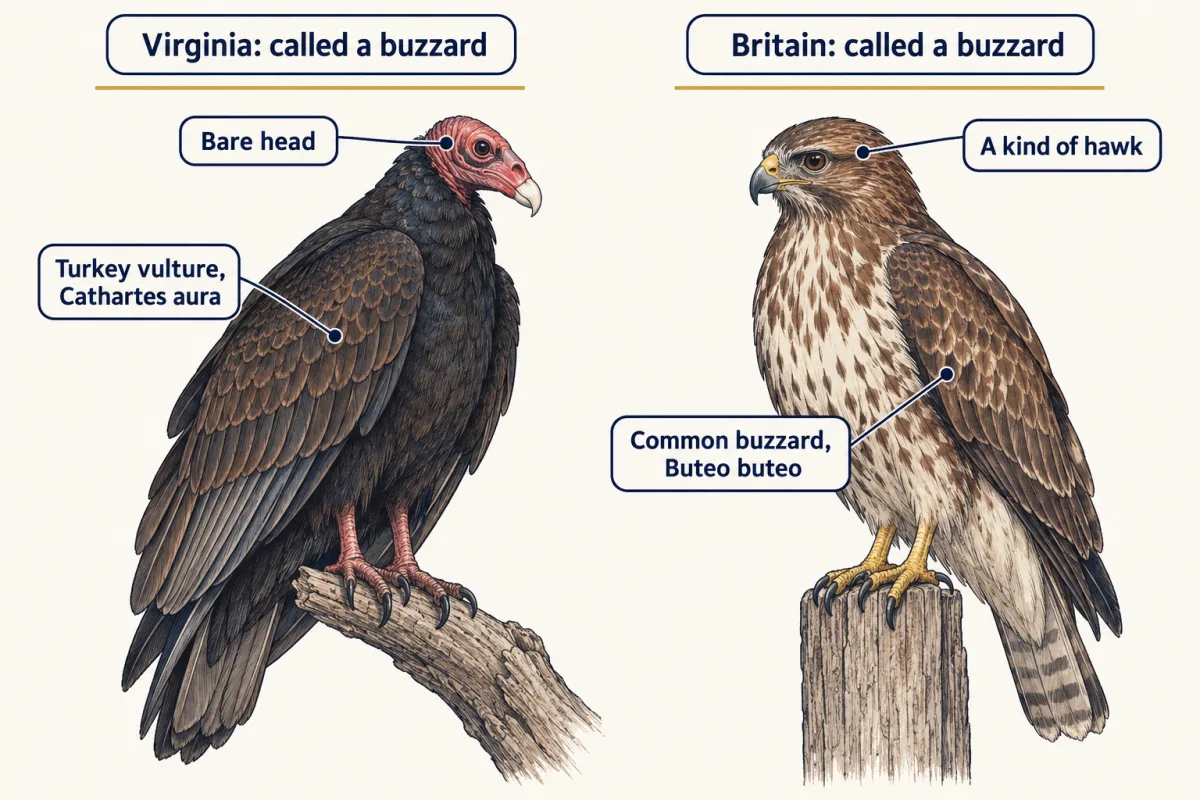
The one idea. Scientists sort every species into eight main levels, nested like boxes, from domain, the most general, to species, the most specific. Its two-part scientific name is the genus name plus a second word, and the two words together label its species box. Scientists everywhere use the same name. The more boxes two living things share, the more closely they are grouped. A dichotomous key is a list of two-choice questions that leads to a name. It finds the name, but the order of its questions does not show how living things are grouped.
Scope: a full classification can add extra levels, such as subspecies, to these eight main ones. The boxes here come from one government database on one day, and scientists can redraw a box when they learn more.
What do you think? Decide before you read.
-
Scientists disagree: Scientists compare body parts, and they also compare DNA. DNA can show that living things that look almost alike belong to different species.
What scientists think
Scientists disagree: Scientists compare body parts, and they also compare DNA. DNA can show that living things that look almost alike belong to different species.
-
Scientists disagree: Names can change when scientists learn more. That is why scientists write down the date they looked up a name.
What scientists think
Scientists disagree: Names can change when scientists learn more. That is why scientists write down the date they looked up a name.
-
Scientists disagree: A key names an organism from traits you can see. Reorder its questions and the neighbors change, but every name stays the same. So a key’s order alone does not show who is related.
What scientists think
Scientists disagree: A key names an organism from traits you can see. Reorder its questions and the neighbors change, but every name stays the same. So a key’s order alone does not show who is related.
Explain: one name for each species
- species
- binomial nomenclature
- genus
- classification
- taxonomy
- domain
- kingdom
- phylum
- dichotomous key
The film’s test for a species, similar organisms that can mate in nature and have young that can also reproduce, is a useful rule for many organisms that reproduce with sex cells, but it has two limits. It cannot be used for organisms that reproduce without sex, such as many bacteria. And some different species do sometimes mate in nature.
The film’s way of naming, one two-part name for each species, is called binomial nomenclature. This way of naming spread after the Swedish botanist Carl Linnaeus used two-part names in a book about plants in 1753. The first word is the genus, a small group of closely related species, so one genus can hold several species. The second word, joined to the genus name, names one species in that genus. The black vulture’s full name is Coragyps atratus.
Explain: eight boxes, from general to specific
Classification is a system for organizing and identifying organisms by the traits they share and how they are related. The science of naming and classifying living things is taxonomy. The film showed one domain, Eukarya; the other two domains are Archaea and Bacteria, whose cells have no nucleus. A phylum is a large group inside a kingdom, such as the arthropods, animals with a hard outer skeleton and jointed legs.
Classification works a bit like a mailing address: country, state, city and street each narrow the search. But the comparison has a limit. Houses on one street are not related to each other, while species in one genus are.
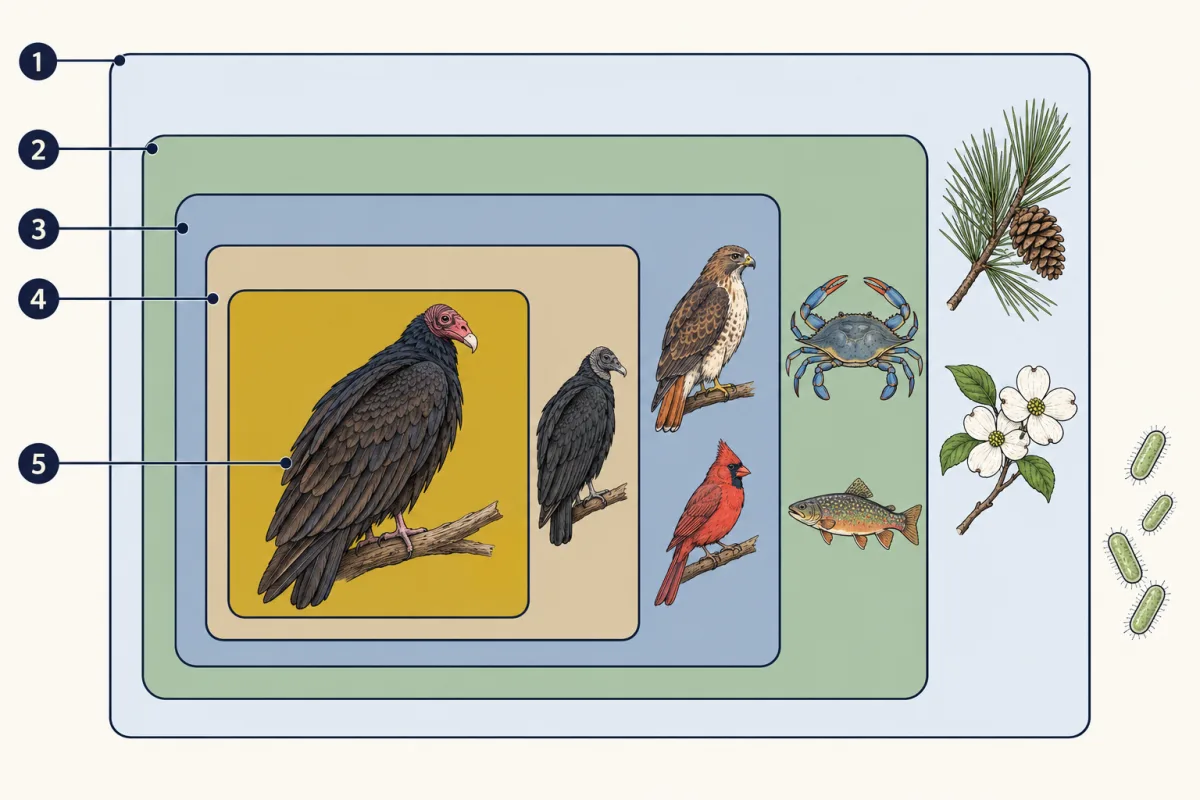
- domain Eukarya
- kingdom Animalia
- class Aves
- family Cathartidae
- species Cathartes aura
- domain Eukarya
- blank
- blank
- blank
- species Cathartes aura
Word bank: class Aves, family Cathartidae, kingdom Animalia
- blank
- blank
- blank
- blank
- blank
Check your labels
- domain Eukarya
- kingdom Animalia
- class Aves
- family Cathartidae
- species Cathartes aura
Scientists place the walls by comparing body parts, what organisms do, and DNA (another lesson explores DNA). New evidence can move a wall.
The first film’s counts, 6 shared boxes for the black vulture and 5 for the hawk, used one database. It puts vultures and hawks in one order, Accipitriformes.
Predict. Another bird checklist, from the American Ornithological Society, gives the New World vultures their own order, Cathartiformes. Under that checklist, does the turkey vulture share more boxes with the red-tailed hawk, or fewer?
Check your prediction
Fewer: 4, down to class Aves, instead of 5. The order box now closes around the vultures alone, so the hawk leaves one box sooner. The birds did not change; one wall moved. So a count of shared boxes belongs to one classification at one time.
Remember the one idea: the more boxes two living things share, the more closely they are grouped.
Explore: run a dichotomous key
In the model, pick a card for one of eight Virginia organisms and answer two-choice questions about what you can see, such as “fins or no fins,” until you reach a scientific name. A switch reorders the questions.
No card yet.
Pick a card to start the key.
In the tree, a numbered circle is a question. The upper branch is the first choice, and the lower branch is the second choice.
In this sketch, pick a card to start the key.
This key written as steps
Assumptions made up for this sketch: only these eight organisms are in the key. The questions about wings, feathers and the head are simple traits chosen here. The second order of questions was picked by hand.
A key names an organism from traits you can see. It works only for the organisms built into it, and neighbors in a key are not shown to be related. This is a sketch of the logic.
Try this.
- Pick the blue crab. Predict how many questions it takes to reach its name, then test.
- Note which organisms sit next to the brook trout. Predict what happens to them when you flip the switch, then check.
- Pick the eastern oyster, but give one wrong answer on purpose. Predict where you will end up. Then test.
You just watched the trout’s neighbors change. The second film asks what that means.
Read the transcript of “A Key Finds a Name, Not Relatives”
Film transcript: A Key Finds a Name, Not Relatives
How could a few two-choice questions give you the name of a crab? You find it on the shore of the Chesapeake Bay, and you do not know what it is. A key can tell you. The first film put living things in nested boxes, to show how they are grouped. This film uses a different tool, called a dichotomous key. Both tools matter, but they do different jobs. A dichotomous key is a series of two-choice steps about traits you can see. Each step splits the path in two. You follow the choice that fits, until you reach a name. Our key holds seven animals, each from a different phylum.
Step one asks, fins or no fins? The crab has no fins, so we go on. Step two asks, jointed legs or no jointed legs? The crab has jointed legs. The path ends at a name, Callinectes sapidus, the blue crab. Look at the whole key. The trout comes off the path first, the crab second, and the oyster third. Now keep every question, but change their order. Ask about the two-part shell and the five arms before the jointed legs. Watch the branches redraw. Run the crab again. It takes more steps now. But the path ends at the same name, Callinectes sapidus. Every animal keeps its name. Only its neighbors change. The crab now sits right next to the sea star.
Has the crab become more closely related to the sea star? No. Drop the animals into the boxes from the first film. The crab is in phylum Arthropoda. The sea star and the oyster are each in a different phylum. The crab shares only two boxes with each of them, the domain and the kingdom. The crab shares just two boxes with the trout, too. In either order, the boxes stay the same. Moving a question cannot make two animals closer relatives. Why does this happen? This key asks about traits that are easy to see, not who is related. So its order alone does not show who is related. The boxes show how one classification groups them. To draw the boxes, scientists compare body parts, what living things do, and DNA.
From the film
- A dichotomous key names a living thing through a series of two-choice steps about traits you can see.
- Changing the order of a key's questions changes which living things sit side by side, but every name stays the same.
- The blue crab shares only two levels, domain and kingdom, with the sea star, the oyster and the trout.
- This key's questions follow traits that are easy to see, so its order alone does not show which living things are related; the boxes show how one classification groups them.
Explain: use a dichotomous key
Here is the second film’s whole key, so you can run an animal the film did not. Each animal’s phylum is in brackets; you do not need it to run the key.
- Has fins: brook trout (chordate). No fins: go to 2.
- Has jointed legs: blue crab (arthropod). No jointed legs: go to 3.
- Has a shell of two hinged halves: eastern oyster (mollusk). No two-part shell: go to 4.
- Has arms in a five-part pattern around a center: sea star (echinoderm). No five-part arm pattern: go to 5.
- Has a long body made of ring-like segments: earthworm (segmented worm). No segments: go to 6.
- Fixed to one spot, body full of tiny holes: sponge. Swims, with a soft bell and trailing tentacles: sea nettle, a jellyfish (cnidarian).
Predict. A garden snail has no fins, no jointed legs and one shell. Run it through this key. Where does it end up?
Check your prediction
Nowhere. Its one shell is not two hinged halves. It has no five-part arms and no segments. At step 6 it is neither fixed in place with holes nor a swimming bell. A key works only for the organisms built into it.
Keys work for plants too. This one covers four plants, one from each of four main plant groups.
- Has a woody twig: go to 2. No woody twig: go to 3.
- Needles in bundles, with cones: loblolly pine. Broad leaves and a flower cluster with four showy bracts: flowering dogwood.
- Large fronds with spore cases: fern. Tiny leafy plant with a capsule on a thin stalk: moss.
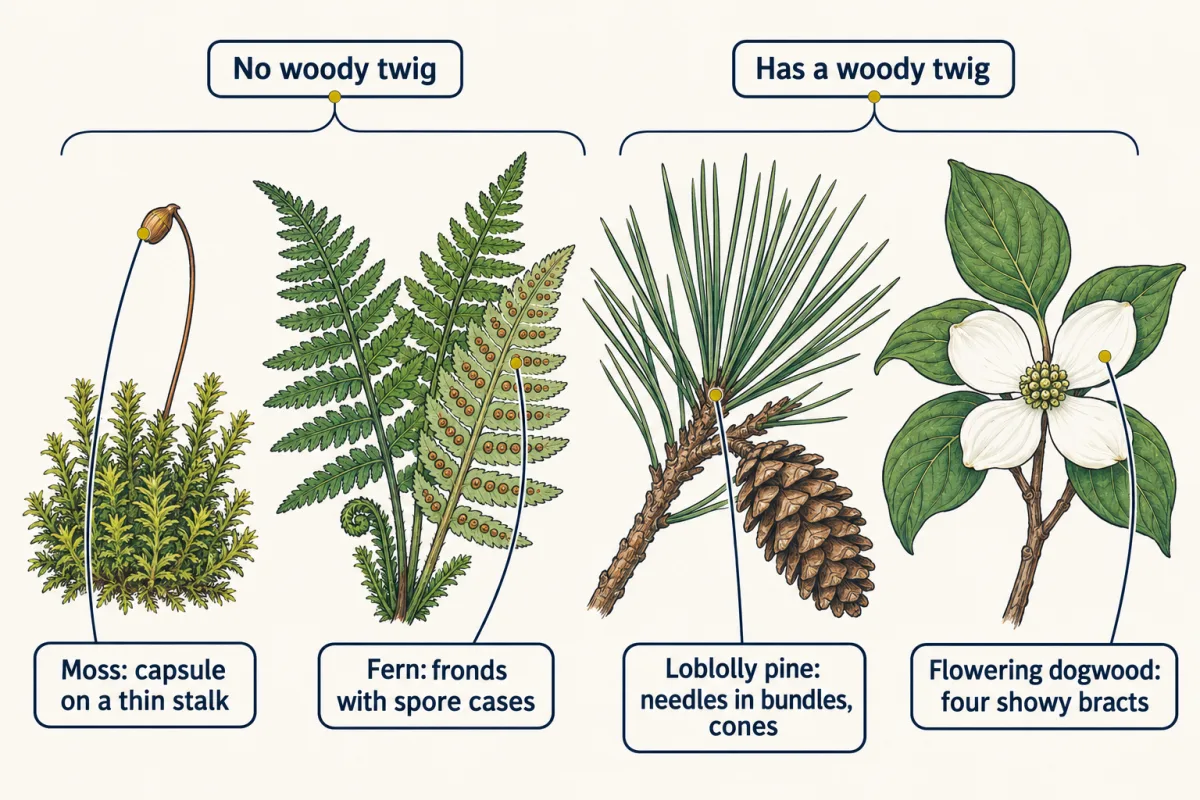
| Plant group | Example | True tubes for water and food (xylem and phloem) | Seeds |
|---|---|---|---|
| Mosses | moss | No | No; spores |
| Ferns | fern | Yes | No; spores |
| Conifers | loblolly pine | Yes | Yes, not inside a fruit |
| Flowering plants | flowering dogwood | Yes | Yes, inside a fruit |
Elaborate: read real classifications
| Organism | Kingdom | Phylum (division) | Class | Order | Family | Genus | Species |
|---|---|---|---|---|---|---|---|
| Turkey vulture | Animalia | Chordata | Aves | Accipitriformes | Cathartidae | Cathartes | Cathartes aura |
| Black vulture | Animalia | Chordata | Aves | Accipitriformes | Cathartidae | Coragyps | Coragyps atratus |
| Red-tailed hawk | Animalia | Chordata | Aves | Accipitriformes | Accipitridae | Buteo | Buteo jamaicensis |
| Common buzzard (Britain) | Animalia | Chordata | Aves | Accipitriformes | Accipitridae | Buteo | Buteo buteo |
| Northern cardinal | Animalia | Chordata | Aves | Passeriformes | Cardinalidae | Cardinalis | Cardinalis cardinalis |
| Brook trout | Animalia | Chordata | Teleostei | Salmoniformes | Salmonidae | Salvelinus | Salvelinus fontinalis |
| Blue crab | Animalia | Arthropoda | Malacostraca | Decapoda | Portunidae | Callinectes | Callinectes sapidus |
| Eastern tiger swallowtail | Animalia | Arthropoda | Insecta | Lepidoptera | Papilionidae | Papilio | Papilio glaucus |
| Flowering dogwood | Plantae | Tracheophyta | Magnoliopsida | Cornales | Cornaceae | Cornus | Cornus florida |
| Loblolly pine | Plantae | Tracheophyta | Pinopsida | Pinales | Pinaceae | Pinus | Pinus taeda |
How to read the table. The group names come from each species’ record in the Integrated Taxonomic Information System (ITIS), a government database, looked up on 23 October 2026. ITIS starts at kingdom; all ten are in domain Eukarya, so count domain as level 1. Some records have extra levels that are not shown. People who study plants often say division instead of phylum. You need not learn the long names; just compare them across rows.
Why your textbook may look different. ITIS puts the pine and the dogwood in one division, Tracheophyta, the plants with xylem and phloem. Many textbooks instead split plants into the four groups in the plant table. Books can also group animals differently, as with the vultures’ order. Going deeper has another example.
- Find the blue crab and the eastern tiger swallowtail. What is the most specific level they share?
- Which two birds share a genus? Write both scientific names correctly.
- How many of the ten organisms are in phylum Chordata? What percent of the table is that? Use the frame: “___ of 10 organisms is ___ out of 100, so ___ percent.”
Predict. Before you count: in this table, which is grouped closer to the turkey vulture, the common buzzard or the red-tailed hawk?
Check your prediction
Neither: it is a tie. Each shares 5 levels with the turkey vulture, down to order Accipitriformes. Being called a buzzard does not move a bird closer.
Claim, evidence, reasoning
Make a claim that answers the essential question: if people call the same bird by different names, how do scientists know they mean the same living thing? Use the table.
Start with: Scientists know they mean the same bird when blank.
Start with: In the table, the word buzzard is used for blank, but the turkey vulture is in genus blank and family blank.
Start with: This matters because a common name blank, while a scientific name blank.
Compare with a model answer
Scientists know they mean the same bird when they use its scientific name and its classification. In the table, the British buzzard is Buteo buteo, in family Accipitridae. The turkey vulture, which some Virginians call a buzzard, is Cathartes aura, in family Cathartidae. The red-tailed hawk shares seven of eight levels with Buteo buteo; the turkey vulture shares five. A common name changes from place to place, but a scientific name is shared everywhere. Limit: these are one database’s records on one day, names can be revised, and another checklist puts vultures in a different order.
Saved in this browser only.
Design problem
Does the order of questions in a key change how well people use it? Plan a test with picture cards.
Saved in this browser only.
One way to do it
- Question: Does the order of questions change how many organisms people name correctly?
- Independent variable: the order of the questions (key 1 or key 2, same questions).
- Dependent variables: the number of correct names out of 10 cards, and the time in seconds to finish.
- Constants: the same 10 cards, the same time limit, and no help from others.
- Control: key 1, the order you started with.
- Trials: at least 10 classmates per key. Report the mean score and mean time.
- What results mean: similar scores suggest the order matters little for naming in this test, even though the neighbors change; compare the times too.
- Limit and safety: one class and one picture set; use pictures, not live or wild-caught animals.
Evaluate: check your thinking
A scientific name, such as Cathartes aura, and its place in the eight levels remove the “buzzard” mix-up between Virginia and Britain.
Science practices you used: using a key to identify organisms, reading and comparing data in a table, calculating a percent, making a claim with evidence, and planning a fair test with repeated trials.
Going deeper
The Costa Rica butterflies
In a 2004 study in Costa Rica, butterflies that looked almost alike were compared by their caterpillars, the plants the caterpillars ate, and short stretches of DNA from museum specimens. The study proposed at least ten species in that region, in a butterfly long treated as one species. Scientists still debate the exact count.
When databases disagree
Besides the vultures’ order, Integrated Taxonomic Information System (ITIS) lists the brook trout’s class as Teleostei, while many books use the larger group Actinopterygii, the ray-finned fishes. A count of shared boxes ranks grouping in one classification; it does not tell how long ago the organisms’ most recent common ancestor lived.
Your notes
Select any text in the lesson to highlight it or add a note to it. Your highlights and notes are saved in this browser and collected in your notebook.
This browser is not letting the site save anything (a private window or strict privacy settings), so highlights and notes will be lost when you leave the page.
How we measure it
Dichotomous key
A key gives two choices at each step, such as "has fins" or "no fins," and each choice leads to the next step until you reach a name. It can identify only the organisms built into it, and its order alone does not show which organisms are related.
Taxonomy database lookup
Databases such as the Integrated Taxonomic Information System (ITIS) store each species' accepted scientific name and the larger groups it belongs to. Scientists use the record to check a name and its classification, and they write down the date they looked it up, because records can be revised.
Where this lesson fits
Before thisReview first
- Leaf DetectivesBiology Together · Ages 5–10, with a grown-up
You already sorted leaves with yes-or-no questions there, which is the same kind of step-by-step key used here.
- Cells Are EverywhereThis course · Lesson 1
You need to know that all living things are made of cells, since the domains are told apart by cell type.
After thisStudy next
- Domains, Kingdoms and DNAThis course · Lesson 8
It takes the domains and kingdoms from this lesson and shows how DNA evidence decides where the walls go.
Elsewhere on the siteFilms, simulations and method films in other courses
- Classify the unknownSimulation · Biology
You can classify an unknown organism by asking ordered questions about its traits, much like using a key.
Suggested by an AI model from the lessons themselves, then checked. How we use AI
Finish line
Test yourself
8 questions
Practice and MCAT-style, with explained answers.
Next · Lesson 8
Domains, Kingdoms and DNA
A mushroom stays in one place like a plant, so why do scientists say fungi are closer relatives of animals?
Continue →