The Molecule Behind the Tree
Read the transcript of “The Molecule Behind the Tree”
Film transcript: The Molecule Behind the Tree
These methane-making microbes look like typical bacteria. Why would a molecule place them on a different branch? Under the microscope, both are tiny cells without nuclei. Shape gives us evidence, but it may hide the ancestry we want to test.
To compare very different cells, scientists need the same kind of record from every sample. Every cell builds proteins on ribosomes. Ribosomal RNA forms much of each ribosome. Conserved parts let researchers line up distant samples, while differing parts provide evidence. Woese and Fox compared catalogues of short ribosomal RNA pieces.
Picture each catalogue as a row of labelled tiles, not a complete molecule. Matching tiles pull the rows together. Fewer matches leave the rows farther apart. The pattern across pairs tests the tree. Here are hidden pairs. A pair shares many ribosomal RNA pieces, while another shares few. Which pair should sit closer on a tree of ancestry? Hold your answer before the labels appear.
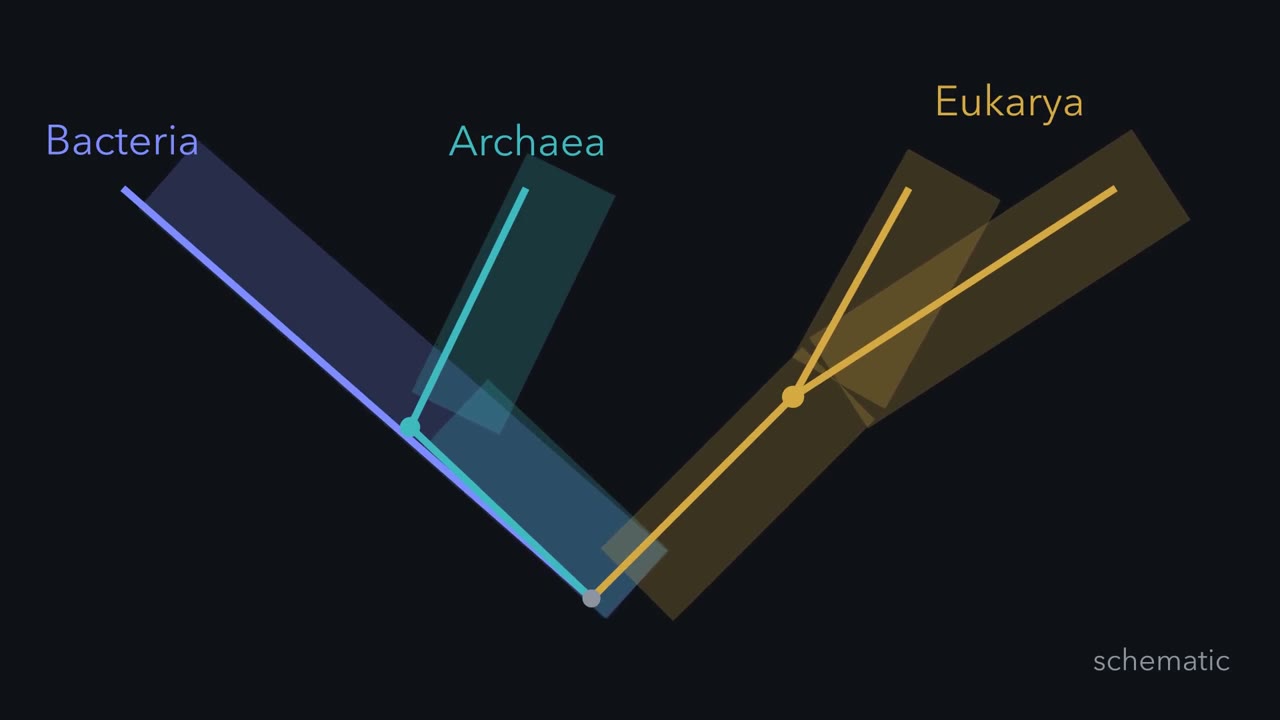
The pair with many shared pieces belongs closer, if the rest of the evidence agrees. The methane makers matched each other far better than they matched typical bacteria. Typical bacteria also matched each other better than they matched methane makers. That repeated pattern challenged a combined prokaryote group. A classification is a testable map of relationships. A branch claims that its members share a more recent common ancestor. When several comparisons challenge that claim, scientists redraw only the supported part. The organisms themselves remain unchanged. The researchers interpreted this pattern as three major lines of descent. Later, the rank called domain named Bacteria, Archaea and Eukarya.
The methane makers joined Archaea. Their cells did not change. The evidence changed the best-supported tree. Molecular evidence does not automatically outrank every other clue. It adds a comparison that can expose misleading similarities in shape. Strong classifications weigh several markers and kinds of evidence. Agreement strengthens a branch.
Conflict shows where to test next. The overlap scores are not percentages of DNA. They do not tell when branches split. They summarize shared pieces in these ribosomal RNA catalogues. A tree remains a claim tested against more organisms, other genes, membranes and any evidence that can challenge it. That is why changing a group after careful testing can be good science.
Classification is a model of ancestry, not a permanent filing cabinet. When stronger evidence changes the picture, scientists revise the model while keeping its limits visible.
If some microbes look just like bacteria under a microscope, how could a molecule inside them show they belong to a different domain of life?
Continue in the lesson: Classification Changes →
3:34 · Free, with captions and a transcript. The lesson has the full text, the questions and the sources.
More films from this lesson
How this film was made. Narration: written from this lesson's text and read by an AI narrator voice (Kokoro, af_heart). Animation: AI-generated in code (Manim) by Claude, a schematic with no drawn molecular structures. Captions come from the narration script. See something wrong? Report it.