Organismal Biology · Unit 1: Organisms and their diversity
New to this? Review it at high school level: Domains and Kingdoms
Plants on Land
Rewritten on : new text, flashcards and film. Your notes and highlights stay, but the text around them may have moved.
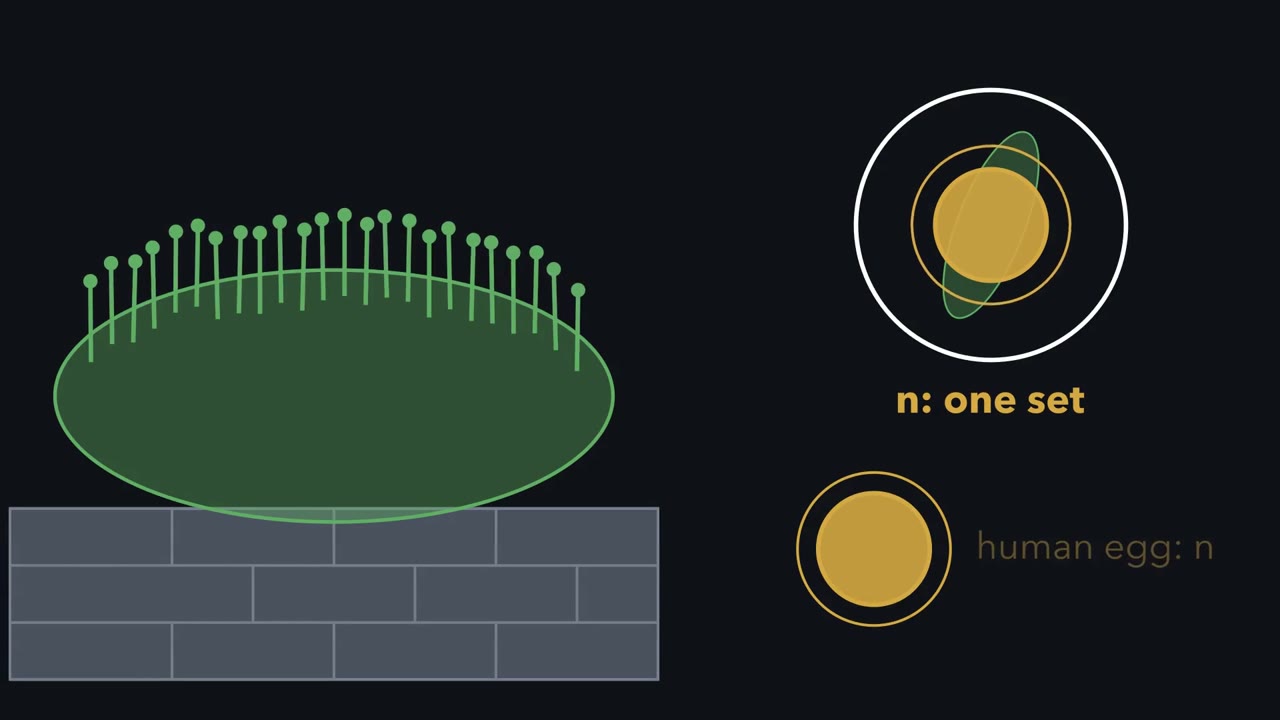
The green cushion of moss on a wall is haploid, like a human egg. So where is the diploid moss?
Pause when the reading reaches a film, and offer to play it. Saved on this device.
Watch the film now, or keep listening
Builds on:Meiosis and VariationThe Cell Cycle and MitosisWhy these?
 ▶ Watch Two Bodies, One Wheel · 3:23
Read the transcript of “Two Bodies, One Wheel”
Film transcript: Two Bodies, One Wheel
This green moss cushion is haploid, like a human egg. So where is the diploid moss? A haploid cell carries one set of chromosomes. We write that as n, and colour it gold. A diploid cell carries two sets, written 2n, and coloured teal. In a normal life cycle, only two kinds of event change that count.
Meiosis halves it. Every fusion of nuclei adds the sets together. Mitosis, which copies a cell, never changes the count. Now draw a land plant's life as a wheel. A diploid body, the sporophyte, or spore plant, makes spores by meiosis.
Each spore is a single cell. A spore divides by mitosis into a second body, the gametophyte, or gamete plant. It is already haploid, so it makes eggs and sperm by mitosis. Then sperm and egg fuse. The zygote, the single fertilized cell, has two sets again. It divides by mitosis into a new sporophyte. So the wheel has two arcs. From meiosis to fertilization, the path is gold. From fertilization to the next meiosis, it is teal. Other fusions can make other labels, as the next film shows. Now the moss. The gold arc swells into the leafy green shoot, so that shoot is the gametophyte. A sperm swims through a film of rain or dew to an egg on it. The teal arc shrinks to a thin stalk and a capsule.
That is the diploid moss. Meiosis in the capsule makes the spores. Now a fern. Here the arcs swap sizes. The big frond is the sporophyte, teal. Spore cases under it make spores by meiosis. Each spore grows into a small plant on the ground. Gold or teal: the spore, and that little plant?
Both gold. They come after the meiosis gate, and no fusion has happened yet. The little plant is a prothallus, a flat, often heart-shaped gametophyte. It lives on its own. Now compare your own wheel. In humans, meiosis makes eggs and sperm directly. The gold arc shrinks to the gametes alone. There is no haploid body. In the green algae closest to land plants, the teal arc shrinks instead. The zygote is often the only diploid cell. It undergoes meiosis when it germinates. So size tells you nothing. The big body can be gold or teal. Find meiosis and fusion first, and every label follows. One problem remains. In both the moss and the fern, sperm swim to the egg through water.
What can a plant do where there is none?
From the film
- A land plant grows two bodies in turn: a haploid gametophyte and a diploid sporophyte.
- Meiosis halves the chromosome sets and fusion adds them; mitosis never changes the count.
- In a land plant, meiosis makes spores, and the gametophyte makes eggs and sperm by mitosis.
- In a moss the leafy plant is the gametophyte; in a fern the frond is the sporophyte.
- Do not judge the label by size: find meiosis and fusion first.
The green cushion of moss on a shady wall is made of cells with one set of chromosomes each, the same count as a human egg, yet it photosynthesizes, grows and lives for years. You have no body like that: your only one-set cells are made while eggs and sperm form. So where is the diploid moss?
The first film found it in the stalk and capsule. This page adds what the films leave out.
A cell with one chromosome set (one copy of each chromosome) is haploid (n); with two sets it is diploid (2n).
The one idea. Chromosome sets change at only two kinds of event: meiosis, the division that halves them, and fusion, where two nuclei join and their sets add. Mitosis, ordinary cell division, copies a cell and never changes the count. So find meiosis and every fusion first, and each stage’s label follows, whichever body happens to be the big one: n or 2n for the two bodies, and for endosperm the sum of the sets that fused.
Scope: normal sexual life cycles of land plants, with labels counted against the species’ own n. The rule gives each stage its label; it does not decide which body grows (see the KNOX2 section). Exceptions are in Going deeper.
Two bodies in one life cycle
The first film’s wheel is alternation of generations: a diploid sporophyte (“spore plant”) makes haploid spores by meiosis, and a haploid gametophyte (“gamete plant”) makes eggs and sperm by mitosis. Wilhelm Hofmeister found this scheme by microscope in 1851 (Going deeper); each division’s mechanics are in meiosis and mitosis.
In land plants both bodies are multicellular. Many fungi share the film’s algal pattern: the zygote, the only diploid cell, undergoes meiosis soon after it forms (see microbes, protists and fungi).
Moss and fern: exposed gametophytes, different dominant bodies
Moss. Take Physcomitrium patens (long called Physcomitrella patens) or the haircap moss Polytrichum. The sporophyte (2n) stays attached to the leafy gametophyte (n) and depends largely on it for nutrients. A cap called the calyptra covers the young capsule.
Predict. The calyptra sits on the diploid capsule, but it grows from the leafy gametophyte’s cells. Is it n or 2n?
Check your prediction
n. It is gametophyte tissue, made by mitosis from a haploid spore’s descendants with no fusion on the way. Sitting on a 2n body cannot change its label.
Fern. The film’s fern makes one kind of spore, so it is homosporous, as is Ceratopteris richardii. Its prothallus lives on its own and photosynthesizes. The fern has what the moss lacks: xylem, which carries water and dissolved mineral nutrients up from the roots, and phloem, which carries sugars. Ferns are vascular even though they have no seeds.
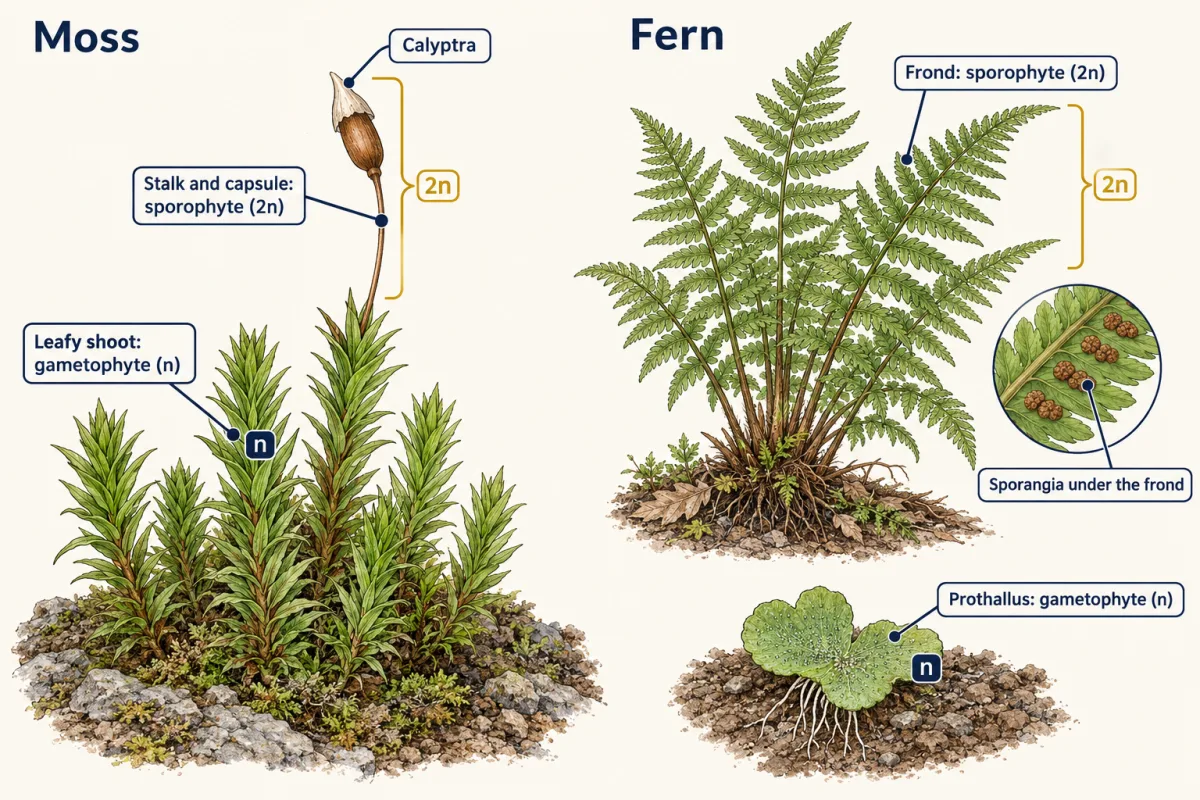
Vascular tissue did not free the fern from water: its sperm, like the moss’s, still swim to the egg. The second film takes that problem to a pine.
Read the transcript of “The Gametophyte Moves Inside”
Film transcript: The Gametophyte Moves Inside
The first film drew one wheel, gold after meiosis and teal after fusion. Now, at the top of a pine there is no water film. So how does a sperm reach an egg? The pine tree is the sporophyte, so it is teal. Its cones make two kinds of spores, so the gold arc splits in two. In small pollen cones, meiosis makes microspores. Each one becomes a pollen grain. A pollen grain is not a sperm. It is a male gametophyte of a few cells. In larger seed cones, meiosis inside an ovule gives four megaspores. Only one survives. It grows into the female gametophyte, which forms eggs. Wind carries pollen to the ovule. A pollen tube grows and delivers sperm to the egg, with no outside water.
Both gametophytes are still here, just shrunk. The female one stays inside the ovule. The male one travels as pollen. The egg is fertilized, and a seed forms. The seed's food store grew from that surviving megaspore. Gold or teal?
Gold. The food store is the female gametophyte, so it is haploid. The seed coat comes from the parent tree, teal. The embryo is the new sporophyte, teal too. One seed holds three generations. Flowering plants shrink the female gametophyte even further. Here too, the pollen grain is the male gametophyte. In Arabidopsis, the female one is the embryo sac, inside the ovule. Meiosis gives four megaspores, and three degenerate. The survivor's nucleus divides three times, without making new cells. Then walls form. Two cells matter here: the egg, and a large central cell holding two nuclei. Those two are the polar nuclei, and both are gold. In Arabidopsis they fuse before fertilization.
Fusion adds, so the central cell is now 2n. A pollen tube brings two sperm. One fuses with the egg, giving a teal zygote. The other fuses with the central cell. Fusion adds again. The result is endosperm, a food tissue, and it carries three sets. That holds in Arabidopsis and most flowering plants, but not all. Every label came from the same two gates. Meiosis halves the sets, and fusion adds them.
Size and place changed, but meiosis still starts each gametophyte, and fertilization each sporophyte. Extra fusions add the endosperm. The female gametophyte now stays inside the ovule.
From the film
- In seed plants both gametophytes shrink: the female stays inside the ovule (in pine, the seed's food store), and the male travels as pollen.
- A pollen grain is a male gametophyte of a few cells, and its tube carries sperm to the egg without outside water.
- A pine seed holds three generations: a 2n coat, an n food store from the female gametophyte, and a 2n embryo.
- In Arabidopsis, one sperm joins the egg to make a 2n zygote; the other joins the central cell's fused 2n nucleus to make 3n endosperm.
- Endosperm's label is the sum of the sets that fused: 3n in Arabidopsis and most flowering plants, not all.
Seed plants: the gametophyte moves inside
Beyond the second film: plants that kept swimming sperm, and the counts in the sac.
Pine. The second film’s pine is heterosporous: it makes two kinds of spores, and its ovule becomes the seed. Yet in cycads and Ginkgo the pollen tube still releases large swimming sperm into fluid inside the ovule.
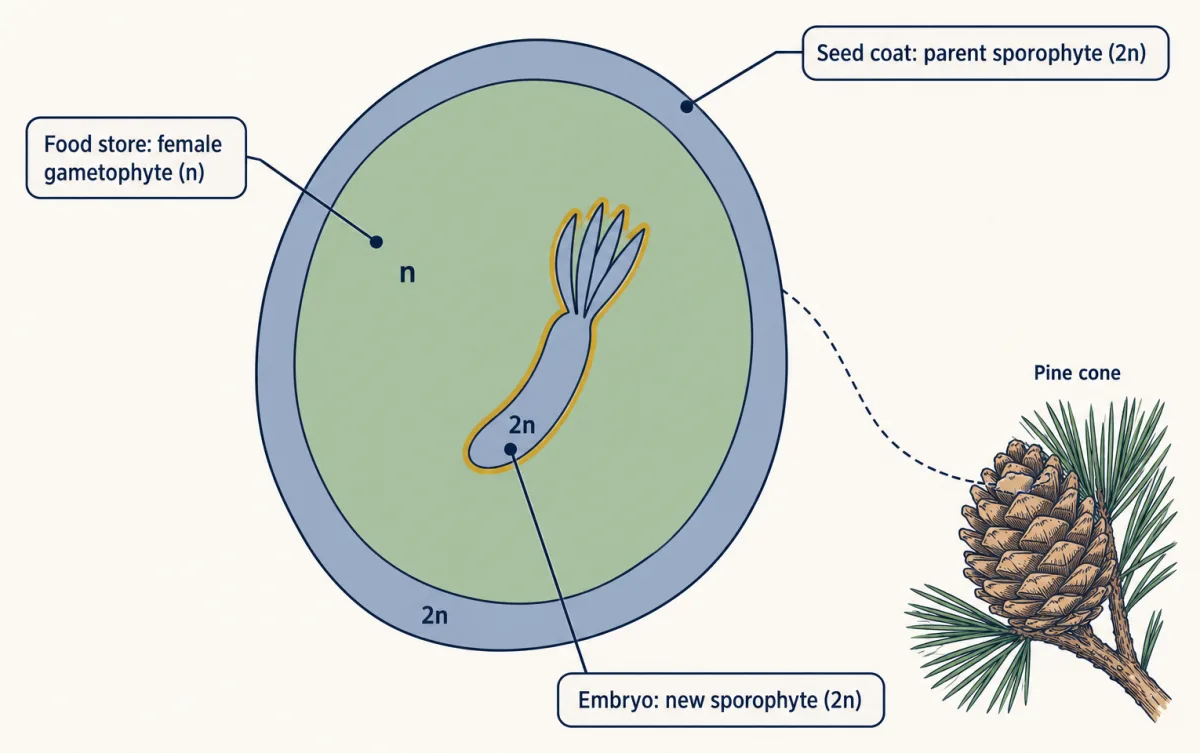
Flowering plant. The second film’s two sperm fusions are double fertilization, one sperm fertilizing the egg while the other fuses with the central cell (more in plant reproduction). In Arabidopsis thaliana the embryo sac comes from a megaspore mother cell, the cell that undergoes meiosis.
Predict. Some flowering plants build their embryo sacs differently. If a central cell held a single polar nucleus and one sperm fused with it, what would the endosperm be?
Check your prediction
2n: one set from the polar nucleus, one from the sperm. The rule holds; only the number of fusing nuclei changed.
Worked problem. Suppose an invented plant with embryo sacs exactly as in Arabidopsis has 2n = 24 (real Arabidopsis has 2n = 10). One ovule’s megaspore mother cell completes meiosis, and development is normal, with no losses beyond the three of four megaspores that degenerate.
Predict. The sac reaches 8 nuclei before any walls form. How many cells does it hold once walls form?
Check your prediction
- Walls form around six nuclei singly: the egg, two synergids beside it and three antipodal cells at the far end. The two polar nuclei share one wall, in the central cell: 6 + 1 = 7 cells.
- Megaspores. 4 megaspores come from meiosis; 3 degenerate, leaving 1 functional megaspore.
- Nuclei. Three nuclear mitoses, in which the nucleus divides but the cell does not, double the count three times: 2 x 2 x 2 = 8 nuclei in the sac.
- Cells. 6 single cells + 1 central cell = 7.
- Chromosomes. Egg: n = 24 / 2 = 12. Zygote: 12 + 12 = 24. Central cell after polar fusion: 12 + 12 = 24. Primary endosperm nucleus: 24 + 12 = 36, which is 3n.
Check: 8 nuclei − 7 cells = 1, the central cell’s extra nucleus.
In this sketch: a schematic cycle, not to scale; chromosome numbers are invented examples.
Keep the rule: find meiosis and fertilization first, because they are the only two places the chromosome number changes, and plant meiosis makes spores, not gametes. Moss, fern, pine, flower is a teaching order, not a line of descent.
The rule gives the label, not the body
Predict. In Physcomitrium patens, researchers deleted KNOX2 regulatory genes. Diploid embryos still formed by fertilization. What label do they carry, and which body would you expect them to build?
Check your prediction
Their label is 2n, because they came from fusion. Yet they grew into gametophyte bodies, without meiosis. Gene activity, not chromosome number alone, sets which body forms.
The result is a clue to the question the Glasgow botanist Frederick Bower asked in 1908: did the sporophyte arise as a new stage inserted into an older haploid cycle, or as a version of the same body?
Problems of land and the innovations that eased them
Land plants arose from green algae (see history of life). Water keeps an alga wet and holds it up, and in algae with swimming sperm it carries them; air does none of these. Lineages with the traits below left descendants on dry ground; no plant evolved them on purpose.
| Problem on land | Trait that eased it | Seen in |
|---|---|---|
| Drying out | Cuticle, a waxy layer on the outer surface | moss, fern, pine, flowering plant |
| Gas exchange through a sealed surface | Stomata, pores bordered by guard cells | fern, pine, flowering plant (moss capsules have stomata too, but their role there is debated) |
| Transport and upright support | Lignified xylem with phloem | fern, pine, flowering plant |
| Fertilization without a water film | Pollen and the pollen tube | pine, flowering plant |
| Protecting and feeding the embryo | Seed | pine, flowering plant |
| Getting pollen and seeds moved | Flowers and fruit | flowering plants |
A cuticle trades one problem for another. It slows water loss (in P. patens a faulty cuticle lets dye in, a sign of a leaky barrier), but a seal that keeps water in also slows carbon dioxide entry, and photosynthesis fixes carbon dioxide drawn from the air (the chemistry is in the Calvin cycle). Stomata are adjustable pores that regulate exchange of gases and water vapour. In P. patens they occur on the capsule, not the leafy shoot, and wet-grown capsules typically have them plugged, so do not assume moss stomata work like a leaf’s.
Lignin, a tough polymer in xylem walls, also stiffens the plant for upright growth. Phloem carries sugars from where they are made or stored (sources) to where they are used (sinks), which can be up or down. Mosses lack lignified vascular tissue and stay low; they need water to grow actively and for sperm to swim, though many survive long dry spells (details in plant transport).
Pollen lands at the ovule in a pine or on a flower’s stigma. A seed wraps an embryo in a food store and a coat, and dormancy, a resting state, lets germination wait. Flowers promote pollination, often by animals, and the ovary wall can develop into a fruit that protects seeds and aids dispersal.
Branches, not a staircase
Living mosses did not turn into ferns; each living group tips a branch that has evolved as long as every other. A trait such as stomata can be old or new on the tree, but a living moss is no older than a pine (see reading phylogenetic trees).
The tree itself has shifted. In 2019 the One Thousand Plant Transcriptomes Initiative, comparing gene sequences from more than 1,100 species, recovered living mosses, liverworts and hornworts as one branch in its nuclear gene trees. All its analyses rejected the hypothesis that liverworts alone are the sister group (closest relative) of a branch holding all other living land plants. A moss is a cousin of vascular plants, not a picture of their ancestor.
Design problem
In 2017 Renault and colleagues deleted the gene PpCYP98, whose relatives in flowering plants act in lignin synthesis, in the moss Physcomitrium patens. Mosses are considered not to make lignin. Design the test of whether the gene is required for a normal cuticle. Say what you would compare and measure, what result would support a role, and what the test cannot tell you.
Saved in this browser only.
One way to do it
Compare wild type with several independent deletion lines, so that a stray second mutation in one line cannot explain the result; the paper used three. Measure surface permeability (dip the leafy shoots, called gametophores, in dilute toluidine blue and score dye uptake; the paper used 0.05 percent dye for two minutes), cuticle structure by transmission electron microscopy, and whether leafy gametophores form normally.
Then rescue. Grow mutants with caffeic acid, a compound made downstream of the missing enzyme (20 micromolar in the paper). If the pathway matters, mutants should take up more dye, show a disrupted cuticle and grow poorly, and supplementation should restore growth and the barrier at least partly. Renault and colleagues reported partial rescue.
Limits: dye uptake shows a leaky barrier but does not measure water loss, so add a weighed drying test for that claim. And a living moss’s cuticle is not the first land plants’; the result shows what this pathway does in this moss.
Going deeper
How Hofmeister compared the groups
In the 1840s some botanists, Matthias Schleiden among them, held that a seed plant’s embryo formed from the tip of the pollen tube. Wilhelm Hofmeister followed germinating spores, the plants they grew into, their flask-shaped female organs (archegonia) and the youngest embryos in mosses, liverworts, ferns, horsetails, clubmosses and conifers. If spore and seed plants shared no plan, the sequences should differ. Instead, in every group, the conifer seed included, the embryo arose from an egg inside the female organ, and a spore-bearing generation alternated with a gamete-bearing one. His 1851 comparison ruled in one alternation of generations across land plants; his 1847 flowering-plant work traced the embryo to an egg in the embryo sac, ruling out the pollen-tube origin. He knew nothing of chromosome numbers; tying the generations to n and 2n came decades later.
Where the labels need care
The one idea covers normal sexual cycles. It does not apply to apomixis, in which seeds form without the usual meiosis and fertilization, or to ferns with apospory or apogamy, in which one body grows from the other without meiosis or without fertilization. Many plant cells also copy their DNA without dividing (endoreduplication), so a nucleus can hold more DNA than its label suggests; the label names the stage of the life cycle, not the DNA content of every nucleus.
The worked problem with five ovules
Take the same plant, 2n = 24, with five ovules that each have one megaspore mother cell, all completing meiosis. Megaspores: 5 x 4 = 20. Survivors: 5 x 3 = 15 degenerate, so 20 - 15 = 5 functional megaspores, one per embryo sac. Nuclei: 5 x 8 = 40. Cells: 5 x 7 = 35. Check: 15 + 5 = 20, and 40 nuclei exceed 35 cells by 5, one extra nucleus per central cell.
Your notes
Select any text in the lesson to highlight it or add a note to it. Your highlights and notes are saved in this browser and collected in your notebook.
This browser is not letting the site save anything (a private window or strict privacy settings), so highlights and notes will be lost when you leave the page.
How we measure it
Comparative light microscopy of development
Follow the same stages (spore, gametophyte, egg, embryo) in many groups under the microscope and compare the sequences. Hofmeister used it to find one life cycle across land plants; today cleared ovules viewed with differential interference contrast optics show the nuclei of an embryo sac.
Gene deletion with chemical rescue
Delete a gene, measure what changes, then supply a compound made downstream of the missing enzyme. Partial rescue ties the defect to the pathway rather than to an unrelated side effect of the deletion.
Toluidine blue permeability and electron microscopy
A brief dip in a dilute dye shows where a surface barrier lets the dye in, and transmission electron microscopy shows the cuticle's layers. Dye uptake indicates a leaky barrier; it is not a measurement of water loss.
Phylogenomics
Build trees from hundreds or thousands of genes across many species and combine them into a species tree. It tests which groups share a common ancestor, which is how mosses, liverworts and hornworts came to be drawn as one branch rather than a series of steps.
Practice questions on this lesson (3) → MCAT-style, original, each with an explanation
Where this lesson fits
Before thisReview first
- Meiosis and VariationBiology · High school
You need meiosis halving chromosome sets and mitosis keeping them the same to place n and 2n in the cycle.
- The Cell Cycle and MitosisBiology · High school
You need to know that mitosis copies a cell without changing its chromosome number.
After thisStudy next
- Double Fertilization: How a Flower Makes a SeedThis course · Lesson 26
It takes the flower's embryo sac and double fertilization further, building on the 3n endosperm counted here.
- Moving Water and Sugar in PlantsThis course · Lesson 23
It explains how xylem and phloem move water and sugar, the vascular tissue introduced here.
- Plant Body and GrowthThis course · Lesson 22
It shows how the sporophyte body grows, building on the diploid plant found here.
Elsewhere on the siteFilms, simulations and method films in other courses
- Set Up: Take a Flower ApartFilm · Biology Together
Taking a flower apart shows the parts where pollen and ovules, the male and female gametophytes' homes, form.
- Set Up: From Bean to BeanFilm · Biology Together
It follows a flowering plant from seed to seed, the sporophyte-to-seed loop this lesson labels.
Suggested by an AI model from the lessons themselves, then checked. How we use AI
Finish line
Test yourself
8 questions
Practice and MCAT-style, with explained answers.
Next · Lesson 6
Tissues, Organs and Homeostasis
In a room heated to about 93 degrees C, close to the boiling point of water, the thermometer under a man’s tongue barely moved. What was holding it there?
Continue →← Lesson 4 · Animal Body Plans: Similar Bodies, Different Branches