Physiology · Unit 8: Defense, skin and temperature
Skin, Sweat and Human Thermoregulation
Rewritten on : new text, figures and flashcards. Your notes and highlights stay, but the text around them may have moved.
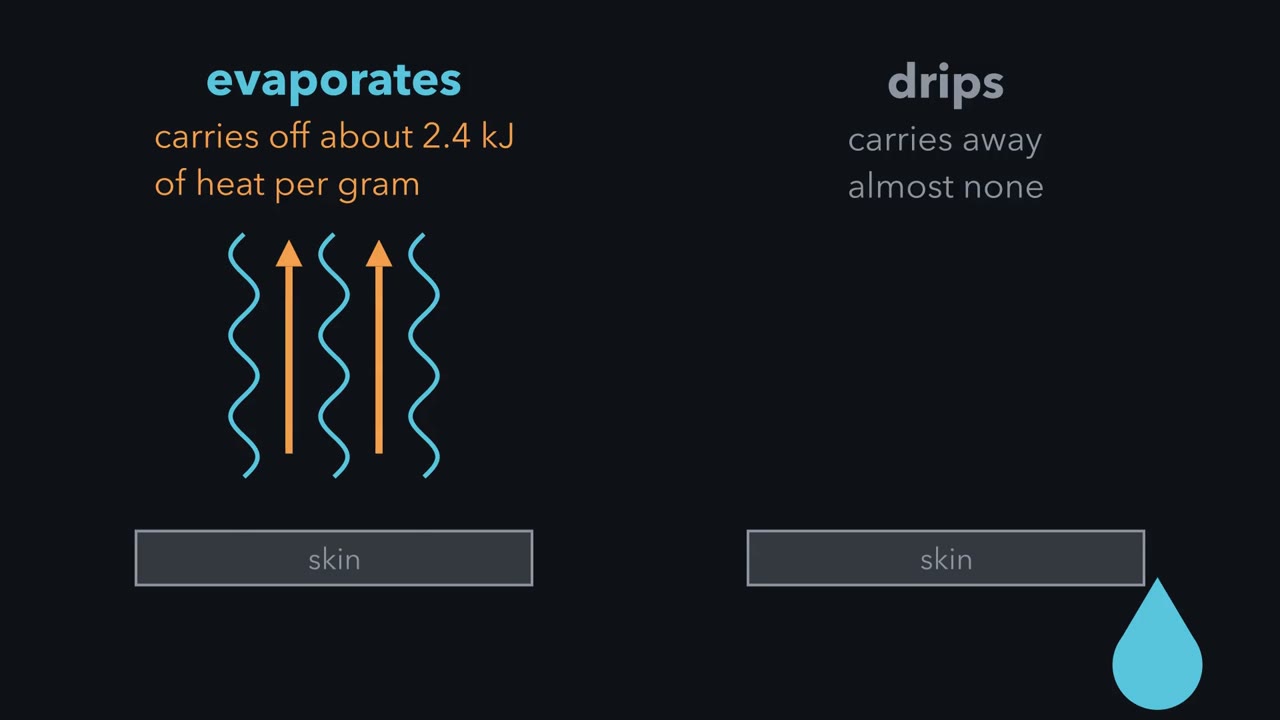
A gram of sweat that evaporates carries off about 2.4 kJ of heat. A gram that drips carries off almost none.
Pause when the reading reaches a film, and offer to play it. Saved on this device.
Watch the film now, or keep listening
Builds on:Body Water and Its CompartmentsSkeletal Muscle: Length, Load and SpeedCardiac Output and Venous ReturnWhy these?
 ▶ Watch Sweat Cools Only When It Evaporates · 2:29
Read the transcript of “Sweat Cools Only When It Evaporates”
Film transcript: Sweat Cools Only When It Evaporates
A gram of sweat that evaporates from your skin carries off about 2.4 kJ of heat. A gram that drips off carries away almost none. So the cooling comes from evaporation, not from sweat itself. Sweat cools you only as fast as air takes up water vapour. On a humid day, that can lag behind the heat your muscles make. For a person, heat balance is a sum. Heat storage equals metabolic rate, minus external work, plus or minus dry exchange, minus evaporative loss. Dry exchange means radiant, convective and conductive heat, and it can run either way. Every term is in watts. When storage is zero, body temperature is steady. Take illustrative numbers for a healthy 70 kg adult cycling steadily in hot, sunny air. Metabolic rate is 1,000 W, and 20 percent of it becomes external work.
That leaves 800 W of heat. Dry heat gain adds 50 W, and respiratory heat loss is ignored. To keep storage at zero, evaporation must remove 850 W. Evaporating sweat takes up about 2.43 kJ per g at skin temperature. So 850 W needs about 1.26 L of sweat per hour, if every gram evaporates. Suppose only 70 percent evaporates and the rest drips. The sweat rate then rises to about 1.80 L per hour. Without drinking, body mass falls about 2.6 percent in that hour. Now let humid air cap evaporation at 700 W, when the body needs 850 The gap of 150 W is stored as heat, 540 kJ in an hour. Take 2.98 kJ per kg per degree C. Then 70 kg stores about 209 kJ per degree.
If body temperature is uniform, it rises about 2.6 degrees C per hour. Once evaporation reaches the most that air allows, sweating harder adds dripping, not cooling. Balance returns three ways. Make less heat by slowing down. Take in less dry heat with shade or cooler air. Or have drier air. These numbers are made up for practice, and the rate predicts no real person. Keep this rule. Sweat cools only when it evaporates, and the air sets how much can.
A gram of sweat that evaporates from your skin carries off about 2.4 kJ of heat. A gram that drips off carries away almost none.
Sweat cools you only as fast as the air takes up water vapour, and on a humid day that can lag behind the heat your muscles make. The heat that cannot leave is stored.
Predict. Two cyclists ride at the same workload in equally hot air, one dry, one humid. Both are dripping sweat. Whose core temperature keeps rising? Would measuring their sweat rates tell you?
Check your prediction
The cyclist in humid air. Humid air already holds a lot of water vapour, so it takes up less from the skin, and less heat leaves by evaporation. Sweat rate would not tell you: dripping shows only that some sweat is not evaporating. In dry air, evaporation can still meet the need; in humid air, it cannot.
The one idea to carry through this lesson. Body temperature holds steady only while heat lost equals heat made, so that heat storage is zero. The body has two levers on the loss side. Skin blood flow decides how much heat from the core reaches the skin. Evaporation of sweat decides how much leaves when dry loss to the air is not enough, as in hot air or hard exercise; once the air is as warm as the skin, it is the only exit. Evaporation has a ceiling, Emax, set by the gap in water-vapour pressure between wet skin and the air (and by air movement and clothing), not by how much you sweat. When the heat that must go exceeds that ceiling, the extra sweat drips and the difference is stored.
The rule covers a whole person in air, at rest or exercising. The skin’s other jobs, its water barrier and vitamin D, come at the end.
The four routes of heat exchange, thermal conductance and the comparative thermoneutral zone are in metabolic rate and body temperature. Here they get human numbers.
A quick map of the skin first, since both levers sit in it. The outer epidermis has no blood vessels. The dermis beneath it holds the vessels, nerves and sweat glands. The hypodermis below that is mostly insulating fat.
The heat budget
Picture the body’s heat as a ledger. Coming in is heat production: the metabolic rate minus any energy that leaves as external work, such as pushing the pedals. Dry exchange, by radiation, convection and conduction, runs either way: a loss when the surroundings are cooler than the skin, a gain when they are warmer. Evaporation almost always runs out. What is left over is storage.
In words Heat stored equals heat made, plus dry heat gained or minus dry heat lost, minus heat carried off by evaporation.
- S“S”
- heat storage; positive means body temperature is risingW
- M“M”
- metabolic rateW
- W“W”
- external work done on the outside worldW
- R, C, K“R, C and K”
- dry exchange by radiation, convection and conduction; each is added as a gain or subtracted as a lossW
- E“E”
- heat lost by evaporationW
Sanity check The dry routes need not agree: in sun, radiation can be a gain while convection is a loss. If net dry exchange is a gain, evaporation is the only exit, so E must match heat production plus that gain for S to be zero.
Try one number
A cyclist’s metabolic rate is 1,000 W, and 200 W leaves as external work, so heat production is 800 W. Hot, sunny air adds a dry gain of 50 W.
If evaporation removes 850 W, S = 800 + 50 − 850 = 0, and body temperature is steady.
Need a refresher? units and prefixes
Heat lost in breath is ignored here, or folded into evaporation and dry exchange.
Lever 1: skin blood flow, a variable insulator
Blood carries heat from the core to the skin, so the skin circulation works as an insulator whose thickness the body can change. With little flow, heat must creep out through tissue, as if through a thick coat; with full flow, blood carries it straight to the surface, and the coat is thin. In a model of an average man, opening the skin vessels fully passes about four times as much heat for the same core-to-skin difference: with a 2 °C difference, about 16 W per m² of skin with vessels constricted and 65 W per m² with them open.
Two nerve systems set the dermal vessels:
- Vasoconstriction in the cold: sympathetic nerves release noradrenaline onto skin arterioles.
- Active vasodilation in heat: sympathetic cholinergic nerves (sympathetic in anatomy, but releasing acetylcholine, not noradrenaline) actively dilate skin vessels. Silent at rest, this system switches on as body temperature rises and supplies 80 to 90 percent of the vasodilation in hairy skin in whole-body heating; withdrawal of constrictor tone supplies the rest. Its mediator is an open question: acetylcholine, nitric oxide and cotransmitters each contribute, and no single one has been identified.
The hairless (glabrous) skin of palms and soles has no active vasodilator system; warming dilates its vessels mainly by withdrawing constrictor tone, much of it in arteriovenous anastomoses, direct links from small arteries to veins.
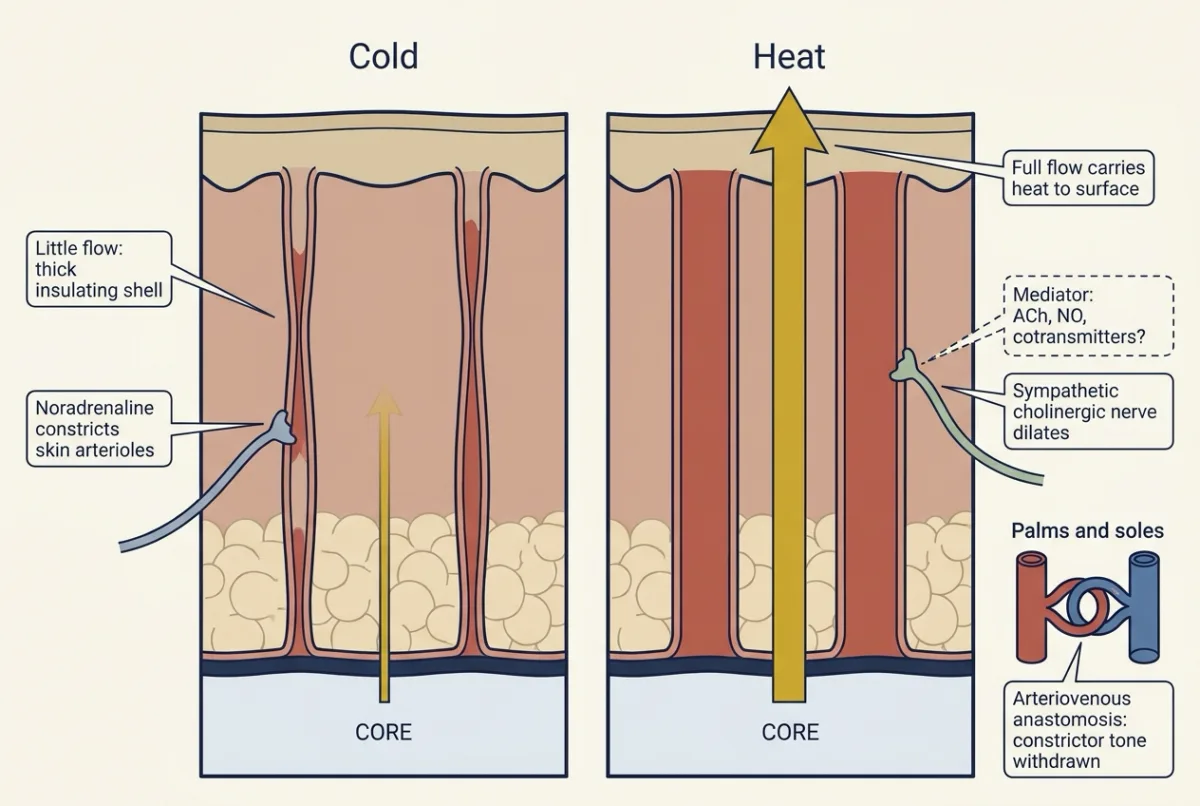
In severe whole-body heating, total skin blood flow can reach 6 to 8 L per min, a load on cardiac output and venous return.
The thermoneutral zone is the range of air temperatures where this lever alone is enough, with no regulatory change in heat production or evaporation. Below it, heat production must rise; above it, regulatory sweating begins. For resting nude people in air, the lower limit is about 28.5 °C.
Predict. A resting, nude volunteer sits in a chamber whose air cools by a couple of degrees but stays inside the thermoneutral zone. What changes: skin blood flow, heat production, or sweating?
Check your prediction
Only skin blood flow, which falls. Noradrenaline constricts the skin arterioles, insulation rises, and less heat reaches the skin. Heat production stays at its resting level, since shivering starts only below the lower limit, and there was no sweating to turn off.
TRP-channel sensing is in thermosensation, the preoptic integrator in the hypothalamus and autonomic control. The regulated temperature is a range, not one number (see the anecdote “Thirty-seven degrees came from the armpit”).
Lever 2: sweat, and its ceiling
Thermal sweat comes from a few million eccrine glands. Sweating responds mainly to core temperature, with a skin contribution, through the preoptic area. As in active vasodilation, the nerves are sympathetic but the transmitter is acetylcholine: postganglionic fibres release it onto muscarinic receptors of the gland. Apocrine glands are not thermoregulatory.
The secretory coil makes a primary fluid close to plasma in osmolality, and the duct reabsorbs sodium and chloride (chloride through cystic fibrosis transmembrane conductance regulator (CFTR), see membrane transport) while staying relatively impermeable to water. Sweat leaves hypotonic, and saltier at high flow, when the duct has less time per millilitre. Heavy sweating therefore loses more water than salt: plasma volume falls and osmolality rises, driving ADH release and thirst (water, sodium and potassium; body fluid compartments).
Why humid air sets a ceiling
Sweat cools only when it turns to vapour, and each gram that does carries off about 2.43 kJ of heat at skin temperature, its latent heat of evaporation, or 580 kcal per kg (2.26 kJ per g is the value at 100 °C).
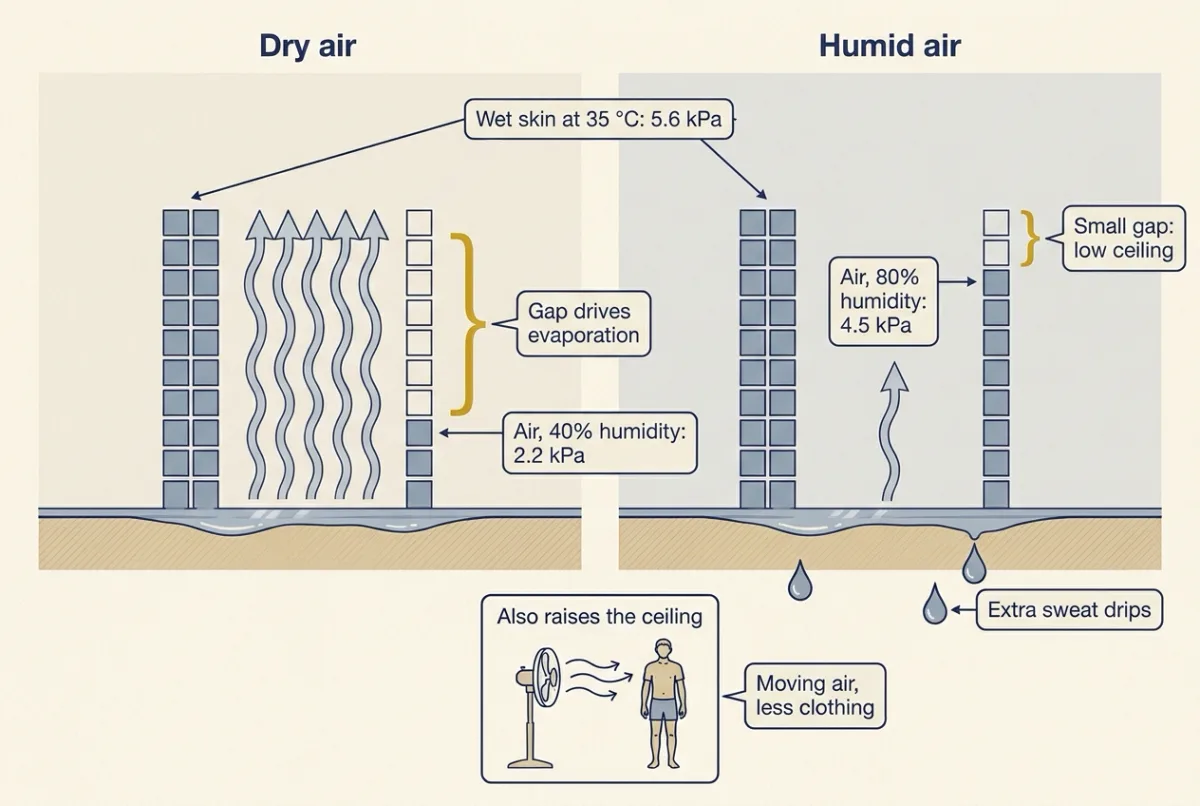
What drives water off the skin as vapour? A difference in water-vapour pressure, the part of the air’s pressure due to water vapour. A film of sweat on skin at 35 °C saturates the air touching it, at about 5.6 kPa. Air at 35 °C and 40 percent relative humidity holds about 2.2 kPa, so vapour moves from skin to air down a gap of about 3.4 kPa. At 80 percent humidity the air holds about 4.5 kPa, and the gap shrinks to about 1.1 kPa, a third as large.
The most heat that evaporation can remove is called Emax. It scales with that gap and with how fast moving air carries the vapour away; clothing lowers it. Notice what is missing from that sentence: your sweat glands. Sweat rate sets how much water is offered. The gap sets how much can leave.
Predict. A cyclist must lose 850 W by evaporation, and the humid air allows at most 700 W. She sweats 1.3 L per hour. Would sweating 2.5 L per hour help?
Check your prediction
Only up to a point. At 1.3 L per hour her sweat could carry off about 880 W if every gram evaporated, more than the 700 W the air allows. If her skin is already fully wet, the rest drips and sweating harder adds dripping, not cooling. If some of her sweat is already dripping, a little more sweat could raise evaporation, but never above 700 W. Either way at least 150 W is stored.
In words Given enough sweat, evaporation removes what the body needs, unless the ceiling is lower; whatever it cannot remove is stored.
- Ereq“E sub req”
- evaporation needed for zero storage: heat production plus any dry gain, or minus any dry lossW
- Emax“E sub max”
- the most evaporation can remove, set by the skin-to-air vapour-pressure gap, air movement and clothingW
- E“E”
- heat evaporation actually removesW
- S“S”
- heat storageW
Sanity check In this simple model, with enough sweat to keep the skin wet: if Emax exceeds Ereq, S is zero however humid the day feels; if Emax is smaller, S is positive whatever the sweat rate. The rate of rise is S ÷ (body mass × specific heat, the energy that warms 1 kg by 1 °C).
Try one number
The numbers are made up for practice, except the latent heat and the specific heat. The cyclist from the heat budget weighs 70 kg: heat production 800 W, dry gain 50 W, no respiratory heat loss, 1 g of sweat = 1 mL, body temperature uniform. So Ereq = 850 W.
Sweat needed if every gram evaporates: 850 J per s ÷ 2,430 J per g = 0.350 g per s, × 3,600 s per h = 1,259 g per h, about 1.26 L per hour.
Some sweat drips before it can evaporate. If only 70 percent evaporates: 1,259 ÷ 0.70 = 1,799 g per h, about 1.80 L per hour. That is the water to replace: without drinking, body mass falls about 1.80 kg in an hour, 1.80 ÷ 70 = 2.6 percent.
Now humid air sets Emax = 700 W. Storage: S = 850 − 700 = 150 W, or 150 J per s × 3,600 s = 540 kJ per hour. Heat capacity: 70 kg × 2.98 kJ per kg per °C = 208.6 kJ per °C. Temperature rises 540 ÷ 208.6 = about 2.6 °C per hour.
Need a refresher? units and prefixes · rates and “per”
The film at the top of the page works this same example and also holds Emax fixed. Where it says the air sets how much can evaporate, read the gap between wet skin and air.
With heat production, dry gain and Emax held fixed, balance returns only three ways: make less heat (slow down), gain less dry heat (shade, cooler air), or raise Emax (drier or faster-moving air, less clothing).
The rate also assumes uniform body temperature, predicts no real person, and depends on the specific heat used (Going deeper).
In a real person the shortfall between Ereq and Emax closes from both sides. As skin warms, the vapour pressure of its sweat rises (about 6.3 kPa at 37 °C), raising Emax, and dry heat gain shrinks, lowering Ereq, so heating often slows toward a new, higher steady state. Heat stress becomes uncompensable when no such state exists, which is what the chamber studies below look for.
- Required evaporation E_req
- 850 W
- Sweat to evaporate to meet E_req
- 1,259 g per h
- Sweat made
- 1,300 g per h
- Evaporation E (smallest of E_req, E_max and what the sweat made could carry)
- 700 W
- Dripped
- 263 g per h
- Heat storage S
- +150 W
- Rate of rise of body temperature
- 2.6 °C per h
- State
- uncompensable, limited by the air (E_max)
In this sketch every number is illustrative and made up for practice, except the latent heat of evaporating sweat (2.43 kJ per g) and the two specific heats. Fixed, as in the lesson’s worked problem: a 70 kg adult, no respiratory heat loss, 1 g of sweat = 1 mL, uniform body temperature for storage, skin blood flow unchanged. Sweat beyond what the air can take drips and is counted as removing no heat. Invented for the sketch: every gram of sweat evaporates until E_req or E_max is reached, and when E_req is below both limits the surplus is counted as dripping, whereas a real body would sweat less. The rate holds only while the sliders stay fixed; it predicts no real person.
Rule to keep: given enough sweat, evaporation is the smaller of E_req and E_max, and storage is what is left, S = (M − W) + dry exchange − E. Past that point, more sweat only drips. The first two bars share one scale, 0 to 1,200 W; the sweat bar runs 0 to 3,000 g per h.
When the ceiling is too low
Once Emax falls below Ereq, core and skin temperatures rise. Both levers now load the circulation: skin blood flow and heart rate rise, and sweat keeps flowing.
Predict. Trained cyclists ride for an hour at a fixed workload in hot, humid air, without drinking, dripping sweat as core temperature climbs. By the end, which way have heart rate, stroke volume and plasma osmolality moved?
Check your prediction
Heart rate up, stroke volume down, osmolality up. Sweat loss shrinks plasma volume and the faster heart shortens filling time, so cardiac filling and stroke volume fall. Sweat is hypotonic, so losing it removes more water than salt and osmolality rises. How much pooling of blood in skin veins adds during exercise is debated.
When dehydration adds to hyperthermia, the skin circulation joins the systemic vasoconstriction, cutting heat delivery to the skin just when it is needed. In 7 trained cyclists exercising in 35 °C heat, cutaneous vascular resistance rose despite a higher oesophageal temperature (González-Alonso and colleagues, 1995; later data in exercise physiology).
If storage goes on, heat illness can follow, and brain function separates two of its named forms:
- Heat exhaustion is heat strain with weakness, faintness or a fast heart rate, without marked central nervous system dysfunction.
- Heat stroke is severe heat illness defined by central nervous system dysfunction, such as confusion, seizures or coma, often with injury to other organs.
Sweating often persists early in exertional heat stroke, so sweating does not mean heat balance.
Acclimation is the adaptation. With repeated heat exposure, sweating starts earlier and rises more steeply with core temperature, and aldosterone lowers the sodium in sweat.
How humid is too humid?
The wet-bulb temperature, read from a wetted thermometer cooled by evaporation, combines air temperature and humidity. A wet-bulb of 35 °C was long cited as the theoretical limit, since fully wet skin near 35 °C could then lose no net heat to the air. A living person also makes heat, even at rest, and must lose it, so the real limit should lie lower.
Vecellio and colleagues (2022), in Kenney’s laboratory, tested young healthy adults at low metabolic rates. Picture their record: core temperature against time as the chamber’s heat stress rises in steps. At first the trace stays nearly flat: at each step the body keeps pace, or close to it. Then, at one step, it bends upward and keeps climbing. That bend, the inflection, marks the critical wet-bulb for that person. No one reached 35 °C: in humid air, the mean inflection came at a wet-bulb of about 30.5 °C, and in hot, dry air dry heat gain outpaced evaporation. These were indoor chamber tests, and longer exposures can still fail below the inflection (Going deeper).
In the cold: constrict, shiver, burn brown fat
In the cold, evaporation is near its floor and the levers change. Vasoconstriction raises insulation and limits loss. Heat production rises, mainly from shivering muscle in adults (skeletal muscle mechanics); if core temperature keeps falling, shivering wanes below about 31 °C. Small arrector pili muscles raise hairs, but in sparsely haired humans the goosebumps trap little air; the response is usually called vestigial.
Brown adipose tissue makes heat without contraction: the protein UCP1 lets protons leak back across the inner mitochondrial membrane without making ATP, so the gradient’s energy becomes heat (the proton-motive force; thyroid hormone).
Brown fat was thought to regress after infancy. In 2009, a study that scanned 24 healthy men by PET-CT after mild cold found active brown fat in 23 of them, mainly in depots above the collarbone and in the neck. A review of clinical scans taken without controlled cold found it in about 3 to 8 percent, more often in cold weather. Detection needs activation. The scans traced a radioactive glucose analogue, FDG, so they report glucose uptake, not heat.
The skin that does all this
The epidermis is a stratified epithelium, thinnest on the eyelids, about 0.05 mm, and thickest on the palms and soles, around half a millimetre or more. It lacks lymph vessels too and is fed by diffusion from below. The dermis is connective tissue; its deeper, reticular part holds hair roots and glands. The hypodermis, mostly white fat, anchors the dermis to muscle and bone.
The epidermis is a conveyor belt. Keratinocytes divide in the stratum basale and move outward through the spinosum, the granulosum, a clear lucidum found only in the thick skin of palms and soles, and the corneum. On the way they fill with keratin and die, ending as corneocytes: flat cells with no nucleus, packed with keratin. Repeated friction thickens the stratum corneum into a callus; nails and hair are hard, keratinized products of specialized epidermis.
Melanocytes sit in the basal layer and make melanin, which absorbs ultraviolet light. Skin colour differs with the amount and type of melanin and the size, distribution and fate of melanosomes, not with melanocyte number, which is similar between people. Langerhans cells, antigen-presenting cells most prominent in the spinosum, carry antigen to lymph nodes (lymphoid organs and immune traffic).
The water barrier is lipid between dead cells
The barrier keeps most water in, so the body can spend water on purpose: a small, steady leak crosses the skin all the time, and large losses go through sweat ducts when the brain calls for them. Where is the seal? Gut and kidney epithelia seal the spaces between cells with tight junctions (epithelia), so the natural guess was that skin does too.
In 1975 Peter Elias and Daniel Friend tested this in the epidermis of neonatal mice. They followed water-soluble tracers that are dense under the electron microscope between cells, and examined freeze-fracture replicas, casts of membranes split open while frozen, from the upper layers. If tight junctions between living cells were the seal, the tracers should stop there. Instead they moved between cells up to the upper stratum granulosum and stopped where lamellar bodies, lipid-filled granules, had emptied their contents into the space between cells. The authors placed the main barrier in that extruded lipid, not in tight junctions.
Later work resolved the lipid as patterned lamellae between corneocytes, often pictured as bricks in mortar. Then tight junctions returned: Furuse and colleagues (2002) found that mice lacking claudin-1 died within a day of birth with excess water loss through the skin, so tight junctions in the granular layer also contribute, and the knockout shows what an uncontrolled leak costs.
Sunlight makes vitamin D in the living epidermis
UVB at 290 to 315 nm photolyses 7-dehydrocholesterol to previtamin D3, and a temperature-dependent isomerization, not light, converts that to vitamin D3. Most synthesis is in the living basale and spinosum, beneath the dead corneum. MacLaughlin, Anderson and Holick (1982) put the optimum at 295 to 300 nm.
Predict. Webb, Kline and Holick (1988) exposed excised human skin, and radiolabelled 7-dehydrocholesterol, to sunlight on cloudless days, month by month. In Boston, at 42.2 °N, would January sunlight make any previtamin D3?
Check your prediction
No. In Boston no previtamin D3 formed from November through February, and in Edmonton (52 °N) none from October through March, while at 34 and 18 °N it formed even in midwinter. Low winter sun sends its light through more atmosphere, where ozone absorbs UVB.
This is photochemistry in vitro, not blood levels in people: it shows when sunlight can start vitamin D synthesis. Melanin also absorbs UVB, so more pigmented skin makes less previtamin D3 from the same exposure and needs a longer exposure to make the same amount. Sunlight has not been reported to cause vitamin D toxicity, because further UVB converts excess previtamin D3 to lumisterol and tachysterol, which do not act as vitamin D3. Activation in liver and kidney is in calcium, phosphate and bone.
Design problem
Do we lose most of our body heat through the head? Design an experiment in healthy volunteers in cold water that measures heat loss from the head and the rest of the body: null prediction, comparisons, measurements.
Saved in this browser only.
One way to do it
Null prediction: each region loses heat roughly in proportion to its surface area. The head is about 7 percent of the surface, so submerging it should add roughly that, not the myth’s 40 to 50 percent.
Use a 2 x 2 design: head in or out of the water, body insulated or not. Suppress shivering with a drug, so changing heat production cannot mask loss. Measure heat loss and the core cooling rate until both are steady.
Pretorius, Bristow, Steinman and Giesbrecht (2006) did this with 8 men in 17 °C water. With the body uninsulated, submerging the head added only about 10 percent to total heat loss, so the head did not lose disproportionately more. Yet the core cooled about 42 percent faster, possibly through redistribution of blood flow.
Limits: 8 men, one water temperature, no shivering, water not air. With a clothed body and bare head, the head is the main uninsulated surface and can carry a larger share. A 1970 US Army survival manual gave 40 to 45 percent; the experiment behind the figure has not been identified.
Going deeper
Insulation in model units
Core-to-skin heat flow per unit area is roughly (core − skin temperature) ÷ body insulation. In the model of an average man, insulation falls from about 0.124 to 0.031 m² °C per W as skin blood flow goes from minimal to maximal, which gives the 16 and 65 W per m² above.
Who set the thermoneutral zone’s lower limit
Hardy and DuBois reported the 28.5 °C lower critical temperature, with skin at 33.5 °C. Kingma and colleagues (2014), reporting that work, argued that skin temperature belongs in the definition of the human thermoneutral zone.
Sweat gland numbers
Humans have about 2 to 4 million eccrine sweat glands, densest on the palms and soles at about 250 to 550 per cm². No new glands form after birth, so their density falls as the body grows. An older figure, that the total number is fixed by about age 2 to 3, is still repeated in reviews; it appears to come from Kuno’s work on how many glands become active, not on how many exist.
The specific heat in the worked example
The 2.98 kJ per kg per °C used in the example is a tissue-based estimate. With the older, assumed 3.47, the example’s heat capacity is 242.9 kJ per °C and temperature rises 540 ÷ 242.9 = about 2.2 °C per hour, against 2.6 with 2.98: the newer value predicts heating about 16 percent faster. The anecdote “The specific heat nobody measured” tells where both values come from.
Below the inflection
Vecellio and colleagues reported a mean critical wet-bulb of 30.55 °C in humid air of 36 to 40 °C, and sweat rates did not differ between environments. Meade and colleagues (2025) then held 12 young volunteers for up to 9 hours above and below each person’s inflection. Above it, core temperature kept rising; below it, the rise was much slower but still did not level off.
The 2009 brown fat scans
Wouter van Marken Lichtenbelt and colleagues’ 24 men were 10 lean and 14 overweight or obese, with indirect calorimetry at 22 and 16 °C. Activity was lower in the overweight and obese men, and three men with high uptake, rescanned at 22 °C, showed none. In the same issue, Cypess and colleagues reviewed clinical scans retrospectively and found brown fat in 7.5 percent of women and 3.1 percent of men; those scans used no controlled cold exposure, and detection was more likely when outdoor temperature was lower.
The study does not show how much heat brown fat adds (brown fat burns mostly fatty acids, not the glucose FDG traces), how women’s brown fat responds to cold (all imaged subjects were men), or whether low activity causes obesity or follows it.
Normal body temperature
In the anecdote “Thirty-seven degrees came from the armpit”, Wunderlich’s 37.0 °C came from axillary readings and Mackowiak’s 36.8 °C from oral ones. Armpit readings usually run lower than oral ones, so the site does not explain why the later mean is lower.
Skin cells in more detail
Corneocytes are packed with keratins 1 and 10. Each melanocyte supplies about 30 to 40 keratinocytes. In mice, Langerhans cells are seeded before birth and renew locally (see the anecdote “Langerhans cells that outlast the marrow”). Elias and Friend’s tracers included horseradish peroxidase and lanthanum.
Your notes
Select any text in the lesson to highlight it or add a note to it. Your highlights and notes are saved in this browser and collected in your notebook.
This browser is not letting the site save anything (a private window or strict privacy settings), so highlights and notes will be lost when you leave the page.
How we measure it
Electron-dense tracers and freeze-fracture electron microscopy
Introduce water-soluble tracers that show up in the electron microscope, such as horseradish peroxidase or lanthanum, and see how far they travel between cells; fracture frozen tissue along its membranes to view junctions and lipid. Together they map where a barrier lies.
18F-FDG PET-CT with controlled cold exposure
Inject a radioactive glucose analogue and image where it accumulates, with CT for anatomy, once at a thermoneutral temperature and once after mild cold. Uptake that appears only in the cold marks active brown fat; it reports glucose uptake, not heat output.
Environmental chamber step protocols
Hold a volunteer at a low, fixed metabolic rate while air temperature or humidity rises in steps, and record core temperature continuously. The point where core temperature stops holding steady and climbs estimates the limit of compensable heat stress for that protocol; longer exposures can still fail below it.
In vitro photoconversion in excised skin
Expose samples of human skin, or a radiolabelled precursor, to sunlight or to narrow bands of ultraviolet light, then measure how much 7-dehydrocholesterol became previtamin D3. It isolates the photochemistry from diet, clothing and blood levels.
Practice questions on this lesson (3) → MCAT-style, original, each with an explanation
Where this lesson fits
Before thisReview first
- Body Water and Its CompartmentsThis course · Lesson 1
Heavy sweating drains plasma volume and raises osmolality, which you read using the fluid compartments from there.
- Skeletal Muscle: Length, Load and SpeedThis course · Lesson 3
Shivering and the heat made by working muscle rest on how muscle turns energy into force and heat.
- Cardiac Output and Venous ReturnThis course · Lesson 7
Skin blood flow of 6 to 8 litres a minute loads cardiac output and venous return as explained there.
After thisStudy next
- Exercise: The Whole Body at WorkThis course · Lesson 30
It extends the heat budget to whole-body exercise, including skin blood flow competing with muscle and dehydration raising heart rate.
Elsewhere on the siteFilms, simulations and method films in other courses
- Threshold and gainSimulation · Neuroscience
The hypothalamic threshold-and-gain idea shows how the brain sets the sweating and cold responses used here.
- Shape is destinyFilm · Biochemistry
Lipid packing explains why lipid layers between dead cells form the skin's water barrier.
- Radioactive and stable isotope tracersMethod film
The tracer experiment locating the water barrier in neonatal mice uses this method.
Suggested by an AI model from the lessons themselves, then checked. How we use AI
Finish line
Test yourself
8 questions
Practice and MCAT-style, with explained answers.
Next · Lesson 27
Sexual Differentiation and the Testis
An AMH-null male mouse can make sperm and retain a uterus. Which testicular signals have separated?
Continue →