Physiology · Skim version
Skin, Sweat and Human Thermoregulation
Read the full lesson → Skim the whole course →
The guiding idea
A gram of sweat that evaporates carries off about 2.4 kJ of heat. A gram that drips carries off almost none.
In the heat, humans lose heat mainly by evaporating sweat, and humid air can cap how much evaporates, so heat is stored and core temperature rises.
-
The heat budget
-
Lever 1: skin blood flow, a variable insulator
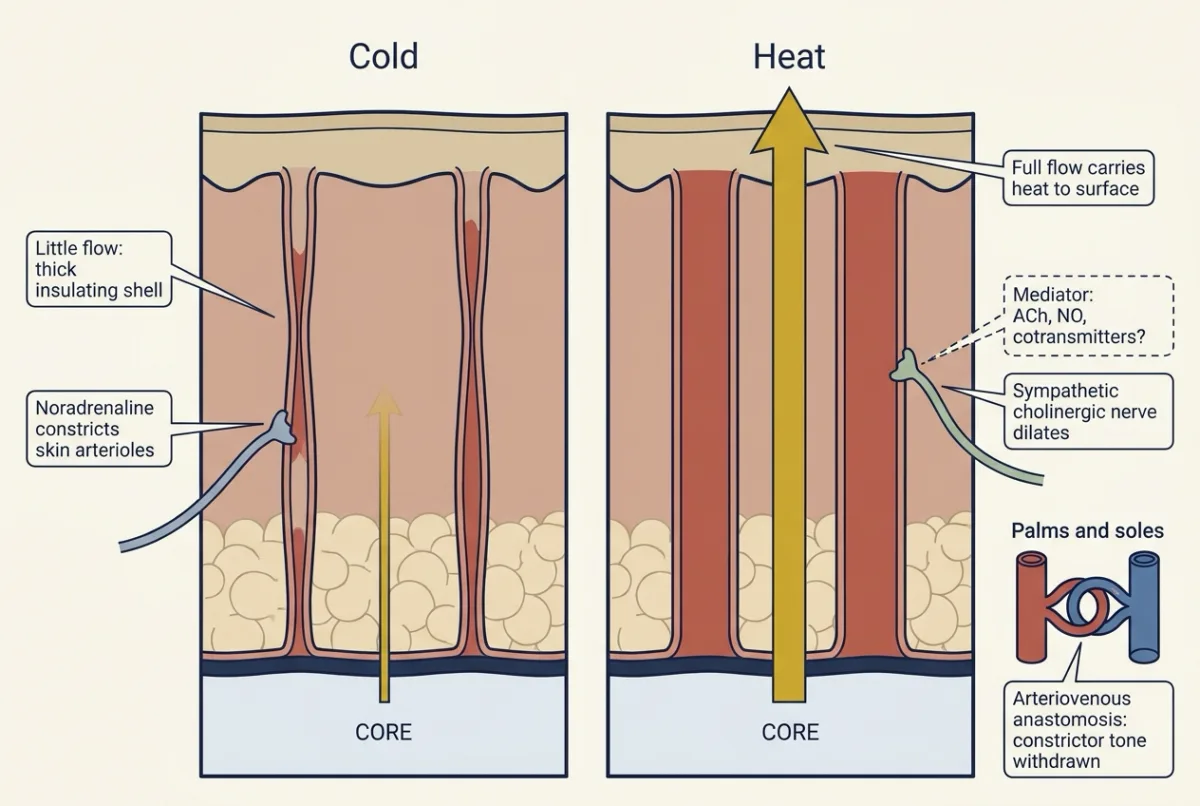
Skin blood flow is the first lever: noradrenaline narrows dermal arterioles in the cold so little core heat reaches the surface, while sympathetic cholinergic nerves, by a mediator still unsettled, open them in the heat so blood carries heat outward. AI-generated illustration -
Lever 2: sweat, and its ceiling
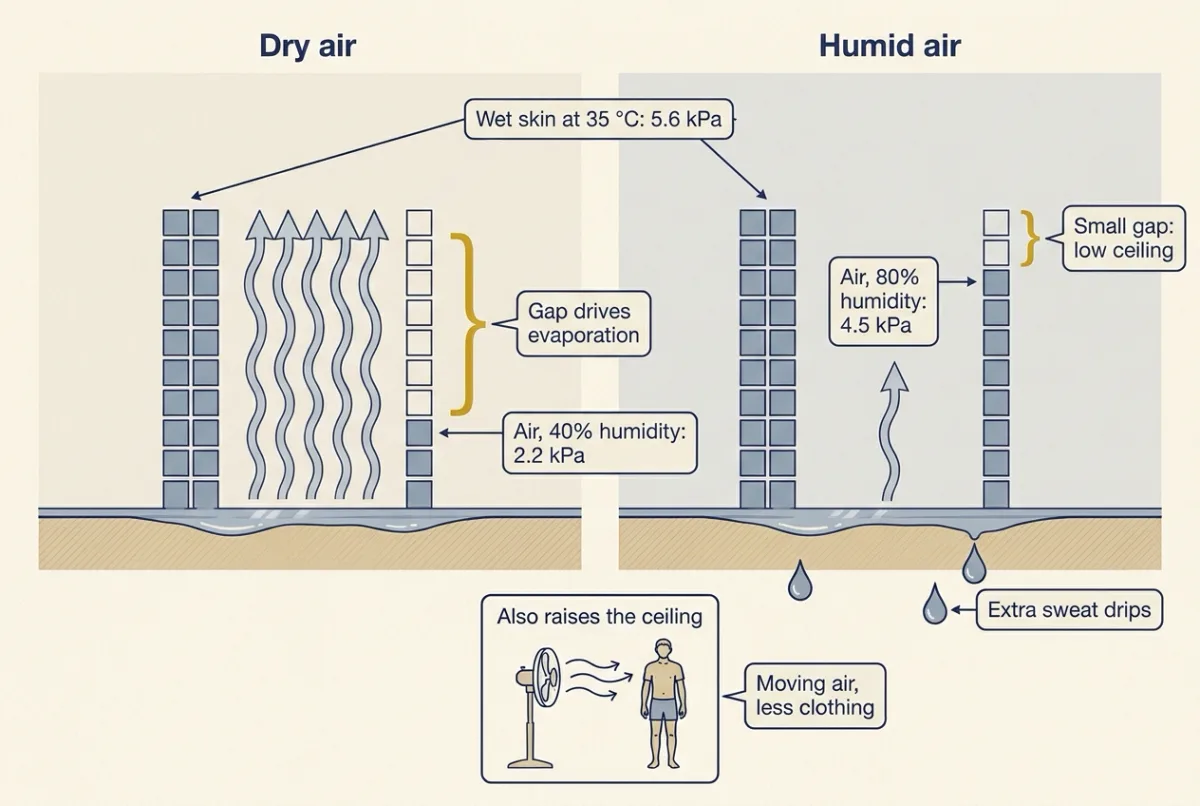
The ceiling on evaporative cooling, E_max, scales with the vapour-pressure gap between wet skin and air (and with air movement and clothing); humid air shrinks that gap to about a third, and sweat beyond what can evaporate drips without cooling. AI-generated illustration -
When the ceiling is too low
-
In the cold: constrict, shiver, burn brown fat
-
The skin that does all this
-
Sunlight makes vitamin D in the living epidermis
-
Going deeper
Where this lesson fits
Before thisReview first
- Body Water and Its CompartmentsThis course · Lesson 1
Heavy sweating drains plasma volume and raises osmolality, which you read using the fluid compartments from there.
- Skeletal Muscle: Length, Load and SpeedThis course · Lesson 3
Shivering and the heat made by working muscle rest on how muscle turns energy into force and heat.
- Cardiac Output and Venous ReturnThis course · Lesson 7
Skin blood flow of 6 to 8 litres a minute loads cardiac output and venous return as explained there.
After thisStudy next
- Exercise: The Whole Body at WorkThis course · Lesson 30
It extends the heat budget to whole-body exercise, including skin blood flow competing with muscle and dehydration raising heart rate.
Elsewhere on the siteFilms, simulations and method films in other courses
- Threshold and gainSimulation · Neuroscience
The hypothalamic threshold-and-gain idea shows how the brain sets the sweating and cold responses used here.
- Shape is destinyFilm · Biochemistry
Lipid packing explains why lipid layers between dead cells form the skin's water barrier.
- Radioactive and stable isotope tracersMethod film
The tracer experiment locating the water barrier in neonatal mice uses this method.
Suggested by an AI model from the lessons themselves, then checked. How we use AI