Organismal Biology · Unit 6: How plants work
Plant Body and Growth
Rewritten on : new text, flashcards and film. Your notes and highlights stay, but the text around them may have moved.
A 300-year-old oak grows new leaves each spring and usually a new ring of wood each year, yet no adult mammal grows a new limb. How does the oak keep building?
Pause when the reading reaches a film, and offer to play it. Saved on this device.
Watch the film now, or keep listening
Builds on:The Cell Cycle and MitosisSize, Scale and SurfacePlants on LandWhy these?
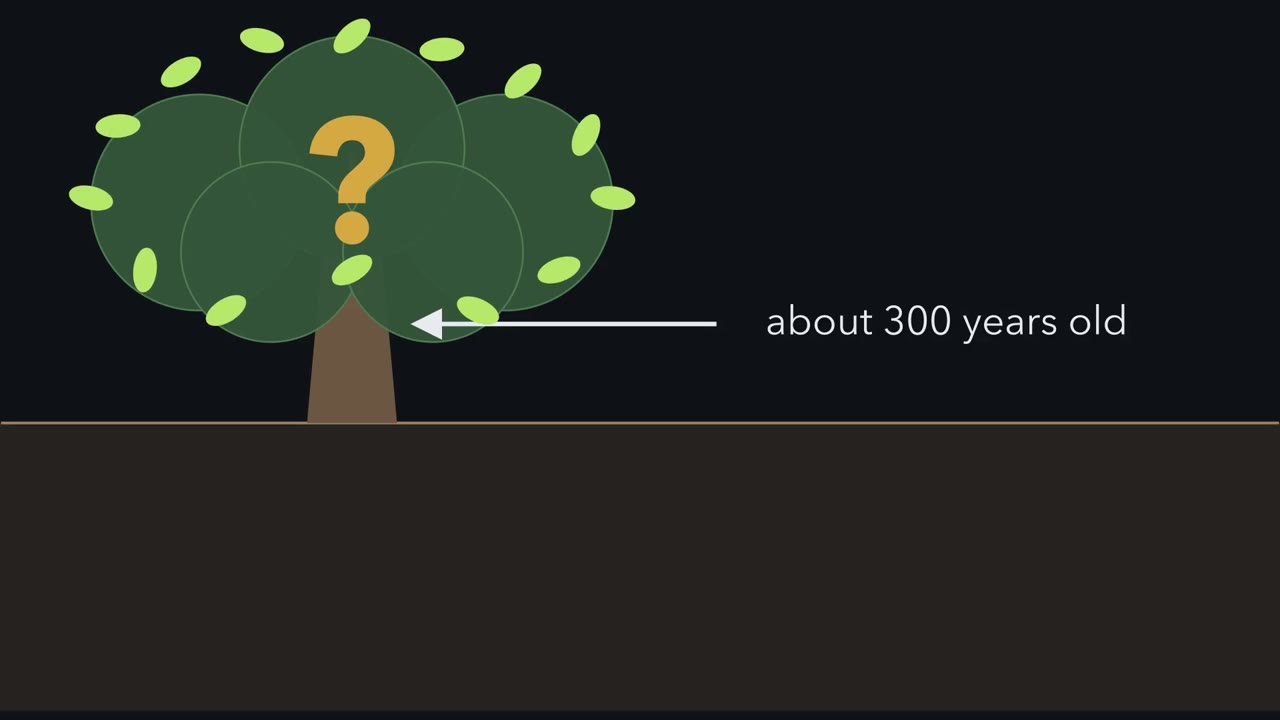 ▶ Watch Where Does a Plant Add New Body? · 2:55
Read the transcript of “Where Does a Plant Add New Body?”
Film transcript: Where Does a Plant Add New Body?
Where on a 300-year-old oak were this spring's new leaves made? The tree is ancient, but this spring's leaves are only months old. The answer is meristems. A meristem is a group of cells that keeps dividing. No adult mammal grows a new limb, but many plants keep their meristems for years. So they keep adding new organs. Apical meristems sit at the tips of growing roots and shoots. Growth from them is called primary growth. It is mainly growth in length. Zoom in on a root tip. A root cap shields the front as it pushes through soil. Just behind the cap, small cells divide. This is the zone of division. A little further back, division tapers off.
Cells lengthen many times over as water fills their vacuoles, the big water sacs inside them. This is the zone of elongation. Further back still, cells stop lengthening. They take on their final types, and root hairs grow out from the surface. This is the zone of maturation. Now follow one lengthwise row of cells, a cell file. New cells leave the meristem at a steady rhythm. Each one stretches, then stops.
Meanwhile the tip keeps moving forward through the soil. Paint ink marks at even spacing along a growing root tip. A day later, which gaps between the marks have widened? Mostly the gaps in the zone of elongation, where cells stretch. In the mature region, where cells have stopped lengthening, the marks stay put. So how fast does the root grow? Count the new cells each file makes per hour. Multiply by the final length each cell reaches. That product is the growth rate. It holds at steady state, when the zones keep their size and every file behaves alike. Now block stretching but leave division alone.
Cells keep coming, yet the tip barely creeps forward. Most of a root's new length comes from stretching, not from dividing. A shoot tip grows the same way, though it has no cap. At each node it adds one or more leaves, with a bud in the angle of each leaf. So a plant's new cells come from its meristems. For a root at steady state, growth equals new cells per file per hour, times their final length.
From the film
- A plant's new cells come from meristems, groups of cells that keep dividing, and many plants keep them for years.
- Behind a root tip, cells divide, then lengthen many times over as water fills their vacuoles, then mature into their final types.
- At steady state, with every cell file alike, root growth equals new cells per file per hour times their final length.
- Most of a root's new length comes from cells lengthening, not from dividing, so blocking elongation slows growth sharply.
The one idea. A plant’s new cells come from its meristems, groups of cells that keep dividing; their daughters then grow and take on their final types. Growth depends on how many cells a meristem makes and how big each one grows. Along a root: length added per hour = new cells per file (a lengthwise row of cells) per hour × final cell length.
Scope: the root rule is exact only at steady state with every file alike. In a tree, height comes from young shoots near the tips; the trunk’s wood and most of its added width come from the vascular cambium, which runs the same rule sideways (the cork cambium adds periderm, the outer part of the bark). Grasses such as maize also lengthen from meristems at the bases of leaves and internodes, and make no wood. These rules are geometry, not forecasts: real growth changes with age, season and site.
A map of the plant body
A flowering plant has three kinds of organ, a structure of several tissues working as a unit: the root anchors it and absorbs water and minerals, the stem holds up leaves, buds and flowers and connects them to the roots, and the leaf is the main site of photosynthesis in most plants.
Each organ is built from the same three tissue systems, sets of tissues that run through the whole plant. The dermal system covers it (in a young plant, the epidermis, usually one cell thick). The vascular system carries water and minerals in xylem and sugars and amino acids in phloem. The ground system is everything else: it stores, supports and, in green parts, photosynthesizes. In a young root, the ground tissue between the epidermis and the central xylem and phloem is the cortex.
Keep three levels apart, like bricks, walls and a house’s wiring: a cell type is one kind of cell, a tissue a group of cells working together, a tissue system a plant-wide set of tissues.
Growing from the tips: division, then elongation
Apical meristems lie at the tips of growing roots and shoots and produce primary growth, mainly growth in length (division itself is in mitosis). The first film walked back from the root cap through the zones of division, elongation and maturation.
Worked problem. These numbers are illustrative, not a measured species. Assume steady state (the zones keep their size and the tip advances at a constant speed) and that every cell file behaves alike. One file in the cortex delivers 1 new cell per hour; cells leave the meristem 15 micrometers long and mature at 300 micrometers. If elongation is blocked, 15 micrometers is also their final length.
| Case | New cells per file per hour | Final cell length (um) | Growth (mm per day) |
|---|---|---|---|
| Normal | 1 | 300 | 7.2 |
| Elongation blocked, division unchanged | 1 | 15 | 0.36 |
| Division halved, elongation normal | 0.5 | 300 | 3.6 |
Each row is cells per hour x final length x 24 hours: 1 x 300 micrometers x 24 = 7.2 mm per day. Blocked elongation leaves growth at one twentieth of normal, so elongation supplies most of the length.
Predict. Halving division gave 3.6 mm per day. A different root also grows at 3.6 mm per day, but its division rate is normal. What changed, and could you have told the two roots apart from their growth rates alone?
Check your prediction
Its cells reach only 150 micrometers: 1 x 150 = 0.5 x 300 = 150 micrometers per hour, the same 3.6 mm per day. So no: growth rate alone cannot tell you whether division or elongation changed; you also need the rate of new cells or the final length.
- Growth per hour
- 300 µm per h
- Growth per day
- 7.2 mm per day
In this sketch: illustrative numbers, not a measured species; steady state; every cell file alike; zones not to scale. Primary growth is division plus elongation, and growth = rate of new cells per file x final cell length.
The first film’s shoot tip has zones less sharply separated than a root’s; the stretches of stem between its nodes are internodes.
Most animals, by contrast, lay down their body plan early (see animal development), though many keep growing in size. Not every plant meristem lasts: in maize the shoot apex finally becomes the tassel.
When the cells at a shoot tip divide, do they mix like dough, or stay in separate sheets? Sophia Satina, Albert Blakeslee and Amos Avery answered this in the Jimson weed, Datura stramonium, in 1940. They needed a mark every descendant inherits. Colchicine, a drug that stops chromosomes separating, doubles a cell’s chromosome number, and doubled cells and their offspring are larger, so they show up in a section. Sometimes only one layer of the shoot tip was doubled: a periclinal chimera, cells of two genetic kinds in layers parallel to the surface.
Predict. If the cells of the tip mixed as they divided, where would the large cells end up as the shoot kept growing?
Check your prediction
Mixing would scatter large cells through many tissues. Instead, a doubled outermost layer gave large cells in the epidermis and not in the tissues beneath. The Datura apex has three layers that stay separate. Later work assigned their fates: L1 makes the epidermis; L2 makes most of the tissue just under it in leaves and flowers, including the cells that go on to make pollen and eggs; L3 makes the inner core of the stem and its vascular tissue.
So Datura has clonally separate layers that persist through primary growth. That does not mean three layers in every plant: maize and some other grasses have two, and in many species a neighbouring cell occasionally invades a layer.
What the meristems’ cells become
- Parenchyma cells are living, thin-walled general workers. Some photosynthesize and some store starch.
- Collenchyma cells are living, with unevenly thickened walls, and give flexible support to young stems and leaves (collenchyma strands, together with the veins, make the tough strings of a celery stalk).
- Sclerenchyma cells have thick secondary walls hardened with lignin, a tough polymer. They come as long fibers and as shorter sclereids (the grit in a pear).
Xylem and phloem are not cell types but complex tissues, each made of several. In xylem, water moves through tracheids and vessel elements, dead at maturity so only their hollow walls remain. Vessel elements join end to end through open perforations to form pipes; water passes between tracheids through thin pits in their walls. In flowering plants, phloem carries sugars through sieve-tube elements, which stay alive at maturity although they lose their nucleus, each supported by a neighbouring companion cell. How water and sugar move is in plant transport.
A leaf: what the shoot tip builds at each node
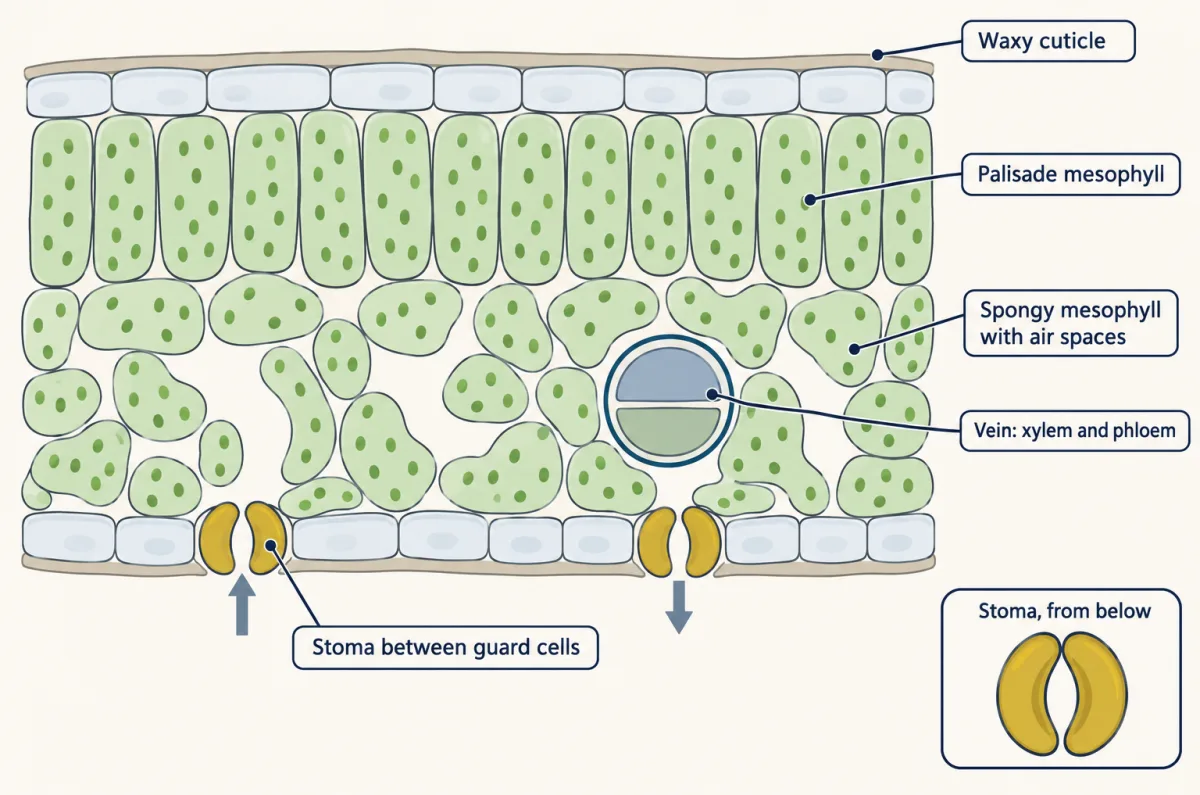
In Datura, a leaf’s epidermis comes from L1 and its inner tissue from the layers beneath. Most leaves are thin, flat organs whose anatomy serves light, water and carbon dioxide. In a typical eudicot leaf:
- A waxy cuticle over the epidermis reduces water loss.
- Stomata (singular stoma) are pores, each between a pair of guard cells that open and close it. In many eudicots most are on the lower surface.
- Under the upper epidermis, palisade mesophyll is a layer of tightly packed column-shaped cells full of chloroplasts.
- Below it, spongy mesophyll has loosely arranged cells, also with chloroplasts, separated by air spaces that connect to the stomata.
- Veins carry xylem and phloem through the blade.
An open stoma lets carbon dioxide in and water vapour out, so every gain of carbon costs water. That trade-off is in organism problems, and the large internal surface of the mesophyll in size and scaling.
Maize (Zea mays) leaves look different: each vein is wrapped in large bundle-sheath cells ringed by mesophyll, a wreath called Kranz anatomy that splits carbon fixation into two steps in two cell types (C4; see Calvin cycle and Going deeper). Kranz anatomy is not required for C4: Bienertia sinuspersici separates the two steps within single cells.
Despite their different leaf anatomy, maize and oak both start leaves at shoot tips, yet an oak trunk can keep widening for centuries while a maize stalk never adds wood.
Read the transcript of “How Does a Trunk Get Wider?”
Film transcript: How Does a Trunk Get Wider?
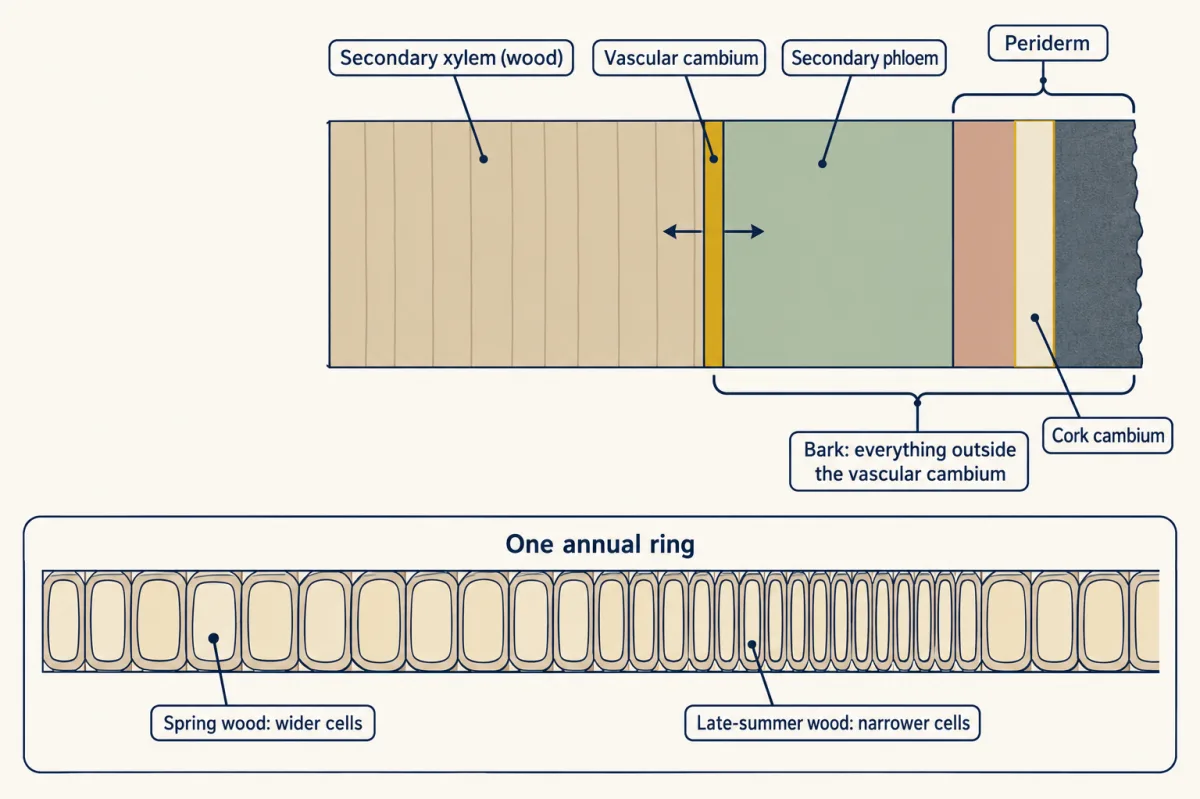
The first film showed growth in length near the tips. So drive a nail into a tree trunk, 1 m up. How high is it many years later? It is still at the same height. That part of the trunk stopped lengthening long ago. A tree gets taller only in young shoots near its tips. But the trunk keeps getting wider. Width comes from a thin cylinder of dividing cells inside the stem, the vascular cambium. It lies between the xylem and the phloem. It is a lateral meristem, running along older stems and roots. Cut a thin strip from the centre of the trunk out to its surface. The vascular cambium is one thin teal line inside it. When a cambium cell divides, some daughters are pushed inward.
They become secondary xylem, which is wood. Other daughters are pushed outward. They become secondary phloem, the tissue that carries sugars from the leaves to the rest of the plant. In a temperate oak, the cambium works in spring and summer and rests in winter. Spring wood has large vessels. Late summer wood has smaller ones. Where one summer's dense wood meets the next spring's large vessels, a line appears. Each year usually leaves one ring. As the trunk widens, its old skin, the epidermis, splits. A second lateral meristem, the cork cambium, usually forms just beneath it. Outward it makes cork, whose cells have waterproofed walls. Inward it makes a thin living layer, the phelloderm.
Cork, cork cambium and phelloderm together form the periderm. The periderm replaces the epidermis. Bark is everything outside the vascular cambium. So its inner part is living phloem, not only dead cork. This is the first film's rule, turned sideways.
Over one year, count the new wood cells in a row out from the cambium. Multiply by their average width. Cell widths change through the season, so the average matters. That gives the width of the ring. Maize has no conventional vascular cambium. Its bundles are scattered, and it makes no wood. It grew tall from its shoot tip and from meristems at the bases of its leaves and internodes. So a tree's shoot tips add height. Its vascular cambium adds width and wood.
From the film
- A tree gets taller only in young shoots near its tips; an older stretch of trunk does not lengthen, it widens.
- The vascular cambium adds wood (secondary xylem) toward the inside and secondary phloem toward the outside, and in temperate trees each year usually leaves one ring.
- Bark is everything outside the vascular cambium, so its inner part is living phloem, not only dead cork.
- Over one year, ring width is the number of new wood cells in a radial row times their average width.
- Maize has no conventional vascular cambium, so it makes no wood.
Growing wider: how much wood a ring adds
The second film’s widening is secondary growth, from the vascular cambium, one of two lateral meristems.
Predict. A cambium adds a ring 2 mm wide in a year, once round a sapling of radius 20 mm and once round a trunk of radius 200 mm, 10 times wider. Does the trunk get 100 times the wood, 10 times, or a little under 10 times?
Check your prediction
A little under 10 times. In cross-section the new wood is the area between two circles:
| Trunk | Ring area | Result |
|---|---|---|
| Radius 200 mm | pi x (202 squared - 200 squared) = pi x 804 | about 2,530 square millimeters |
| Radius 20 mm | pi x (22 squared - 20 squared) = pi x 84 | about 264 square millimeters |
About 9.6 times. Unroll the ring and it is a strip 2 mm wide whose length is the circumference at the middle of the ring, radius 201 mm against 21 mm. So, for the same height of trunk, the area added scales roughly with radius, not radius squared.
The ring width is itself the one idea’s product: with illustrative xylem cells averaging 40 micrometers wide radially, a 2 mm ring is about 50 new cells per radial file.
Conventional secondary growth is usual in woody eudicots and in conifers. In maize, a monocot, the meristems at the bases of leaves and internodes in the second film are intercalary meristems, inserted between mature tissues.
The second film’s cork is also called phellem, and in old trunks bark also includes older periderms and the dead tissue outside them.
Four bodies, one toolkit: herb, tree, grass, cactus
Arabidopsis thaliana, a small herbaceous eudicot, grows mostly by primary growth, though its hypocotyl (the stem below the seed leaves) and its root each form a cambium.
Oak or poplar usually adds a ring of wood each year and replaces its epidermis with periderm.
Maize has parallel leaf veins and, as the second film showed, no wood.
A prickly pear cactus (Opuntia) photosynthesizes in its flattened green stems. Its spines are modified leaves. It uses CAM, opening its stomata mainly at night (chemistry in Calvin cycle).
None is more advanced than the others; each lineage has had the same time to evolve. The life cycles behind them are in plant diversity and life cycles, and how they respond to their surroundings is in plant signals.
Design problem
Shi, Lebovka, Lopez-Salmeron, Sanchez and Greb (Development, 2019) switched on a permanent fluorescent mark in a few scattered cells of the Arabidopsis hypocotyl cambium and followed their descendants for 10 days. Of 99 marked clones, 35 spanned xylem, cambium and phloem. Does this show that one stem cell makes both xylem and phloem? What would you check before you believed it, and what can you not conclude?
Saved in this browser only.
One way to do it
A permanent lineage mark is inherited by every descendant of the marked cell, so a clone that reaches both xylem and phloem means one cell’s lineage made both. A pulse label such as EdU, which dilutes as cells divide, could not show that.
The main alternative: two neighbouring cells marked at once, one feeding xylem and one phloem, would look like a single bifacial clone. Controls: keep induction sparse enough that marked cells are rarely adjacent, count how often two marks appear close together in short-term samples, and check that the reporter is off without the inducer.
35 of 99 is about 35 percent. That is the fraction of this sample of clones, not the fraction of cambium cells that are stem cells, because a clone’s type depends on which cell happened to be marked and on how long it was followed.
This is the Arabidopsis hypocotyl over 10 days, not the cambium of an oak. The data support a bifacial stem cell, which is what the authors concluded, but they do not say whether each daughter’s fate is set by an asymmetry at division or by its position afterward.
Going deeper
How the Datura layers were traced
The team made the chimeras by soaking Datura seeds in colchicine; a doubled layer’s descendants were then traced by their larger cells in sections.
Why the circumference at the middle of the ring
The exact area, pi x ((r + w) squared - r squared), equals 2 x pi x (r + w/2) x w for any trunk. The shortcut 2 x pi x r x w (inner circumference) comes out low: 0.5 percent on the 200 mm trunk, 4.8 percent on the sapling, 16.7 percent on a 5 mm twig.
Reading a ring
In oak (Quercus) the second film’s annual ring shows mainly as a band of large early-spring vessels; poplar (Populus) also lays down rings. Some years leave a false extra ring or none, so one ring per year is usual, not certain.
C4 and oxygen in the leaf
In maize’s C4 arrangement the mesophyll first fixes carbon into a four-carbon acid, and the bundle-sheath cells, rich in the enzyme Rubisco, break that acid down to release carbon dioxide, which Rubisco fixes again on the way to sugar. Oxygen leaves the leaf through the stomata as a by-product of splitting water in the light reactions.
Your notes
Select any text in the lesson to highlight it or add a note to it. Your highlights and notes are saved in this browser and collected in your notebook.
This browser is not letting the site save anything (a private window or strict privacy settings), so highlights and notes will be lost when you leave the page.
How we measure it
Induced polyploid periclinal chimeras
Treat seeds or a growing shoot apex with colchicine so that some cells double their chromosome number, pick out shoots in which one whole layer is polyploid, then follow that layer's descendants by their larger cells, which can be told apart by size. It shows which apical layer gives rise to which tissues, in the species tested.
Inducible genetic lineage tracing
Use a drug-inducible switch, such as Cre recombinase acting on a reporter gene, to turn on a permanent fluorescent mark in a few scattered cells. Because every descendant inherits the mark, the clone that forms shows which tissues one cell's lineage produced.
EdU pulse labeling
Supply the thymidine analogue EdU for a short period so that cells copying their DNA take it up, then detect it in sections. It shows which cells copied their DNA during the pulse, usually a sign that they were cycling, though plant cells can also copy DNA without dividing. The label dilutes as cells keep dividing. A pulse-chase can follow the labeled group of cells for some days, but it cannot show which cells came from one parent, so it is not a lineage trace.
Sectioning and light or confocal microscopy
Cut thin cross-sections of root, stem or leaf, stain or image them, and identify cells by wall thickness, shape, contents and position. This is how tissue systems, cambia and annual rings are recognized.
Practice questions on this lesson (3) → MCAT-style, original, each with an explanation
Where this lesson fits
Before thisReview first
- The Cell Cycle and MitosisBiology · High school
You need to know how one cell divides into two with full chromosome sets, since meristems keep doing exactly this.
- Size, Scale and SurfaceThis course · Lesson 2
Surface area and volume arguments there explain why plants and leaves take the forms they do.
- Plants on LandThis course · Lesson 5
This lesson uses its plant groups and the flowering plant body, so you should know the major plant lineages first.
After thisStudy next
- Moving Water and Sugar in PlantsThis course · Lesson 23
It explains how the xylem and phloem tissues described here move water and sugar.
- Auxin and Plant Hormones: How Plants Steer GrowthThis course · Lesson 25
It shows how auxin steers the growth of the shoot and root tips described here.
- Soil, Nutrients and PartnersThis course · Lesson 24
It follows the root's absorbing surface and soil partners, building on the root zones mapped here.
Elsewhere on the siteFilms, simulations and method films in other courses
- Set Up: Wake Up a SeedFilm · Biology Together
It shows a seed starting growth, the first step before meristems build a plant body.
- Heal the scrapeSimulation · Life Science
Cells that divide make new tissue, and meristems rely on exactly this division.
- Set Up: Plant Parts We EatFilm · Biology Together
Sorting roots, stems, leaves and fruits onto a plant shows the organs this lesson names.
Suggested by an AI model from the lessons themselves, then checked. How we use AI
Finish line
Test yourself
8 questions
Practice and MCAT-style, with explained answers.
Next · Lesson 23
Moving Water and Sugar in Plants
A coast redwood lifts water more than 100 m with no heart or other pump organ. Where does the force come from?
Continue →