Biochemistry · Photosynthesis
New to this? Review it at high school level: Capturing Sunlight
The Calvin Cycle: Fixing Carbon from Thin Air
Rewritten on : new text, figures and flashcards. Your notes and highlights stay, but the text around them may have moved.
Most of the carbon in the sugars, proteins, and DNA of living things was first fixed from CO2 by this loop.
Pause when the reading reaches a film, and offer to play it. Saved on this device.
Watch the film now, or keep listening
Builds on:Photosynthesis: The Light ReactionsBasic Concepts of Enzyme ActionGlycolysis: The Investment-and-Payoff PathwayWhy these?
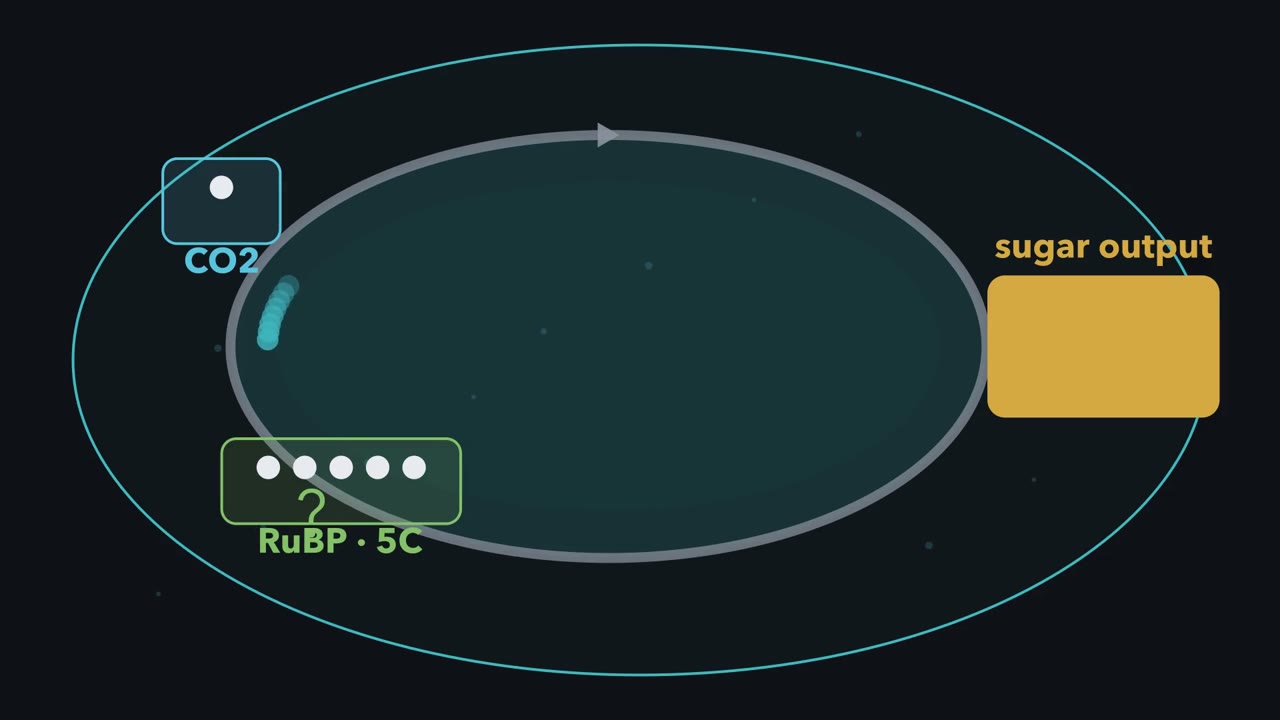 ▶ Watch The Carbon Count Pays the Bill · 3:08
Read the transcript of “The Carbon Count Pays the Bill”
Film transcript: The Carbon Count Pays the Bill
How can a leaf pull carbon from air, build sugar, and still keep its carbon-catching machine running? Follow the carbon count, and the energy bill will reveal itself. The Calvin cycle runs in chloroplast stroma, using ATP and NADPH from light reactions. Rubisco joins one CO2 to RuBP, a five-carbon acceptor. The brief six-carbon intermediate immediately splits into two three-carbon molecules of 3-phosphoglycerate, or 3-PGA.
Fixation itself spends no ATP or NADPH. Both 3-PGA molecules must become the triose sugar G3P. Each conversion spends one ATP to prime the acid and one NADPH to reduce it. So far, one CO2 has cost 2 ATP and 2 NADPH. But can both new trioses leave while the conveyor keeps turning? Count the carbons needed to rebuild each five-carbon acceptor.
Scale up to 3 turns. 3 RuBP plus 3 CO2 make 6 trioses, holding 18 carbons altogether. Only 3 carbons came from air, so only 1 triose is net gain. The other 5 trioses hold 15 carbons, exactly enough to rebuild 3 five-carbon acceptors. The counters are reshuffled, not discarded. Regeneration then spends 3 more ATP to remake RuBP and close all 3 loops. Now divide that 3-turn bill by 3. At steady state, the ordinary C3 cycle costs 3 ATP per CO2. It also costs 2 NADPH. One extra ATP beyond reduction pays to rebuild the acceptor. Count the carbons, and the bill follows. 3 turns therefore spend 9 ATP and 6 NADPH for 1 net G3P. 6 turns spend 18 ATP and 12 NADPH for 2 net trioses.
Those trioses can supply 1 hexose phosphate at the same Calvin-cycle cost. The plant does not directly release free glucose here. This is the simplest steady-state picture. Startup, photorespiration, and carbon-concentrating pathways change the accounting; the page below develops those cases. A leaf builds carbon product only while rebuilding its carbon catcher. That is why 1 triose in 6 is net, and why ATP demand exceeds NADPH demand.
From the film
- Rubisco joins one CO₂ to five-carbon RuBP, yielding two 3-PGA.
- Over three steady-state turns, five of six G3P rebuild RuBP; one is net.
- At steady state, the ordinary C3 cycle costs 3 ATP and 2 NADPH per CO₂.
- Rebuilding RuBP explains why ATP demand exceeds NADPH demand.
Pick a carbon atom in the CO₂ you just breathed out. Follow it. A leaf might fix it next week, or years from now (on average a CO₂ molecule spends several years in the air), and the machine that welds it into a sugar is the Calvin cycle. Nearly every carbon in your body, in your last meal, in the wood of the table in front of you, entered the living world through this one loop of chemistry. Each year it builds roughly 100 billion tons of carbon into new plant and algal biomass, on land and in the sea.
The cycle runs in the stroma, the soup inside the chloroplast surrounding the thylakoid stacks. It is often called the “dark reactions,” and that name is doubly wrong. It runs in broad daylight, and it cannot run without the light reactions, because it spends two products they make: ATP for energy and NADPH for reducing power, the electrons that actually build the sugar.
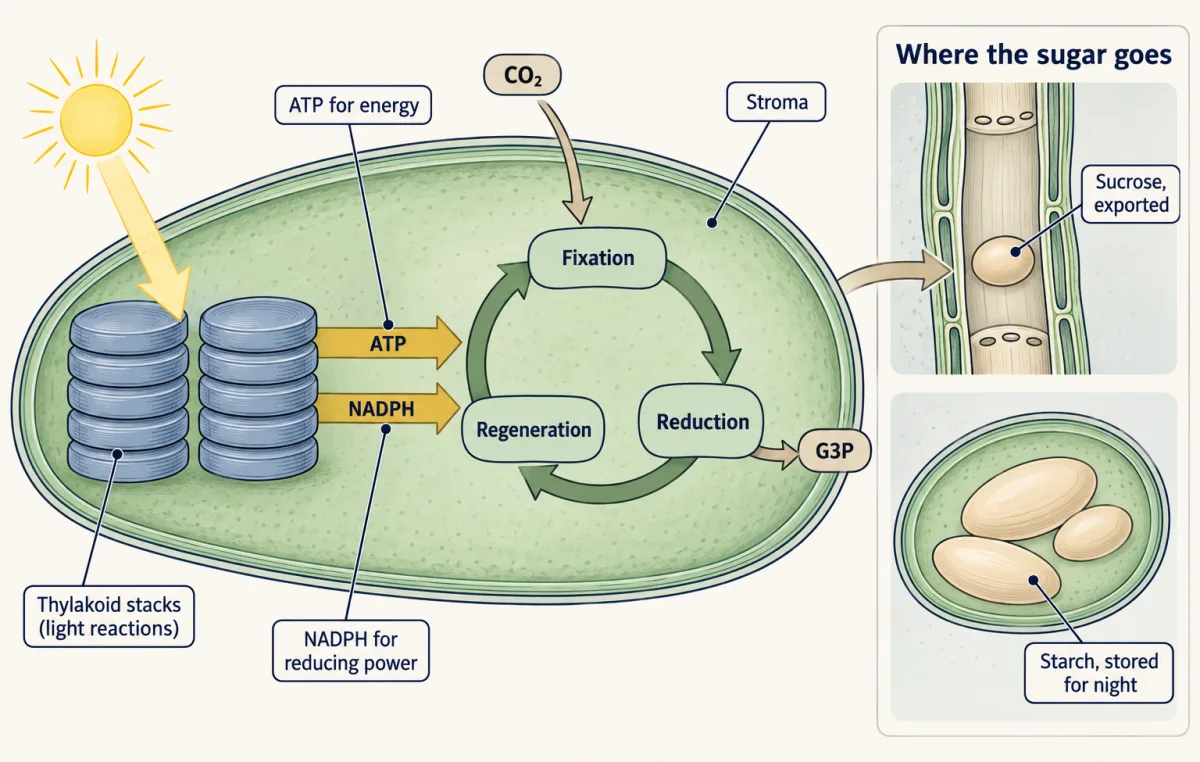
The film above animates the carbon count and energy bill: 3 ATP + 2 NADPH per CO₂, with one triose in six kept. That rule assumes the ordinary (C3) cycle in the light at steady state, with the ribulose 1,5-bisphosphate (RuBP) pool neither growing nor shrinking; photorespiration, C4 and CAM plants, and start-up at dawn bend it (Going deeper, “Where the rule bends”).
Below, derive the chemistry and see where that rule bends. The Calvin cycle supplies hexose phosphates; making sucrose or starch then costs a little more ATP or UTP.
Act 1 is the engine and its cost. Act 2 is the control panel that light switches on at dawn and off at dusk.
Act 1, the first clue: a three-carbon acid
Calvin, Benson and Bassham fed green algae carbon-14-labeled CO₂, killed the cells after shorter and shorter exposures, and separated the labeled molecules on paper (Techniques). At thirty seconds the label had spread into a wide variety of compounds. At a few seconds it sat in only a handful. At the shortest exposures one spot held most of it: 3-phosphoglycerate (3-PGA).
Whatever lights up first is the earliest product, so carbon from the air lands first in a three-carbon acid. What the CO₂ joins came from a second experiment, later in this act.
Count the carbons, and the bill follows
Why count three turns at a time? Each turn adds one carbon to ribulose 1,5-bisphosphate (RuBP), the five-carbon acceptor, and a triose has three, so three turns is the smallest batch that makes one whole molecule to take out.
Predict. Three RuBP and three CO₂ go in. How many three-carbon molecules come out, and how many can the plant keep?
Check your prediction
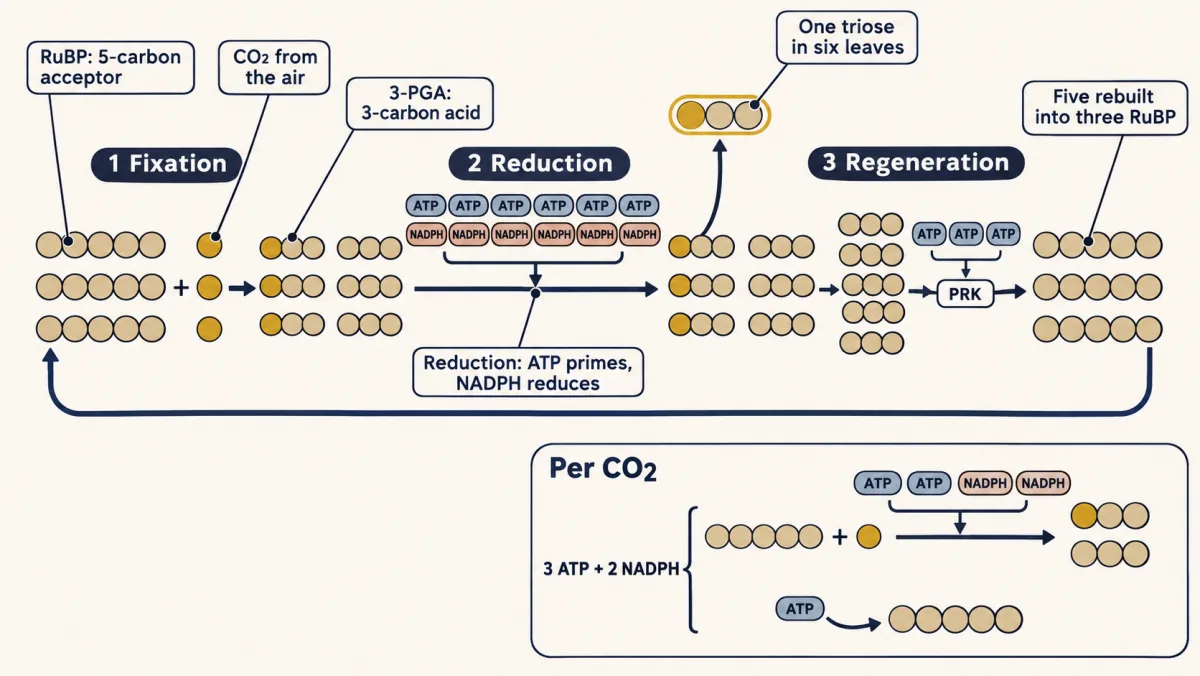
3 RuBP (3 × 5 = 15 C) + 3 CO₂ (3 C) → 6 three-carbon acids (3-PGA, 18 C) → 6 trioses (18 C)
→ 1 triose leaves (3 C); 5 trioses (15 C) are rebuilt into 3 RuBP (15 C) for the next round.
Only one triose is profit: three carbons, exactly as many as came from the air.
Now the three stages.
Stage 1, fixation. Rubisco (ribulose-1,5-bisphosphate carboxylase/oxygenase), the most abundant protein on Earth, joins one CO₂ to one RuBP (ribulose-1,5-bisphosphate). The six-carbon intermediate is so unstable it never accumulates; it is hydrated and split at once into two 3-PGA. It needs no ATP because the reaction is strongly downhill on its own, and no NADPH because no outside electrons enter; Rubisco shuffles electrons within the molecule. It is often the rate-limiting step, especially when CO₂ is scarce; under other conditions, rebuilding RuBP sets the pace.
Stage 2, reduction. Each 3-PGA is primed by ATP (phosphoglycerate kinase adds a phosphate to its acid end) to 1,3-bisphosphoglycerate, then reduced by NADPH (G3P dehydrogenase) to glyceraldehyde-3-phosphate (G3P), a triose. These are glycolysis’s two steps run backward, using NADPH instead of NADH. Per three CO₂, reduction spends 6 ATP and 6 NADPH, most of the cost.
Stage 3, regeneration. The job is to turn five trioses (15 C) into three five-carbon sugars (15 C), adding and losing no carbon. Aldolase joins two sugars into one; transketolase moves a two-carbon piece from one sugar to another; two phosphatases, fructose-1,6-bisphosphatase (FBPase) and sedoheptulose-1,7-bisphosphatase (SBPase), clip off phosphates.
| Step | Carbons | What happens |
|---|---|---|
| 1 | 3 + 3 → 6 | Aldolase joins two trioses into fructose-1,6-bisphosphate; FBPase clips one phosphate |
| 2 | 6 + 3 → 4 + 5 | Transketolase moves two carbons from the six-carbon sugar onto a triose |
| 3 | 4 + 3 → 7 | Aldolase joins the four-carbon sugar to a triose; SBPase clips one phosphate |
| 4 | 7 + 3 → 5 + 5 | Transketolase moves two carbons again |
The table uses 2 + 1 + 1 + 1 = 5 trioses. Finally, phosphoribulokinase (PRK) spends one ATP on each five-carbon sugar to make RuBP, closing the loop: 3 ATP per three CO₂, with no NADPH.
Predict. Why does the cycle need more ATP than NADPH?
Check your prediction
Two kinds of step spend ATP and only one spends NADPH: 1 ATP + 1 NADPH per 3-PGA to make a triose, and 1 ATP per RuBP rebuilt. One CO₂ makes two 3-PGA and uses one RuBP: 2 × (1 ATP + 1 NADPH) + 1 ATP = 3 ATP + 2 NADPH.
Chemistry checks the NADPH independently. Turning CO₂ carbon (oxidation state +4, as oxidized as carbon gets) into sugar carbon (0 on average) takes at least four electrons per carbon, the load of two NADPH, by any route, and the Calvin cycle spends exactly that.
In words Each carbon fixed costs three ATP and two NADPH, so a three-carbon sugar costs nine and six, and a six-carbon sugar costs eighteen and twelve.
- ATP“A T P”
- spent twice per CO₂ to prime the two 3-PGA, and once to rebuild RuBPmolecules
- NADPH“N A D P H”
- spent once per 3-PGA, twice per CO₂, to reduce the acid to a sugarmolecules
Sanity check The ATP-to-NADPH ratio is 3:2 at every scale. A pathway that claimed fewer than four electrons (2 NADPH-equivalents) per carbon turned into sugar would be breaking redox chemistry.
Try one number
One hexose takes 6 CO₂, so six turns.
Six turns make 12 3-PGA: 12 ATP + 12 NADPH to reduce them.
Six RuBP must be rebuilt: 6 more ATP.
Total: 18 ATP + 12 NADPH.
Need a refresher? rates and “per”
The full balance sheet for one hexose:
6 CO₂ + 18 ATP + 12 NADPH + 12 H₂O → C₆H₁₂O₆ + 18 ADP + 18 Pᵢ + 12 NADP⁺ + 6 H⁺
Now follow the carbon from the opening. Welded onto RuBP, it becomes the acid (–COO⁻) end of one 3-PGA, and ATP and NADPH turn that end into the aldehyde (C=O) end of a G3P. Only one triose in six leaves each time, so it may go around the loop several times before it is exported as sugar.
regulated step − used up
The fixation step, and often the rate-limiter. RuBP forms a C2–C3 enediol; CO₂ adds at C2 to give a six-carbon intermediate that is hydrated and then cleaved at the C2–C3 bond into two molecules of 3-PGA. It costs no ATP or NADPH — the energy is paid later. Needs the Lys-201 carbamate plus Mg²⁺, and that carbamate CO₂ is not the substrate CO₂.
Clinical. Rubisco is the most abundant protein on Earth, yet each active site in a typical plant enzyme fixes only about 3 CO2 per second. That slowness is one of the main limits on crop photosynthesis, and plants compensate by making astonishing amounts of it, up to about half of the soluble protein in a leaf.
Reduction stage begins. One ATP phosphorylates the carboxylate to a mixed anhydride, priming the carbon for reduction — a glycolytic payoff step run backward. It happens twice per CO₂, once for each 3-PGA.
NADPH delivers the electrons that actually reduce the molecule to a triose sugar, releasing Pᵢ. The chloroplast isoform prefers NADPH (it can also use NADH) — the reducing power comes from Photosystem I, by way of ferredoxin and ferredoxin-NADP+ reductase. This is the only true reduction in the cycle, and it runs twice per CO₂.
Regeneration. Five of every six G3P (15 carbons) are reshuffled into three 5-carbon sugars by aldolase and transketolase, with FBPase and SBPase clipping phosphates; an isomerase and an epimerase then turn ribose-5-P and xylulose-5-P into ribulose-5-P. The sixth G3P (3C) leaves as profit — one triose per three CO₂. FBPase and SBPase are light-activated control points.
The last ATP of the cycle phosphorylates ribulose-5-P back to the CO₂ acceptor RuBP, closing the loop. This regeneration ATP is why the cycle needs more ATP than NADPH (3:2). PRK is switched on by reduced thioredoxin in the light and off in the dark.
Exported G3P doesn’t stay G3P. Two trioses (one first isomerized to dihydroxyacetone phosphate) join into fructose-1,6-bisphosphate, then fructose-6-phosphate, a path that mirrors gluconeogenesis almost step for step. The plant then makes sucrose, exported through the phloem, or starch, stockpiled in the chloroplast for the night. Trees also bank carbon across seasons: the sweetness in a tapped maple’s spring sap is sucrose the tree fixed in summers past and stored, now mobilized through the xylem.
Switch off the light, or the CO₂
Calvin’s group let algae fix labeled CO₂ steadily, then suddenly changed one input and watched two pools, 3-PGA and ribulose 1,5-bisphosphate (RuBP).
Predict. The light goes off. Which pool rises?
Check your prediction
3-PGA rises and RuBP falls. Without ATP and NADPH, 3-PGA cannot be reduced, and RuBP cannot be rebuilt while Rubisco keeps using it. Cutting off CO₂ in the light does the reverse: RuBP rises and 3-PGA falls, because regeneration keeps making RuBP and nothing uses it.
A molecule that piles up when CO₂ is withheld is a candidate acceptor: this is the experiment that pointed to RuBP, later confirmed with the purified enzyme. It also shows the loop’s weak point: without regeneration, fixation stops when RuBP runs out.
Act 2: the control panel runs on light
In the dark, a running cycle would spend ATP and NADPH that are no longer being made. Worse, at night the chloroplast makes NADPH by burning sugar (the oxidative pentose phosphate pathway), so the cycle would build sugar while that pathway burns it: a futile cycle. So light flips the switches, through three stromal signals.
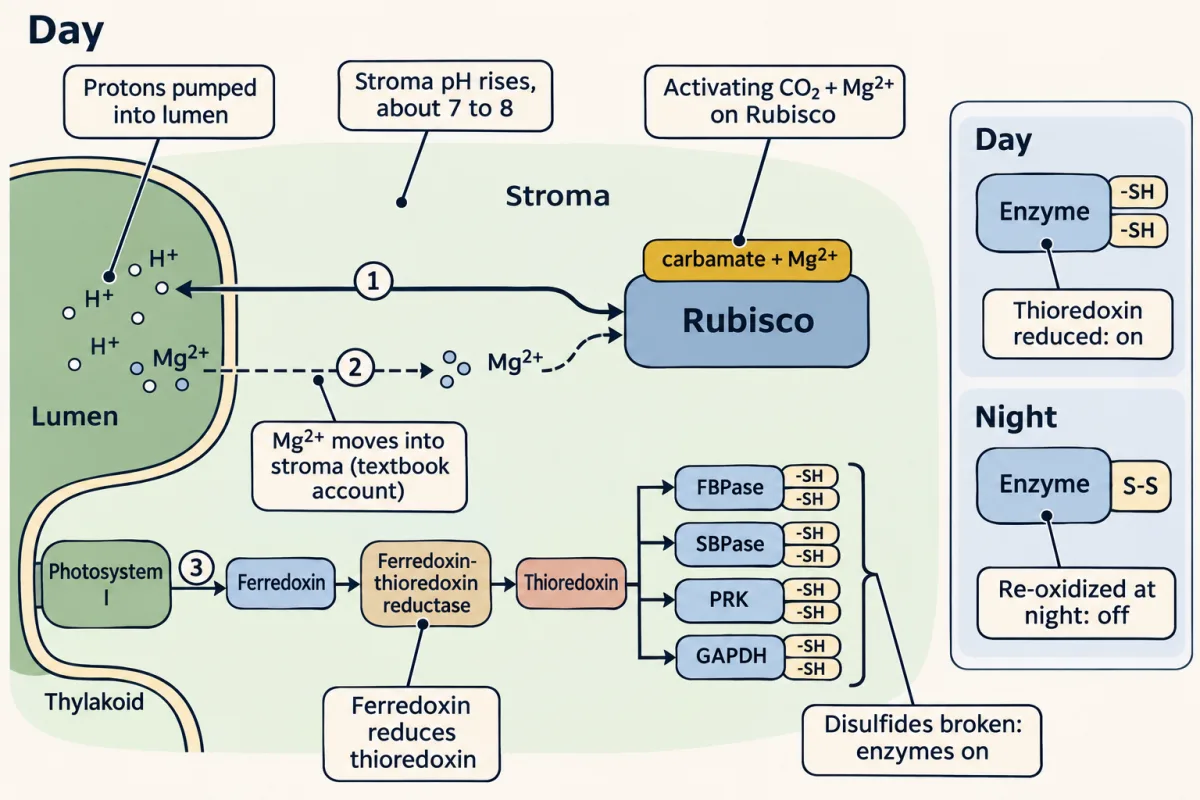
First, as the light reactions pump protons into the thylakoid lumen (the space inside the thylakoids), stromal pH rises from about 7 to 8. Second, in the textbook account, Mg²⁺ flows out of the lumen into the stroma to balance the charge.
Both act on Rubisco. A separate CO₂ first reacts with a lysine on the large subunit (Lys-201) to form a carbamate, which then holds a Mg²⁺ ion; that pair builds the working active site. High pH helps the lysine react, and more Mg²⁺ completes the pair. So one CO₂ switches the enzyme on, and a different CO₂ gets fixed. A Rubisco that is not switched on clamps onto ribulose 1,5-bisphosphate (RuBP) so tightly it shuts itself down, and an ATP-burning chaperone, Rubisco activase, pries the sugar loose.
Third, and most elegant: Photosystem I makes reduced ferredoxin, which feeds ferredoxin-thioredoxin reductase to make reduced thioredoxin. In four Calvin enzymes (FBPase, SBPase, phosphoribulokinase (PRK) and the chloroplast glyceraldehyde-3-phosphate (G3P) dehydrogenase), thioredoxin reduces a regulatory disulfide, breaking an S–S bridge between two cysteines into two –SH groups so the enzyme can take its active shape. In plants that make the redox-sensitive alpha form of Rubisco activase, it switches that on too. At nightfall thioredoxin is re-oxidized via peroxiredoxin, which passes the electrons to hydrogen peroxide; the disulfides reform, and the cycle quietly stalls. The plant has wired its sugar factory directly to the sun.
Photorespiration: the ledger broken
Rubisco has a costly flaw written into its name: it is also an oxygenase. When O₂ wins the active site, ribulose 1,5-bisphosphate (RuBP) is split into one 3-PGA plus one two-carbon phosphoglycolate: RuBP spent, no carbon fixed. This is photorespiration, and it worsens on hot, dry days.
Predict. On a hot afternoon the leaf closes its stomata to save water. Which reaction gains, carboxylation or oxygenation?
Check your prediction
Oxygenation. With stomata closed, CO₂ inside the leaf falls while O₂ stays high. Heat also lowers Rubisco’s preference for CO₂ over O₂ and makes CO₂ less soluble relative to O₂.
Salvaging phosphoglycolate costs ATP and reducing power, and it releases CO₂: two phosphoglycolates (4 carbons) become one 3-PGA (3 carbons) plus one CO₂. On a scorching afternoon a plant can lose a quarter of its fixed carbon this way.
Predict. Run six oxygenations, using six RuBP (30 carbons). After salvage, is there enough carbon to rebuild all six?
Check your prediction
No. Oxygenation gives six 3-PGA (18 carbons) and six phosphoglycolates (12 carbons); salvage turns those 12 into three 3-PGA (9 carbons) and three CO₂. That is 27 carbons back and three lost as CO₂. Six RuBP need 30, so the loop ends three carbons short, and it takes three ordinary fixations just to break even. Real leaves mix both reactions, so net gain shrinks, and in extreme heat and low CO₂ can stop.
- Carboxylation : oxygenation
- 3 : 1
- Net CO₂ kept per 100 Rubisco reactions
- 62 (75 fixed − 13 lost)
- RuBP spent per net CO₂ kept
- 1.6
At typical leaf conditions (25 °C, normal air) Rubisco fixes carbon about three times for every wasteful reaction with O₂.
Oxygenation makes 2-phosphoglycolate, which the cell must salvage by photorespiration — spending ATP and releasing one CO₂ for every two oxygenations. Heat and water stress (closed stomata → low CO₂) make it worse, which is why C4 and CAM plants concentrate CO₂ around Rubisco.
C4 and CAM: paying for a CO₂ pump
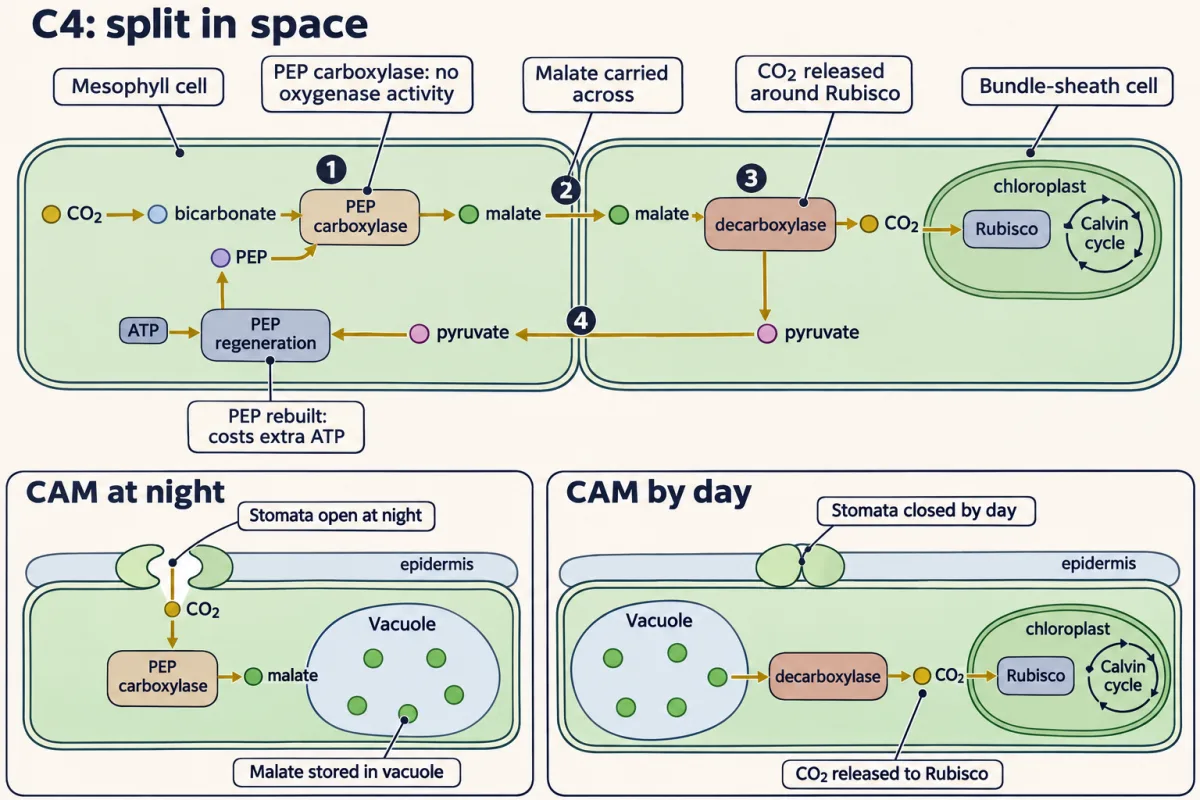
Two fixes evolved, each many times over. C4 plants (corn, sugarcane) separate the chemistry in space:
- Capture. In mesophyll cells, carbonic anhydrase turns CO₂ into bicarbonate, and phosphoenolpyruvate (PEP) carboxylase, which binds bicarbonate tightly and has no oxygenase activity, fixes it onto PEP to make oxaloacetate, then malate.
- Carry. Malate is shuttled into bundle-sheath cells, where Rubisco sits (some species carry aspartate instead).
- Release. Malate is decarboxylated there, flooding Rubisco with CO₂.
- Pay. Regenerating PEP costs two extra ATP per CO₂, so maize-type C4 runs at about 5 ATP + 2 NADPH per CO₂, worth it in hot, bright, dry conditions.
CAM plants (cacti, agave, pineapple) separate it in time: they open stomata mainly at night and use the same PEP carboxylase to fix CO₂ into malate, then close up by day and release that CO₂ to the Calvin cycle, conserving water. CAM pays extra ATP too, usually somewhat more than C4 (Going deeper, “Where the rule bends”).
The film’s carbon count frames both detours: photorespiration spends ribulose 1,5-bisphosphate (RuBP) without adding carbon, while C4 and CAM pay ATP to suppress it.
Next comes the pentose phosphate pathway. Your own cells run the same transketolase carbon shuffles you just watched regenerate RuBP, there to make NADPH and the ribose for nucleotides.
Going deeper
Where the rule bends
Photorespiration uses ribulose 1,5-bisphosphate (RuBP) without fixing CO₂, so the cost per net CO₂ rises. CAM’s surcharge over C4 varies with the subtype and the carbohydrate it stores, because it also stores malate overnight and rebuilds its phosphoenolpyruvate (PEP) from that carbohydrate. At dawn the cycle keeps more than five of six trioses to build up its RuBP pool (it is autocatalytic). On the supply side, with 14 c subunits in the chloroplast ATP synthase (4.67 H⁺ per ATP) and about 6 H⁺ per NADPH, linear electron flow makes about 1.29 ATP per NADPH, short of the 1.5 the cycle needs; cyclic electron flow tops up the ATP.
How Rubisco makes the cut
RuBP first forms a reactive 2,3-enediolate (an enediol across carbons 2 and 3). CO₂ adds to C2, producing a six-carbon intermediate, 2-carboxy-3-keto-arabinitol-1,5-bisphosphate, that is immediately hydrated and cleaved between C2 and C3 into two 3-PGA. Only one 3-PGA carries the new carbon, as its carboxyl; the other is old RuBP carbon that Rubisco’s internal electron shuffle left as an acid. So the bill is counted per 3-PGA, not per new atom.
The full regeneration list
Triose-phosphate isomerase turns some glyceraldehyde-3-phosphate (G3P) into dihydroxyacetone phosphate, aldolase’s partner in steps 1 and 3. Step 2 makes erythrose-4-phosphate and xylulose-5-phosphate; step 3 makes sedoheptulose-1,7-bisphosphate, which SBPase trims to sedoheptulose-7-phosphate; step 4 makes ribose-5-phosphate and a second xylulose-5-phosphate. Ribose-5-phosphate isomerase and ribulose-5-phosphate epimerase turn these into ribulose-5-phosphate for phosphoribulokinase (PRK).
Rubisco activase
Lys-201 is spinach numbering. The RuBP-locked, uncarbamylated enzyme is structure 1RCX. Inhibitory sugar phosphates such as CA1P can jam the site too, and activase, an AAA+ ATPase, spends ATP to strip them off as well.
C4 isotope signatures
A C4 plant makes its first capture with PEP carboxylase rather than Rubisco, and the two enzymes treat carbon isotopes differently. PEP carboxylase discriminates much less against heavy 13C than Rubisco does, which is why C4 and C3 plants carry distinct isotopic signatures, a fingerprint paleoecologists read straight out of fossils.
Diffuse light and the Pinatubo canopy
When Mount Pinatubo erupted in 1991, its sulfate haze scattered sunlight into soft, diffuse light. Photosynthesis at a well-studied deciduous forest rose on clear days: the upper canopy was already light-saturated, so the diffuse light reached deeper into shaded lower leaves that had been starved for photons. A plant canopy’s carbon fixation depends on how evenly light reaches its leaves as well as on how much light arrives.
Your notes
Select any text in the lesson to highlight it or add a note to it. Your highlights and notes are saved in this browser and collected in your notebook.
This browser is not letting the site save anything (a private window or strict privacy settings), so highlights and notes will be lost when you leave the page.
How we measure it
Carbon-14 radiotracer kinetics
Feed a photosynthesizing system 14CO2, then kill the cells at shorter and shorter intervals. Whichever molecule is labeled first is the earliest product. This is how Calvin's team caught 3-phosphoglycerate as the first stable product of fixation — in fractions of a second it held 80 to 90 percent of the fixed label.
Two-dimensional paper chromatography
Spread a killed cell extract across paper, run solvent in one direction, rotate 90°, run a second solvent, then press the sheet against X-ray film. Each labeled compound lands at its own spot and exposes the film. Pairing this with the 14C pulse let the Berkeley group map the entire loop one intermediate at a time.
Stable-isotope (13C/12C) signature analysis
PEP carboxylase discriminates much less against heavy 13C than Rubisco does, so C4 plants leave a measurably different 13C/12C ratio than C3 plants. CAM plants fall across a wide range, depending on how much of their carbon they fix at night. Mass spectrometry of this ratio lets paleoecologists read whether ancient diets and ecosystems were C3- or C4-based from fossil teeth and soil carbon.
Transition-state analog crystallography
To trap Rubisco in its active, carbamylated form, crystallographers co-crystallize it with 2-carboxyarabinitol-1,5-bisphosphate (2-CABP), a stable mimic of the unstable 6-carbon reaction intermediate. The analog locks the enzyme around the geometry of a fleeting reaction intermediate, revealing the Lys-201 carbamate and Mg2+ in place (PDB 8RUC).
Practice questions on this lesson (3) → MCAT-style, original, each with an explanation
Where this lesson fits
Before thisReview first
- Photosynthesis: The Light ReactionsThis course · Lesson 22
This lesson spends the ATP and NADPH that the light reactions make, and uses their ferredoxin-thioredoxin signal.
- Basic Concepts of Enzyme ActionThis course · Lesson 7
You need to know how enzymes speed a reaction, to follow how Rubisco makes its cut without spending ATP.
- Glycolysis: The Investment-and-Payoff PathwayThis course · Lesson 16
The reduction stage runs two glycolysis steps backward, so you need those steps and the triose sugars from there.
After thisStudy next
- The Pentose Phosphate Pathway: NADPH and Five-Carbon SugarsThis course · Lesson 24
It runs the same transketolase carbon shuffles in reverse to make NADPH and ribose-5-phosphate.
- Integration of Metabolism: How the Body Switches FuelsThis course · Lesson 30
It shows how light-driven carbon fixation and the sugar it makes fit into the whole body's fuel switching.
Elsewhere on the siteFilms, simulations and method films in other courses
- A Tree Made of AirFilm · Biology
It shows how carbon from air becomes glucose and why atoms are conserved, the carbon count used here.
- What Becomes a Tree?Film · Life Science
It shows light powering sugar-building from carbon dioxide and water, the job this cycle does.
- Pulled From the TopFilm · Organismal Biology
It shows why leaf pores that take in carbon dioxide also lose water, which is why C4 and CAM matter.
Suggested by an AI model from the lessons themselves, then checked. How we use AI
Finish line
Test yourself
8 questions
Practice and MCAT-style, with explained answers.
Next · Lesson 24
The Pentose Phosphate Pathway: NADPH and Five-Carbon Sugars
It makes no ATP, and that is the point: NADPH and ribose-5-phosphate are the products that matter.
Continue →