Biochemistry · Photosynthesis
New to this? Review it at high school level: Capturing Sunlight
Photosynthesis: The Light Reactions
Rewritten on : new text, figures and flashcards. Your notes and highlights stay, but the text around them may have moved.
Two photon-driven uphill boosts, wired so water splits, oxygen leaves, and NADPH and ATP get made.
Pause when the reading reaches a film, and offer to play it. Saved on this device.
Watch the film now, or keep listening
Builds on:Oxidative Phosphorylation: The Electron-Transport ChainMetabolism: Basic Concepts and DesignWhy these?
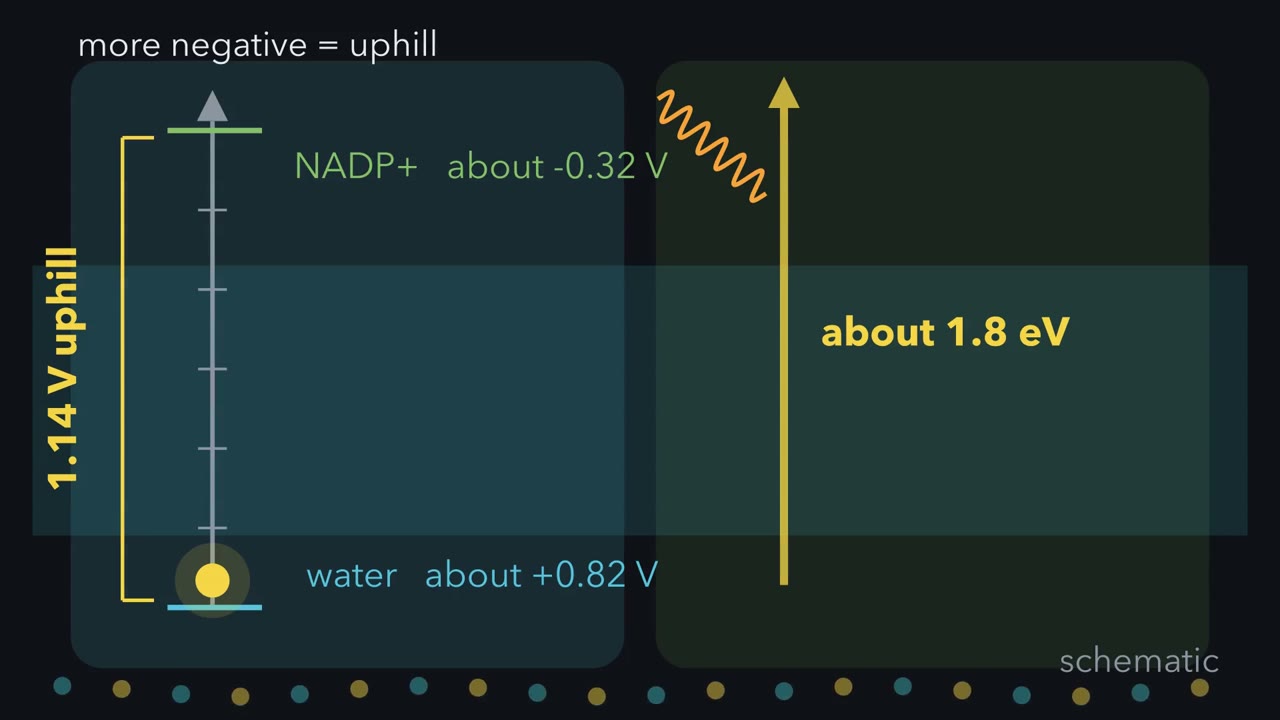 ▶ Watch Why One Photon Is Not Enough · 3:08
Read the transcript of “Why One Photon Is Not Enough”
Film transcript: Why One Photon Is Not Enough
One red photon carries more energy than the climb from water to NADP+ plus seems to require. So why does a chloroplast spend two photons on every electron? Track one electron here. More negative potential is uphill. Water starts at about plus 0 .82 volts. And a dP plus weights at about -0.32 V. The gap is 1.14 V. A red photon carries about 1.8 eV. On paper, one photon looks sufficient. But it must arrive somewhere stable, not merely visit an excited state.
Predict: how many photons does each electron actually need, one or two? Two. Fast downhill steps pull separated charges apart before they recombine. Those steps spend much of the photon's energy. Each stable lift keeps only about 0.7 to 0.8 V. Now place that rule into the thylakoid membrane.
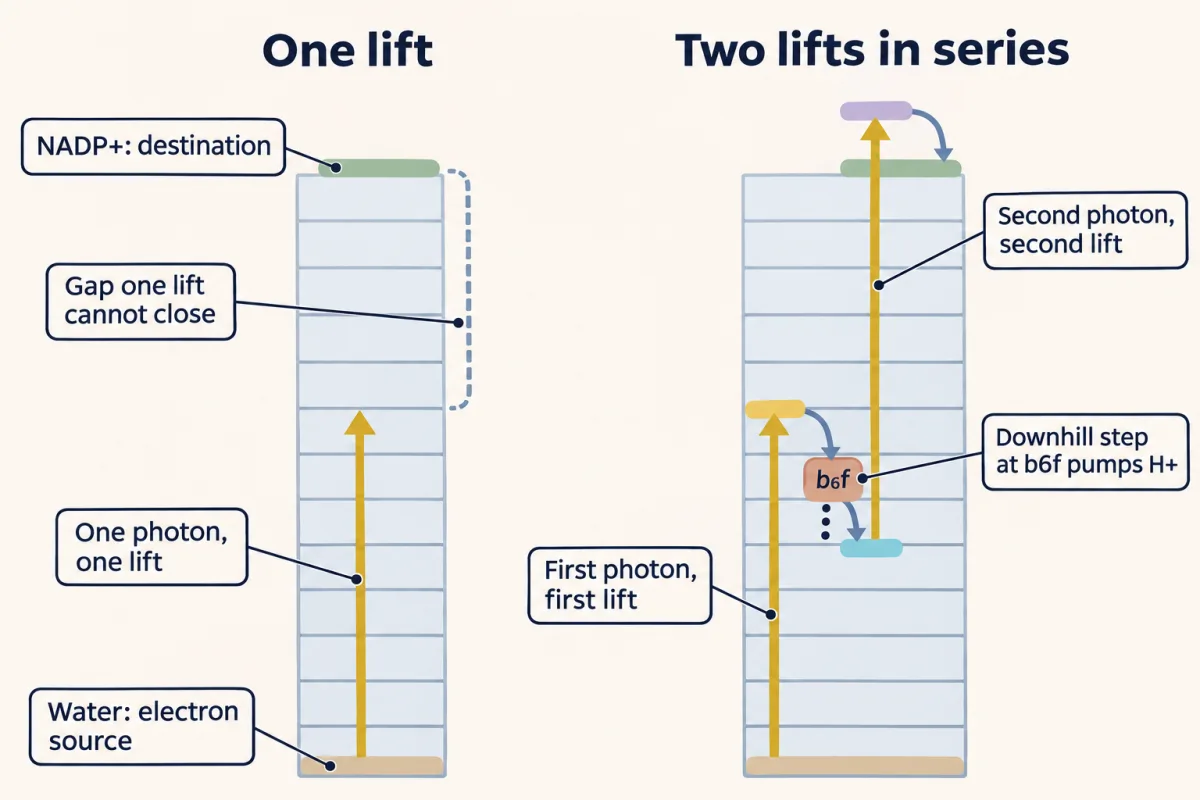
Photosystem II takes the first photon, sending one electron into a downhill chain. It then replaces that missing electron from water. Splitting water releases oxygen, while protons enter the lumen. Cytochrome b6f uses the downhill bridge to add more lumen protons. Together, those protons build a gradient. At Photosystem I, a second photon lifts the same electron again. Downhill steps stabilize that charge separation too.
Ferredoxin and FNR deliver electrons to NADP+, +, making NADPH. That is the Z-scheme's logic. Two light-driven lifts in series span a gap no single stable lift covers. The electron climbs, falls, then climbs again. Repeat the route four times to release one oxygen molecule.
Linear flow uses 8 photons and makes 2 NADPH. Water and cytochrome b6f together place about 12 protons in the lumen. As protons flow back to the stroma, ATP synthase uses their gradient to make ATP. This is linear flow, the simplest form. Chloroplasts can also cycle electrons to adjust ATP output. Return to the opening puzzle. A photon has enough raw energy, but a reaction center cannot keep it all. Two stable lifts turn water's electrons into NADPH and a proton gradient.
From the film
- In linear flow, each electron needs two light-driven lifts from water to NADP+.
- Fast downhill steps stabilize charge separation but spend much of each photon's energy.
- Water splitting and cytochrome b6f load protons into the lumen.
- The lumen proton gradient powers ATP synthase.
Almost every oxygen molecule you have ever breathed was built from the oxygen atoms of water, split apart at a single protein in a leaf, an alga or a cyanobacterium. That protein is Photosystem II, and splitting water means pushing electrons uphill.
In a mitochondrion, electrons from NADH fall to oxygen and the fall pays for ATP. A chloroplast runs that fall backwards, hauling electrons from water up to NADP⁺ to make NADPH, and makes ATP too: the two currencies the Calvin cycle spends to build sugar.
The film above shows why this linear path needs two stable lifts and how the downhill bridge between them helps build the proton gradient. The potentials below are approximate values at pH 7; cyclic flow comes near the end.
Where it happens: a captured bacterium
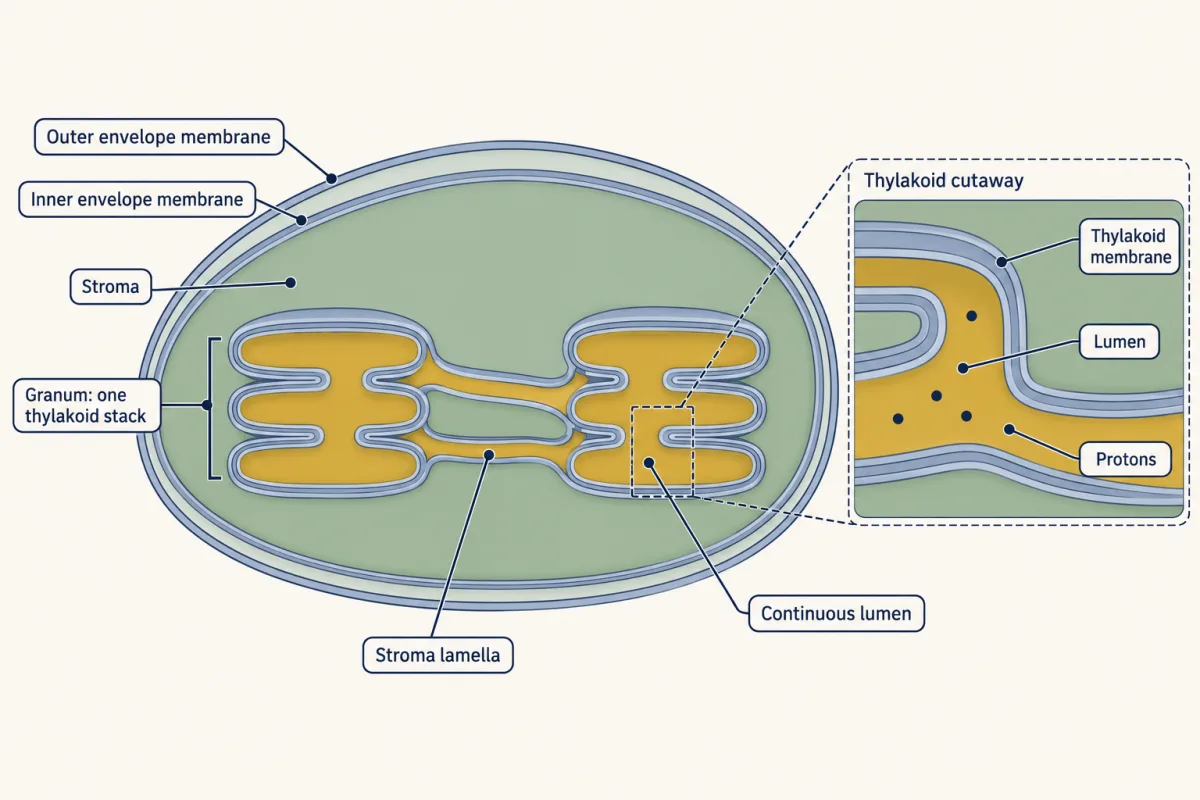
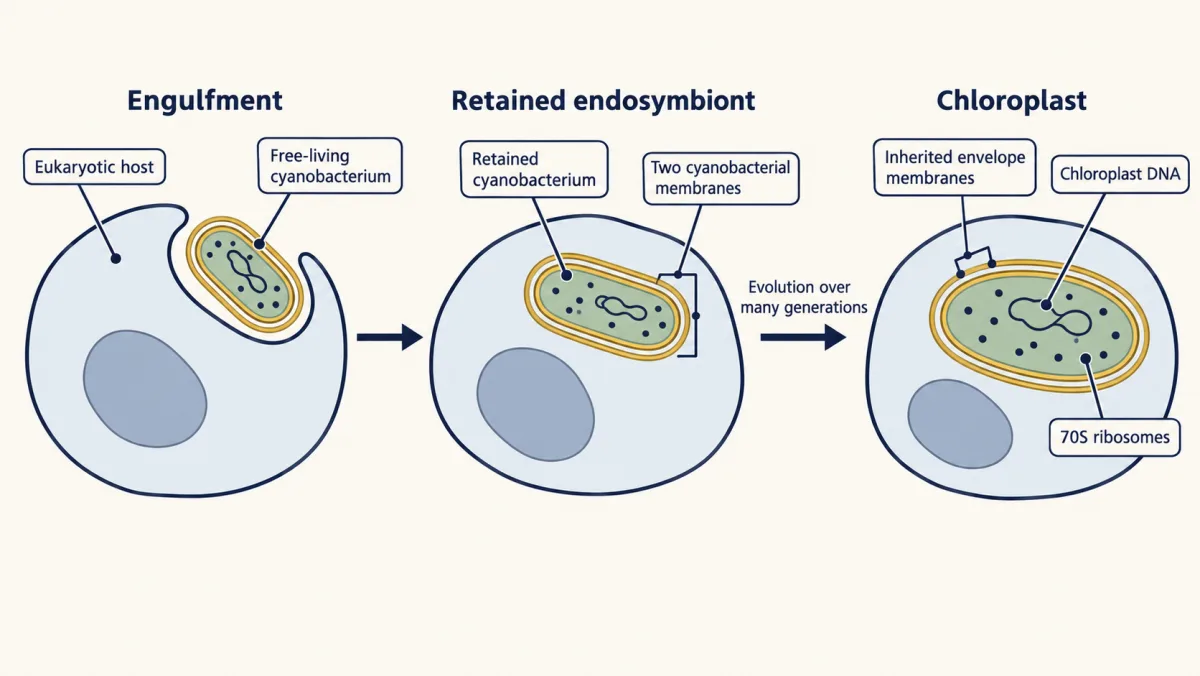
The chloroplast is a double-membrane organelle, and that second membrane is a fossil of an engulfed cyanobacterium (the evidence is in Going deeper). Inside the inner membrane sits the stroma, the soup where carbon gets fixed later. Floating in the stroma is a folded network of flattened sacs called thylakoid membranes, stacked like poker chips into grana and joined by unstacked stroma lamellae. The sacs enclose one connected interior space called the lumen. The light reactions run in and across the thylakoid membrane, and where the protons end up, the lumen, is the whole point.
What a photon can do
Light is energy in discrete packets, photons, each carrying E = hν. When a pigment absorbs one, an electron jumps to an excited state, and that excitation can go one of three ways.
It can simply fall back down, releasing the energy as fluorescence or heat. It can hand its energy to a neighboring pigment without the electron going anywhere: resonance energy transfer. Or, at one special spot, it can hand off the electron itself.
The second fate is where most students stumble. An antenna of many light-harvesting complexes packs roughly 200 to 300 pigment molecules around each reaction center like a satellite dish. Wherever a photon lands, the energy hops pigment to pigment toward the center, a bucket brigade in which no bucket actually moves. Energy travels by resonance; the electron transfers only at the reaction center.
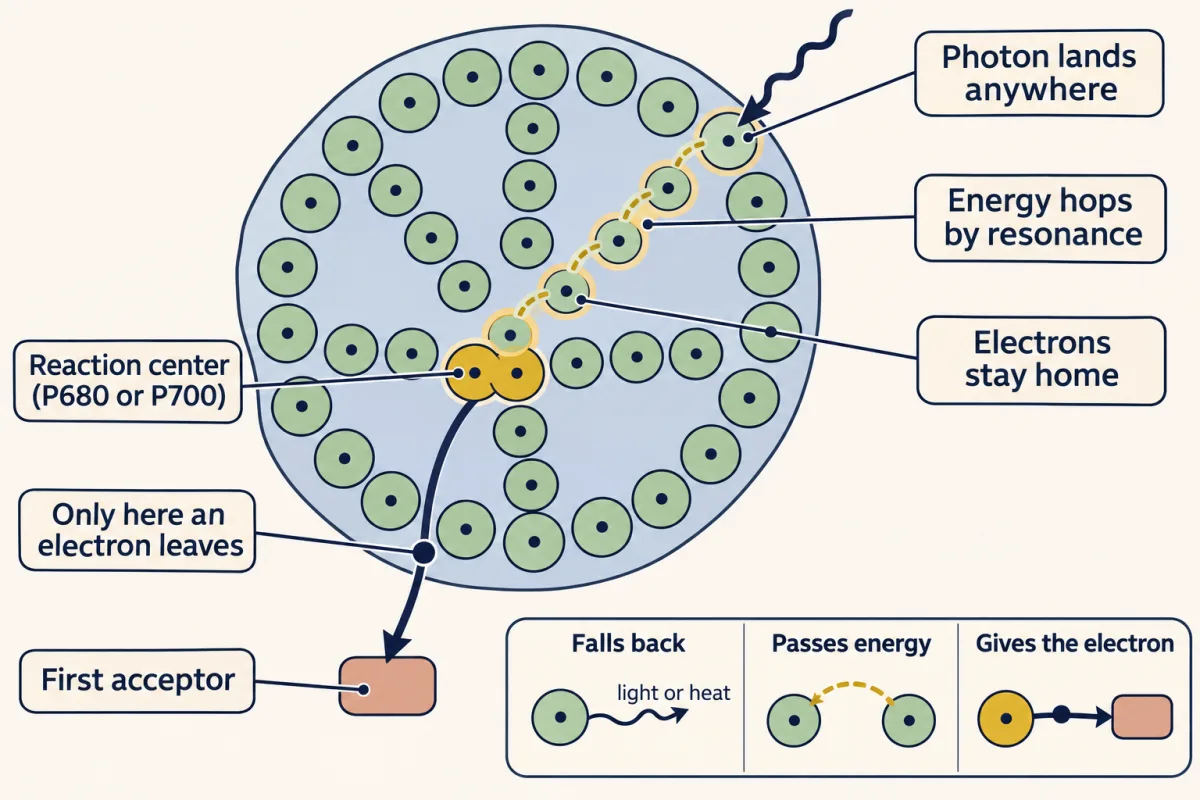
The main pigment is chlorophyll, a magnesium-centered ring related to heme, helped by accessory carotenoids. The reaction-center chlorophylls are named for the wavelength they absorb best: P680 in Photosystem II, P700 in Photosystem I.
A blue photon carries about 2.8 eV. It is used too, but the extra energy is shed as heat within picoseconds, so every photon delivers about one red photon’s worth, 1.8 eV, to the reaction center. “One photon, one lift” holds whatever the color, so the film’s red photon stands in for blue ones too.
At the reaction center, the third fate fires. An excited donor (D*) gives its electron to an acceptor (A), creating a separated pair of charges, D⁺ and A⁻. The surrounding protein passes the electron on to the next acceptor fast enough that it rarely snaps back. That photoinduced charge separation is the actual conversion of light into chemistry, and Deisenhofer and Michel won a Nobel for being the first to see its machinery, atom by atom.
Why two lifts
The film above plots the 1.14 V climb from water (about +0.82 V) to NADP⁺ (about −0.32 V). Its vertical axis is reduction potential, E, in volts: more positive E holds electrons tightly, while more negative E gives them up easily. Left alone, electrons flow from more negative to more positive E, the way water runs downhill. Diagrams put the most negative values at the top, so “uphill” means toward more negative E, and climbing costs energy.
In words The free-energy change equals minus the number of electrons moved, times the Faraday constant, times the change in reduction potential from donor to acceptor.
- ΔG“delta G”
- free-energy change; positive means uphill, it needs an energy inputkJ/mol
- n“n”
- electrons moved per moleculenone
- F“F”
- the Faraday constant, about 96.5 kJ per mole per voltkJ/(mol·V)
- ΔE“delta E”
- E of the acceptor minus E of the donorV
Sanity check Electrons moving toward a more positive E give a positive ΔE and a negative ΔG: downhill. Water to NADP⁺ goes toward a more negative E, so ΔG is positive.
Try one number
Two electrons, from water to NADP⁺: ΔE = −0.32 − (+0.82) = −1.14 V.
ΔG = −2 × 96.5 × (−1.14) ≈ +220 kJ for every mole of NADPH made.
This uses standard potentials at pH 7, so strictly it is ΔG°′; real stromal and lumenal concentrations shift it.
Need a refresher? reading an equation · units and prefixes
Predict. A red photon carries about 1.8 eV, enough in principle to lift one electron through 1.8 V. The gap is 1.14 V. How many photons does each electron need?
Check your prediction
Two. A reaction center cannot keep the whole photon: to stop the separated charges snapping back together, it moves the electron away through quick downhill steps, and each step costs energy. What a lift keeps is measured from where the electron starts to where it stably lands, not to the brief excited state. Photosystem II keeps only about 0.7 V of its 1.8 eV (from water at +0.82 V to plastoquinone at about +0.1 V, though P680* briefly reaches about −0.6 V). Photosystem I keeps about 0.8 V (from plastocyanin at +0.37 V to ferredoxin at −0.42 V). Neither covers 1.14 V alone. Two in series cover it with about 0.4 V to spare.
That answer is the Z.
Walking the Z
The film above shows the whole Z in motion. Now follow one electron through the carriers the film leaves out: a lift, a bridge, then a second lift.
Stage 1: Photosystem II, the first lift
Energy collected by the antenna reaches P680 and makes P680*, which at about −0.6 V gives its electron away easily. The electron goes to pheophytin (chlorophyll without its magnesium), then to a bound plastoquinone, QA, and then to a second one, QB. After two such electrons, and two protons taken from the stroma, QB becomes plastoquinol (PQH₂) and drifts off into the membrane.
The same photon leaves something behind: P680⁺, at about +1.2 V the strongest biological oxidant known. One photon has made a strong electron donor at the top of the Z and a strong electron grabber at the bottom.
Predict. P680⁺ sits at about +1.2 V and water at +0.82 V. Which way do electrons flow between them, and does that step need light?
Check your prediction
From water to P680⁺, and no. P680⁺ is about 0.4 V more positive than water, so the step is downhill. Light was needed only to make P680⁺. That 0.4 V drop is the driving force that makes water oxidation go.
P680⁺ takes its replacement electron from the oxygen-evolving complex, a cluster of four manganese atoms, one calcium and five oxygens (Mn₄CaO₅). Making one O₂ takes four electrons, and each photon removes only one, so the cluster counts: its S-state (Kok) cycle steps from S0 to S4, storing one oxidizing step per photon, and at S4 it releases O₂ and resets.
2 H₂O + 4 photons → O₂ + 4 H⁺ (into the lumen) + 4 e⁻
Stage 2: the bridge, downhill through cytochrome b6f
Plastoquinol carries the electrons to the cytochrome b6f complex. From about +0.1 V they fall to plastocyanin, a small copper protein in the lumen, at about +0.37 V. This is the stretch of the Z where a fall pumps protons: for each electron it passes on, b6f releases two protons into the lumen (roughly 4 H⁺ per pair). One rode in on plastoquinol, picked up from the stroma at QB. The other is moved by the Q-cycle you met in Complex III, which sends half the electrons back to make more plastoquinol. That is twice the one proton per electron that water-splitting releases.
Stage 3: Photosystem I, the second lift
Plastocyanin hands the electron to P700⁺. A second photon makes P700*, at about −1.3 V among the most reducing species in the chloroplast. The electron runs through A₀, A₁ (phylloquinone) and iron-sulfur clusters to ferredoxin, a strong soluble reductant in the stroma, at −0.42 V. Ferredoxin-NADP⁺ reductase (FNR), a FAD flavoprotein, collects two electrons from two ferredoxins, adds a proton, and makes NADPH on the stromal side, exactly where the Calvin cycle waits.
| Rung, in the electron’s order | Approximate E (V) | How the electron gets there |
|---|---|---|
| O₂/H₂O | +0.82 | the source |
| P680⁺ | +1.2 | an electron falls in from water |
| P680* | −0.6 | lift 1 (photon) |
| QA | −0.1 | falls |
| Plastoquinone pool | +0.1 | falls |
| Plastocyanin | +0.37 | falls through b6f, protons pumped |
| P700⁺ | +0.45 | falls |
| P700* | −1.3 | lift 2 (photon) |
| Ferredoxin | −0.42 | falls |
| NADP⁺/NADPH | −0.32 | falls, the destination |
Plotted with negative at the top, the lifts and falls draw a sideways Z. P680⁺ and P680* are one pigment in two states, as are P700⁺ and P700*. (Published values vary a little, the excited states most.)
Read the Z left to right and the bookkeeping is honest: light pays twice. The first photon lifts an electron from P680 and leaves P680⁺ behind, an oxidant strong enough that water then gives up an electron downhill, with no light needed for that step. Most of the downhill falls after each lift are the price of making charge separation fast and one-way; only the fall through cytochrome b₆f pumps protons, and water adds its own protons when it is split. The second photon lifts the same electron again, high enough to reduce NADP⁺. Two lifts, one valley; out come O₂, a proton gradient and NADPH.
Fire each photon and watch the electron climb, fall and climb again. Most of the downhill steps, from P680* to QA and from P700* to ferredoxin, are the price each reaction center pays to make its step fast and one-way; the drop from water to P680⁺ is the driving force that lets water be oxidized. Only the bridge at b6f pumps protons with its fall, through the Q-cycle (half of what it releases came from the stroma at QB); water’s protons are released by splitting it, not pumped.
The film’s carried electron makes the coupling explicit: every electron that reaches NADPH was lifted by both photosystems. ATP comes from protons deposited by water-splitting and, mostly, at b6f.
Predict. Press “Break PSII” in the widget and keep firing photons at PSI. What happens?
Check your prediction
PSI lifts the electrons already waiting on plastocyanin, and then the chain starves. In linear flow every electron PSI lifts was first pulled off water by PSII, so with PSII broken no O₂ appears and NADPH production stops. PSII acts first despite its number, which is historical.
The tally: protons, ATP and the shortfall
The film above animates the tally per O₂: 8 photons, 2 NADPH and 12 lumenal H⁺ (4 from water, 8 at b6f).
The protons drive ATP synthase by chemiosmosis: the same proton-gradient logic Peter Mitchell proposed for mitochondria, and the same rotary motor from the last chapter, run here with protons flowing out of the lumen into the stroma. So the lumen plays the mitochondrial intermembrane space, where protons pile up, and the stroma plays the matrix, where the synthase makes ATP.
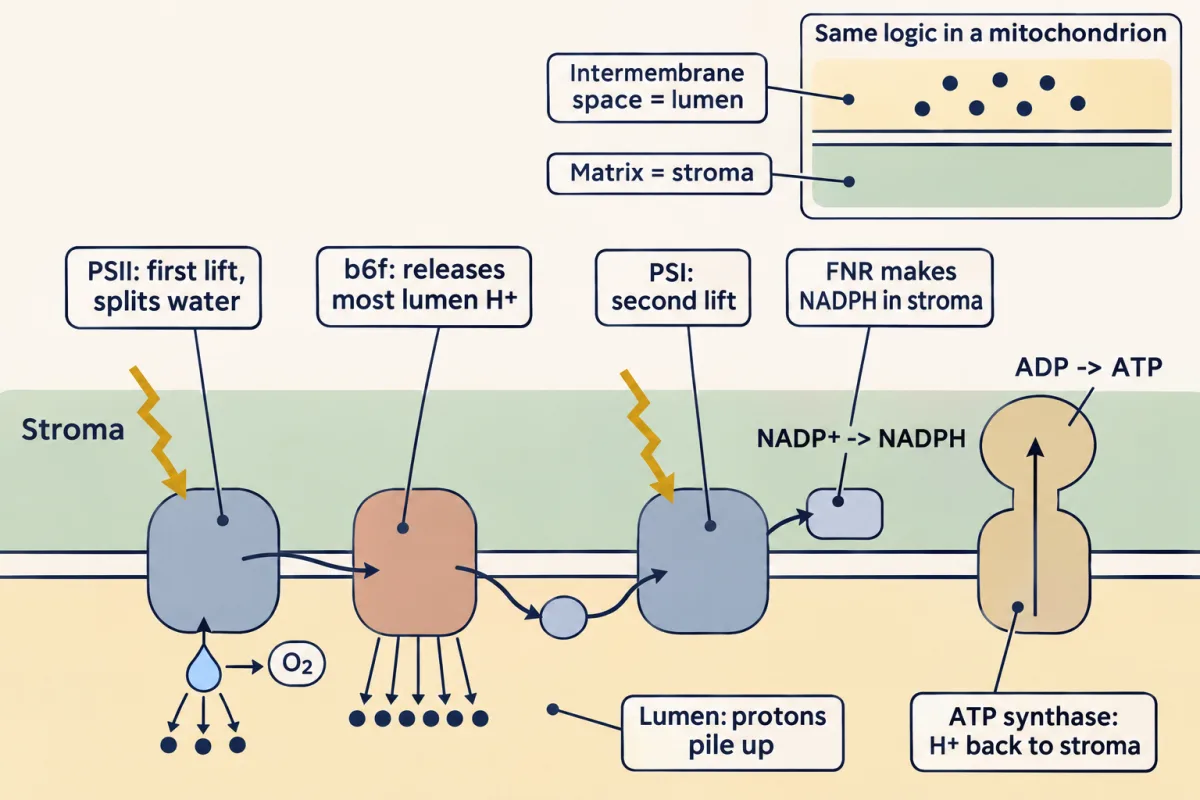
For years many biochemists rejected Mitchell’s idea that a proton gradient, rather than a high-energy chemical intermediate, links electron flow to ATP synthesis.
Predict. Jagendorf and Uribe soaked chloroplasts at pH 4, then dropped them into pH 8 buffer in total darkness. No light, no electron flow. Did they make ATP?
Check your prediction
Yes. The acid soak filled the lumen with protons, so at pH 8 the gradient across the thylakoid membrane alone drove ATP synthase: strong early evidence for chemiosmosis.
The chloroplast’s rotor has 14 subunits, each carrying one proton across per turn, and one full turn makes 3 ATP, so 14 H⁺ make 3 ATP.
Predict. The Calvin cycle spends 3 ATP for every 2 NADPH. Linear flow makes 2 NADPH and 12 H⁺ per O₂. Is that enough ATP?
Check your prediction
Not quite. 12 H⁺ × 3/14 ≈ 2.6 ATP, about 0.4 ATP short. The missing 0.43 ATP is 2 H⁺ (0.43 × 14/3 = 2), exactly what one more electron through b6f pumps. Sending about one electron per O₂ round a loop that skips NADP⁺ makes up the difference: about 9 photons per O₂ instead of 8. The shortfall depends on the 14-subunit rotor (Going deeper).
That loop is cyclic flow. Arnon showed isolated chloroplasts can make ATP two ways: non-cyclic photophosphorylation (the linear path: ATP, NADPH and O₂) and cyclic photophosphorylation (electrons loop PSI → ferredoxin → b6f and back, making ATP only). It uses only the second lift, one photon per electron, and b6f still pumps protons. The chloroplast mixes it in, along with other balancing routes, to reach 3:2. Switch between linear, cyclic and both below to compare outputs.
Two products, two jobs. Linear flow is the only mode that splits water and reduces NADP⁺, so it has to run — it is where the O₂ and all the NADPH come from. But the protons it delivers to the lumen buy slightly less than the 3 ATP the Calvin cycle spends for every 2 NADPH it consumes, so a leaf living on linear flow alone would slowly run out of ATP. Cyclic flow is the fix: route PSI's electrons back through b6f, pump protons without touching NADP⁺, and make ATP with no NADPH on the side. The chloroplast dials in just enough cyclic flow to balance the books at 3:2 — the same trick as topping up one currency without minting the other.
What comes next
The manganese cluster that splits water became the planet’s oxygen source, slowly. In CH23, the Calvin cycle, you’ll watch the cell spend the ATP and NADPH just made in the stroma to pull carbon out of the air and build sugar.
Going deeper
Which chlorophylls make up P680
The lesson treats each reaction-center pigment as one chlorophyll, but they differ. P700 is a chlorophyll pair. P680 is better pictured as a small cluster of four chlorophylls, and the first electron transfer often starts at one of the accessory chlorophylls (ChlD1) rather than at the central pair.
Chlorophyll, heme and overcooked greens
Chlorophyll is a substituted tetrapyrrole related to heme, but with a magnesium ion at its center instead of iron, a fifth ring fused onto the ring system, one of its four pyrrole rings partly reduced (which makes it, strictly, a chlorin rather than a porphyrin), and a long greasy phytol tail that anchors it in the membrane. Chlorophylls a and b absorb slightly different colors, though together they still leave the green gap. Boil greens too long and they go drab olive: acid swaps the central Mg²⁺ for two protons, converting chlorophyll into pheophytin, a sort of zombie chlorophyll, the same molecule that is PSII’s first electron acceptor.
Carotenoids, sunscreen and autumn
Carotenoids absorb blue-green light chlorophyll misses, widening the range a leaf can use, and act as sunscreen, mopping up dangerous excited states. When light is too intense, certain carotenoids (xanthophylls such as zeaxanthin) work with the protein PsbS in nonphotochemical quenching (NPQ), which dumps excess energy as harmless heat. They were in the leaf all along: autumn removes the masking green and lets the yellows and oranges show; the reds are freshly made anthocyanins.
The rotor sets the shortfall
The tally’s 0.4 ATP shortfall assumes 3 H⁺ per electron and the chloroplast’s measured 14-subunit rotor. A 12-subunit rotor would make exactly 3 ATP from 12 H⁺, and linear flow alone would match the Calvin cycle.
Is “two” a law?
No. It follows from how much each real reaction center loses to its charge separation. The rule predicts the exception: green sulfur bacteria start from sulfide, near −0.25 V, more than 1 V more negative than water and close to NADP⁺, so one lift is enough, and they use a single photosystem.
Timing of oxygen and the planet it changed
When Photosystem II learned to pry electrons off water is still debated, but it was before oxygen began building up in the air. Oxygen built up only slowly, because iron, sulfur and volcanic gases soaked it up first; the Great Oxidation Event began about 2.4 billion years ago. Some of the iron dissolved in the oceans rusted out as banded iron formations, an ozone layer formed, and aerobic respiration became possible. Oxygen reached near-modern levels only about two billion years after that first rise. The biochemist Albert Szent-Györgyi put the larger picture this way: life runs on a small electric current, kept going by sunlight.
The evidence that chloroplasts were bacteria
Why two membranes? Because more than a billion years ago a eukaryotic cell engulfed a free-living cyanobacterium and never digested it. The evidence: the double membrane (inherited from the cyanobacterium’s own two membranes), the chloroplast’s own DNA, and bacterial-style 70S ribosomes inside it. Your own mitochondria carry the same scar from a separate engulfment.
Your notes
Select any text in the lesson to highlight it or add a note to it. Your highlights and notes are saved in this browser and collected in your notebook.
This browser is not letting the site save anything (a private window or strict privacy settings), so highlights and notes will be lost when you leave the page.
How we measure it
X-ray crystallography of membrane proteins
Membrane proteins were long thought too greasy to crystallize, hiding a large share of all proteins from structure determination. Substituting detergents for natural lipids let Deisenhofer and Michel crystallize the bacterial photosynthetic reaction center — the first membrane protein ever solved — and read the nearly mirror-symmetric arrangement of bacteriochlorophylls and other cofactors that carries light-driven electrons across the membrane. The same approach later gave us PSII, PSI and cytochrome b6f; the complete chloroplast ATP synthase shown here came later from cryo-electron microscopy.
Absorption and action spectroscopy
Shine monochromatic light across the visible spectrum and measure either how much a pigment absorbs (absorption spectrum) or how fast photosynthesis runs (action spectrum). This is how chlorophyll a and b were distinguished, how the reaction-center chlorophylls were named for their absorption maxima (P680, P700), and how accessory carotenoids were shown to fill the blue-green gap chlorophyll misses.
The acid-bath / pH-jump experiment
Jagendorf and Uribe soaked chloroplasts at pH 4, then dropped them into pH 8 buffer in total darkness. The artificial proton gradient alone drove ATP synthesis with no light and no electron transport — strong early evidence for Mitchell's chemiosmotic theory, showing that a proton gradient across the thylakoid membrane can power ATP synthase.
Isolated-chloroplast photophosphorylation assays
Arnon's group supplied isolated chloroplasts with ADP and phosphate, then caught them making ATP in the light. Running the reaction without oxygen (and erasing the apparent O2 requirement with added flavin mononucleotide) showed the ATP came from light, not from contaminating mitochondria — and separated cyclic from non-cyclic photophosphorylation.
Practice questions on this lesson (3) → MCAT-style, original, each with an explanation
Where this lesson fits
Before thisReview first
- Oxidative Phosphorylation: The Electron-Transport ChainThis course · Lesson 20
The Z-scheme reverses the electron-transport chain you met there, and the Q-cycle in cytochrome b6f is the one from Complex III.
- Metabolism: Basic Concepts and DesignThis course · Lesson 15
Reduction potentials, ΔG from ΔE and NADPH and ATP as energy currencies are used here without being re-taught.
After thisStudy next
- The Calvin Cycle: Fixing Carbon from Thin AirThis course · Lesson 23
It spends the ATP and NADPH made here in the stroma to fix carbon into sugar.
- The Pentose Phosphate Pathway: NADPH and Five-Carbon SugarsThis course · Lesson 24
It makes the same NADPH, here from sugar, which the light reactions make from light.
- Integration of Metabolism: How the Body Switches FuelsThis course · Lesson 30
It shows how the body balances ATP and NADPH supply against demand, much as cyclic flow balances the chloroplast's ratio.
Elsewhere on the siteFilms, simulations and method films in other courses
- Leaf-disk float raceSimulation · Biology
It shows how light energy is captured and carbon dioxide and water become glucose and oxygen.
- A Tree Made of AirFilm · Biology
It follows the atoms of photosynthesis and shows where the light energy goes.
- Two Jobs in One Green CellFilm · Life Science
It shows chloroplasts adding oxygen in light, the oxygen released by water splitting here.
Suggested by an AI model from the lessons themselves, then checked. How we use AI
Finish line
Test yourself
8 questions
Practice and MCAT-style, with explained answers.
Next · Lesson 23
The Calvin Cycle: Fixing Carbon from Thin Air
Most of the carbon in the sugars, proteins, and DNA of living things was first fixed from CO2 by this loop.
Continue →