Organismal Biology · Unit 6: How plants work
Soil, Nutrients and Partners
Rewritten on : new text, flashcards and film. Your notes and highlights stay, but the text around them may have moved.
A green plant builds most of its body from carbon dioxide and water. What else does it need from the soil, and why can't it make it?
Pause when the reading reaches a film, and offer to play it. Saved on this device.
Watch the film now, or keep listening
Builds on:Moving Water and Sugar in PlantsDiffusion and OsmosisPhotosynthesis Feeds the WorldWhy these?
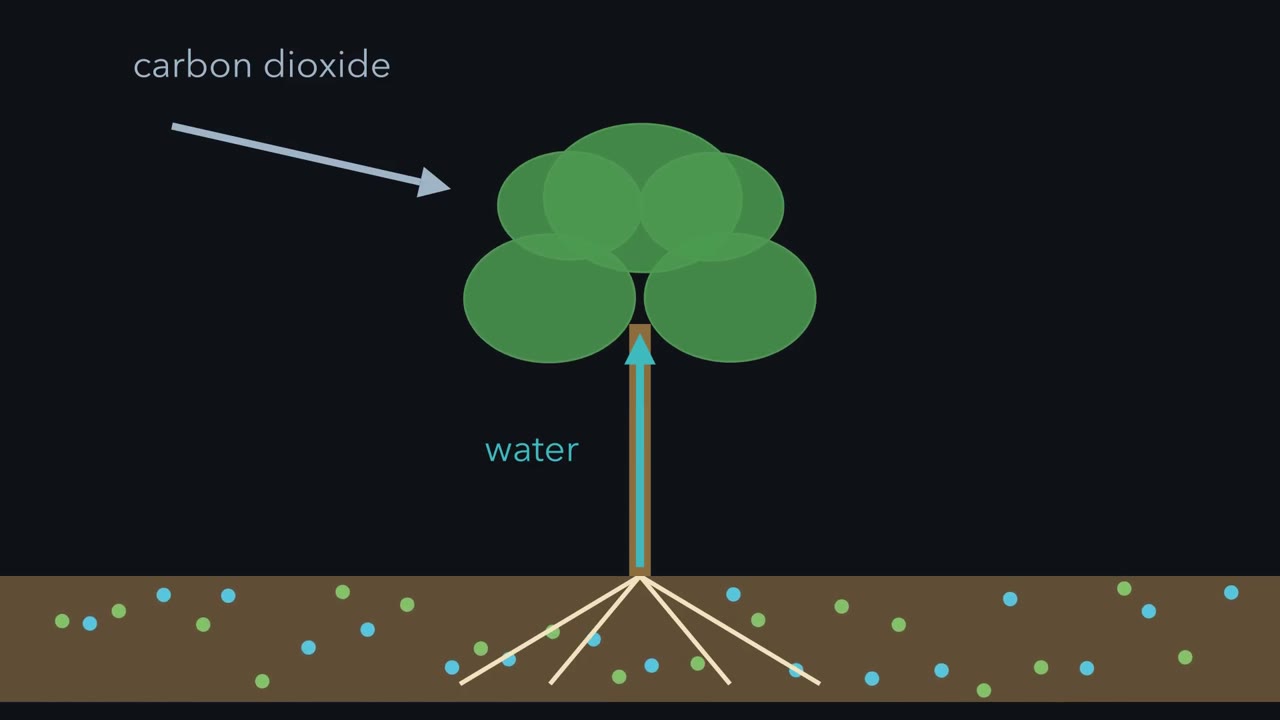 ▶ Watch What a Root Has to Reach · 3:20
Read the transcript of “What a Root Has to Reach”
Film transcript: What a Root Has to Reach
A green plant builds most of its body from carbon dioxide and water. But it also needs elements from the soil. Why can't it make those? A green plant can build all the organic molecules it needs. Every amino acid, every lipid, every nucleotide, it makes for itself. You cannot do that; you must eat some of yours. But no plant can make an element. Each element in its body has to come in from outside. That is the one thing it cannot do for itself. Seventeen elements are conventionally essential. Carbon, hydrogen and oxygen come from carbon dioxide and water. The other fourteen are mineral nutrients. Most plants take them chiefly from the soil. How the plant gets each one depends on three things.
The form the element is in. How far that form moves. And who can take it up. This film follows how far. Start with phosphate. Here is a young root, a little behind its growing tip, in soil dotted with phosphate. As the root takes phosphate in, the soil right around it runs low. Phosphate creeps through soil so slowly that little arrives from farther out. Root hairs help. Each is a tube grown out from a single surface cell. Hairs push into the spaces between soil particles, past the depleted zone. Many plants reach farther with a fungal partner, called a mycorrhiza. Its threads, called hyphae, are thinner still. They run far out into the soil and bring phosphate back.
Nitrate is a different story. It moves through soil far more readily, and water flowing toward the root carries it too. For nitrate, reach matters less. Inside the plant, elements can move again. The phloem, the tissue that carries sugar, can move some of them out of old leaves.
Nitrogen, phosphorus, potassium and magnesium are among them. Now suppose nitrogen runs short. Which leaves turn yellow first, the old ones or the young ones? The old ones. The plant pulls nitrogen out of its oldest leaves and sends it up to the growing tip. So the old leaves yellow first. Iron and calcium are different. Once laid down, they stay largely where they are. So a shortage of iron shows first in young leaves. Treat these patterns as clues to test, not a key for every species. Different shortages can look alike. So the plant faces one question again and again. It cannot make an element. How far does each nutrient move, and how will the plant reach it?
From the film
- A green plant builds its organic molecules from carbon dioxide, water and mineral nutrients, but it cannot make an element: besides carbon, hydrogen and oxygen it needs 14 mineral nutrients, which most plants take chiefly from the soil.
- Phosphate moves through soil so slowly that uptake lowers it in the soil right around a root, a depletion zone; root hairs and the threads of a fungal partner reach past it.
- Nitrate moves through soil far more readily, and water flowing to the root carries it too, so for nitrate, reach matters less: how far a nutrient moves shapes how a plant must reach it.
- Elements the phloem can carry, such as nitrogen and magnesium, are moved from old leaves to new ones when supply runs short, so old leaves show the shortage first.
- Elements that stay where they are laid down, such as iron and calcium, show a shortage first in young leaves; treat these patterns as clues to test, not a key for every species.
The first film showed why a root must reach for some nutrients; here is what it left out.
The one idea. A green plant builds its organic compounds from carbon dioxide, water and mineral nutrients, but it cannot make an element. How it gets each mineral nutrient depends on three things: the form the element is in, how far that form moves, and who can take it up, the plant or a partner.
Scope: green vascular plants that make their own food, and the conventional 17-element list. Most land plants take the 14 mineral nutrients chiefly from soil, though partners, prey, hosts and leaves can supply some. How far an ion moves in soil varies with moisture, texture and how tightly the soil binds it. The root’s checkpoint holds where the Casparian strip is complete. Leaf-age patterns are tendencies, not a key for every species.
What a plant must get from the soil
The first film sorted the 17 essential elements by source. (Why you must eat amino acids a plant can make: digestive systems; how the leaf fixes carbon: the Calvin cycle.) What earns an element its place?
An element is essential if, without it, a plant cannot complete its life cycle from seed to seed. Daniel Arnon and Perry Stout added two more conditions in 1939: no other element can stand in for it, and it acts directly in the plant rather than by changing the soil or its microbes.
The conventional list for vascular plants has 17 essential elements:
- From air and water: carbon, hydrogen and oxygen.
- Macronutrients (required in larger amounts): nitrogen, phosphorus, potassium, calcium, magnesium and sulfur.
- Micronutrients (required in trace amounts): chlorine, boron, iron, manganese, copper, zinc, nickel and molybdenum.
Some lists add further elements, called beneficial: they improve growth in some species but are not universal requirements. Sodium helps some plants with C4 or CAM photosynthesis, silicon strengthens grasses such as rice, and cobalt is used by the nitrogen-fixing bacteria in legume nodules.
The list was built in water culture. Dennis Hoagland and Arnon published a standard nutrient solution in 1938, and leaving one element out of it, then putting it back, is still the basic test.
Design problem
Brown, Welch and Cary (Plant Physiology, 1987) asked whether nickel is essential for barley (Hordeum vulgare, cultivar Onda). Nickel is needed in such small amounts that contamination from salts, water and the seed itself can hide a requirement. Design the test.
Saved in this browser only.
One way to do it
Grow barley in solution culture made with purified salts and clean water, so the solution is depleted of nickel. Give one group no added nickel and a second group the same solution plus nickel, and keep a third group of deficient plants for later add-back. Run it for the whole life cycle and into the next generation, because a seed carries nickel from its mother, and a first-generation plant may live on that store. Measure grain nickel and test whether the grain germinates. In the published experiment, adding nickel completely relieved the deficiency symptoms in the mother plants, and grain with less than 30 ng of nickel per gram of dry weight was not viable. Failure without nickel and rescue with it meet the Arnon and Stout criterion of a life cycle that cannot be completed without the element. The limits: this was one cereal in one preparation, so it does not give a threshold for all plants or any fertiliser rate.
Reading a sick leaf
The first film showed how mobility, whether the plant can move an element out of old tissue through the phloem to growing tissue, predicts which leaves show a shortage first. It left out what the symptoms look like, and why calcium misses young leaves.
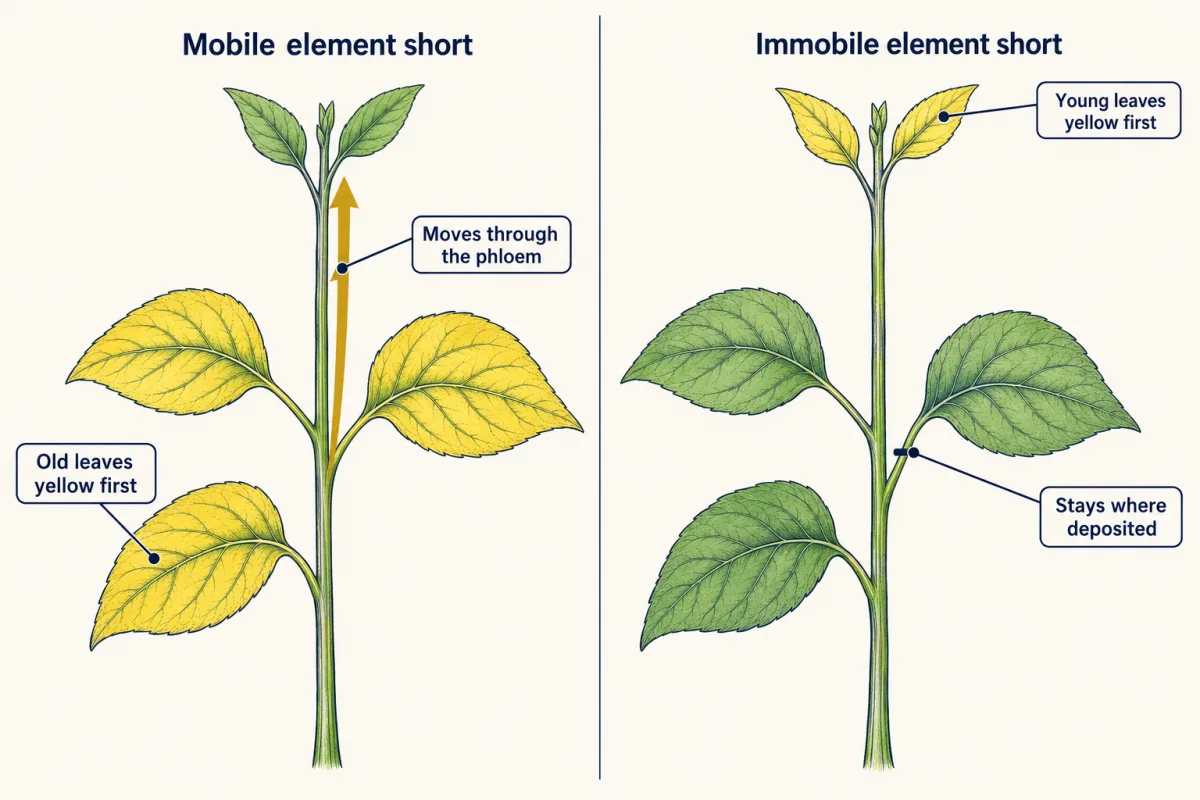
For immobile elements, new leaves and growing tips depend mainly on what arrives from the roots. The symptom itself differs. Without nitrogen the whole leaf yellows, chlorosis, from lost chlorophyll; without phosphorus, Japanese mint blades turned dark green with purple margins (Going deeper).
Why can’t a young leaf get more calcium from the roots? The xylem carries water up from the roots, and calcium rides in that water, so it goes mostly where water leaves fastest by transpiration, evaporation from the leaves.
Predict. A plant is transpiring hard and carrying fruit. Which parts get most of the calcium coming up from the roots: the large mature leaves, or the young leaves and the fruit?
Check your prediction
The large mature leaves, which lose water fastest. Much of their calcium becomes bound in cell walls and is not readily moved again. Young leaves and fruit lose much less water, so they receive less, and calcium moves only poorly in the phloem, which cannot make up the difference.
Different deficiencies can look alike, and drought, disease or cold can mimic them, so a symptom is a hypothesis. Tissue analysis, measuring the elements in the leaf, tests it; add-back, supplying the suspected element and watching new growth recover, confirms it.
Into the root: hairs, two routes and a checkpoint
How much surface do the first film’s root hairs and mycorrhizal hyphae add past the depletion zone, and at what cost in material?
Worked problem. These are illustrative numbers, not measurements from one species. Treat every structure as a cylinder and ignore the ends.
side area of a cylinder = pi x d x L surface per volume of a cylinder = 4 / d
- The root. A 10 mm segment, 0.5 mm in diameter: pi x 0.5 mm x 10 mm = 15.7 mm2.
- The hairs. Suppose 1,000 hairs on that segment, each 0.5 mm long and 0.010 mm wide. One hair: pi x 0.010 mm x 0.5 mm = 0.0157 mm2. All of them: 1,000 x 0.0157 = 15.7 mm2. The hairs double the surface, to 31.4 mm2.
- The fungus. Suppose 1 m (1,000 mm) of mycorrhizal hyphae, each 0.004 mm wide, attached to the segment: pi x 0.004 mm x 1,000 mm = 12.6 mm2. The total is now 15.7 + 15.7 + 12.6 = 44.0 mm2.
- Surface per material. With 4 / d, the root gives 4 / 0.5 = 8 mm2 of surface per mm3 of material, a hair 4 / 0.010 = 400 and a hypha 4 / 0.004 = 1,000. So the hyphae add more than three quarters of the root’s own surface for under one per cent of its volume (the volume check is in Going deeper).
In this sketch: illustrative numbers, not a measured species; every structure is a cylinder; ends ignored; not to scale; drawn lines are a sample, not a count.
Side area of a cylinder = π × d × L, and surface per volume of a cylinder = 4 / d, so the thinner the cylinder, the more surface per unit of material.
Predict. Root hairs help with phosphate. Do they help a plant take up water just as reliably?
Check your prediction
Not everywhere. In barley, root hairs aided water extraction by rapidly transpiring plants in drying soil, while a hairless maize mutant took up water no differently in sand or loam. (Moving water and sugar in plants covers water potential and the pull of transpiration.)
Reaching an ion is half the job; it still has to cross the cortex, a thick layer of cells, to the xylem in the root’s centre, by two routes it can switch between.
- The apoplast is the cell walls and the spaces between them, outside the living membranes: a connected wet pathway through the outer root that water and ions seep along without entering a cell.
- The symplast is the living cytoplasm, joined from cell to cell by plasmodesmata, narrow channels through the walls. An ion enters it by crossing a plasma membrane once, through a transporter or channel, and can then pass from cell to cell without crossing another.
(Water can also cross from cell to cell through membranes.)
Both routes reach the endodermis, a single ring of cells around the central cylinder, the root’s core that holds the xylem. In the walls between endodermal cells runs the Casparian strip, a band that seals the wall route. Where the strip is complete, an ion travelling in the walls must cross a plasma membrane into a living cell, while an ion already in the symplast carries on through the endodermal cells. So the endodermis is the root’s checkpoint: whatever reaches the xylem has passed through a living cell, whose transporters and channels could have kept it out. (Its make-up and a second barrier: Going deeper.)
Crossing a membrane often costs energy. The inside of a root cell is negative, so an anion, a negative ion such as nitrate or phosphate, is pushed back by the voltage, and often by its concentration gradient too. A proton pump, an ATP-driven H+-ATPase in the plasma membrane, moves protons out of root cells. Transporters then let a proton flow back in, down its gradient, carrying nitrate or another ion with it: cotransport (see membrane transport).
Borrowing nitrogen and phosphorus: nodules and mycorrhizae
Nitrate and ammonium are the main nitrogen forms a root takes up. Yet the air around every leaf is mostly nitrogen gas, which no plant enzyme can use. Here the problem is form, not distance; the second film follows the pots that showed how a pea gets around it.
Read the transcript of “Why the Pea Didn't Starve”
Film transcript: Why the Pea Didn't Starve
Nitrogen gas makes up most of the air around every plant. So why can a pea use it, while an oat beside it starves? The first film showed that how far a nutrient moves shapes how a plant reaches it. But form matters too. Nitrogen gas is everywhere, yet no plant enzyme can use it. At an experiment station in Bernburg, Hermann Hellriegel and Hermann Wilfarth tested this in pots. They grew peas and oats in washed, sterilised sand. Every pot got a base solution with the other mineral nutrients, but no nitrogen. So any extra nitrogen had to come from what they added, or from the air. Now think about what that means. If every plant relied on soil nitrogen alone, none could end up with more nitrogen than its seed held.
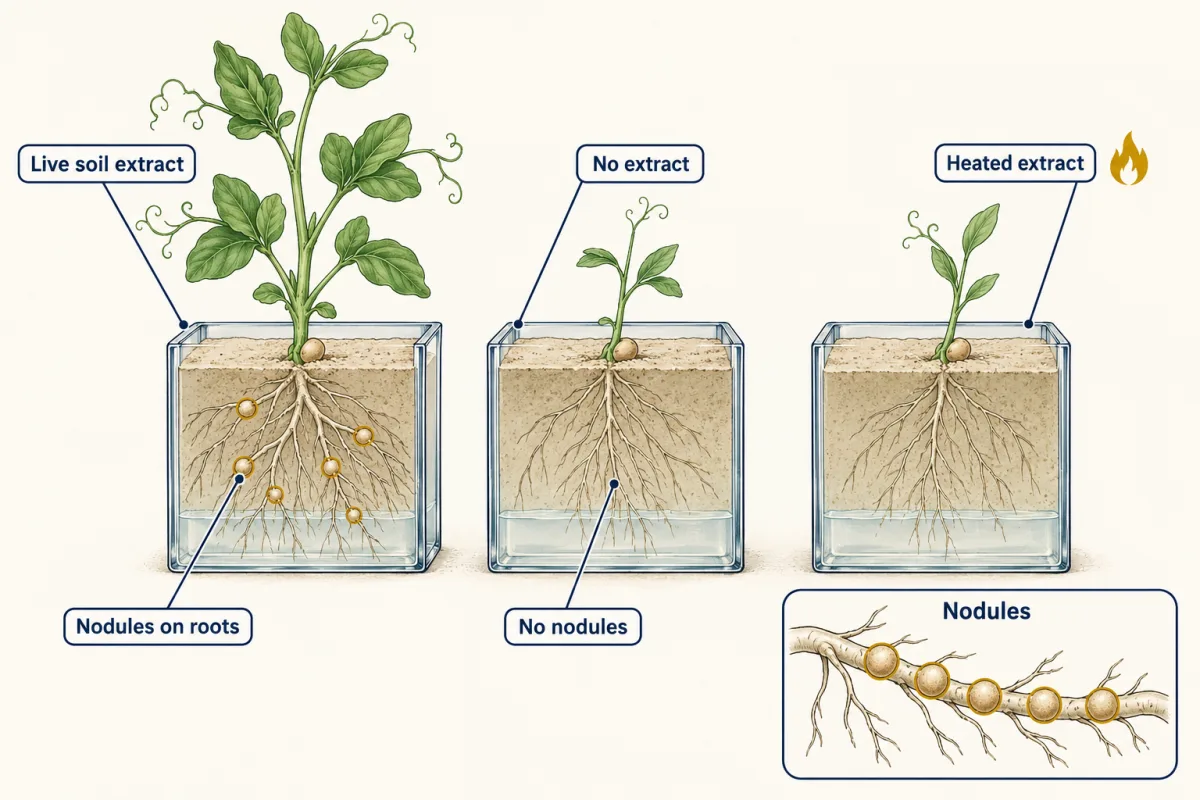
Some oat pots got no nitrogen at all. Others got measured doses of nitrate. The oats grew only as far as the nitrate they were given allowed. Peas with nothing added did the same, and stayed small. But some peas got a little extract shaken from field soil. Those grew well. Their roots formed swellings called nodules. And the plants ended up with far more nitrogen than their seeds had held. That extra nitrogen came from the air. One more set of pots got soil extract that had been heated first. Will those peas form nodules, and gain nitrogen?
No. No nodules, and no nitrogen gained. A living agent in the soil, tied to the nodules, was needed. That agent is a group of bacteria called rhizobia. They enter the root. Inside nodule cells, they change into bacteroids. Bacteroids hold an enzyme called nitrogenase. It turns nitrogen gas into ammonia, a form the plant can use. The pea itself makes no nitrogenase. The pea pays for this. Sugar made in its leaves travels down to the nodule. There it is turned into malate, which fuels the bacteroids. So the trade is carbon for nitrogen.
Oats have no nodules. They depend mainly on nitrate and ammonium already in the soil. Nitrogen gas is all around the pea, but in a form it cannot use. So it pays carbon to a partner that can use it.
From the film
- In sand watered with every mineral but nitrogen, oats grew only as far as the nitrate they were given, but peas given live soil extract formed root nodules and ended with far more nitrogen than their seeds held.
- Peas without extract, or with heated extract, formed no nodules and gained no nitrogen, so a living agent from soil was needed.
- That agent is rhizobia: inside nodule cells they become bacteroids whose enzyme, nitrogenase, turns nitrogen gas into ammonia; the plant makes no nitrogenase.
- The plant pays in carbon: sugar from its leaves is turned into malate, which fuels the bacteroids. A form the plant cannot use can be bought from a partner.
The 1888 pots did not identify the living agent behind the nodules, the root swellings; in the same year Martinus Beijerinck reported isolating bacteria from nodules, the rhizobia. Barley, like oats, has no nodules and depends mainly on nitrate and ammonium in the soil.
The nodule hides a contradiction. Nitrogenase is damaged by oxygen, yet the bacteroids that make it respire. A plant protein, leghemoglobin, binds oxygen and buffers it at a low, steady level; it does not exclude oxygen. Silencing it stops fixation (Going deeper). The ecosystem side of fixation is in nutrient cycling.
A related trade is made with fungi: the plant pays carbon, and the fungus extends its reach beyond the depletion zone, though the root still takes up phosphate itself (hyphae: microbes, protists and fungi).
- Arbuscular mycorrhizae form in most land plants. Hyphae push through the walls of cortex cells and branch into arbuscules, tree-like structures wrapped in the plant’s folded cell membrane, where nutrients are exchanged. The fungus delivers minerals taken from soil, especially phosphate. The plant pays in sugars, and in Lotus japonicus with the fungus Rhizophagus irregularis, Keymer and colleagues (2017) showed with isotope labelling and plant mutants that it pays in lipids as well.
- Ectomycorrhizae form on trees such as pines and oaks, and help supply the trees with nitrogen. The fungus wraps the root tip in a sheath and grows a network between root cells without entering them: among the epidermal cells in flowering trees such as oaks, and deeper, between cortex cells, in pines.
Partners differ in quality, and hosts can respond to that, as mutualism, parasitism and coevolution explains.
Plants that eat animals and plants that tap plants
Some plants also take in ready-made organic compounds. The purple pitcher plant, Sarracenia purpurea, grows in nitrogen-poor bogs. It photosynthesizes like any green plant. Insects drown in rainwater held in the pitchers, where bacteria, protists and larvae break them down, releasing mineral nitrogen and also competing with the plant for it. Karagatzides, Butler and Ellison (2009) added labelled amino acids to pitchers in Ontario and Massachusetts and found data consistent with direct amino-acid uptake by the plant, clearest for phenylalanine.
Dodder (Cuscuta), a twining stem parasite, takes a different route: it forms haustoria, organs that grow into the host stem and connect to its xylem and phloem, drawing water, nutrients and sugars.
A pea borrows from bacteria, a pine from fungi, a pitcher plant from insects and a food web, and dodder from another plant. The one idea again: a plant cannot make an element, so how it gets each one depends on its form, how far that form moves, and who can take it up.
How plants sense and respond to what they find, through hormones, comes next in plant signals.
Going deeper
The Japanese mint deficiency study
In Japanese mint (Mentha arvensis), grown in greenhouse hydroponics with one nutrient left out of Hoagland’s solution at a time, the whole blade of old leaves yellowed first without nitrogen, and young leaves yellowed without iron. Symptoms in plants without nitrogen were first seen 15 days after transplanting. Without potassium, old leaves developed yellow spots; the phosphorus result is in the main text. As a general pattern, not a result of this study, many plants short of magnesium yellow between the veins of older leaves while the veins stay green. Necrosis means patches of dead tissue.
Surface per volume: the volume check
Check by volume: the hyphae occupy pi x (0.002 mm)2 x 1,000 mm = 0.013 mm3, against 2.0 mm3 for the root segment.
What the Casparian strip is made of, and a second barrier
In young Arabidopsis roots the strip is lignin, not suberin as older textbooks say; suberin is laid down later. Many species, though not Arabidopsis, also have an exodermis, an outer layer under the epidermis with Casparian bands of its own.
The proton pump and a nitrate transporter
The proton pump is an H+-ATPase of the P type. In Arabidopsis the NRT1.1 nitrate transporter is a cotransporter that lets a proton flow in with nitrate.
Silencing leghemoglobin
Ott and colleagues (2005) silenced the leghemoglobin genes in Lotus japonicus. Free oxygen in the nodules rose, fixation stopped, and the plants grew normally only when given mineral nitrogen, so leghemoglobin is needed for fixation, not for growth itself.
Pitcher and phyllodium
The purple pitcher plant’s flat leaves, phyllodia, photosynthesize more efficiently than its pitchers.
Your notes
Select any text in the lesson to highlight it or add a note to it. Your highlights and notes are saved in this browser and collected in your notebook.
This browser is not letting the site save anything (a private window or strict privacy settings), so highlights and notes will be lost when you leave the page.
How we measure it
Solution culture with omission and add-back
Grow plants in a complete nutrient solution made from purified salts, and in matching solutions each lacking one element, then add the element back to some deficient plants. A symptom that appears on omission and disappears on add-back ties the symptom to that element in that species.
Tissue elemental analysis
Dry and dissolve leaf or grain tissue and measure its elements, today often by inductively coupled plasma mass spectrometry (ICP-MS). It tests a diagnosis made from symptoms, since different deficiencies can look alike.
Stable-isotope pulse-chase
Supply a compound labelled with a heavy isotope, such as nitrogen-15 in amino acids, and measure where the label turns up over the following hours or days. With controls, such as two labels on one molecule, it can show which route a nutrient took into a plant or between partners.
Tracer dye exclusion at the endodermis
Bathe roots in a dye such as propidium iodide that travels in cell walls but does not cross intact membranes, and look under the microscope for whether it reaches the central cylinder. An intact Casparian strip stops it at the endodermis.
Practice questions on this lesson (3) → MCAT-style, original, each with an explanation
Where this lesson fits
Before thisReview first
- Moving Water and Sugar in PlantsThis course · Lesson 23
You need water movement through xylem and the apoplast and symplast from there to follow ions into the root.
- Diffusion and OsmosisLife Science · Grade 7
Ion and water movement across root membranes builds on diffusion and osmosis taught there.
- Photosynthesis Feeds the WorldLife Science · Grade 7
It shows that a plant builds its body mainly from carbon dioxide and water, which this lesson takes as given.
After thisStudy next
- Auxin and Plant Hormones: How Plants Steer GrowthThis course · Lesson 25
Hormones steer how a plant responds to the nutrients and partners it finds.
Elsewhere on the siteFilms, simulations and method films in other courses
- Switch off a microbe groupSimulation · Biology
It shows how losing soybean root-nodule bacteria removes the plant's usable nitrogen.
- Nitrogen Everywhere, and Not a Bit to UseFilm · Life Science
It shows why plants cannot use nitrogen gas and how soybeans differ from corn.
- Set Up: Thirsty CeleryFilm · Biology Together
It shows water moving up a stalk, the path that carries dissolved minerals.
Suggested by an AI model from the lessons themselves, then checked. How we use AI
Finish line
Test yourself
8 questions
Practice and MCAT-style, with explained answers.
Next · Lesson 25
Auxin and Plant Hormones: How Plants Steer Growth
Light an oat seedling from one side and it bends toward the lamp. The tip senses the light, yet the bend forms lower down. What told it?
Continue →