Organismal Biology · Skim version
Plant Body and Growth
Read the full lesson → Skim the whole course →
The guiding idea
A 300-year-old oak grows new leaves each spring and usually a new ring of wood each year, yet no adult mammal grows a new limb. How does the oak keep building?
A plant's new cells come from its meristems, and growth depends on how many cells a meristem makes and how big each one grows: in a tree, young shoots near the tips add height, and the vascular cambium adds width and wood.
From the film: Where Does a Plant Add New Body?
- A plant's new cells come from meristems, groups of cells that keep dividing, and many plants keep them for years.
- Behind a root tip, cells divide, then lengthen many times over as water fills their vacuoles, then mature into their final types.
- At steady state, with every cell file alike, root growth equals new cells per file per hour times their final length.
- Most of a root's new length comes from cells lengthening, not from dividing, so blocking elongation slows growth sharply.
From the film: How Does a Trunk Get Wider?
- A tree gets taller only in young shoots near its tips; an older stretch of trunk does not lengthen, it widens.
- The vascular cambium adds wood (secondary xylem) toward the inside and secondary phloem toward the outside, and in temperate trees each year usually leaves one ring.
- Bark is everything outside the vascular cambium, so its inner part is living phloem, not only dead cork.
- Over one year, ring width is the number of new wood cells in a radial row times their average width.
- Maize has no conventional vascular cambium, so it makes no wood.
-
A map of the plant body
-
Growing from the tips: division, then elongation
-
What the meristems’ cells become
-
A leaf: what the shoot tip builds at each node
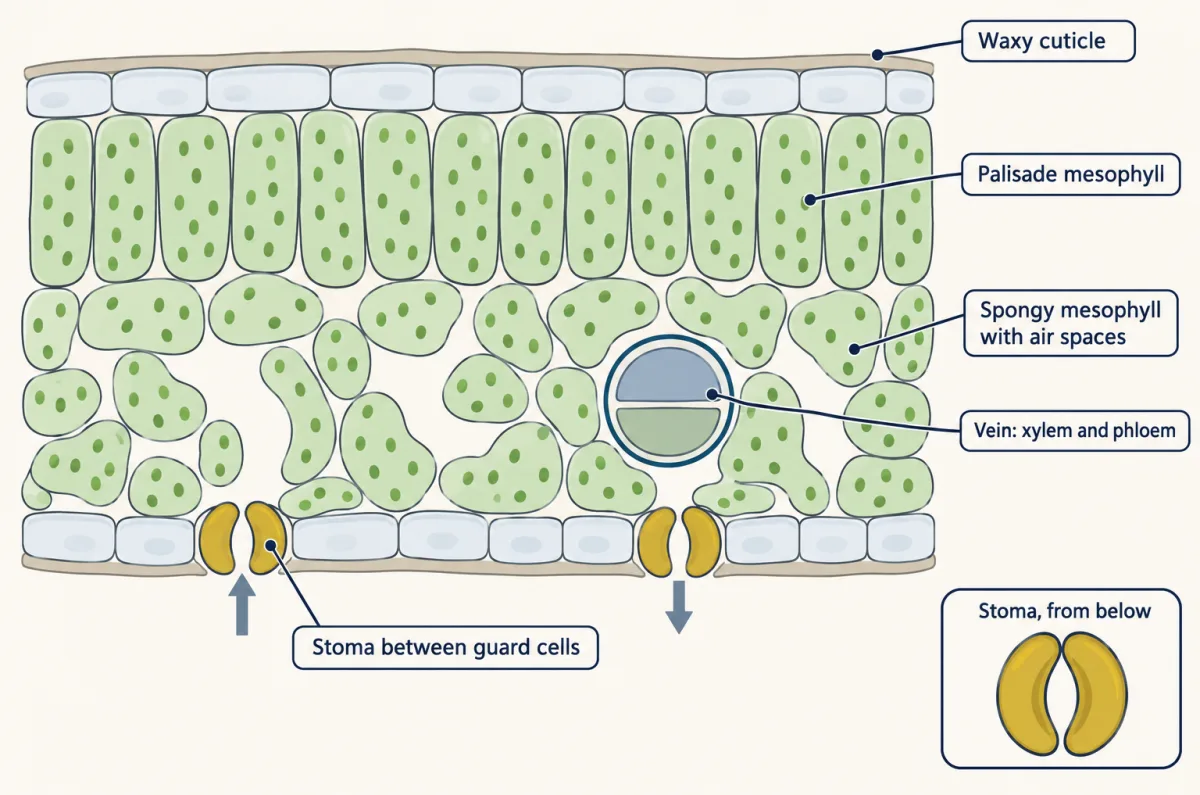
A leaf trades water for carbon: a waxy cuticle limits water loss, palisade and spongy mesophyll capture light around air spaces, and every open stoma lets carbon dioxide in and water vapour out. AI-generated illustration -
Growing wider: how much wood a ring adds
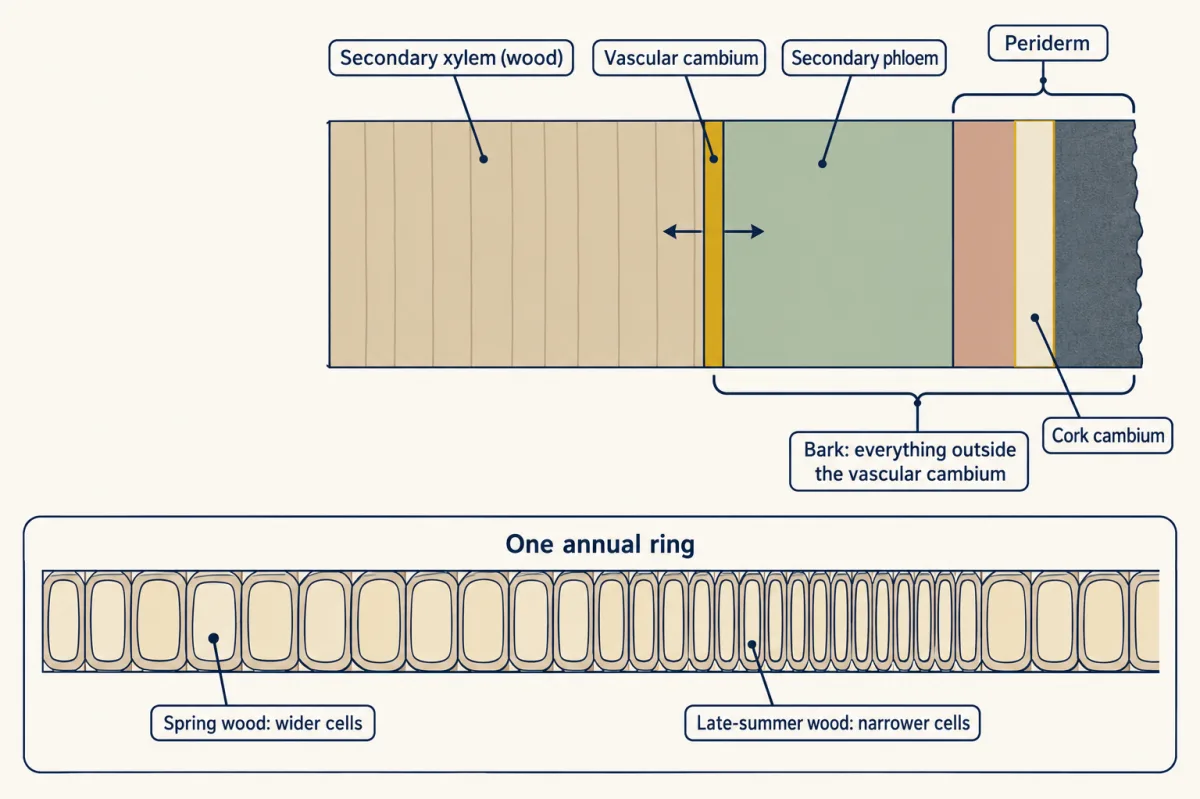
The vascular cambium adds wood inward and phloem outward, so bark, everything outside the vascular cambium, includes living phloem as well as the periderm of phelloderm, cork cambium and cork. AI-generated illustration -
Four bodies, one toolkit: herb, tree, grass, cactus
-
Going deeper
Where this lesson fits
Before thisReview first
- The Cell Cycle and MitosisBiology · High school
You need to know how one cell divides into two with full chromosome sets, since meristems keep doing exactly this.
- Size, Scale and SurfaceThis course · Lesson 2
Surface area and volume arguments there explain why plants and leaves take the forms they do.
- Plants on LandThis course · Lesson 5
This lesson uses its plant groups and the flowering plant body, so you should know the major plant lineages first.
After thisStudy next
- Moving Water and Sugar in PlantsThis course · Lesson 23
It explains how the xylem and phloem tissues described here move water and sugar.
- Auxin and Plant Hormones: How Plants Steer GrowthThis course · Lesson 25
It shows how auxin steers the growth of the shoot and root tips described here.
- Soil, Nutrients and PartnersThis course · Lesson 24
It follows the root's absorbing surface and soil partners, building on the root zones mapped here.
Elsewhere on the siteFilms, simulations and method films in other courses
- Set Up: Wake Up a SeedFilm · Biology Together
It shows a seed starting growth, the first step before meristems build a plant body.
- Heal the scrapeSimulation · Life Science
Cells that divide make new tissue, and meristems rely on exactly this division.
- Set Up: Plant Parts We EatFilm · Biology Together
Sorting roots, stems, leaves and fruits onto a plant shows the organs this lesson names.
Suggested by an AI model from the lessons themselves, then checked. How we use AI