Organismal Biology · Skim version
What an Organism Has to Do
Read the full lesson → Skim the whole course →
The guiding idea
A barley leaf cannot take in carbon dioxide without letting water out of the same pores. How much water does each bite of carbon cost, and can a plant pay less?
A leaf in air not saturated with water vapour cannot take in carbon dioxide without losing water through the same pores, at a price set, to a first approximation, by the two concentration gaps across them; it is the course's first example of a solution paid for somewhere else.
From the film: The Price of a Breath
- Every multicellular organism faces five problems: energy and materials, exchange and transport, a stable inside, defense, and reproduction.
- A leaf takes in carbon dioxide and loses water vapour through the same pores, the stomata.
- As a first approximation for a leaf in air not saturated with water vapour, the pores set how fast gas moves; the two concentration gaps across them set the price, water lost per carbon dioxide gained.
- A leaf pays hundreds of water molecules for each carbon dioxide; a lung pays about one for each oxygen, because each breath gives up about as much water vapour as the oxygen it takes in.
- Stomata can close; the lung, sheltered in the chest, cannot.
From the film: Fewer Pores
- Barley made to overexpress HvEPF1 formed far fewer stomata: two lines had about a quarter and an eighth of the control density.
- Well-watered plants with fewer stomata exchanged much less gas with the air.
- With fewer pores, a leaf can save more water than it loses carbon, so carbon gained per water lost can rise.
- In a small greenhouse trial, no drop in grain yield was detected, which is not proof that yields were equal.
- The experiment shows how HvEPF1 limits stomata and what fewer stomata do, not why wild barley evolved its stomatal density.
-
Five problems, one checklist for the course
-
Where the price comes from: one leaf, one lung
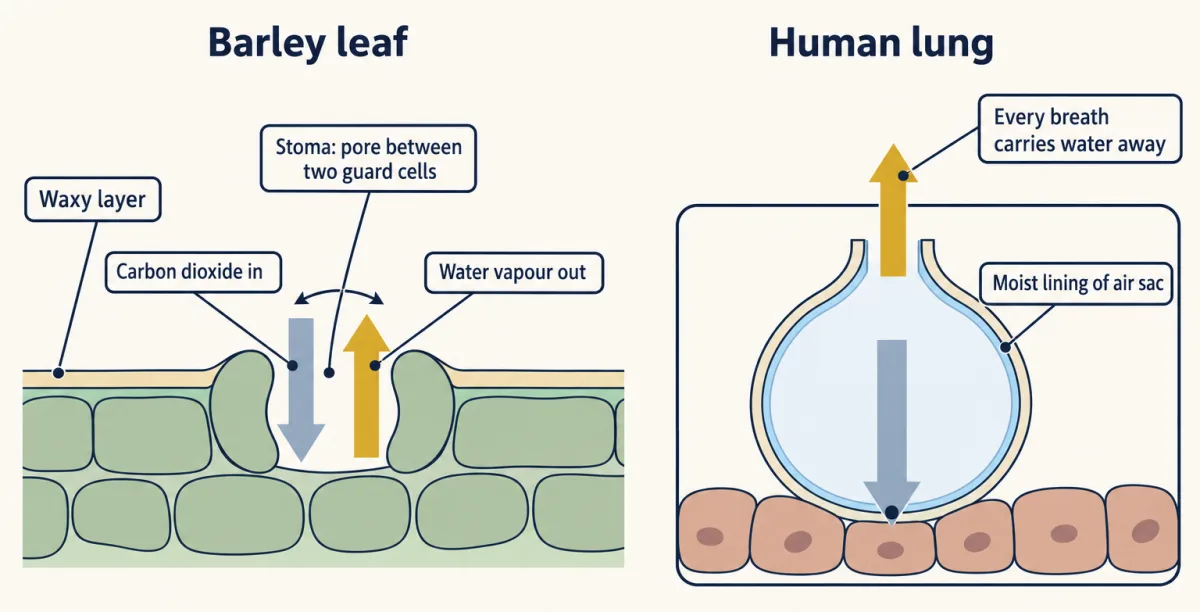
A leaf pays hundreds of water molecules for each carbon dioxide; a lung pays about one for each oxygen; only the leaf can close its pores. AI-generated illustration -
Worked problem: what a leaf pays
-
A test in barley: what the film left out
-
Why structure fits function, and why never perfectly
-
How questions and why questions
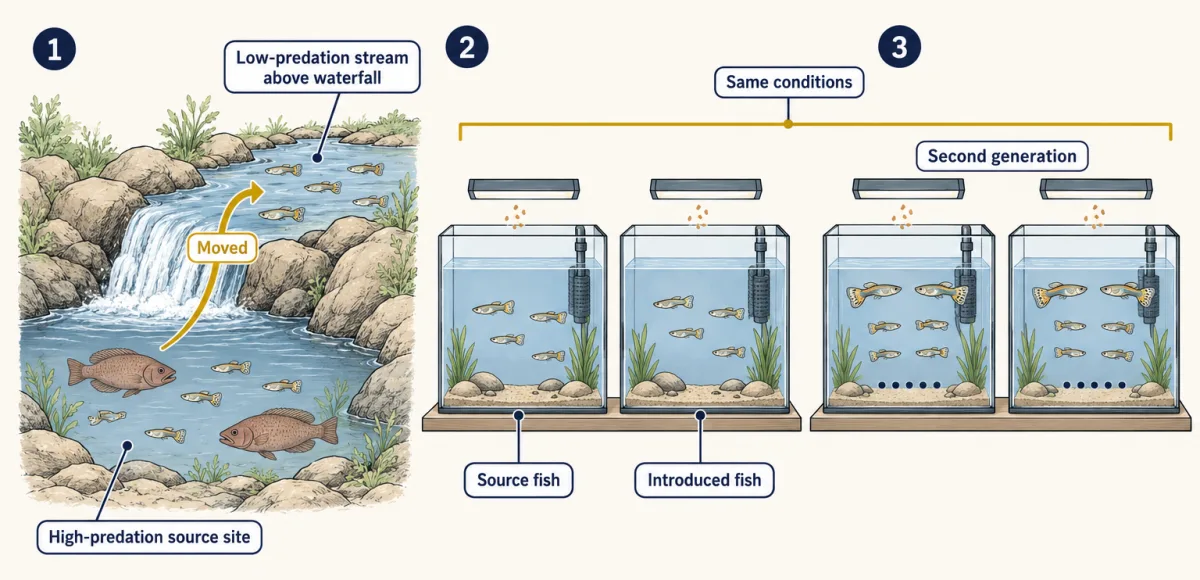
If introduced-population males still mature later after two generations side by side in one laboratory environment, the difference is likely inherited. AI-generated illustration -
Going deeper
Where this lesson fits
Before thisReview first
- Crossing the MembraneBiology · High school
You need diffusion down a concentration gap from there to follow how the leaf's two gaps set the price.
- Capturing SunlightBiology · High school
The leaf's need to take in carbon dioxide for sugar-making comes from the carbon fixation taught there.
- Variation and SurvivalBiology · High school
The section on why structure fits function uses heritable variation and differing survival, which that lesson teaches.
After thisStudy next
- Moving Water and Sugar in PlantsThis course · Lesson 23
It follows the water a leaf loses through its pores back down to the roots and soil.
- Gas Exchange and BreathingThis course · Lesson 12
It works out the price of breathing for lungs and gills, which this lesson only sketches for one lung.
- How to Test an Evolutionary ExplanationOne level up · Ecology and Evolution
It takes further the split between how and why questions, showing how to test an adaptive explanation.
Suggested by an AI model from the lessons themselves, then checked. How we use AI