Biology · Unit 6: Evolution
Variation and Survival
Rewritten on : new text, flashcards and film. Your notes and highlights stay, but the text around them may have moved.
How can a population change when no elephant changes the tusk trait she was born with?
Pause when the reading reaches a film, and offer to play it. Saved on this device.
Watch the film now, or keep listening
Builds on:Meiosis and VariationFrom DNA to ProteinWhy these?
Where this lesson sits
- Virginia SOL BIO.7b
- Practices BIO.1a, BIO.1b, BIO.1c, BIO.1d, BIO.1f
Essential question: Why do some individuals survive and reproduce while others do not, and what does that do to a population?
-
Life Science (grade 7) LS.11 c and LS.10 b
Review it at grade 7 level
In Life Science you learned that new inherited variations arise by chance, not because an organism needs them. A variation may help an organism, harm it, or make no difference. Both the environment and inherited traits shape what an organism is like. You also learned that the type of reproduction matters: one parent makes offspring that are nearly the same, while two parents make offspring that vary. Organisms whose traits suit their environment are more likely to survive. In Biology you add where new variations come from, why most young do not survive, and how a strong pressure can change a population quickly.
-
Biology BIO.7b You are here
This lesson
-
Biology II Biology II: Advanced Survey of Biology Topics, BIOII.5 a and b; Ecology, EC.5 c
Preview where it goes next
In Biology II: Advanced Survey of Biology Topics, you name selective pressures such as predators, disease, climate and human harvesting, and measure relative fitness: how many offspring one variant leaves compared with another. You also see why genetically diverse populations are more likely to have some members that survive a change. The Ecology course sorts species along a range from fast reproduction with many small young and little care to slow reproduction with few, large, cared-for young. Older textbooks call these r- and K-selected species; many ecologists now describe a fast-to-slow range of life histories instead. It adds survivorship curves, which show at what ages most members of a population die, and connects these patterns to the pressures a species faces.
-
College
 ▶ Watch How Populations Change · 3:49
Read the transcript of “How Populations Change”
Film transcript: How Populations Change
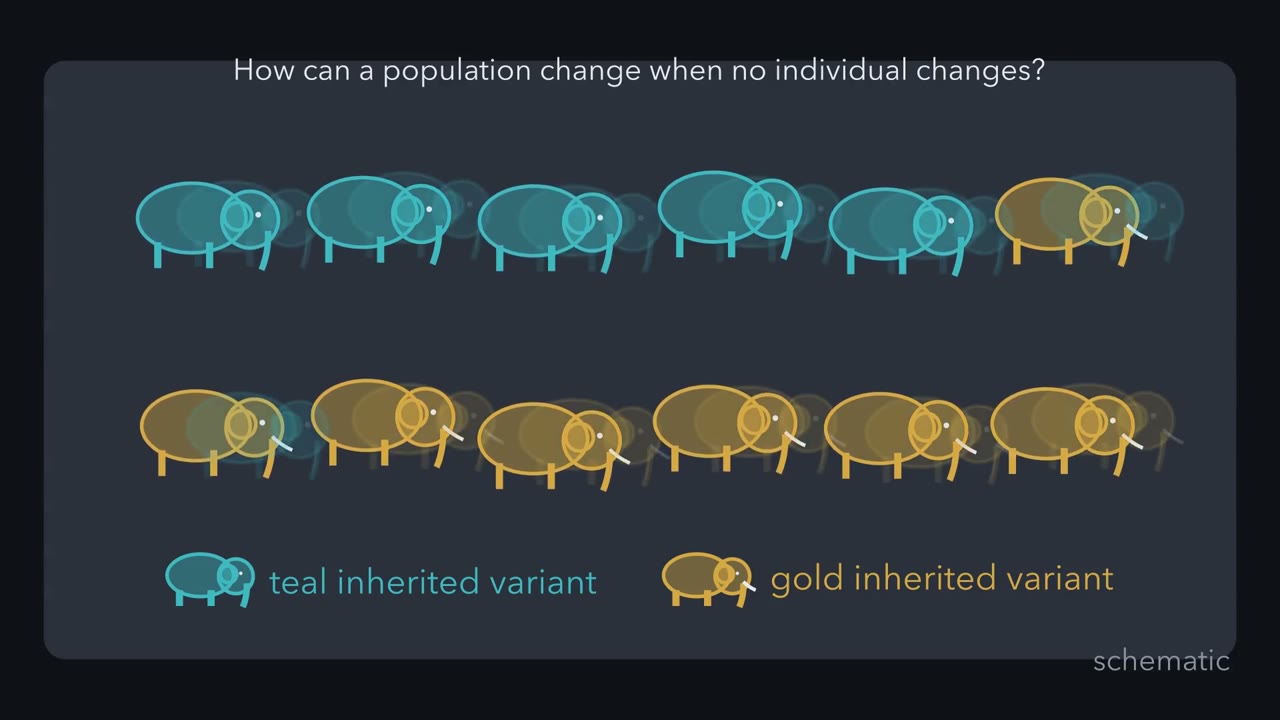
How can a population change when no individual changes its inherited trait? Watch this schematic herd. Each animal keeps its color through life, but the colored shares can change when a new generation replaces the old. Individuals in one population are not identical. Some differences come from food or experience. Others are inherited. Only inherited differences can pass from parents to offspring, so those differences can shape later generations. Zoom into the population's gene pool: all its alleles, meaning versions of genes. A mutation can make a new allele. Gene flow can bring an allele from another population. Both can change what the pool contains.
Sexual reproduction does something different. Meiosis and fertilization reshuffle alleles that already exist into new combinations. The offspring can differ from both parents without a new allele appearing. Now suppose teal and gold individuals leave offspring equally often.
Predict the next generation. Will one color steadily take over, or will their shares simply wobble? With equal reproductive success, neither color has a consistent advantage. Chance can still make the shares wobble. Yet the model has no directional push toward teal or gold. Real populations usually produce more young than their environments can support. Food, space, predators, disease, and other limits mean many never reproduce. The surviving adults are only part of the story; reproduction matters too. Now change the conditions.
Suppose teal individuals leave more offspring because their inherited variation fits those conditions better. More teal markers pass through the survival-and-reproduction filter. The next generation starts with a larger teal share. When inherited variations affect reproductive success, populations change across generations. That process is natural selection. It needs inherited variation and unequal reproductive success under the current conditions. Follow one gold individual. It never turns teal. Follow one teal individual. It never turns gold. The changing pattern appears only when we compare the population across generations. Selection can work only with variation that is present.
If every marker begins gold and no new teal allele appears or arrives, a teal advantage cannot change the population. Conditions cannot select a variant that is absent. Whether a variation helps, harms, or has no effect often depends on the environment. Selection does not plan ahead, and organisms do not change inherited traits because they need them. Return to the whole field. Different individuals entered, some left more offspring, and the next generation has a different mix. The population changed because reproductive success differed, not because individuals transformed.
From the film
- When inherited variations affect reproductive success, populations change across generations.
- Mutation makes new alleles, gene flow moves alleles, and sexual reproduction reshuffles alleles.
- An individual keeps its inherited variant while the population's mix can change.
- Natural selection needs inherited variation and unequal reproductive success under the current conditions.
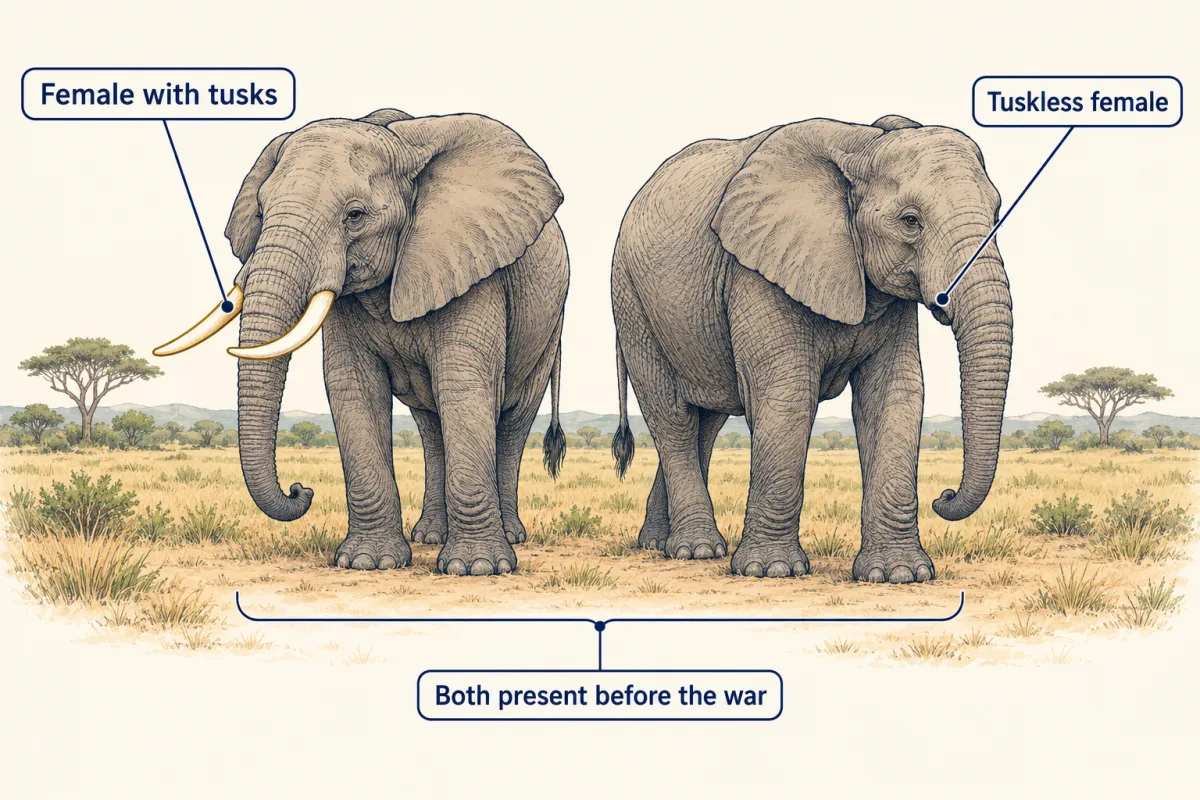
In Mozambique’s Gorongosa National Park, soldiers on both sides of a civil war that lasted from 1977 to 1992 killed elephants for ivory. Before the war, about 1 in 5 of the females researchers sampled had no tusks; among the females that survived the war, about half had none. No elephant had to lose her tusks for those group percentages to change.
The one idea. When inherited variations affect reproductive success, populations change across generations.
Scope: This rule describes natural selection. It works only when variants are inherited and the current conditions make the individuals that carry them leave different numbers of offspring. Mutation, gene flow and genetic drift (chance) can also change populations. Under some conditions, selection keeps a mix steady instead of changing it.
What do you think? Decide before you read.
-
Scientists disagree: Whether an elephant grows tusks depends on the genes she was born with. What changed was the population: researchers compared photos of females from before the war with females seen afterwards. Tuskless females were already present before the war and survived poaching more often, so their share of the population rose.
What scientists think
Scientists disagree: Whether an elephant grows tusks depends on the genes she was born with. What changed was the population: researchers compared photos of females from before the war with females seen afterwards. Tuskless females were already present before the war and survived poaching more often, so their share of the population rose.
-
Scientists disagree: Natural selection needs no wanting or trying. Variations arise by chance, from mutations and from the reshuffling of alleles in reproduction, whether or not they help. When the environment changes, individuals that happen to carry a helpful variation survive and reproduce more often. Field studies, such as moths released on tree branches, measure this difference in survival directly.
What scientists think
Scientists disagree: Natural selection needs no wanting or trying. Variations arise by chance, from mutations and from the reshuffling of alleles in reproduction, whether or not they help. When the environment changes, individuals that happen to carry a helpful variation survive and reproduce more often. Field studies, such as moths released on tree branches, measure this difference in survival directly.
-
Scientists disagree: Different variants usually keep living side by side. In Gorongosa, about half of the females that survived the war still had tusks, and most daughters born after the war had tusks. Evolution is a change in how common an inherited variant is in a population over generations, not every member changing together.
What scientists think
Scientists disagree: Different variants usually keep living side by side. In Gorongosa, about half of the females that survived the war still had tusks, and most daughters born after the war had tusks. Evolution is a change in how common an inherited variant is in a population over generations, not every member changing together.
Explore: put a population under pressure
In this model, a population of animals carries an inherited trait, such as having tusks or not. You set how strong a pressure is, such as how often hunters take tusked animals, and whether new variations can arise by mutation. A graph tracks each trait’s share over many generations.
| Expected | This run (simulated) |
|---|
In this sketch: 100 animals per generation. Each tusked animal is taken with a chance of 5 percent per pressure unit (so 25 percent at 5); animals with no tusks are not taken. The survivors make the next 100 young, and each young copies the trait of one survivor chosen at random. With new variation on, 1 in 200 young of a tusked survivor is born with no tusks. These rates are the sketch’s own relative settings, not measurements, and one parent per young simplifies real inheritance.
An animal keeps the trait it was born with. What changes from generation to generation is how common each trait is in the population, and it changes faster under a stronger pressure. This is a sketch of the logic, not a prediction for any real herd.
Predict, then test. The first film showed that with no pressure the shares change only by chance, with no consistent direction, and that a missing variant cannot be selected. In a population of limited size, chance alone can eventually remove one variant entirely. Measure what the film did not.
- Set the pressure to zero and run it several times. How far does the share drift in 40 generations? Does one kind ever disappear?
- Turn the pressure up to strong. Predict how many generations it takes for the share to change a lot. Then try a weak pressure and compare.
- Start with no tuskless animals, strong pressure and new variation switched on. Predict how long tusklessness takes to spread once it first appears.
Explain: where variation comes from
- variation
- allele
- gene pool
- mutation
- gene flow
- sexual reproduction
- natural selection
- selective pressure
- reproductive strategy
The first film drew the gene pool; here are the words for its parts.
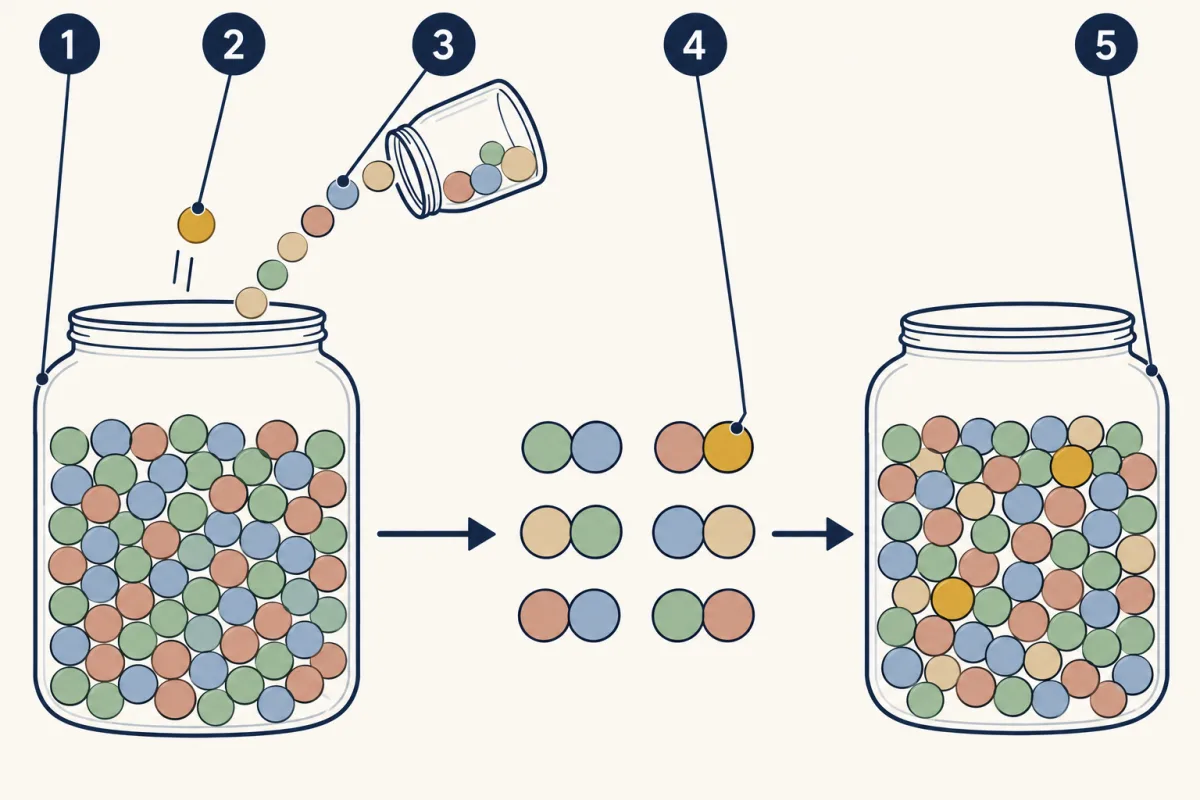
Variation is the differences among individuals in a population. An allele is one version of a gene. The gene pool is all the alleles of all the individuals in a population. Three processes add to or reshape it.
- Mutation is a change in an organism’s DNA. It is the original source of new alleles. Many mutations have no effect, some harm, and a few help, depending on the environment.
- Gene flow is the movement of alleles from one population to another, when individuals move and breed or when pollen blows to another field. It can bring in an allele the population did not have.
- Sexual reproduction joins an egg and a sperm from two parents. You saw in Meiosis and Variation that meiosis shuffles chromosome pairs and swaps pieces between them. This makes new combinations of alleles that already exist, so each offspring is a new mix.
Over generations, mutation and gene flow change what is in the gene pool. Natural selection and chance (genetic drift) also change how common each allele is.
Predict. A mutation happens in a skin cell on an elephant’s trunk. Could her calf inherit it?
Check your prediction
No. In most animals, only mutations in the cells that make eggs or sperm pass to offspring.
- gene pool
- mutation
- gene flow
- meiosis and fertilization
- one generation later
- gene pool
- mutation
- blank
- blank
- blank
Word bank: gene flow, meiosis and fertilization, one generation later
- blank
- blank
- blank
- blank
- blank
Check your labels
- gene pool
- mutation
- gene flow
- meiosis and fertilization
- one generation later
Variation is the raw material; the second film shows what a pressure does with it in Gorongosa.
Read the transcript of “Reading Selection in a Population”
Film transcript: Reading Selection in a Population
The first film followed inherited variants across generations. How can data show that selection, rather than chance, shaped a population shift? Return to the same teal and gold map, now tied to Gorongosa elephants. Teal marks tuskless females, and gold marks tusked females.
Historical film and photographs give the prewar group. Later sightings give the survivors. The bars use the reported group sizes and percentages. The teal share is higher among survivors. What changed? Did individual elephants lose tusks, or do the two groups contain different shares of elephants born with each trait?
Track two schematic animals between panels. A gold animal stays gold, and a teal animal stays teal. The survivor group contains more teal because tuskless females survived poaching more often. Ivory poaching was a selective pressure because it affected the variants differently. Tusked elephants were killed more often. The data support a change in the population's makeup, not a choice or transformation by elephants. A severe population crash can also change shares by chance.
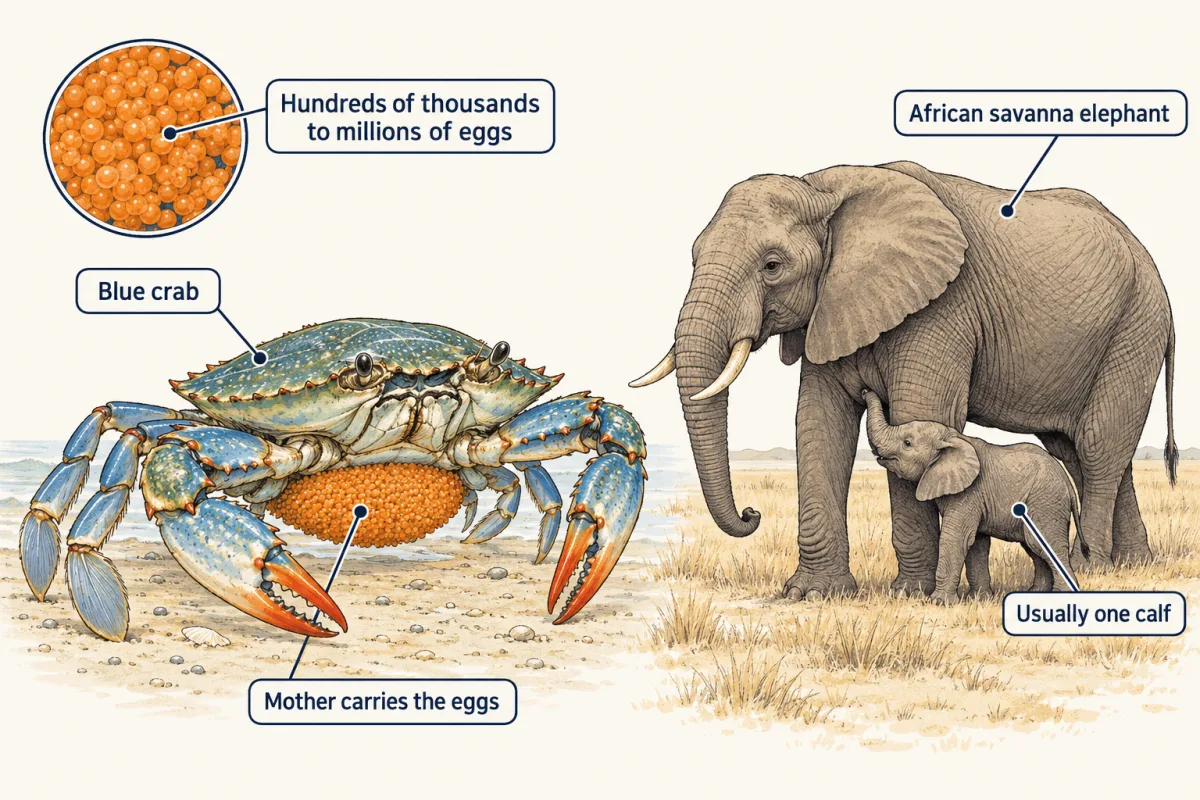
Researchers modeled the crash with equal survival for tusked and tuskless females. The observed rise was far beyond what that chance model usually produced. Daughters born later kept tusklessness above the prewar share. That pattern fits an inherited trait and a response to selection. It still does not identify the exact allele or prove what happened to every elephant. Now widen the picture. Populations usually produce more young than their environments can support. A female blue crab carries an enormous egg mass. An elephant mother invests years in a calf. Most crab young die before reproducing. These are endpoints on a range, not two rigid boxes.
One strategy makes many young with less investment in each. The other makes fewer young with more care. Many species fall between them. For selection, count offspring that survive and reproduce. Strength, effort, and need are not the score. The conditions decide whether an inherited variant changes reproductive success. When inherited variations affect reproductive success, populations change across generations. In Gorongosa, the trait pattern, selective pressure, survival difference, and daughters all support that rule together. Before-and-after data show a pattern. The selective pressure, survival estimate, chance comparison, and later daughters make the selection explanation stronger.
Good evidence supports a claim while keeping its limits visible. Read the bars as population snapshots, not biographies. Read the filter as a comparison, not a promise. Then ask whether inherited differences changed who left the next generation.
From the film
- When inherited variations affect reproductive success, populations change across generations.
- Populations usually produce more young than their environments can support.
- A trait-frequency shift describes groups, not an individual changing during life.
- Comparisons against chance strengthen a claim that selection shaped a population.
Explain: what the film left out
The second film showed the Gorongosa bars and the chance test in outline; here are the terms and details behind them.
Natural selection is the process by which individuals with certain inherited variations survive and reproduce more than others, so those variations become more common in later generations.
A selective pressure is anything in the environment that makes some variants more likely to survive or reproduce than others: predators, disease, drought or human hunting. In Gorongosa it was ivory poaching. In this park tusklessness is seen only in females; no tuskless male has been recorded there.
Beyond the chance test, the researchers estimated that tuskless females survived about five times as well as tusked females. They concluded that poaching most likely caused strong selection for tusklessness.
A female blue crab in the Chesapeake Bay may carry about 750,000 to 8 million eggs, according to the Virginia Institute of Marine Science. Only a small fraction become adults.
A reproductive strategy is a species’ pattern of how many young it makes and how much it invests in each. Neither end of the range is always better; each can leave surviving offspring under some conditions.
| Blue crab | African savanna elephant | |
|---|---|---|
| Young per breeding | Hundreds of thousands to millions of eggs | Usually one calf |
| Care | Mother carries the eggs until they hatch | Mother nurses the calf, and births are years apart |
| Survival of each young | Very low | Higher |
Elaborate: read the elephant and crab data
| Measure | Value | Units | Group or place |
|---|---|---|---|
| Tuskless females, before the war | 18.5 (54 females) | percent | Gorongosa, before 1977 |
| Tuskless females, war survivors | 50.9 (108 females) | percent | Gorongosa, survived 1977 to 1992 |
| Tuskless daughters, first generation after the war | 33 (91 females) | percent | Gorongosa, born about 1995 to 2004 |
| Elephants in the park, all ages and sexes | 2,542 | elephants | Gorongosa, 1972 count |
| Elephants in the park, all ages and sexes | 242 | elephants | Gorongosa, 2000 count |
| Time between births, mean | 4.5 | years | Amboseli, Kenya (255 females) |
| Time between surviving calves, median | 3 | years | Gorongosa (124 intervals) |
| Blue crab egg mass, low end of reported range | 750,000 | eggs | Chesapeake Bay |
| Blue crab egg mass, high end of reported range | 8,000,000 | eggs | Chesapeake Bay |
Sources: tusk percentages and park counts from Campbell-Staton and colleagues, Science (2021), Figure 1. Amboseli births from Moss, Journal of Zoology (2001), a study begun in 1972. Gorongosa calf intervals from Poole and Granli, Pachyderm (2022), field trips 2011 to 2019. Egg mass range from the Virginia Institute of Marine Science, a summary range, not one dated sample.
Predict. Is the rise from 18.5 percent to 50.9 percent a change of 32.4 percentage points, or 32.4 percent?
Check your prediction
It is 32.4 percentage points: 50.9 − 18.5 = 32.4. As a percent change it is 32.4 ÷ 18.5, a rise of about 175 percent.
- Why might the daughters’ share (33 percent) be lower than their mothers’ generation (50.9 percent)?
- Compare the two elephant interval values. Why might they differ?
Claim, evidence, reasoning
Make a claim about why tuskless females became more common in Gorongosa, using these data.
Start with: Tuskless females became more common because blank.
Start with: Before the war blank percent of sampled females were tuskless, and among survivors blank percent were.
Start with: Poachers killed tusked elephants more often, so blank, and because tusklessness is inherited, blank.
Compare with a model answer
Tuskless females became more common because poaching for ivory killed tusked elephants more often, so tuskless females were more likely to survive. In the prewar sample, 18.5 percent of 54 females were tuskless; among 108 war survivors, 50.9 percent were, a rise of 32.4 percentage points. The share among daughters born after the war, 33 percent, is still above the prewar 18.5 percent, which fits an inherited trait. The data have limits: the samples are small, the percentages count a visible trait rather than alleles, and they cannot prove what happened to each elephant or which gene causes the trait.
Saved in this browser only.
Design problem
Plan an ethical study to test whether hunting, not chance, explains the rise in tuskless females in a park. You cannot assign hunting to elephants. What groups would you compare, what would you count, and what could mislead you?
Saved in this browser only.
One way to do it
- Question: Did tuskless females become more common in parks with heavy poaching than in parks with little poaching?
- Comparison groups: several parks with heavy poaching and several with little poaching, with photos or counts from before and after the same years.
- What you count: the number of adult females with and without tusks in each park and period. Report the number of animals, not only the percentage.
- Constants: the same definition of “tuskless”, the same age range of females, and observers trained the same way.
- Sample size and repeats: as many recognized females as possible, and more than one park in each group, because one small sample can change by chance.
- What could mislead you: old photos may show some animals more than others, and tuskless elephants may be easier or harder to spot. Recording each known individual once helps.
- Ethics: observe and photograph only; never harm animals to test an idea.
A larger rise in heavy-poaching parks than in low-poaching parks would support selection by hunting.
Going deeper
How quickly can a population change?
Pressure can be strong or weak. A strong pressure, like heavy poaching, can change a trait’s frequency within a few decades when inherited variation is present. A weak pressure changes it slowly over many generations. Biologists argue about how often evolution happens in quick bursts and how often it creeps along; you will meet those two ideas in Natural Selection and New Species.
Why do two sample sizes appear?
Campbell-Staton and colleagues give 52 prewar females in the paper’s text, but Figure 1 labels 54. The table follows the figure.
Evaluate: check your thinking
The Gorongosa case fits the rule: inherited tusklessness was already present, and poaching changed which females survived to leave the next generation.
Science practices you used: making predictions and testing them with a model, reading a table of percentages and sample sizes, calculating a change in percentage points, planning an ethical observational study, and naming the limits of small samples and of a model.
Your notes
Select any text in the lesson to highlight it or add a note to it. Your highlights and notes are saved in this browser and collected in your notebook.
This browser is not letting the site save anything (a private window or strict privacy settings), so highlights and notes will be lost when you leave the page.
How we measure it
Photo surveys of known animals
Researchers compare old photographs and film with sightings of animals today and record a trait, such as whether a female elephant has tusks. Counting the trait in each group gives a percentage for that group, and comparing groups shows whether the trait became more common.
Long-term records of known individuals
Field teams learn to recognize individual animals and follow them for years, writing down births and deaths. These records give numbers such as the average time between a mother's calves.
Genome scanning
Scientists read DNA from many animals with and without a trait and look for regions that differ between the two groups. A region that stands out is a candidate for the cause; more work is needed to show that it is the cause.
Where this lesson fits
Before thisReview first
- Meiosis and VariationThis course · Lesson 19
Meiosis shuffling chromosomes into new allele combinations is used here to explain why offspring differ.
- From DNA to ProteinThis course · Lesson 18
You need to know how a changed DNA letter can change a protein to see how mutations make new traits.
After thisStudy next
- Natural Selection and New SpeciesThis course · Lesson 28
It takes selection further, showing how pressure on variation reshapes finches and can split one population into new species.
- Populations and Carrying CapacityThis course · Lesson 29
It builds on the idea that populations make more young than the environment supports, using blue crab numbers.
Elsewhere on the siteFilms, simulations and method films in other courses
- How a Population Changes ColourFilm · Life Science
The moth film shows a trait becoming common because carriers survive and reproduce more under a pressure.
- Moths and birdsSimulation · Life Science
You can change the environment and watch moth colour frequencies shift across generations.
Suggested by an AI model from the lessons themselves, then checked. How we use AI
Finish line
Test yourself
8 questions
Practice and MCAT-style, with explained answers.
Next · Lesson 28
Natural Selection and New Species
Did a drought reshape the finches on one small island, or change which birds were left?
Continue →