Life Science · Unit 2: Organizing and classifying life
Domains, Kingdoms and DNA
Rewritten on : new text, figures, flashcards and film. Your notes and highlights stay, but the text around them may have moved.
A mushroom stays in one place like a plant, so why do scientists say fungi are closer relatives of animals?
Pause when the reading reaches a film, and offer to play it. Saved on this device.
Watch the film now, or keep listening
Builds on:Sorting Living ThingsInside a CellPlant Cells and Animal CellsWhy these?
Where this lesson sits
- Virginia SOL LS.3 c
- Practices LS.1 c, LS.1 d, LS.1 f
Essential question: Why are mushrooms no longer called plants, and how can DNA change where a living thing belongs?
-
Life Science (grade 7) LS.3 c You are here
This lesson
-
Biology
Preview it at high school level
In Biology you will read the real evidence that created the domain Archaea. In 1977, Carl Woese and George Fox compared ribosomal RNA, a molecule every cell uses, and found that some microbes formed their own line of life. You will learn two new words: prokaryote, a cell with no nucleus, and eukaryote, a cell with a nucleus. You will see how the chemistry of cell walls and cell membranes also separates Archaea from Bacteria. You will meet other groups that DNA has changed, such as African forest and savanna elephants, now counted as two species instead of one.
-
Biology II Biology II: Genetics, GEN.6 e
Preview where it goes next
In the Biology II Genetics course you compare different ways to define a species: by whether organisms can mate and have young that can reproduce, by body form, or by shared ancestry read from genes. You see how genetic makeup is used to classify organisms, especially microbes that do not mate in the usual way. Newer genome studies also suggest that Eukarya branched from within one group of archaea, and you learn why scientists still keep the three domain names.
-
College
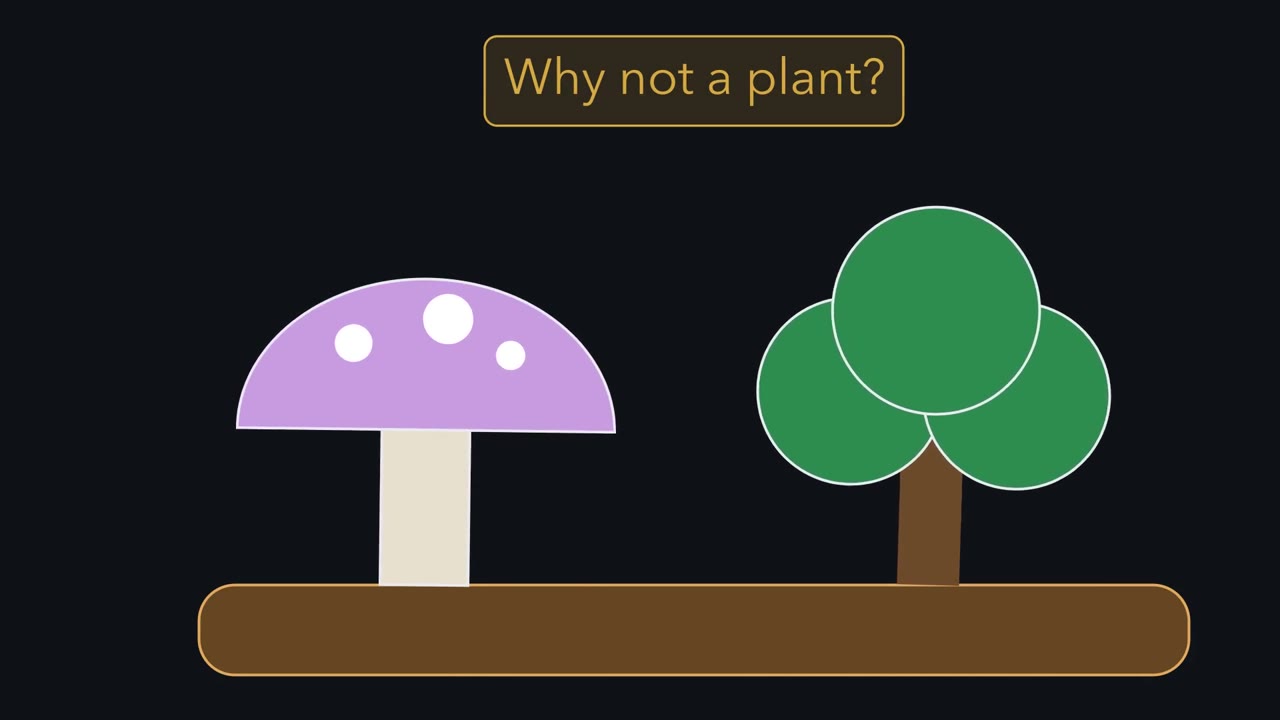 ▶ Watch Climbing the Evidence Ladder · 3:20
Read the transcript of “Climbing the Evidence Ladder”
Film transcript: Climbing the Evidence Ladder
A mushroom stays in one place, like a plant. So why don't scientists call it a plant? The answer depends on your tools. Here are six living things: a mushroom, an oak, a deer, a paramecium, a bacterium and an archaeon. Scientists sort living things with several kinds of evidence. This ladder orders them; it is not a timeline. The bottom rung is your eyes. The mushroom stays put, like the oak, so it sits with the plants. The deer has an animal's body and walks away, so it goes with the animals. The three tiny ones are too small to make out. For a long time, many scientists grouped mushrooms with plants. Next rung, the light microscope. It answers three questions.
Does each cell have a nucleus, the part that holds its DNA? Which cell parts does it have? Does it have one cell or many? A fourth question needs other tests. Does it make its own food, or take food in? The first question splits the cards. Four of them have cells with a nucleus. The bacterium and the archaeon have no nucleus, and under the microscope they look alike. Now zoom in on the mushroom. Its cells have a nucleus and a cell wall, like a plant's. But they have no chloroplasts, the green parts where a cell makes sugar using light. So a mushroom cannot make its own food. It releases digesting substances into the log. They break the wood into tiny dissolved pieces, and the mushroom takes them in.
Most plants make their own food instead. So the mushroom slides out of the plant group. Later, fungi got a kingdom of their own. Third rung, cell chemistry. The bacterium and the archaeon look the same under a microscope. Are they the same kind of living thing?
No. The chemicals that build their cell walls and membranes are different. Their genes, compared on the top rung, differ too. So scientists split them into two domains, Bacteria and Archaea. Every living thing whose cells have a nucleus goes in a third domain, Eukarya. So life has three domains.
Kingdoms sit inside them. Fungi, plants and animals are kingdoms inside Eukarya. The paramecium waits. You will place it yourself. Look back. The living things never changed. The evidence did, and new evidence could move a card to a new group. One rung is left, DNA.
Scientists compare the same gene in different living things. Will the mushroom's gene match the oak's or the deer's more closely?
From the film
- Scientists sort living things with several kinds of evidence, and new evidence can move a living thing to a new group.
- A microscope shows three clues, a nucleus or not, which cell parts, and one cell or many; other tests add a fourth, making food or taking it in.
- A mushroom has no chloroplasts and takes in its food, so fungi have their own kingdom, not a place with plants.
- Bacteria and Archaea both lack a nucleus and look alike, but their chemistry and genes differ, so they are two domains; every cell with a nucleus is in Eukarya.
A mushroom pops up on a dead log after rain. It does not walk, swim or fly away. For a long time, many scientists grouped mushrooms with plants. Today fungi have a kingdom of their own, and DNA comparisons strongly support a surprising answer: fungi are closer to animals like you than to an oak tree. How can a molecule show that?
What do you think? Decide before you read.
-
Scientists disagree: Scientists also compare DNA and proteins. In 1993, two scientists compared 25 proteins in animals, fungi and plants. The results strongly supported fungi being closer to animals than to plants, even though a mushroom looks more like a plant.
What scientists think
Scientists disagree: Scientists also compare DNA and proteins. In 1993, two scientists compared 25 proteins in animals, fungi and plants. The results strongly supported fungi being closer to animals than to plants, even though a mushroom looks more like a plant.
-
Scientists disagree: In 1735, living things were sorted into two kingdoms, plants and animals. Microscopes, cell studies and then comparisons of molecules each added new evidence. By 1990 scientists had proposed three domains above the kingdoms.
What scientists think
Scientists disagree: In 1735, living things were sorted into two kingdoms, plants and animals. Microscopes, cell studies and then comparisons of molecules each added new evidence. By 1990 scientists had proposed three domains above the kingdoms.
-
Scientists disagree: Bacteria and Archaea look alike under a light microscope, and neither has a nucleus. But comparing a molecule that all cells share showed they are very different. Yeast is a microorganism too, and its cells have a nucleus, like yours.
What scientists think
Scientists disagree: Bacteria and Archaea look alike under a light microscope, and neither has a nucleus. But comparing a molecule that all cells share showed they are very different. Yeast is a microorganism too, and its cells have a nucleus, like yours.
The one idea. Scientists sort living things with several kinds of evidence: what eyes see, what a microscope shows, tests of feeding and cell chemistry, and DNA. New evidence can move a living thing to a new group. On the top rung, scientists compare the same gene or protein across living things and build family trees from many genes before they trust a grouping. Groups that many genes put together probably share a more recent common ancestor, an organism both groups descend from.
Scope (for every “match” or “closer” in this lesson): the ladder orders kinds of evidence, not dates. One match count is a clue, not proof: one group’s gene can change faster, so the closest match is not always the closest relative. A closer relative is not the same kind: fungi are closer to animals, but a mushroom is not an animal.
Explore: sort living things by evidence
The slider adds one rung at a time; kingdom boxes appear only on the DNA rung. There, a bar shows how alike one protein is for the pair you pick, using the mean of real pairs in the Elaborate table (mushroom for two fungi, oak for two plants, deer for a human).
Protein match (one protein) for the pair you picked
Made up for this sketch: only six organisms; boxes, not branches; the order of the four kinds of evidence; the mushroom, deer and oak stand in for groups the table measured with other organisms; bar values are that table’s means, rounded.
Rule to keep: the more alike two organisms’ DNA sequences are, the more recent their common ancestor, and new evidence can change the groups.
Try this.
- Predict the paramecium’s box on the DNA rung: animals, plants, fungi or its own. Then test it.
- Pick the mushroom and the deer, then the mushroom and the oak. How far apart are the bars? Elaborate asks whether a gap that size can be trusted.
Explain: six kingdoms inside three domains
- nucleus
- cell wall
- chloroplast
- Bacteria
- Archaea
- Eukarya
- protist
- fungus
- DNA sequence
- common ancestor
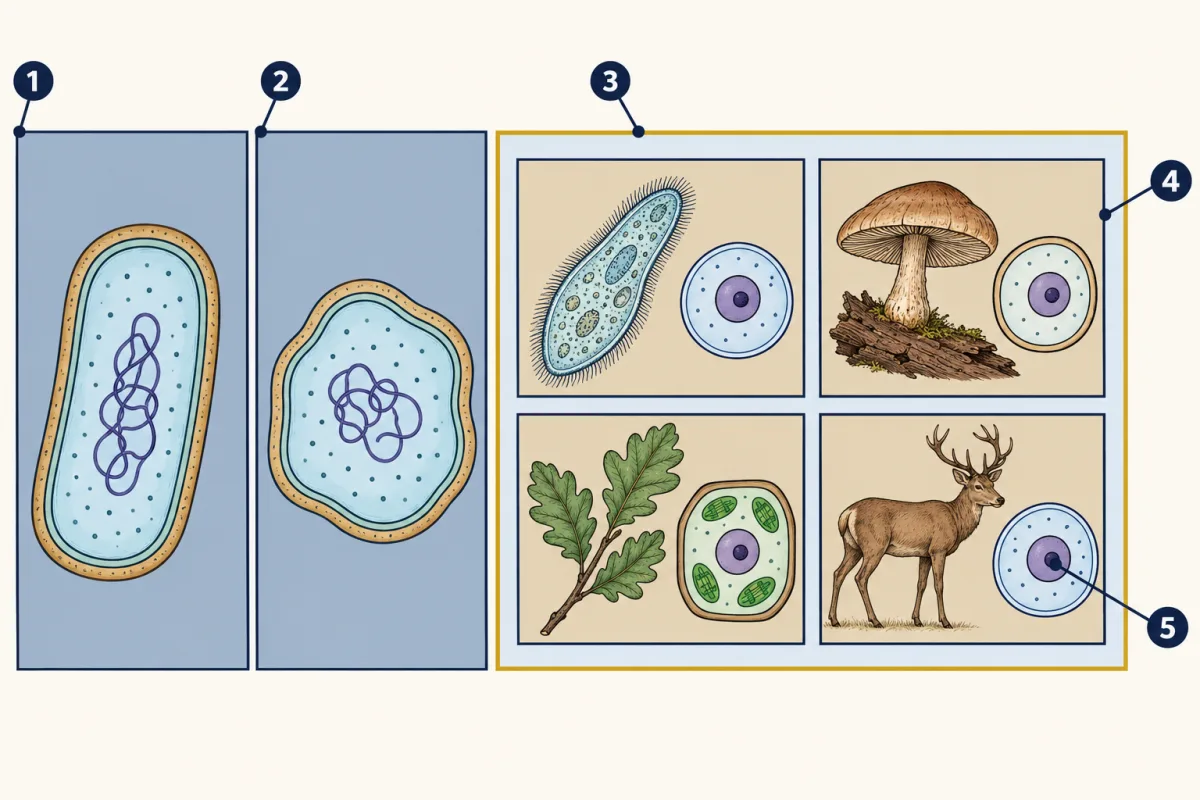
You met the levels of classification, from domain down to species, in that lesson. A nucleus is the part of a cell that holds its DNA. A cell wall is a stiff layer outside the cell membrane. A chloroplast is a green part where a cell makes sugar (glucose) using light. Bacteria and Archaea are two domains of tiny, mostly single-celled organisms with no nucleus; they look alike but differ in cell chemistry and genes. Eukarya is the domain of all organisms whose cells have a nucleus.
Many US textbooks use six kingdoms: Bacteria and Archaea each get one, and four are inside Eukarya. A protist is an organism with a nucleus that is not a plant, animal or fungus, such as a paramecium; protists are a mixed group (see Going deeper). A fungus is an organism such as a mushroom, mold or yeast.
Predict. Baker’s yeast is a single cell, like a paramecium. It has a nucleus and a cell wall but no chloroplasts, and it takes in sugar as food. Is it a protist or a fungus?
Check your prediction
A fungus. One cell does not make it a protist: its wall, missing chloroplasts and feeding match the Fungi row below.
| Kingdom | Nucleus? | Cell wall? | Chloroplasts? | Cells | Food |
|---|---|---|---|---|---|
| Bacteria | No | Most have one | No | Mostly one | Some make it, some take it in |
| Archaea | No | Most have one | No | Mostly one | Some make it, some take it in |
| Protists | Yes | Some | Some | Most one, some many | Some make it, some take it in |
| Fungi | Yes | Yes | No | Most many; yeast one | Take it in |
| Plants | Yes | Yes | Yes, in green parts | Many | Most make it |
| Animals | Yes | No | No | Many | Take it in |
In the figure, name each numbered part.
- Bacteria
- Archaea
- Eukarya
- Fungi
- nucleus
- blank
- blank
- Eukarya
- blank
- nucleus
Word bank: Archaea, Bacteria, Fungi
- blank
- blank
- blank
- blank
- blank
Check your labels
- Bacteria
- Archaea
- Eukarya
- Fungi
- nucleus
Explain: new tools bring new evidence
Read the Groups column first: 2, 3, 4, 5 kingdoms, then domains. The DNA rung compares sequences, the order of building blocks in DNA or in the RNA and proteins made from it.
| Year | Scientist | Groups | New evidence behind it | Rung |
|---|---|---|---|---|
| 1735 | Linnaeus | 2 kingdoms of living things | Body parts seen by eye | Eyes |
| 1866 | Haeckel | 3 kingdoms | Tiny living things that were neither plant nor animal | Microscope |
| 1938 | Copeland | 4 kingdoms | Cells with no nucleus put in their own kingdom | Microscope |
| 1969 | Whittaker | 5 kingdoms | Fungi separated by how they get food | Microscope and feeding tests |
| 1977 | Woese and Fox | Found a third main line of life, later named Archaea | Comparing the sequence of a molecule all cells have (ribosomal RNA) | DNA (sequences) |
| 1990 | Woese, Kandler and Wheelis | Named the three lines domains, a level above kingdoms | Molecule comparisons | DNA (sequences) |
Not every fungus feeds on dead wood like the first film’s mushroom: others feed on living hosts or trade with living plants, taking sugar and giving water and minerals.
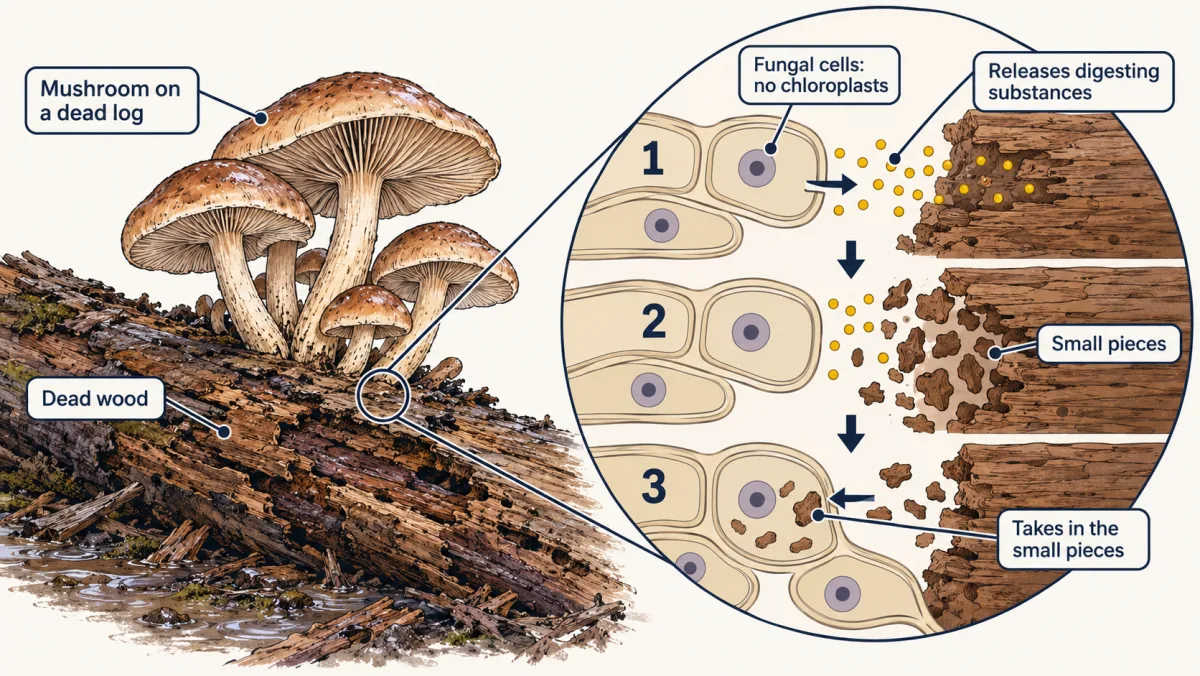
Cell clues and feeding cannot say who the fungi’s closest relatives are, so the second film climbs to the DNA rung.
Read the transcript of “Reading the DNA Rung”
Film transcript: Reading the DNA Rung
Cell clues and feeding showed that a mushroom is not a plant. They cannot show who its closest relatives are. How could the cells' own instructions tell you? The first film climbed three rungs of the evidence ladder. Now climb the top rung, DNA, with the same six cards. The order of the chemical letters in a stretch of DNA is its DNA sequence. Each protein is built from a gene's instructions. So comparing proteins is another way to compare genes. A protein is a chain of building blocks called amino acids. To compare, line up the same protein from two living things. Each place in the line is a position. At each position, the building blocks match, or they do not.
Here is a made-up example, only ten building blocks long. Line up living thing A with living thing B, and count the matches. Then line up A with C. A matches B more closely in this one protein. That is one clue that A and B may share a more recent common ancestor. That is an organism both groups descend from. But a match count is a clue, not proof. One group's version can change faster than another's. So scientists build family trees from many genes before they trust a grouping. In 1993, Sandra Baldauf and Jeffrey Palmer looked at 25 proteins from animals, fungi, plants and other living things. One protein is called EF-1 alpha. In this protein, the animals and fungi they studied share an extra stretch, 12 building blocks long.
Do the plants have it too? Decide what each answer would mean. The plants did not have it. The simplest story is one change, in an ancestor that animals and fungi share but plants do not. And all four proteins they used to draw family trees grouped animals with fungi. So the evidence supports this tree. Fungi and animals sit on neighbouring branches. Plants sit farther off. Fungi and animals share a more recent common ancestor than either shares with plants. Many other proteins agree. One last warning. A closer relative is not the same kind. Fungi are closer to animals, but a mushroom is still not an animal. Closer means a more recent common ancestor.
From the film
- To compare two living things, scientists line up the same protein or gene and count the positions that match.
- Compare one living thing with two others using the same protein; a clearly higher match is one clue to a more recent common ancestor.
- A match count is a clue, not proof, so scientists build family trees from many genes before they trust a grouping.
- In one protein, EF-1 alpha, the animals and fungi studied shared an extra stretch of 12 building blocks that the plants lacked.
- Being closer to animals does not make a mushroom an animal.
Elaborate: compare one protein in five organisms
The second film’s example was made up. Here are real counts for EF-1 alpha, about 460 positions long, which all five organisms make. Comparing the same protein gives evidence about the gene that holds its instructions. But these percents count matching amino acids, the building blocks of a protein. They do not count matching letters in the gene’s DNA sequence, the order of its chemical letters (that lesson). Baker’s yeast and bread mold are fungi, like the mushroom. Thale cress, a small weed used in plant research, and wheat are plants, like the oak. You, the human, are the animal, like the deer.
| Pair compared | Kind of pair | Matching positions (out of positions compared) | Match (%) |
|---|---|---|---|
| Human and baker’s yeast | Animal and fungus | 371 of 460 | 80.7 |
| Human and bread mold | Animal and fungus | 387 of 461 | 83.9 |
| Baker’s yeast and thale cress | Fungus and plant | 339 of 461 | 73.5 |
| Baker’s yeast and wheat | Fungus and plant | 336 of 457 | 73.5 |
| Bread mold and thale cress | Fungus and plant | 342 of 462 | 74.0 |
| Bread mold and wheat | Fungus and plant | 345 of 458 | 75.3 |
| Baker’s yeast and bread mold | Fungus and fungus | 394 of 460 | 85.7 |
| Thale cress and wheat | Plant and plant | 425 of 446 | 95.3 |
Source: protein records from the NCBI Protein database, compared with NCBI’s BLAST program on 23 October 2026 for this course. These percents are for one protein, not for all of the DNA. The table has no animal-and-plant pair.
In the dot chart, each dot is one pair; higher dots matched more.
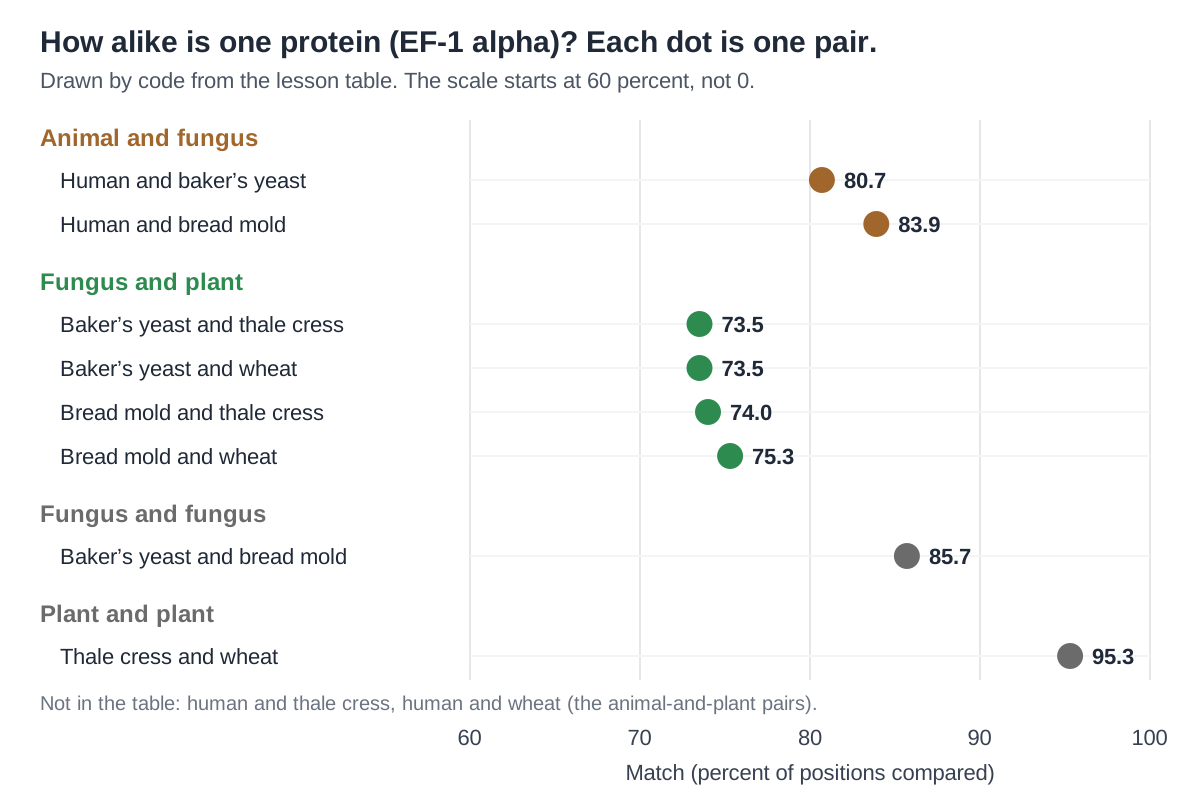
- Find the mean match for the two animal-and-fungus pairs. Then find the mean for the four fungus-and-plant pairs.
- Which is higher, and by about how many percentage points?
- Which pair matches best of all? Why does that make sense?
Predict. From the human’s side, bread mold matched about 3 percentage points better than baker’s yeast. Does that make bread mold a closer relative of humans than yeast is?
Check your prediction
No. Both are fungi, so on the family tree they are equally related to animals. The two percents cannot show why yeast’s version differs. Perhaps it changed more; yeast also matches both plants a little less. The animal-and-fungus gap is different: both animal-and-fungus pairs beat all four fungus-and-plant pairs. Even so, it is one protein, and many genes must agree.
- The fungi matched the blank more closely than the blank.
- This suggests that fungi share a more recent common ancestor with blank.
- One limit of this data is blank. (Hint: compare the human with yeast and with bread mold.)
Claim, evidence, reasoning
Make a claim that answers the essential question: where do fungi belong, and how can DNA evidence change that? Use the table.
Start with: The data show that fungi are closer to blank than to blank.
Start with: The two animal-and-fungus pairs have a mean match of blank percent, while the four fungus-and-plant pairs have a mean of blank percent.
Start with: A higher match means blank, so fungi share a more recent common ancestor with blank.
Compare with a model answer
Fungi are closer to animals than to plants. The two animal-and-fungus pairs have a mean match of about 82.3 percent. The four fungus-and-plant pairs have a mean of about 74.1 percent. A higher match means the protein is more alike, which suggests a more recent common ancestor. So fungi should not be grouped with plants. One limit: this is one protein from only five organisms, with one animal. Scientists trust the claim more because many other proteins agree.
Saved in this browser only.
Design problem
A fungus takes in food. Does baker’s yeast, a single-celled fungus, need sugar to stay active? Plan a test. Active yeast gives off a gas, carbon dioxide, which you can collect in a balloon.
Saved in this browser only.
One way to do it
- Question: Does yeast give off more gas when it has sugar to take in?
- Independent variable: sugar added (0 grams or 10 grams).
- Dependent variable: the distance around the balloon, in centimetres, after 30 minutes.
- Constants: 7 grams of yeast, 100 millilitres of warm tap water, the same size bottle and balloon, the same room.
- Control: the bottle with yeast and water but no sugar.
- Trials: three bottles of each kind; find the mean of each.
- What results mean: larger balloons with sugar show the yeast takes in sugar and breaks it down. Similar balloons would mean this test did not show a clear effect of sugar.
- Safety: use warm tap water, never a flame or stove. Wear goggles, do not taste anything, and wash your hands.
Evaluate: check your thinking
Back to the one idea: cell clues and feeding moved the mushroom out of the plants, and the DNA rung put it beside the animals. Your two means differed by about 8 percentage points; the yeast and bread mold results showed why one protein needs backup from many genes.
Science practices you used: sorting organisms with evidence, reading a data table and finding a mean, making a claim with evidence and naming a limit, and planning a fair test with a control and repeated trials.
Going deeper
DNA shows that protists come from many separate branches of Eukarya. Some look-alikes, such as water molds, share the fungus clues, but DNA shows they are not fungi. And for some genes, the archaea version is more like the version in your own cells than the bacteria version is.
Your notes
Select any text in the lesson to highlight it or add a note to it. Your highlights and notes are saved in this browser and collected in your notebook.
This browser is not letting the site save anything (a private window or strict privacy settings), so highlights and notes will be lost when you leave the page.
How we measure it
Light microscope
A light microscope shows whether a cell has a nucleus, a cell wall or chloroplasts. Scientists use these cell clues to place an organism in a domain and a kingdom.
Sequence comparison on a computer
A computer program lines up the DNA, RNA or protein of two organisms and counts the places that match. A clearly higher match is a clue to a closer relationship, and scientists test it with family trees built from many genes.
Where this lesson fits
Before thisReview first
- Sorting Living ThingsThis course · Lesson 7
You need the levels of classification from domain to species and how a key sorts organisms, which this lesson builds on.
- Inside a CellThis course · Lesson 2
The clues here use the nucleus and other cell parts, so you should know what they are.
- Plant Cells and Animal CellsThis course · Lesson 3
You need to know that plant cells have cell walls and chloroplasts while animal cells do not.
After thisStudy next
- DNA: The Code of LifeThis course · Lesson 27
It explains what DNA letters are and how they differ between living things, which these protein comparisons depend on.
- Evidence for Change Over TimeThis course · Lesson 33
It uses shared molecules like proteins as evidence of common ancestry, taking the comparison idea further.
- Mutations and VariationThis course · Lesson 31
It shows how DNA changes build up over time, which is why match counts tell about relatives.
Elsewhere on the siteFilms, simulations and method films in other courses
- The First SplitFilm · Biology
It sorts organisms by a nucleus first, then uses molecular evidence where looks fail.
- Classify the unknownSimulation · Biology
You classify an unknown organism into domains and kingdoms by asking ordered questions.
- Which Similarities Reveal Relatives?Film · Biology
It shows how shared traits point to closest relatives, as with fungi and animals.
Suggested by an AI model from the lessons themselves, then checked. How we use AI
Finish line
Test yourself
8 questions
Practice and MCAT-style, with explained answers.
Next · Lesson 9
Photosynthesis Feeds the World
How can a tiny seed become a giant tree without the soil shrinking by the same amount?
Continue →