Life Science · Skim version
Domains, Kingdoms and DNA
Read the full lesson → Skim the whole course →
The guiding idea
A mushroom stays in one place like a plant, so why do scientists say fungi are closer relatives of animals?
Scientists sort living things with several kinds of evidence, from the microscope to DNA, and new evidence can move a living thing to a new group.
From the film: Climbing the Evidence Ladder
- Scientists sort living things with several kinds of evidence, and new evidence can move a living thing to a new group.
- A microscope shows three clues, a nucleus or not, which cell parts, and one cell or many; other tests add a fourth, making food or taking it in.
- A mushroom has no chloroplasts and takes in its food, so fungi have their own kingdom, not a place with plants.
- Bacteria and Archaea both lack a nucleus and look alike, but their chemistry and genes differ, so they are two domains; every cell with a nucleus is in Eukarya.
From the film: Reading the DNA Rung
- To compare two living things, scientists line up the same protein or gene and count the positions that match.
- Compare one living thing with two others using the same protein; a clearly higher match is one clue to a more recent common ancestor.
- A match count is a clue, not proof, so scientists build family trees from many genes before they trust a grouping.
- In one protein, EF-1 alpha, the animals and fungi studied shared an extra stretch of 12 building blocks that the plants lacked.
- Being closer to animals does not make a mushroom an animal.
-
Explore: sort living things by evidence
-
Explain: six kingdoms inside three domains
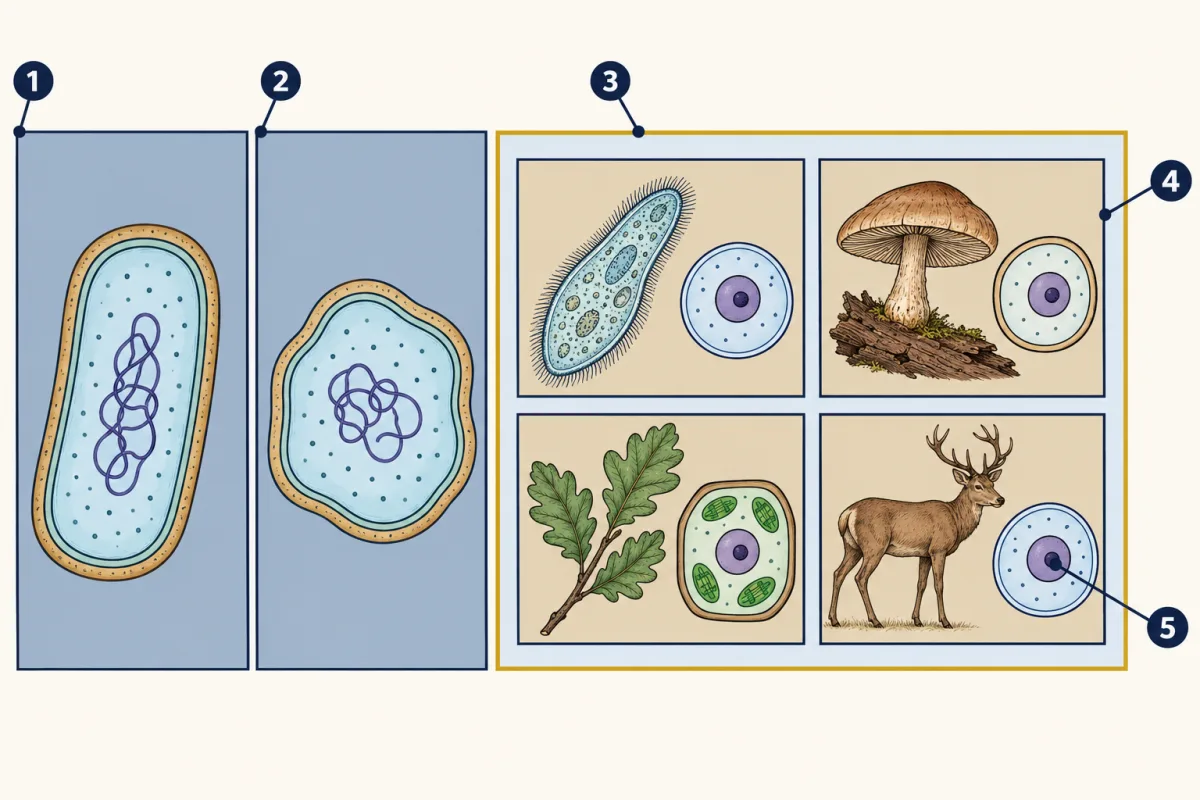
- Bacteria
- Archaea
- Eukarya
- Fungi
- nucleus
-
Explain: new tools bring new evidence
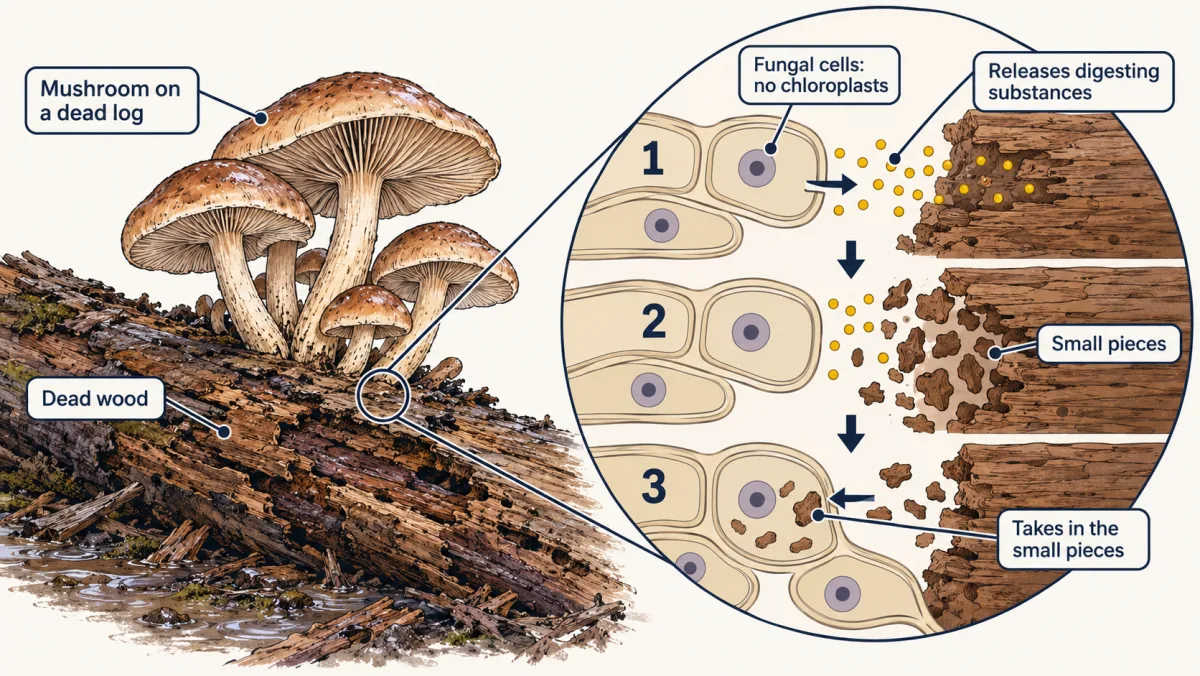
A fungus cannot make sugar from light, so it releases digesting substances outside its cells and takes in the small, dissolved pieces. AI-generated illustration -
Elaborate: compare one protein in five organisms
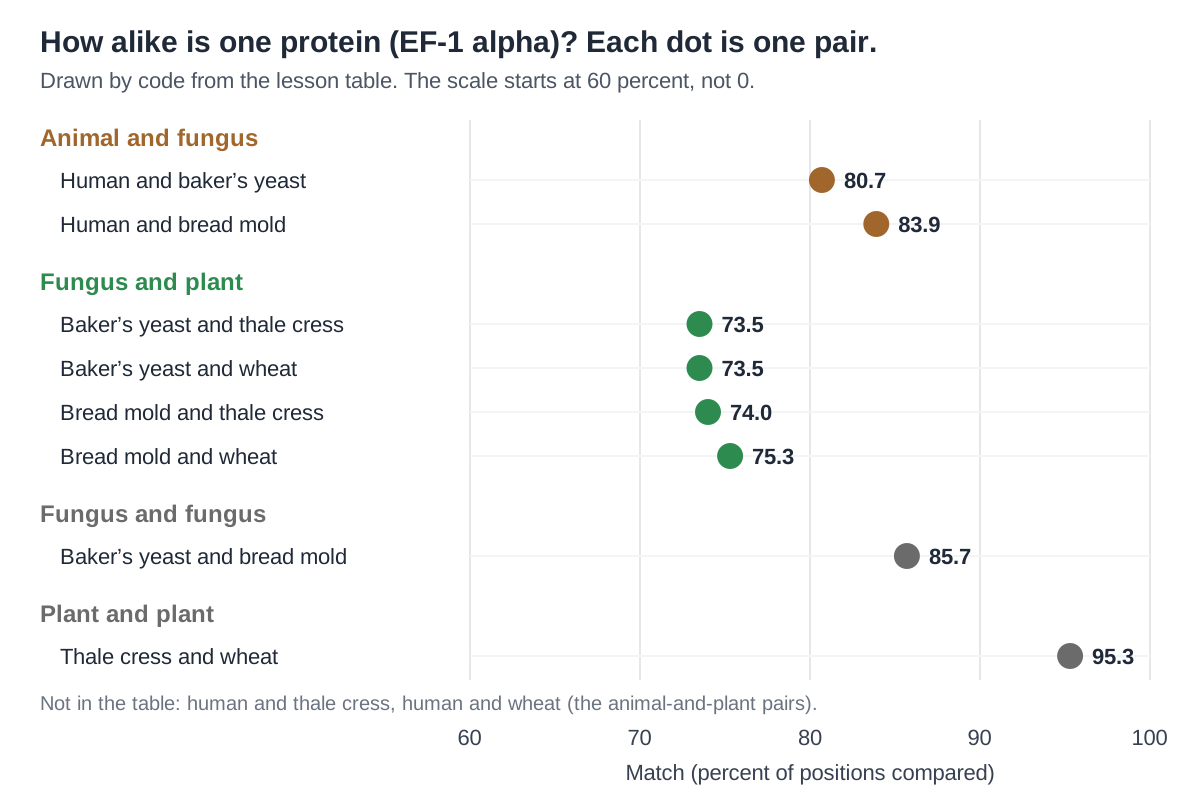
Every animal-and-fungus pair matched EF-1 alpha more closely than every fungus-and-plant pair did, by several percentage points. AI-generated illustration -
Evaluate: check your thinking
-
Going deeper
Where this lesson fits
Before thisReview first
- Sorting Living ThingsThis course · Lesson 7
You need the levels of classification from domain to species and how a key sorts organisms, which this lesson builds on.
- Inside a CellThis course · Lesson 2
The clues here use the nucleus and other cell parts, so you should know what they are.
- Plant Cells and Animal CellsThis course · Lesson 3
You need to know that plant cells have cell walls and chloroplasts while animal cells do not.
After thisStudy next
- DNA: The Code of LifeThis course · Lesson 27
It explains what DNA letters are and how they differ between living things, which these protein comparisons depend on.
- Evidence for Change Over TimeThis course · Lesson 33
It uses shared molecules like proteins as evidence of common ancestry, taking the comparison idea further.
- Mutations and VariationThis course · Lesson 31
It shows how DNA changes build up over time, which is why match counts tell about relatives.
Elsewhere on the siteFilms, simulations and method films in other courses
- The First SplitFilm · Biology
It sorts organisms by a nucleus first, then uses molecular evidence where looks fail.
- Classify the unknownSimulation · Biology
You classify an unknown organism into domains and kingdoms by asking ordered questions.
- Which Similarities Reveal Relatives?Film · Biology
It shows how shared traits point to closest relatives, as with fungi and animals.
Suggested by an AI model from the lessons themselves, then checked. How we use AI