Life Science · Unit 1: Cells
Plant Cells and Animal Cells
Rewritten on : new text, flashcards and film. Your notes and highlights stay, but the text around them may have moved.
Why does a limp stalk of celery get crisp again in water, when drinking water does not make you any stiffer?
Pause when the reading reaches a film, and offer to play it. Saved on this device.
Watch the film now, or keep listening
Builds on:Inside a CellCells Are EverywhereWhy these?
Where this lesson sits
- Virginia SOL LS.2 c
- Practices LS.1 b, LS.1 c, LS.1 e
Essential question: How does a plant stand up without a skeleton, and how are its cells different from mine?
-
Life Science (grade 7) LS.2 c You are here
This lesson
-
Biology
Preview it at high school level
In Biology you will learn that a cell works like a system, with each part passing its product to the next. You will meet three new parts. Ribosomes build proteins. The Golgi apparatus sorts and packs them and sends them on. Lysosomes are small sacs that break down worn-out cell parts. You will follow the instructions for one protein from the nucleus, then the protein itself through the endoplasmic reticulum and the Golgi, to the outside of the cell. You will also compare cells that have a nucleus with bacteria, which do not.
-
Biology II Biology II: Advanced Survey of Biology Topics, BIOII.2 a
Preview where it goes next
In Biology II: Advanced Survey of Biology Topics, the cell is studied as a system of parts that depend on each other: the nucleus, mitochondria making ATP, ribosomes, the endoplasmic reticulum, the Golgi and the cytoskeleton, a set of protein fibres that gives a cell its shape and moves its parts. You also see how a cell’s shape and parts fit its job across many kinds of plant and animal tissue.
-
College
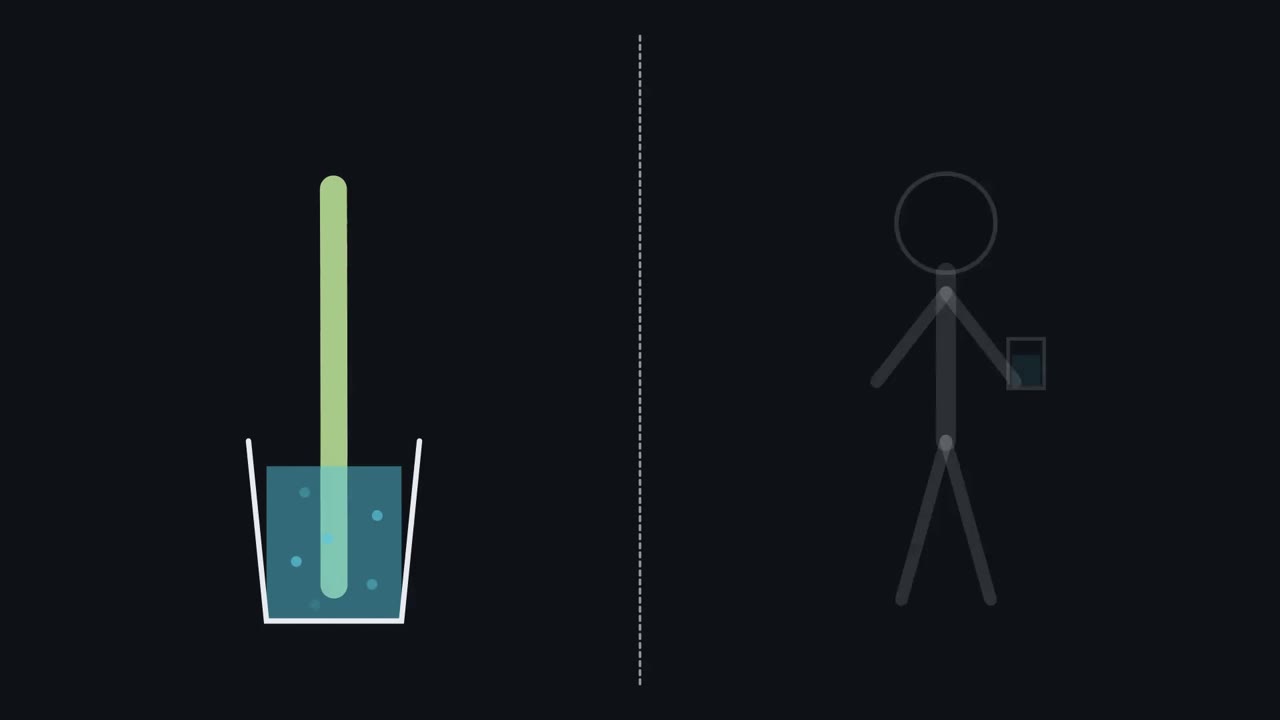 ▶ Watch A Water Balloon in a Box · 3:06
Read the transcript of “A Water Balloon in a Box”
Film transcript: A Water Balloon in a Box
A limp stalk of celery stands in water for a few hours, and it can turn crisp again. You drink water every day and stay just as bendy. What is different about the plant's cells? Start with one of your own cells. A nucleus holds its instructions. A thin cell membrane wraps the cell and controls what goes in and out. Jelly-like cytoplasm fills the inside. A folded network, the endoplasmic reticulum, makes and moves materials.
Mitochondria release energy from sugar. Small sacs called vacuoles store water. A celery cell has this whole kit too. Now we turn your cell into a celery cell, by adding one part at a time. First, a stiff cell wall closes around the outside. The membrane stays, just inside it. Think of the wall as a cardboard box. Second, chloroplasts. In green cells, these food makers capture energy from light to make sugar. Third, one large central vacuole. It is a water tank, and in a full-grown cell it fills most of the space. Now let water flow in. The tank swells. It pushes the cytoplasm and the membrane outward, until the membrane presses into the corners of the box.
The stiff wall pushes back. It holds the rising pressure in, and the cell turns firm. Picture a water balloon filled tight inside a cardboard box. A celery stalk holds many of these firm cells, side by side. Together they hold the stalk up. Now the stalk sits on the counter all day, and it loses water. What happens to the tank, and then to the stalk?
The tank shrinks, so it pushes less. The box is no longer pushed tight. Each cell goes soft, and the stalk goes limp. Put the limp stalk back in water. Water moves into the cells, the tanks fill again, and the stalk can turn crisp.
So why does water not stiffen you? Your cells have the shared kit, but no box. With no stiff wall to push against, water cannot make them firm. Your body is held up a different way. A skeleton of bones does that job. Your body also controls how much water stays inside you. Same shared kit inside, plus a box, a food maker and a water tank. When the tank is full, it pushes the cell out against the stiff box, and a soft plant stands up.
From the film
- Plant and animal cells share most of their working parts, such as the nucleus, cell membrane and cytoplasm.
- Plant cells add three parts: a stiff cell wall, chloroplasts in green cells, and one large central vacuole in most full-grown cells.
- When the central vacuole fills with water, it pushes the cell out against its stiff wall, and the cell becomes firm.
- Many firm cells side by side hold up soft plant parts like a celery stalk.
- Your cells have no wall, so water does not hold you up; your skeleton does.
A cut stalk of celery left out can go limp as it loses water. Put it in water, and it can become crisp again. The first film showed why. This page adds what it left out: how hard a plant cell pushes, why some plant cells are not green, and how big real cells are.
The one idea. Plant and animal cells share most of their working parts. Plant cells add three: a stiff cell wall (the box), chloroplasts in green cells (food makers that use light) and one large central vacuole (the water tank). When the tank is full, it pushes the cell out against the box, the box pushes back, and the cell is firm.
Scope: this describes typical cells. The big tank fills most full-grown plant cells, and a few cells of either kind break the pattern (Going deeper names one). Water pressure holds up soft plant parts, like celery stalks, leaves and young stems. A woody tree trunk stands mainly on thick, hard cell walls. The walls keep holding it up even after the cells inside them die. Your cells have the shared kit but no box, so water does not hold you up; your skeleton does.
One check below uses the micrometre (µm), one thousandth of a millimetre. About 18 human cheek cells laid side by side would span one millimetre on a ruler.
What do you think? Decide before you read.
-
Scientists disagree: Measured cell sizes vary a lot. One study found onion skin cells about 412 micrometres long. Human cheek cells are flat and about 55 micrometres across. A textbook shows one “typical” cell, but real cells come in many shapes.
What scientists think
Scientists disagree: Measured cell sizes vary a lot. One study found onion skin cells about 412 micrometres long. Human cheek cells are flat and about 55 micrometres across. A textbook shows one “typical” cell, but real cells come in many shapes.
-
Scientists disagree: Green plant cells have both. In 2017, scientists put glowing labels on the parts of waterweed leaf cells. The labels lit up chloroplasts, and other labels lit up mitochondria in the same kind of cell.
What scientists think
Scientists disagree: Green plant cells have both. In 2017, scientists put glowing labels on the parts of waterweed leaf cells. The labels lit up chloroplasts, and other labels lit up mitochondria in the same kind of cell.
-
Scientists disagree: Look at an onion. The layers inside the bulb get no light, and their skin cells are not green. Scientists checked onion bulb skin with a microscope and found no developed chloroplasts. These cells are still plant cells with a cell wall.
What scientists think
Scientists disagree: Look at an onion. The layers inside the bulb get no light, and their skin cells are not green. Scientists checked onion bulb skin with a microscope and found no developed chloroplasts. These cells are still plant cells with a cell wall.
Explore: build a cell for a job
Switch a cell wall, chloroplasts and a large central vacuole on or off, and change the water and the light. One bar shows how stiff the cell is; the other, how much food it makes.
Switch on a part to build your cell. Then change the water or the light.
In this sketch, one cell stands for a whole celery stalk. The bars are relative units, not measurements. Stiffness is 10 times the water supply when the cell has a wall and a large central vacuole, and 0 otherwise (a simple rule for this sketch, not a measurement). The food bar checks chloroplasts, light and water. Carbon dioxide is not shown.
Rule to keep: a full vacuole presses on a stiff cell wall and keeps a plant firm, and chloroplasts need light to make food.
Try this.
- What if the box is there but the tank is not? Switch on the wall and the chloroplasts, keep the water high and leave the large central vacuole off. Predict the stiffness bar, then test it.
- Predict what happens to the cell’s shape if you switch off the cell wall. Then test it, and watch the outline.
- Turn the light off but keep the chloroplasts on. Predict the food bar. Then switch the chloroplasts off with the light on, and compare.
Explain: the parts all these cells share
- organelle
- nucleus
- cell membrane
- cytoplasm
- endoplasmic reticulum
- mitochondria
- vacuole
- cell wall
- chloroplast
- central vacuole
An organelle is a small part inside a cell with its own jobs; you met them in that lesson. The shared parts:
- The nucleus holds the cell’s DNA, its instructions, and controls what the cell does.
- The cell membrane is a thin outer layer that controls what goes in and out.
- The cytoplasm is the jelly-like part between the membrane and the nucleus.
- The endoplasmic reticulum is a folded network of membranes that helps make and move materials.
- The mitochondria release energy from sugar (glucose) in a form the cell can use.
- A vacuole is a sac that stores water and other materials. Animal cells usually have only small ones, if any.
Explain: three parts plants add
| Part | Job | Plant cells | Animal cells |
|---|---|---|---|
| Cell wall | Supports and protects the cell | Yes, outside the membrane | No |
| Chloroplasts | Capture radiant energy to make food | In green cells | No |
| Large central vacuole | Stores water; when full, pushes the cell out against the wall | Yes, in most full-grown (mature) cells | Usually no; most have only small vacuoles, if any |
The cell wall is a stiff layer outside the cell membrane that supports and protects the cell. It contains a tough material called cellulose, along with other sugar-based materials.
A chloroplast is a green organelle that captures radiant energy, the energy in light. It uses that energy to make sugar (glucose) from carbon dioxide and water; you will study this in that lesson. Plant cells have mitochondria too, so they can release energy from that sugar, day and night.
The first film showed a full central vacuole pushing its cell against the wall, but not how hard.
Predict. Does a full plant cell push out against its wall harder than the air in a blown-up party balloon pushes on the balloon, or more gently?
Check your prediction
Far harder. Scientists pushed a very fine probe into single onion skin cells and measured about three times the extra pressure pumped into a car tyre, a tyre too hard to squeeze with your hand. A party balloon could never push that hard without bursting; the plant cell can because the wall holds it in.
Water moves into and out of a cell, across its membrane, by osmosis, which you will study in that lesson.
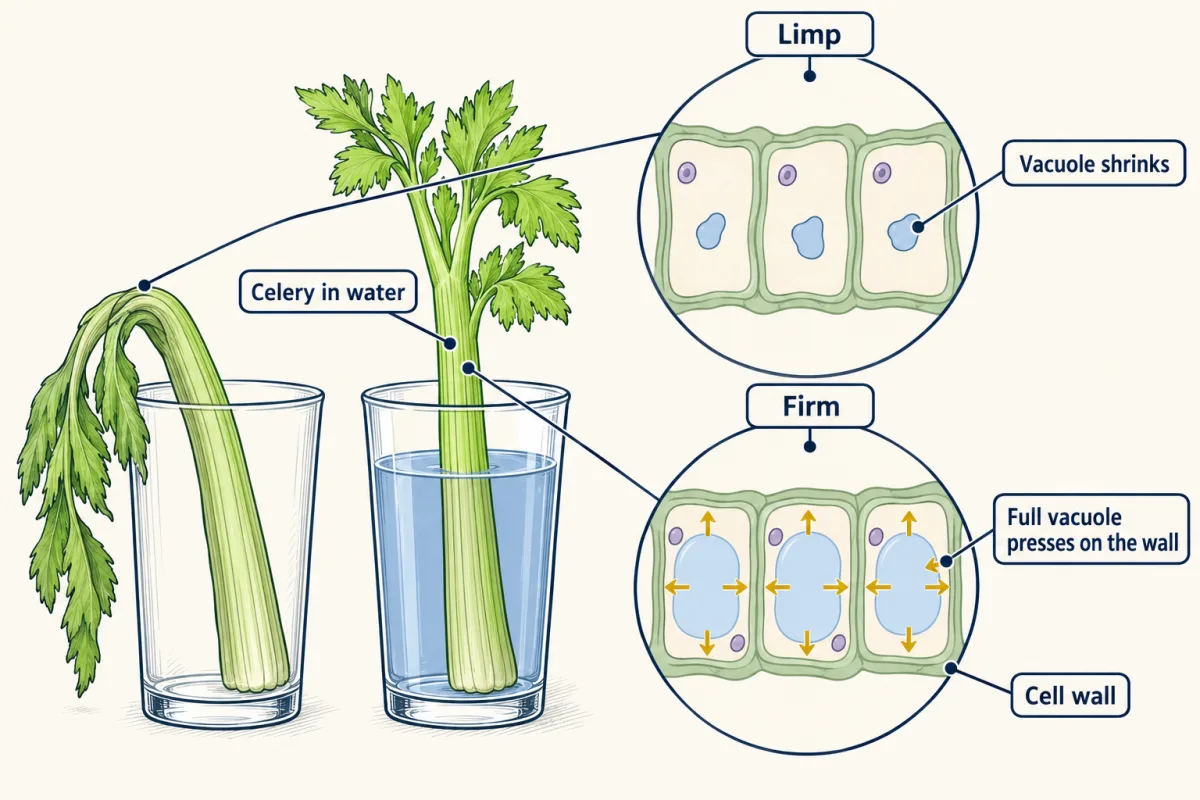
The balloon-in-a-box model has limits. A real wall can stretch a little, and water moves in and out of a cell all the time.
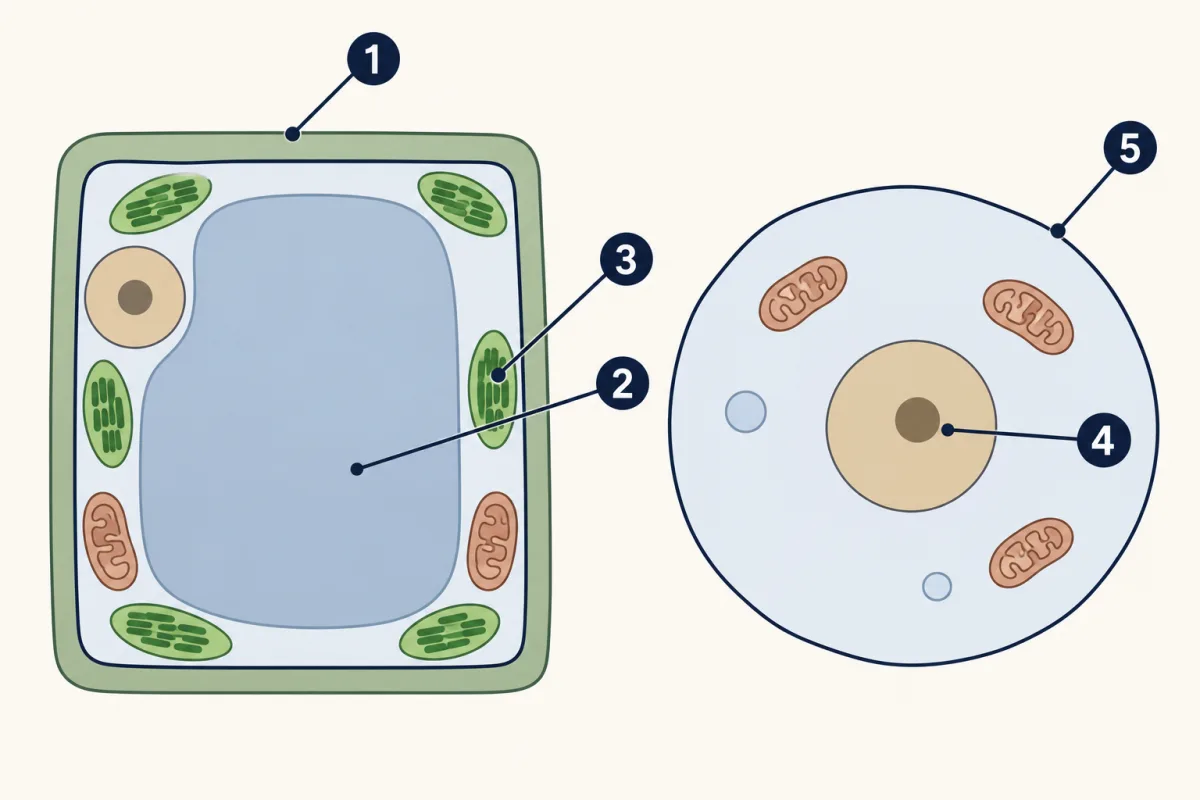
- cell wall
- large central vacuole
- chloroplast
- nucleus
- cell membrane
- cell wall
- blank
- blank
- nucleus
- blank
Word bank: cell membrane, chloroplast, large central vacuole
- blank
- blank
- blank
- blank
- blank
Check your labels
- cell wall
- large central vacuole
- chloroplast
- nucleus
- cell membrane
Elaborate: look at real cells
The second film checks the model’s parts (the box, the chloroplasts and the tank) in real onion, waterweed and cheek cells under a microscope, and shows a way to measure them.
Read the transcript of “Looking at Real Cells”
Film transcript: Looking at Real Cells
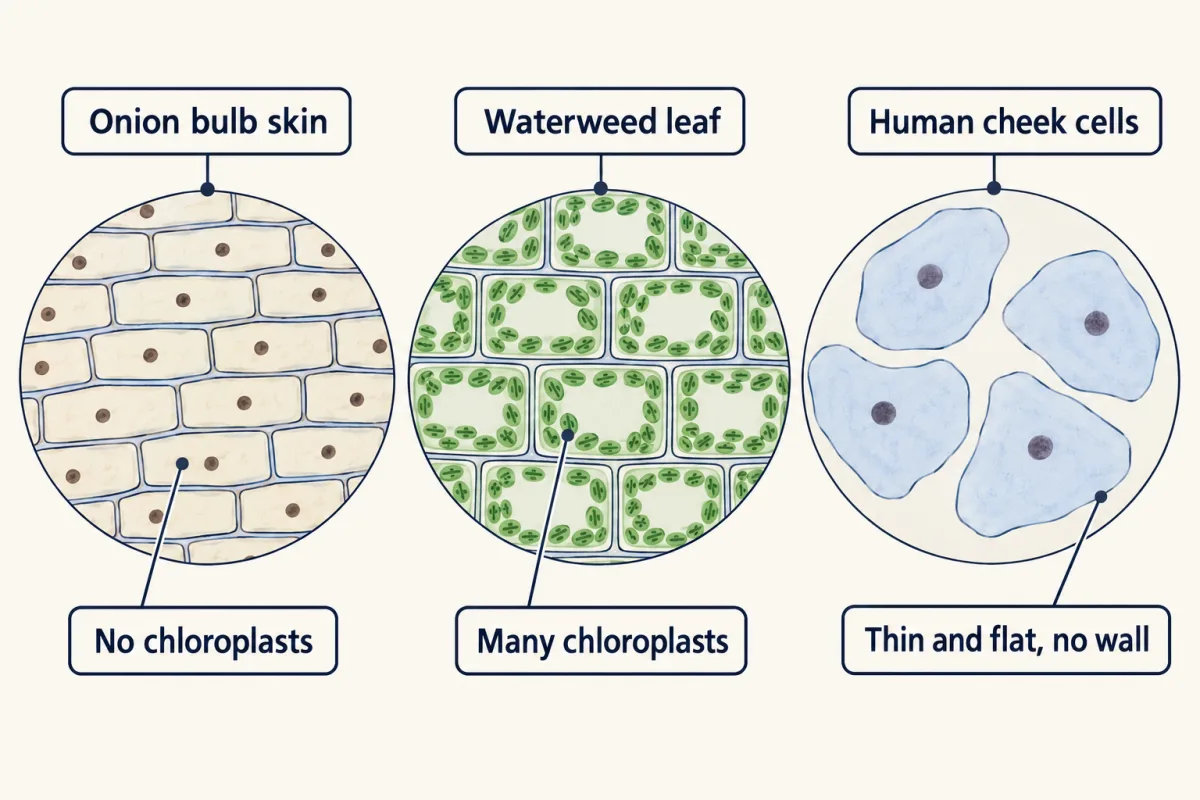
Everything in the first film was a drawing: a kit, a box and a water tank. How do we know a real plant cell has a box? And how big is one? A real celery cell is too small to see with your eyes alone. To check the model's parts, you need a light microscope and a way to measure. First, make a wet mount. A thin piece of onion skin sits in a drop of iodine stain, under a thin glass cover slip. Light passes up through the thin layer. Through the eyepiece, you see a round circle of light. Inside it, onion skin cells sit side by side, like long boxes. The stain makes each nucleus look darker. Notice what is missing. These onion cells are not green. They have walls, but no developed chloroplasts.
Now a waterweed leaf, mounted in a drop of water. Its cells are boxy too, and most are packed with green chloroplasts. Last, a few cells from the inside of a cheek, colored with a blue stain. They have no box. They are thin and flat, like tiles on a floor. So the box is real. The plant cells show straight walls. The cheek cells show only a thin outline, with no wall. Now, how big? Scientists measure cells in micrometres. The screen shows how small one micrometre is.
Scientists use a tiny ruler inside the eyepiece. In class, you can use the circle of light itself. Count similar cells lying end to end across it. Then divide the circle's width by that count. That gives a rough average width for one cell. Try a made-up class example with cheek cells. The circle's width and the cell count are on the screen. About how wide is one cell?
Divide, and the answer is on the screen. One published study measured cheek cells at nearly the same width. A rough count lands close. One more surprise. Scientists found small clusters of colorless cells inside green waterweed leaves. These cells had no chloroplasts. A dye still lit up a large central vacuole inside them. So even in one green leaf, not every plant cell is green. Look and measure. The box is real, and so are the green chloroplasts and the water tank. But only some plant cells are green, and cells come in many shapes and sizes.
From the film
- Under a light microscope, onion skin and waterweed leaf cells look boxy, with straight walls.
- Cheek cells have no wall and are thin and flat, like tiles.
- For a rough size, count similar cells lying end to end across the circle of light, then divide the circle's width by that count to get their average width.
- Not every plant cell is green: onion bulb skin cells and some waterweed leaf cells have no chloroplasts.
Predict. Most of a plant’s roots grow in dark soil. Do you expect most root cells to have chloroplasts?
Check your prediction
Usually not. A cell’s parts most often fit its job, and a chloroplast’s job needs light. Cells that get no light, like most root cells and onion bulb cells, usually have no chloroplasts. They still have a wall, and mitochondria to release energy from sugar.
But light is not the whole story: the second film’s colorless waterweed cells sat inside a green leaf. Shape fits too: the wall gives plant cells straight sides, while animal cells are often rounder or flatter.
- A plant cell can stand firm because blank presses on blank.
- A leaf cell has chloroplasts, but an onion bulb cell does not, because blank.
- My cells do not need a cell wall because blank.
Measure real cells
Scientists measured these seven kinds of cell in different studies. “Not reported” means a study did not give the number.
| Cell | Plant or animal | Length (µm) | Width or diameter (µm) | Parts seen |
|---|---|---|---|---|
| Onion bulb skin | Plant | 412 | 55 wide | Nucleus with iodine; no chloroplasts |
| Waterweed leaf, normal | Plant | about 150 | about 50 | Chloroplasts (tens to hundreds); large central vacuole with a dye |
| Waterweed leaf, colorless cell | Plant | most 60 to 200 | not reported | No chloroplasts; large central vacuole with a dye |
| Potato storage cell (from the part you eat) | Plant | not reported | 212 (diameter) | Cell wall with a dye |
| Guard cell (one of two around a leaf pore; Arabidopsis, a small lab plant) | Plant | 20 | 9 | Not reported |
| Human cheek cell | Animal | not reported | 55 (diameter) | Nucleus, 9 µm across, with a stain |
| Human red blood cell | Animal | not reported | 7.7 (diameter) | No nucleus |
Each study used its own method, and most values are averages, not fixed sizes for every cell. Sources are under Going deeper.
- Which cell in the table is the largest across? Which is the smallest?
- The cheek cell and the onion cell have about the same width. How many times longer is the onion cell than it is wide?
- Which rows show that not every plant cell has chloroplasts?
Claim, evidence, reasoning
Make a claim that answers the essential question: how are plant cells different from your cells? Use this data.
Start with: The data show that plant cells blank, while animal cells blank.
Start with: The onion cell was blank µm long, but the cheek cell was blank µm across. The blank cells had no chloroplasts.
Start with: This matters because a cell wall and a full vacuole blank, while my body is held up by blank.
Compare with a model answer
Plant and animal cells differ in their parts, and often in shape. The onion skin cell was about 412 µm long and 55 µm wide, a long box. The cheek cell was flat and about 55 µm across. Size alone does not tell them apart: the plant guard cell, 20 µm long, is smaller than the cheek cell. In the table, the potato cells had walls and the waterweed cells had large central vacuoles. Walls with full vacuoles hold a plant firm. But not every plant cell had chloroplasts: the onion cell and the colorless waterweed cells had none. One limit: the values come from several studies that used different methods, and some measured only a few cells or a few people.
Saved in this browser only.
Design problem
Does the amount of water change how firm celery gets? Plan an investigation you could do in class. Name your question, variables, constants, control, trials, measurements and safety steps.
Saved in this browser only.
One way to do it
- Question: Does limp celery get firmer when it stands in water than when it stands in an empty cup?
- Independent variable: water or no water in the cup.
- Dependent variable: how far each stalk bends. Clamp the thick end to a table edge, hang a 20-gram mass on the thin end, and measure the bend in centimetres with a ruler.
- Constants: all stalks left out on a counter for a day first so they start limp; stalks from the same bunch, cut to the same length (15 cm), same room, same time.
- Control: stalks in empty cups, measured the same way.
- Trials: at least five stalks in each group. Measure each one at the start and after 3 hours. Find the mean bend for each group.
- Safety: your teacher cuts the stalks. Wipe up spills. Do not eat lab celery.
Evaluate: check your thinking
Back to the celery: the first film’s tanks and boxes answer it, and your skeleton, not water pressure, holds you up.
Science practices you used: planning a fair test with a control, reading and comparing measurements in a table, and using a model and saying how it differs from a real cell.
Going deeper
More about the parts
Young plant cells, such as those near the tips of roots, have smaller vacuoles that grow as the cell grows. Scientists call the water pressure inside a plant cell turgor pressure. Most plant and animal cells have a nucleus, but a few do not: mature red blood cells in mammals have none, as the table shows.
Sources for the cell measurements
Onion: Przedpelska-Wasowicz and Wierzbicka, 2011 (6 cells), with the iodine-stained nucleus from an Ohio State University teaching page and the missing chloroplasts from Osaki and Kodama, 2017; waterweed (Egeria densa), Osaki and Kodama, 2017, and Hara and colleagues, 2015; potato, Gibson’s 2012 review (the wall dye is from Biswas and Barma, 2020); cheek, Prasad and colleagues, 2010 (five adults, 50 cells each); guard cell and red blood cell, the BioNumbers database.
Your notes
Select any text in the lesson to highlight it or add a note to it. Your highlights and notes are saved in this browser and collected in your notebook.
This browser is not letting the site save anything (a private window or strict privacy settings), so highlights and notes will be lost when you leave the page.
How we measure it
Light microscope and wet mount
A thin piece of a plant or a few cheek cells sit in a drop of water or stain under a cover slip, and light passes through them. You see each cell’s outline and some of its parts, so you can compare plant and animal cells side by side.
Stains
Iodine stain darkens the nucleus in onion skin, and methylene blue colors cheek cells. A stain shows parts that are hard to see, so a part you cannot see may still be there.
Measuring cells with the field of view
If you know how wide the circle of light is, count similar cells lying end to end across it and divide the circle’s width by that count. That gives a rough average width, not the size of any one cell. Scientists use a tiny ruler inside the eyepiece, called a micrometer, to measure each cell in micrometres.
Where this lesson fits
Before thisReview first
- Inside a CellThis course · Lesson 2
You need the organelles and their jobs from there, since this lesson compares those parts between plant and animal cells.
- Cells Are EverywhereThis course · Lesson 1
It shows that living things are made of cells, which this lesson compares between plants and animals.
After thisStudy next
- Diffusion and OsmosisThis course · Lesson 5
It explains how water crosses a membrane, which is what fills and empties a plant cell's central vacuole.
- Photosynthesis Feeds the WorldThis course · Lesson 9
It shows how chloroplasts use light to make sugar, the job introduced here.
- Crossing the MembraneOne level up · Biology
It takes water movement across a membrane further, explaining why a cell in salty or plain water goes limp or firm.
Elsewhere on the siteFilms, simulations and method films in other courses
- Set Up: Thirsty CeleryFilm · Biology Together
It shows water traveling up a celery stalk, the same celery that gets crisp in this lesson.
Suggested by an AI model from the lessons themselves, then checked. How we use AI
Finish line
Test yourself
8 questions
Practice and MCAT-style, with explained answers.
Next · Lesson 4
How Cells Divide
When you scrape your knee, where does the new skin come from?
Continue →