Life Science · Unit 8: Change over time
Mutations and Variation
Rewritten on : new text, flashcards and film. Your notes and highlights stay, but the text around them may have moved.
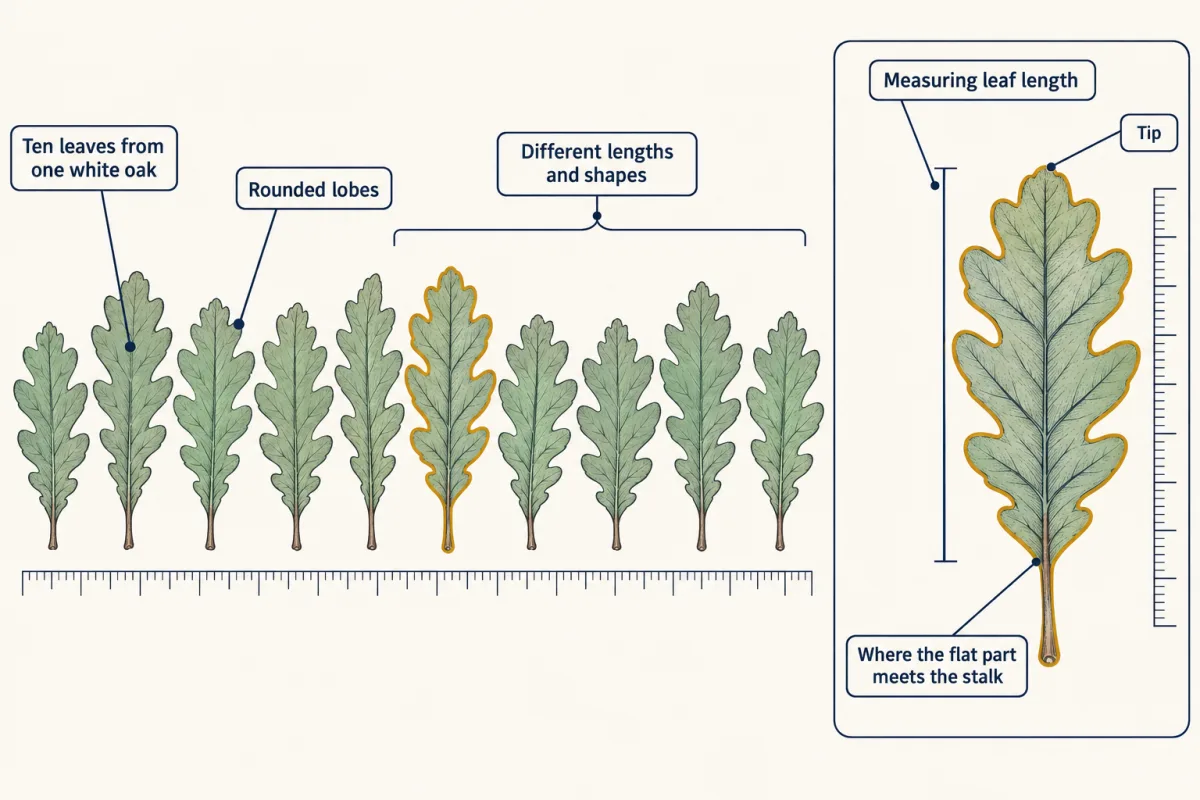
Ten leaves grew on one white oak and share rounded lobes. Why do their sizes and shapes still differ?
Pause when the reading reaches a film, and offer to play it. Saved on this device.
Watch the film now, or keep listening
Builds on:DNA: The Code of LifeReproduction and MeiosisInherited or Acquired?Why these?
Where this lesson sits
- Virginia SOL LS.11 a
- Virginia SOL LS.11 c
- Practices LS.1 b, LS.1 c, LS.1 d, LS.1 e
Essential question: Why is no living thing exactly like another, and are all mutations bad?
-
Life Science (grade 7) LS.11 a, LS.11 c You are here
This lesson
-
Biology
Preview it at high school level
In Biology you will learn more ways a population gets its variation. Mutation makes new alleles. Gene flow brings alleles in when animals or pollen move from one population to another. Meiosis and fertilization shuffle alleles into new mixes. You will also learn that populations make more young than the environment can support, so many die before they reproduce. Individuals whose variations suit the conditions leave more young. You will measure this with real survival data, such as counts of tuskless elephants before and after years of ivory poaching.
-
Biology II Biology II: Advanced Survey of Biology Topics, BIOII.5 a and b; Ecology, EC.5 c
Preview where it goes next
In Biology II: Advanced Survey of Biology Topics, you name selective pressures, such as predators, disease, climate and hunting, and connect a changing environment to changes in how common each allele is in a population. You also see why a population with more variation is more likely to have some members that survive a change. The Ecology course looks at how populations grow, what limits them, and how the way a species reproduces shapes which young survive.
-
College
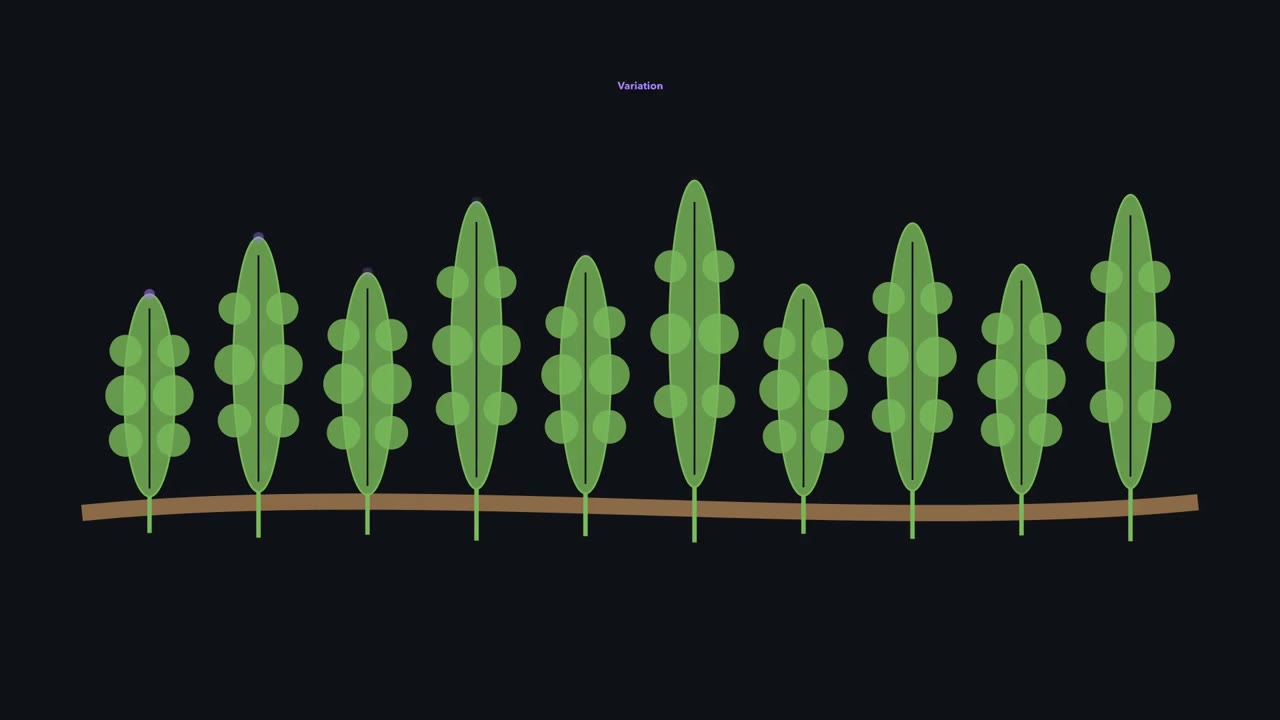 ▶ Watch Where Differences Begin · 3:36
Read the transcript of “Where Differences Begin”
Film transcript: Where Differences Begin
Ten leaves grew on the same oak. Why do they share rounded lobes but differ in size and shape? Their story begins with variation. Look closely as each leaf settles beside the ruler. A trait is a feature, like leaf shape or height. A population is a group of the same kind of living thing in one area. Variation means differences among its members.
Shared traits and differences can exist at the same time. Two routes shape many traits. Blue inherited information comes from parents. Green environmental conditions include food, health, sunlight, and water. The routes often act together. For many traits, both matter. Height shows both routes. Many genes contribute to height.
Food and health during childhood matter too. Similar inherited information does not guarantee exactly the same height. A height bar is not a prediction for one person. Sexual reproduction reshuffles alleles already present in the parents. Picture blue cards dealt into new hands. The combinations are new, but the cards already existed. Siblings can receive different mixes from the same parents. Mutation adds a different route. A mutation changes the DNA sequence, the order of its bases. That change can make a new allele. It may change a protein, its amount, or neither. Copying mistakes, radiation, or some chemicals can cause mutations. The change does not appear because a living thing needs its effect.
Need sends no instructions backward. More exposure can raise chance without choosing the result. Now predict. Two children inherit very similar height alleles, but their food and health differ. Must they reach exactly the same height? Hold your answer. Watch both coloured routes before you decide.
No. Genes and environment act together, so different conditions can lead to different heights. This does not prove which route caused any one person's height. The picture shows a possibility, not that child's history. In animals that reproduce with eggs and sperm, location also matters. A mutation in a body cell stays in that body. A mutation in an egg or sperm can reach offspring. The path, not usefulness, decides whether inheritance is possible. Follow the full picture.
Shared traits can vary. Inherited information and environment shape that variation. Chance mutation can add a new genetic difference. This rule does not make every visible difference inherited. A new difference still has no fixed label. Next, ask whether its effect changes when the surroundings change. That is the second film's puzzle.
From the film
- Genes and environments shape variation; chance mutations add new genetic differences.
- Variation means the differences among members of a population.
- Sexual reproduction reshuffles existing alleles; mutation can make a new allele.
- In animals that reproduce with eggs and sperm, a sex-cell mutation can reach offspring, but a body-cell mutation cannot.
A trait is a feature such as colour, shape or height. A population is a group of the same kind of living thing in one area. Variation means differences among its members. Your class is like the oak leaves: everyone has two hands and one nose, yet heights and hair differ.
The one idea: Genes and environments shape variation; chance mutations add new genetic differences. A mutation’s effect depends on the change and often on its environment.
Scope: This rule describes variation within a population. Not every difference is inherited or visible. The effect can also depend on the living thing that carries the mutation. “Chance” means a mutation does not happen because a living thing needs its effect. The body-cell and sex-cell rule is for animals that reproduce with eggs and sperm.
What do you think? Decide before you read.
-
Scientists disagree: A mutation can help, harm or make no difference. Scientists have found DNA changes that let some adults keep digesting milk sugar, and others that let bacteria grow with an antibiotic. They compare DNA with traits in many people and test bacteria in the lab.
What scientists think
Scientists disagree: A mutation can help, harm or make no difference. Scientists have found DNA changes that let some adults keep digesting milk sugar, and others that let bacteria grow with an antibiotic. They compare DNA with traits in many people and test bacteria in the lab.
-
Scientists disagree: Only changes in sex cells, the eggs and sperm, can reach a child. Scientists have found mutated patches of skin cells in people without skin cancer, more often in sun-exposed skin. Those changes stay in the skin and are not inherited.
What scientists think
Scientists disagree: Only changes in sex cells, the eggs and sperm, can reach a child. Scientists have found mutated patches of skin cells in people without skin cancer, more often in sun-exposed skin. Those changes stay in the skin and are not inherited.
-
Scientists disagree: Some mammals change their coat with the seasons, but that is their existing genes responding to the season. New genetic variations arise by chance, not because they are needed. In a 1943 experiment, bacteria that could resist a virus were already there before the virus was added.
What scientists think
Scientists disagree: Some mammals change their coat with the seasons, but that is their existing genes responding to the season. New genetic variations arise by chance, not because they are needed. In a 1943 experiment, bacteria that could resist a virus were already there before the virus was added.
Explore: test where a new difference goes
In this model, 30 beetles vary in body colour and size. You set how often mutations happen (high stands for more radiation or chemicals). You also choose whether they happen in a body cell or a sex cell. Then press “Next generation” and watch the colour counts.
- ring: a new mutation in this generation
- small dot: a patch of body cells with a new colour
Made up for this sketch, not measured: one gene sets body colour, and a mutation turns a beetle’s colour into one of the other four at random. Low, medium and high mean about 1 in 20, 1 in 8 and 1 in 4 new beetles get a mutation. On the background shown, helpful beetles survive 9 times in 10, harmful 4 in 10, and neutral ones 7 in 10, the same chance as the starting colour, green. Which colour is helpful, harmful or neutral on each background is also made up. Survivors have young at random, with no mates. Size varies at random and does not change survival. A patch does not change survival either.
Rule to keep: mutations arise by chance, a mutation does not “know” whether it will help, only a mutation in a sex cell can pass to young, and whether a colour helps depends on where the beetle lives. This is a sketch of the logic, not a measurement.
Predict 1. With the mutation rate at medium, will a new colour first appear in the same place every run?
Test your prediction
Run the model three times and record the first new colour. Runs can differ because the model places mutations by chance.
Next, predict what a body-cell mutation does at the next generation, then try a sex-cell mutation and watch the bar graph. Last, change the background and predict whether a helpful colour stays helpful; check the tags.
Two sources shape many traits
- trait
- population
- variation
- mutation
- body cells
- sex cells
- random
The first film named the two routes. Inherited variation comes from alleles passed from parents and reshuffled when sex cells form and join (Reproduction and Meiosis). Environmental variation comes from different conditions and experiences as an organism grows and lives. Height uses both: many genes, plus childhood food and health. You can sort traits by route in Inherited or Acquired?.
The oak leaves add a source the first film left out: chance during growth.
Mutation adds a new genetic difference
A mutation is a change in the DNA sequence, the order of the bases. Reshuffling mixes alleles the parents already have. A mutation can make a new allele. Recall from DNA: The Code of Life that many genes carry the code for a protein. So a mutation can change that protein or how much of it a cell makes. Sometimes the protein works the same as before.
Causes include copying mistakes before a cell divides, radiation such as ultraviolet light from the Sun, and some chemicals.
Mutations are random: they happen by chance, not because a living thing needs their effect.
In animals, location controls inheritance
As the first film showed, in people and other animals a body-cell mutation stays in that one body, but a sex-cell mutation can be passed to offspring. Body cells are all the cells of the body except eggs, sperm and the cells that make them, such as skin, muscle and bone cells. Sex cells are eggs and sperm. Bacteria and plants use other routes (see Going deeper).
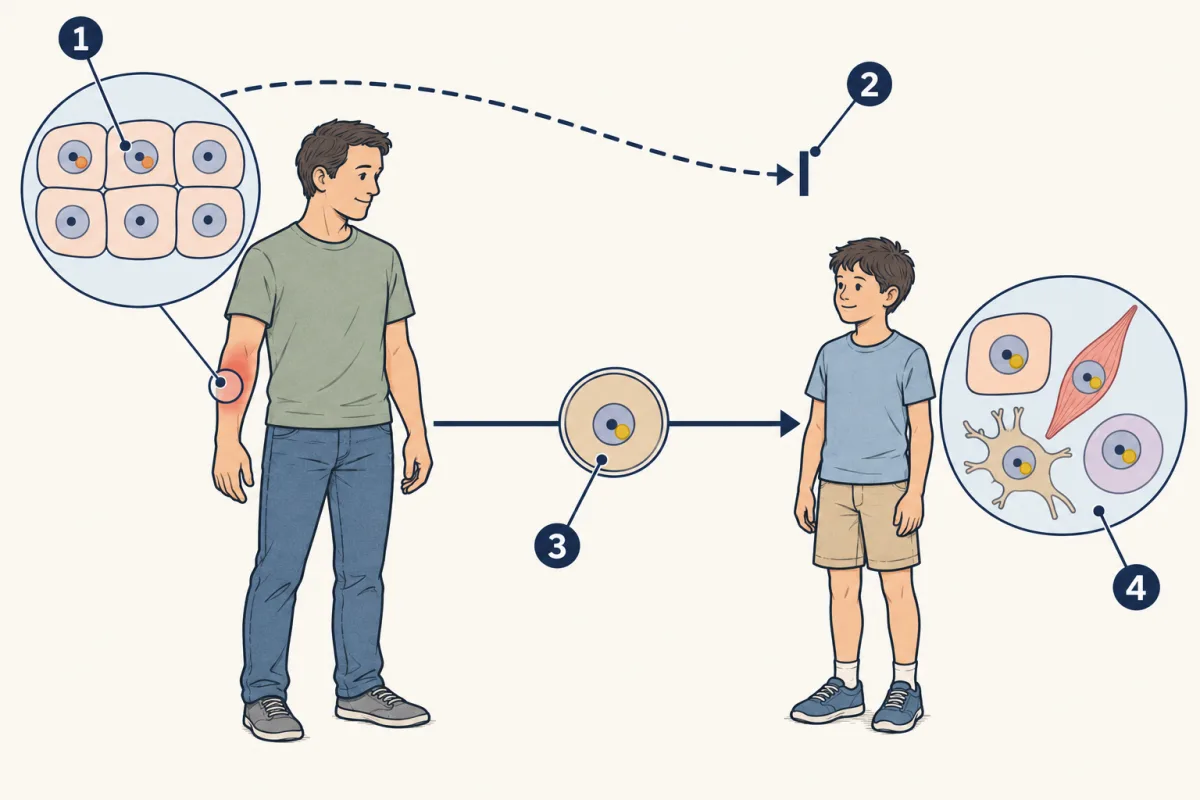
- skin cell with a mutation
- the mutation stays in the parent
- sex cell with a different mutation
- the child carries the sex-cell mutation in every cell
- skin cell with a mutation
- blank
- blank
- blank
Word bank: sex cell with a different mutation, the child carries the sex-cell mutation in every cell, the mutation stays in the parent
- blank
- blank
- blank
- blank
Check your labels
- skin cell with a mutation
- the mutation stays in the parent
- sex cell with a different mutation
- the child carries the sex-cell mutation in every cell
Where a mutation goes does not tell us what it does. The second film asks that next.
Read the transcript of “When a Mutation Matters”
Film transcript: When a Mutation Matters
The first film showed how a new genetic difference can begin. How can one mutation help in one setting but not another? Follow its effect. Keep the DNA fixed while the world moves around it. A mutation does not come with a fixed label. Its effect depends on the change, and often on its environment. Start with colour. A label only makes sense beside a measured outcome. Place the beetle on a matching background. It is harder to notice there. Slide the same beetle onto a contrasting background. It becomes easier to notice. The model shows a possible effect, not a promised outcome. The DNA did not change during that move. The environment changed.
A colour that affects survival one way here may act differently there. That separation is the key test. Predict before the next move. If the background changes again, must the beetle's DNA change before the colour's effect changes? Hold your answer. Keep your eyes on the locked gold marker.
No. Keep the mutation fixed and change only the setting. The effect can change because survival and reproduction happen in an environment, not outside one. The same change now meets different conditions. Many mutations change little that matters for survival. Some harm how a protein works. A few can help under particular conditions. These are outcomes, not intentions. A mutation can also change how much protein a cell makes. Bacteria make the same point. One mutation can allow growth with an antibiotic. Yet with different food, which mutant grows best can change. Food and the drug are both parts of the environment. Human examples differ too.
Continued lactase production can help where adults drink milk. A dry-earwax change has no survival effect shown in this lesson's evidence. These cases test different traits under different conditions. Effect and inheritance are separate questions. In animals that reproduce with eggs and sperm, a helpful body-cell mutation still cannot reach offspring. A sex-cell mutation can pass without being helpful. Usefulness cannot open a blocked inheritance route. So do not judge a mutation from its name alone.
Compare the changed trait, the environment, survival, and reproduction. Evidence decides the effect in that setting. Without those comparisons, the label is only a guess. The tables below give that evidence. Use them to separate what changed from the conditions in which scientists tested it. The text also gives limits that this picture cannot carry.
From the film
- A mutation's effect depends on the change and often on its environment.
- A mutation can help, harm or make no difference. Many make little difference, some harm, and a few help.
- A helpful effect in one setting may not be helpful in another.
- Whether a mutation helps does not decide whether it can be inherited.
Helpful, harmful or neither: test the claim
A mutation is like a misprint in a recipe. Many misprints change little, some spoil the dish, and a few make it better, perhaps only in one kitchen. The comparison stops there: a recipe has a writer, but no one chooses a mutation.
Mutations are the source of new genetic variation. Heredity passes it from parents to offspring, so offspring resemble their parents. That variation may or may not help an individual survive and reproduce. Individuals that happen to carry a helpful variation are more likely to survive and pass it on (Natural Selection in Action). Over many generations, natural selection and chance act on that variation, and this helps produce the diversity of life.
Read the evidence: height
The table gives reference heights for children just over 12. A 25th-percentile height means about 25 percent of children in the reference were that height or shorter. These are CDC values from U.S. surveys, not seven measured children.
| Percentile | Boys’ height (cm) | Girls’ height (cm) |
|---|---|---|
| 5th | 137.3 | 139.2 |
| 10th | 139.9 | 142.0 |
| 25th | 144.3 | 146.5 |
| 50th | 149.3 | 151.5 |
| 75th | 154.4 | 156.4 |
| 90th | 159.0 | 160.8 |
| 95th | 161.9 | 163.5 |
For boys, subtract the 5th-percentile height from the 95th-percentile height:
161.9 cm − 137.3 cm = 24.6 cm
This is how widely the middle 90 percent of boys in the reference spread. It does not explain one child’s height.
Predict 2. Is the girls’ 5th-to-95th-percentile spread greater than, less than or equal to 24.6 centimetres?
Calculate and check
163.5 − 139.2 = 24.3 centimetres, which is 0.3 centimetres smaller.
Predict 3. At the 50th percentile, which reference height is greater, and by how much?
Calculate and check
151.5 − 149.3 = 2.2 centimetres, with the girls’ value greater.
Read the evidence: mutation effects
| DNA change | Living thing | What it does | Effect |
|---|---|---|---|
| Keeps adults making lactase, a milk-digesting protein | People in East Africa | Adults can digest milk sugar | Helpful where people drink milk |
| Change in one bacterial gene | E. coli bacteria in a lab | Bacteria grow with the antibiotic rifampicin | Helpful to bacteria with the drug |
| Loss of a protein needed for dark colour | Cane toads in captivity, gene-edited | Albino toads competed and fed worse | Harmful |
| Change in one gene | People | Dry earwax instead of wet | No survival effect shown |
| Sun-linked change in skin cells | People | Small patches of mutated skin cells | Body cells only; not inherited |
In the bacteria study, which mutant grew best changed when the food changed. Sources are under Going deeper.
- Which rows name an environment in which the change is helpful?
- Which row gives no survival effect shown?
- Which row shows a mutation that cannot be inherited from those cells?
Predict 4. In a made-up class experiment, five dishes have resistant-colony counts of 0, 0, 7, 0 and 1 after an antibiotic is added. Does that uneven pattern fit mutations that arose by chance before the drug? Or does it fit the idea that the drug caused the needed mutations? That would give similar small counts in every dish.
Check your prediction
It fits chance mutations before the drug. An early change can leave many resistant descendants in one dish, while another dish gets none. Real tests use more dishes.
- The heights vary from blank cm to blank cm, which shows blank.
- The blank mutation was helpful because blank, but the blank mutation was harmful because blank.
Claim, evidence, reasoning
Make a claim that answers the essential question: why is no living thing exactly like another, and are all mutations bad?
Start with: Living things vary because blank, and mutations are blank.
Start with: For boys, height ranged from blank cm at the 5th percentile to blank cm at the 95th. The table shows blank.
Start with: This variation matters because blank, and a mutation's effect depends on blank.
Compare with a model answer
Living things vary because of their genes and their environment, and mutations are not all bad. For 12-year-old boys, height runs from 137.3 cm at the 5th percentile to 161.9 cm at the 95th, a spread of 24.6 cm. The mutation table shows a helpful change (lactase in adults who drink milk), a harmful one (albino toads) and one with no survival effect shown (earwax). A DNA change can alter a protein, and whether that helps depends on the environment, as lactase helps only where people drink milk. A limit: the height values are U.S. reference values from surveys taken decades ago, and five mutations are a tiny sample of all mutations.
Saved in this browser only.
Design problem
Plan a study of how much white oak leaves vary. Do leaves from the sunny side of one tree differ in length from leaves on the shady side?
Predict 5. Before collecting data, can you know whether the sunny-side leaves will be longer or shorter?
Saved in this browser only.
Check your prediction
No. The environment may affect growth, but measurements must show the direction.
One way to do it
- Question: Are oak leaves from the sunny side of a tree longer or shorter than leaves from the shady side?
- Independent variable: the side of the tree, sunny or shady.
- Dependent variable: leaf length in centimetres, measured from where the flat part of the leaf meets the stalk to the tip.
- Constants: one tree, leaves collected on the same day, the same ruler and the same start and end points.
- Control: comparing the two sides of the same tree, so the tree’s genes are the same.
- Repeated trials: pick 20 leaves from low branches on each side, then repeat with a second tree.
- Safety: pick leaves only from branches you can reach from the ground, wash hands afterwards, and never climb the tree.
If one side’s leaves are clearly longer, the environment affects leaf length. The spread within each side shows variation even with the same genes.
Evaluate: check your thinking
Leaves on one oak share nearly the same inherited DNA, so their differences come from growth conditions and chance during growth. Height is shaped by both inheritance and environment. New genetic variation starts with mutations, which arise by chance. Many make little difference, some harm and a few help, and in animals only those in sex cells can reach offspring.
Science practices you used: making predictions with a model, reading and comparing data in tables, calculating a difference, planning a fair test with constants and repeated trials, and naming the limits of data.
Going deeper
Other inheritance routes
The body-cell and sex-cell rule is for people and other animals that reproduce with eggs and sperm. Some animals can also make young by budding or from a broken-off piece, and then a body-cell change can reach the young. A bacterium can pass a DNA change to descendant cells when it splits. In a plant, a change near a growing tip can reach cells that later make flowers.
Where the height numbers come from
The heights come from the CDC 2000 growth charts (file statage.csv). The CDC built them mostly from U.S. surveys taken from 1963 to 1994.
Sources and gene names for the mutation table
Lactase persistence in people in East Africa: Tishkoff and colleagues (2007). A change in the bacterial gene called rpoB in E. coli in a lab: Soley and colleagues (2023). Gene-edited albino cane toads in captivity: Funk and colleagues (2025). A change in the gene called ABCC11 in people: Yoshiura and colleagues (2006). Sun-linked changes in skin cells in people: Jonason and colleagues (1996).
Your notes
Select any text in the lesson to highlight it or add a note to it. Your highlights and notes are saved in this browser and collected in your notebook.
This browser is not letting the site save anything (a private window or strict privacy settings), so highlights and notes will be lost when you leave the page.
How we measure it
Measuring height and ranking it in percentiles
Health workers measure children's height in centimetres with a fixed ruler. The CDC sorted measurements from large U.S. surveys into percentiles, which show where a height falls compared with others of the same age and sex.
Reading DNA
Scientists read the order of the bases in a stretch of DNA from many people or animals. They compare the DNA with a trait, such as earwax type, to find which DNA change goes with which trait.
Growing bacteria in the lab
Bacteria are grown in dishes or tubes with and without an antibiotic, a medicine that stops bacteria growing, and their growth is measured over time. This shows whether a DNA change helps them grow under each condition.
Where this lesson fits
Before thisReview first
- DNA: The Code of LifeThis course · Lesson 27
You need to know that DNA's code makes proteins to see how a mutation can change one.
- Reproduction and MeiosisThis course · Lesson 28
Sex cells and reshuffled alleles from there show what mutation adds that reshuffling cannot.
- Inherited or Acquired?This course · Lesson 30
You use its sorting of traits into inherited and environmental routes to explain why height varies.
After thisStudy next
- Natural Selection in ActionThis course · Lesson 32
It shows how a helpful variation becomes more common when its carriers survive and reproduce more.
- Evidence for Change Over TimeThis course · Lesson 33
It uses new variation passed down over many generations to explain the change over time seen in fossils.
Elsewhere on the siteFilms, simulations and method films in other courses
- One Strand Is EnoughFilm · Biology
It shows how DNA is copied, which is where copying mistakes that cause mutations come from.
- From Gene Copy to Protein ChainFilm · Biology
It shows how changing one DNA letter can change a protein, as in the mutation table.
- Transcribe, translate, mutateSimulation · Biology
You can change a letter in a gene and see how the protein changes.
Suggested by an AI model from the lessons themselves, then checked. How we use AI
Finish line
Test yourself
8 questions
Practice and MCAT-style, with explained answers.
Next · Lesson 32
Natural Selection in Action
Why did nearly black peppered moths become common in smoky industrial areas, and then become rare again once the air got cleaner?
Continue →