Which Similarities Reveal Relatives?
Read the transcript of “Which Similarities Reveal Relatives?”
Film transcript: Which Similarities Reveal Relatives?
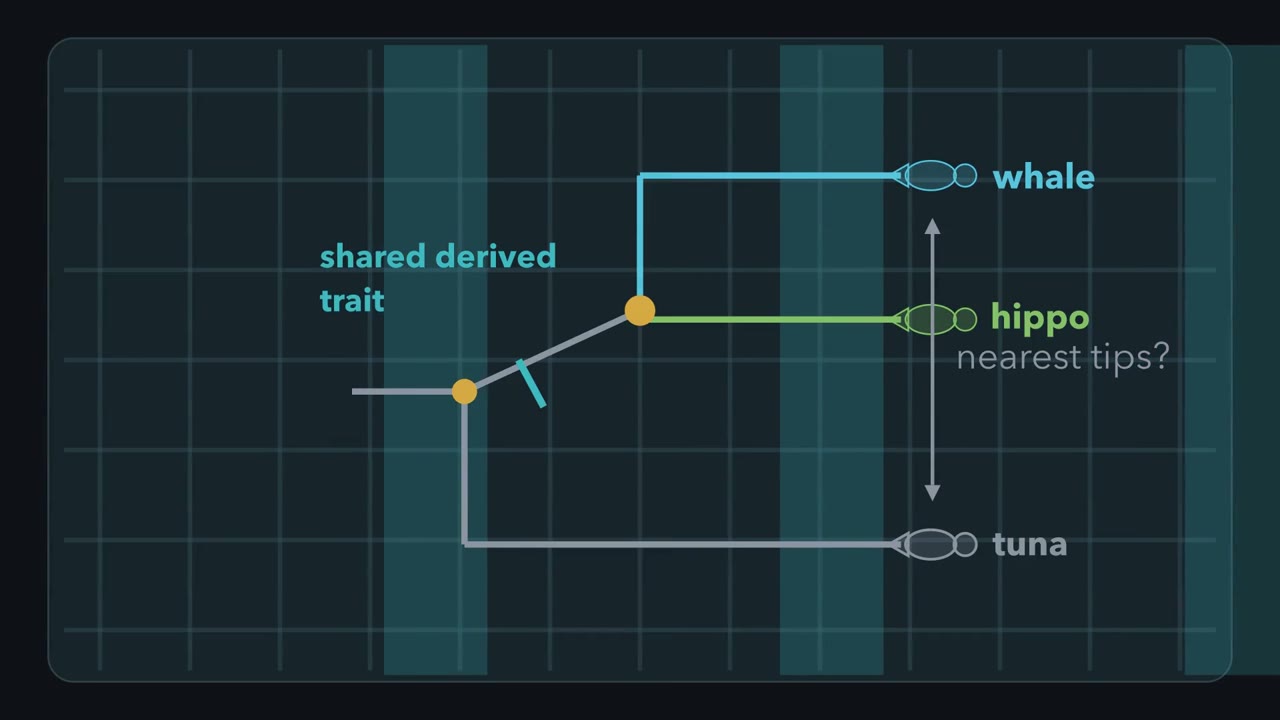
A whale looks more like a tuna than a hippo. So why does the family tree pair whale with hippo? Shape offers one clue, but ancestry can leave a different pattern. Watch which features travel together through the branches.
Whales and tuna both move through water. A smooth body and fins help both animals swim. Similar conditions can favour similar solutions, even in groups that are not close relatives. Scientists therefore ask a sharper question. Which similarities were inherited from a shared ancestor? Suppose you could follow only one trail. Would you choose the outside shape, or features passed through generations?
Hold your answer. The useful trail should explain several different observations, not just one resemblance. Start inside the front limb. A human hand, bat wing, and whale flipper do different jobs. Yet each keeps the same basic bone pattern. Matching parts shift into new shapes without losing their order. That pattern is a homologous structure, inherited from a common ancestor. Development and fossils add other views. Vertebrate embryos can begin with shared parts, then follow different paths.
Fossils place past body forms in time order. Whale embryos begin hind limbs, and fossil whales had working legs. Neither clue depends on an adult whale looking like a fish. DNA supplies another record. Scientists compare corresponding sequences and look for changes inherited together.
Shared insertions at matching locations are especially useful clues. Several such clues place whales beside hippos. When body, embryo, fossil, and DNA evidence agree, the grouping becomes stronger. One clue can be incomplete, so scientists compare independent evidence. Body structures, development, fossils, and DNA test the same branches from different angles. When they agree, the grouping gains support. The useful traits are derived traits. A derived trait first appeared in one ancestor and passed to its descendants. Trace shared derived traits to branch points to find the closest relatives. Now the first question has an answer. The whale's swimming shape links it to tuna by function.
Its lungs, limb bones, and embryos link it to four-limbed land animals. Its milk, fossils, and DNA link it to mammals. Within living mammals, the evidence places whales closest to hippos. The tree records ancestry, not overall appearance. Looks still matter when they preserve inherited parts. They mislead when a shared job produces a similar form. So begin with traits, test them with independent evidence, and follow their paths toward shared ancestors. That turns a resemblance into a claim you can check.
A whale lives in the sea and has a body shaped like a fish, so why do biologists say its closest living relatives are hippos?
Continue in the lesson: Building a Tree of Life →
3:36 · Free, with captions and a transcript. The lesson has the full text, the questions and the sources.
More films from this lesson
How this film was made. Narration: written from this lesson's text and read by an AI narrator voice (Kokoro, af_heart). Animation: AI-generated in code (Manim) by Claude, a schematic with no drawn molecular structures. Captions come from the narration script. See something wrong? Report it.