Biology · Unit 5: Classifying life
Classification Changes
Rewritten on : new text, flashcards and film. Your notes and highlights stay, but the text around them may have moved.
If some microbes look just like bacteria under a microscope, how could a molecule inside them show they belong to a different domain of life?
Pause when the reading reaches a film, and offer to play it. Saved on this device.
Watch the film now, or keep listening
Builds on:Domains and KingdomsBuilding a Tree of LifeDNA: Structure and CopyingWhy these?
Where this lesson sits
- Virginia SOL BIO.6f
- Practices BIO.1c, BIO.1d, BIO.1f
Essential question: How has DNA changed the way we classify life, and why is it fine for science to change its mind?
-
Life Science (grade 7) LS.3 c
Review it at grade 7 level
In Life Science you sorted organisms into three domains, Archaea, Bacteria and Eukarya, and then into kingdoms. You used clues such as whether cells have a nucleus, what structures the cells have, how many cells there are and how the organism gets its energy. You learned that DNA sequences can show how similar two organisms are. You also learned that new technology gives new evidence, and new evidence can change how an organism is classified. In Biology you read the real evidence that created the Archaea and see why changing a group is good science.
-
Biology BIO.6f You are here
This lesson
-
Biology II Biology II: Genetics, GEN.6 e
Preview where it goes next
In the Biology II Genetics course you compare ways to define a species. The biological species concept asks whether populations can interbreed and produce fertile offspring. The morphological concept uses body form. The phylogenetic concept uses shared ancestry, often read from genetic makeup. Each fits some organisms better than others: bacteria do not interbreed in the usual way, so genetic makeup matters most for them. You also draw trees from shared derived traits. Newer genome studies raise a question this lesson only touched: they place eukaryotes within one branch of the archaea, called the Asgard archaea, and studies still disagree about the exact branch.
-
College
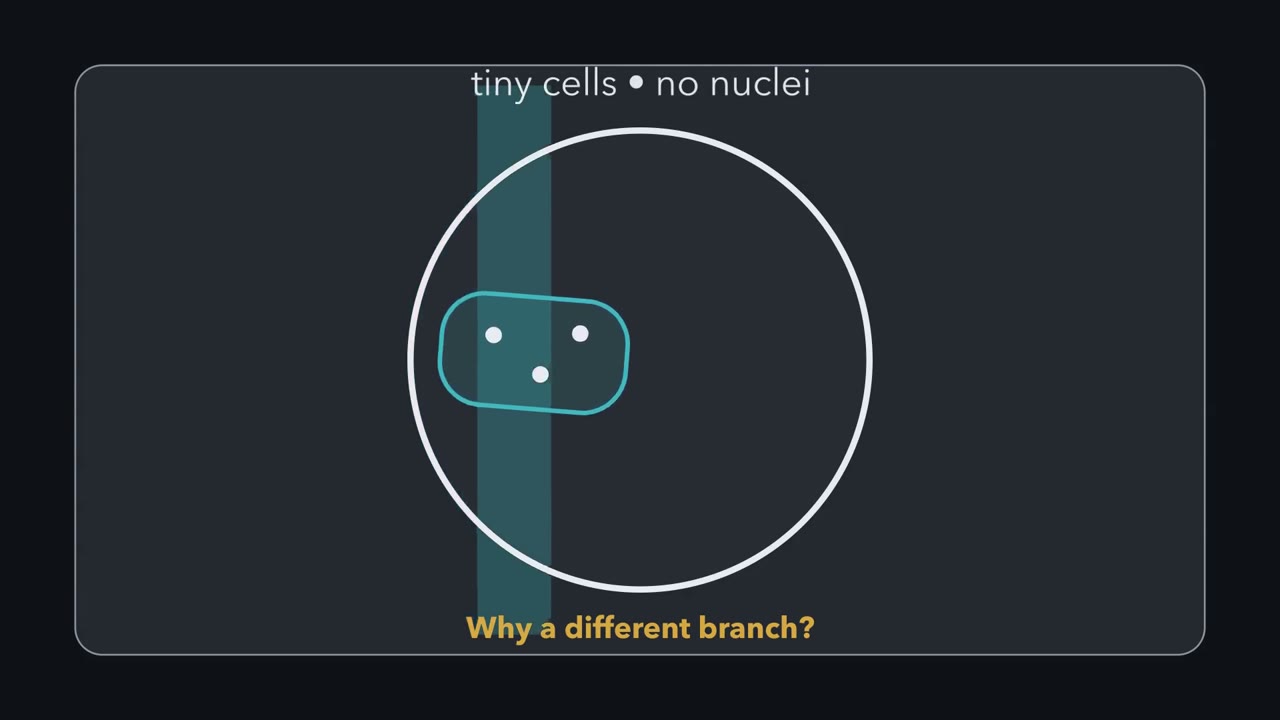 ▶ Watch The Molecule Behind the Tree · 3:34
Read the transcript of “The Molecule Behind the Tree”
Film transcript: The Molecule Behind the Tree
These methane-making microbes look like typical bacteria. Why would a molecule place them on a different branch? Under the microscope, both are tiny cells without nuclei. Shape gives us evidence, but it may hide the ancestry we want to test.
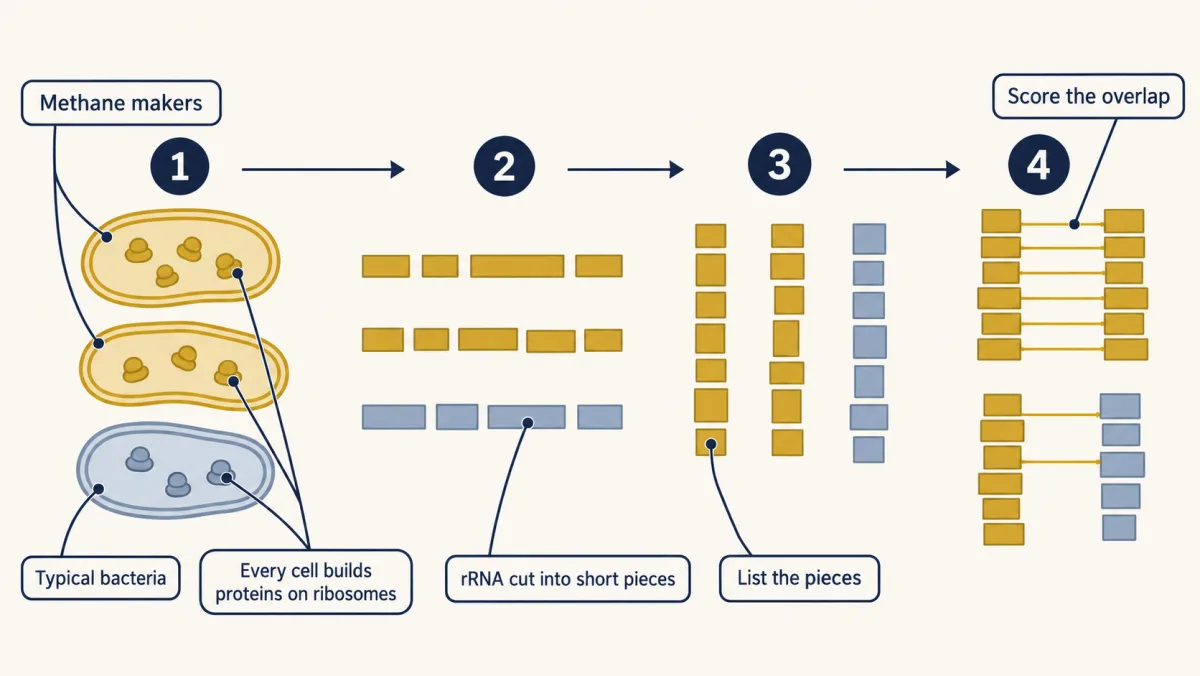
To compare very different cells, scientists need the same kind of record from every sample. Every cell builds proteins on ribosomes. Ribosomal RNA forms much of each ribosome. Conserved parts let researchers line up distant samples, while differing parts provide evidence. Woese and Fox compared catalogues of short ribosomal RNA pieces.
Picture each catalogue as a row of labelled tiles, not a complete molecule. Matching tiles pull the rows together. Fewer matches leave the rows farther apart. The pattern across pairs tests the tree. Here are hidden pairs. A pair shares many ribosomal RNA pieces, while another shares few. Which pair should sit closer on a tree of ancestry? Hold your answer before the labels appear.
The pair with many shared pieces belongs closer, if the rest of the evidence agrees. The methane makers matched each other far better than they matched typical bacteria. Typical bacteria also matched each other better than they matched methane makers. That repeated pattern challenged a combined prokaryote group. A classification is a testable map of relationships. A branch claims that its members share a more recent common ancestor. When several comparisons challenge that claim, scientists redraw only the supported part. The organisms themselves remain unchanged. The researchers interpreted this pattern as three major lines of descent. Later, the rank called domain named Bacteria, Archaea and Eukarya.
The methane makers joined Archaea. Their cells did not change. The evidence changed the best-supported tree. Molecular evidence does not automatically outrank every other clue. It adds a comparison that can expose misleading similarities in shape. Strong classifications weigh several markers and kinds of evidence. Agreement strengthens a branch.
Conflict shows where to test next. The overlap scores are not percentages of DNA. They do not tell when branches split. They summarize shared pieces in these ribosomal RNA catalogues. A tree remains a claim tested against more organisms, other genes, membranes and any evidence that can challenge it. That is why changing a group after careful testing can be good science.
Classification is a model of ancestry, not a permanent filing cabinet. When stronger evidence changes the picture, scientists revise the model while keeping its limits visible.
From the film
- Classification changes when new evidence changes the best-supported picture of ancestry.
- Ribosomal RNA can be compared across all cellular life.
- A repeated pattern across comparisons matters more than one score.
- The 1977 rRNA evidence separated the methane makers, later called Archaea, from typical bacteria.
Now test the first film’s reasoning on a tree, other organisms and real data.
What do you think? Decide before you read.
-
Scientists disagree: Whole groups have moved. A 1977 comparison of ribosomal RNA separated methane-making microbes from typical bacteria. Nuclear DNA studies from 2001 to 2010 supported splitting African elephants into two species.
What scientists think
Scientists disagree: Whole groups have moved. A 1977 comparison of ribosomal RNA separated methane-making microbes from typical bacteria. Nuclear DNA studies from 2001 to 2010 supported splitting African elephants into two species.
-
Scientists disagree: Earlier biologists used the evidence they had: body form, cell structure and how organisms get food. DNA and RNA comparisons added new evidence. Revising a group to fit better evidence is careful science.
What scientists think
Scientists disagree: Earlier biologists used the evidence they had: body form, cell structure and how organisms get food. DNA and RNA comparisons added new evidence. Revising a group to fit better evidence is careful science.
-
Scientists disagree: Fungi look plant-like, but a 1993 protein comparison strongly supported fungi being closer to animals. Fungi had already received their own kingdom in 1969.
What scientists think
Scientists disagree: Fungi look plant-like, but a 1993 protein comparison strongly supported fungi being closer to animals. Fungi had already received their own kingdom in 1969.
Explore: remodel a tree with new evidence
Start with the five-kingdom tree many biologists used in the 1970s. Add an RNA comparison, a test of cell-membrane fats or a set of gene sequences. Each card redraws the tree and names the evidence that moved a group.
Predict 1. Will the final supported tree depend on the order of the cards, or only on which evidence is present?
Which evidence moved which group
In this sketch each card moves its own groups, so the order of the cards does not change the finished tree, and branch lengths are not to scale. Rule to keep: the RNA card splits Monera, membrane fats add support to that split, and gene sequences move Fungi and Protista. The number of protist groups and where they attach are schematic; the lesson says only that Protista splits into many groups. The tree is still being tested, and scientists still use the three domain names.
Try this.
- Before any card, predict which kingdom will split first. Then add the RNA card.
- Test Predict 1: add the cards in two orders.
- Watch where Fungi sit after the gene card. Did they move toward plants or animals?
- Remove one card. Which branch loses support?
Build the model: evidence tests a tree
- classification
- kingdom
- domain
- phylogeny
- embryology
- protist
- ribosomal RNA
- Archaea
- Bacteria
- Eukarya
Classification sorts living things into groups based on relationships. The groups nest inside one another. A kingdom is a large group, such as plants or animals. A domain is the largest group, above kingdom.
A phylogeny is the history of ancestors and descendants, often drawn as a branching tree. Classification groups are meant to follow that history. Biologists test a phylogeny with several kinds of evidence:
- Structure: body parts and cell parts, such as a nucleus or cell wall.
- Embryology: the study of early development, before birth, hatching or sprouting.
- DNA and RNA: the order of bases in genes and other molecules.
The one idea. Classification changes when new evidence changes the best-supported picture of ancestry.
Scope: New evidence includes a new reading of old evidence. The rule describes modern classification. Early schemes, such as Linnaeus’s, sorted by similarity. Some changes only rename a group. One result does not settle every branch.
How ribosomal RNA exposed a hidden branch
The first film showed how lists of ribosomal RNA (rRNA) pieces compare distant cells. rRNA is the RNA that forms much of every ribosome. Each overlap score ran from 0, no overlap, to 1, the same. In 1977, Woese and Fox interpreted the film’s two-way pattern as evidence for three major lines of descent: eubacteria, archaebacteria and urkaryotes. The scores have no units, are not percentages of DNA and cannot date a split.
In 1990, Woese, Otto Kandler and Mark Wheelis proposed three domains:
- Bacteria: familiar single-celled prokaryotes, such as E. coli.
- Archaea: single-celled prokaryotes that differ from bacteria in their RNA and membranes.
- Eukarya: organisms whose cells have a nucleus, including animals, plants, fungi and protists. The paper spelled this name Eucarya.
Predict 2. If Archaea is a group based on ancestry, must every archaeon live in an extreme place?
Check your prediction
No. The 1977 samples included one that grows best at moderate temperatures. In 1992, archaea were found in ordinary coastal seawater. Habitat alone does not define the domain.
Archaea moved because a repeated pattern challenged one old group. Does every new result move a branch? The second film tests that question on smaller branches.
Read the transcript of “When Evidence Redraws a Branch”
Film transcript: When Evidence Redraws a Branch
Archaea moved because a repeated pattern challenged one old group. How do we decide whether another branch should move? Start with the current tree as a claim. Then ask which relationship each new comparison supports. Fungi once seemed plant-like because they grow in place and have cell walls. On our tree, a mushroom icon begins beside a plant. That placement is a hypothesis about ancestry.
Looking alike can suggest a group, but the branch must survive other tests. Protein comparisons supplied another test. Several protein trees grouped the sampled fungi with animals. Shared added or missing stretches supported the same relationship. The mushroom branch slides beside the animal branch. This does not mean animals came from modern mushrooms. A result can be a clue, not a final verdict.
Confidence grows when different comparisons support the same branch and sampling is broad enough. Conflicting results send scientists back to methods, markers and organisms. The tree stays open to testing. A new evidence card supports the branch already drawn, and no strong comparison challenges it. Should scientists move that branch, keep it, or erase the whole tree?
Choose before the card reaches the joint. Keep it. New evidence does not require movement. It may strengthen the present relationship instead. Revision belongs where the evidence changes the picture. Scientists should not rebuild every branch because a well-supported branch was tested. The same logic reaches species.
Nuclear DNA supported treating forest and savanna elephants as separate species. Yet one large study sampled very few animals of each kind. Broad stretches of DNA strengthened the split, while the small sample kept a limit visible. DNA comparisons also placed whales among even-toed hoofed mammals, with hippos as their closest living relatives.
Gene sequences split the old Protista kingdom into many branches. These changes differ in scale, but each asks which tree fits the evidence. Each change still needs its own evidence and its own limits. Reclassification changes the scientific model. It does not make organisms switch ancestors, and it does not prove earlier scientists careless. They used the evidence available. Better tools can reveal patterns that shape, habitat or a short comparison could not show. Ask these questions whenever a group changes. What relationship did the old tree claim? What new pattern challenges it? What important limits remain? Those questions turn a changed label into a clear evidence-based scientific explanation.
From the film
- Classification changes when new evidence changes the best-supported picture of ancestry.
- Scientists revise the classification model; organisms do not switch ancestry.
- New evidence can strengthen a branch instead of moving it.
- Different kinds of molecular evidence can test relationships suggested by appearance.
- A classification claim stays open to more evidence.
Other groups that moved
The second film gave the logic of each move. Here are the numbers, dates and limits.
- Fungi and animals. In 1993, trees built from four protein sequences grouped animals with fungi. Across 25 proteins, the sampled animals and fungi shared four insertions or deletions (added or missing stretches of amino acids). Plants, protists and bacteria lacked them.
- Two African elephants. Nuclear DNA support for two species, forest and savanna, began in 2001. A 2010 study added 39,763 DNA bases from 375 places in the nuclear genome. It sampled only one or two animals of each kind, so it could not settle every detail.
- Whales. With whales placed among the even-toed hoofed mammals, some biologists call the combined group Cetartiodactyla. Others widen Artiodactyla to include whales.
Predict 3. If two group names cover the same whales and hoofed mammals, must they show different phylogenies?
Check your prediction
No. Cetartiodactyla and a widened Artiodactyla can name the same branch. Evidence decides where whales sit on the tree. Which name to use is a separate choice.
A reclassification makes the groups fit the current evidence better, not perfectly, so they can be revised again.
Use real data: the 1977 similarity scores
Each score compares the rRNA-piece lists of two laboratory samples.
| Sample A | Sample B | Kind of pair | Similarity score (no units, 0 to 1) |
|---|---|---|---|
| Yeast (Saccharomyces cerevisiae) | Duckweed (Lemna minor) | Within eukaryotes | 0.29 |
| Escherichia coli | Bacillus firmus | Within bacteria | 0.25 |
| Methanobacterium thermoautotrophicum | M. ruminantium | Within methane makers | 0.51 |
| Yeast | E. coli | Between groups | 0.05 |
| Yeast | B. firmus | Between groups | 0.08 |
| Yeast | M. thermoautotrophicum | Between groups | 0.11 |
| Yeast | M. ruminantium | Between groups | 0.11 |
| E. coli | M. thermoautotrophicum | Between groups | 0.11 |
| E. coli | M. ruminantium | Between groups | 0.12 |
Source: Woese and Fox, PNAS 1977, Table 1. The names are those used in 1977. These nine pairs came from a larger table, so this is a chosen teaching set, not a random sample.
Predict 4. Before calculating means, compare the ranges. Is any selected between-group score higher than any selected within-group score?
Check your prediction
No. The largest selected between-group score is 0.12. The smallest selected within-group score is 0.25. That separation describes this chosen set, not every possible sample.
- Find the mean of the three within-group scores and the six between-group scores.
- Compare E. coli with B. firmus against E. coli with each methane maker.
- Explain which placement for the methane makers fits this evidence.
Claim, evidence, reasoning
Make a claim that answers the essential question: can sequence evidence justify changing how we classify life? Use these 1977 scores.
Start with: The data show that the methane makers blank, so classification blank.
Start with: The within-group mean is blank while the between-group mean is blank. The two methane makers scored blank with each other but only blank with E. coli.
Start with: A higher score means blank. Because the methane makers blank, scientists were right to blank.
Compare with a model answer
The scores support placing the methane makers in their own group, so classification can change with new evidence. The mean of the three within-group scores is 0.35, and the mean of the six between-group scores is about 0.10. The two methane makers scored 0.51 with each other but only 0.11 and 0.12 with E. coli, which scored 0.25 with another bacterium. A higher score means more shared rRNA pieces, so the methane makers are more like each other than like typical bacteria. One limit: these are nine chosen pairs from one 1977 table, and the scores cannot date the splits.
Saved in this browser only.
Design problem
You think a newly found pond microbe might be an archaeon, not a bacterium. Plan a sequence comparison.
Predict 5. Why would comparing it with one archaeon and one bacterium be weaker than using several of each?
Saved in this browser only.
One way to do it
- Question: Is the pond microbe’s rRNA more similar to known archaea or known bacteria?
- Independent variable: the comparison organism, using several known archaea and bacteria.
- Dependent variable: percent matching bases in the same rRNA gene.
- Constants: the same gene, sequence length and computer method for every pair.
- Control: compare two known bacteria and two known archaea to show within-group scores.
- Repeated trials and sample size: sequence the pond microbe more than once and use at least five organisms from each domain. One unusual comparison organism could mislead.
- Second evidence line: check another gene or membrane fats, since one marker can mislead.
- Safety: treat unknown microbes as possible germs and grow them only in a supervised lab.
If the microbe scores clearly higher with every archaeon than with every bacterium, and the second marker agrees, the evidence supports calling it an archaeon.
Going deeper: systems change, and testing continues
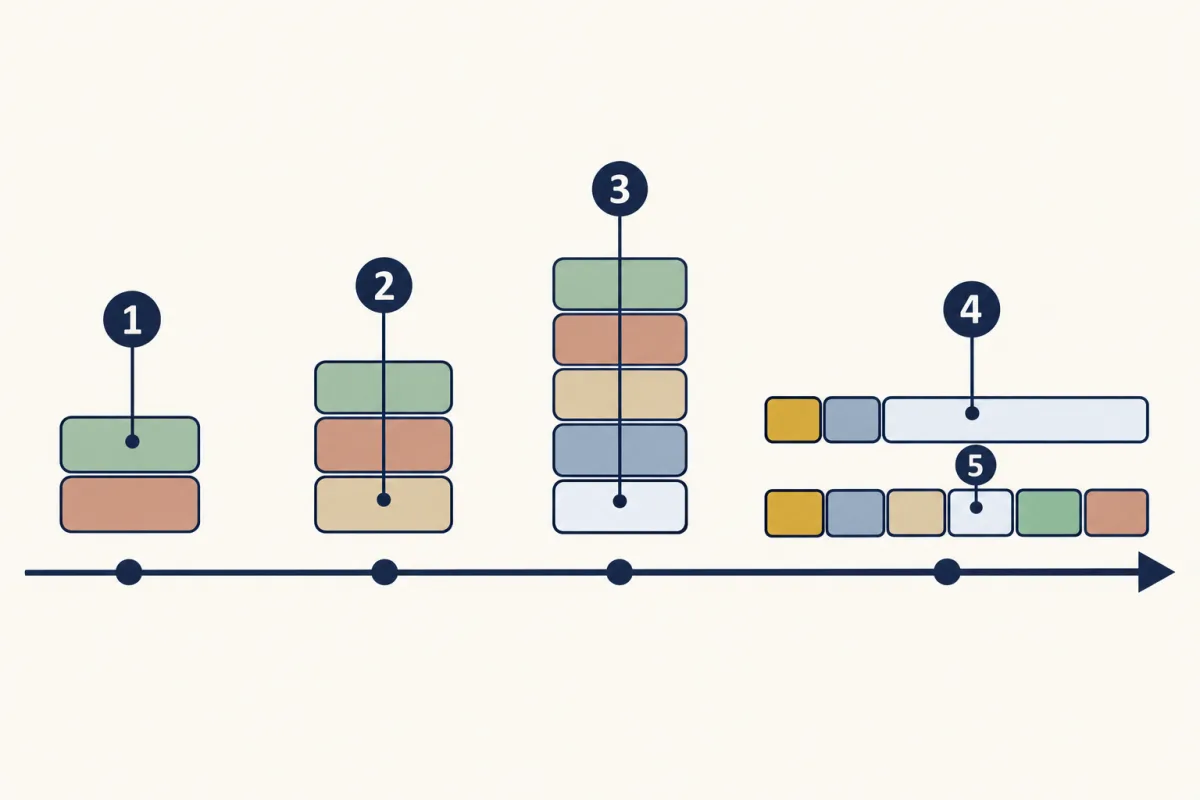
Each date below marks publication of a scheme, not the year everyone agreed.
| Year | Scheme | What changed |
|---|---|---|
| 1735 | Linnaeus, Systema naturae | Living things sorted as plants or animals (minerals too) |
| 1866 | Haeckel | Protista added as a third living kingdom |
| 1938 | Copeland | A four-kingdom system, with bacteria apart |
| 1969 | Whittaker | Five kingdoms, with Fungi apart from plants |
| 1977 | Woese and Fox | RNA evidence for three major lines of descent |
| 1990 | Woese, Kandler and Wheelis | Three domains placed above the kingdoms |
Many US textbooks use six kingdoms: Archaebacteria, Eubacteria, Protista, Fungi, Plantae and Animalia. A protist is a eukaryote that is not a plant, animal or fungus. Virginia’s Biology standards keep Protista as a kingdom, so you will use it. Newer trees divide protists into separate groups because some are closer to animals or plants than to other protists.
- plants or animals
- Protista added
- Five kingdoms
- Three domains
- six kingdoms
- plants or animals
- blank
- blank
- Three domains
- blank
Word bank: Five kingdoms, Protista added, six kingdoms
- blank
- blank
- blank
- blank
- blank
Check your labels
- plants or animals
- Protista added
- Five kingdoms
- Three domains
- six kingdoms
Testing continues. Since 2015, genome studies have placed eukaryotes inside the Asgard archaea. If that model is right, eukaryotes grew from within Archaea, leaving two primary branches of cellular life rather than three. Studies from 2023 and 2025 disagree about the exact branch, and scientists still use the three domain names.
Evaluate: check your thinking
The methane makers looked like bacteria, but their rRNA showed a line of descent the microscope could not. Classification changes when new evidence changes the best-supported picture of ancestry.
Science practices you used: using a model and naming its limits, calculating and comparing means, and making and judging a claim from evidence.
Your notes
Select any text in the lesson to highlight it or add a note to it. Your highlights and notes are saved in this browser and collected in your notebook.
This browser is not letting the site save anything (a private window or strict privacy settings), so highlights and notes will be lost when you leave the page.
How we measure it
Ribosomal RNA cataloguing
An enzyme cuts a cell’s ribosomal RNA into short pieces, and the pieces are read and listed. Comparing the lists from two organisms gives a score for how much they overlap.
DNA sequencing and alignment
A machine reads the order of bases in stretches of DNA, and a computer lines up matching stretches from different organisms. The differences show how similar their genes are.
Building a tree from sequences
A computer method tests which branching pattern best fits the sequence differences. Scientists compare the result with other markers and other kinds of evidence before they change a group.
Where this lesson fits
Before thisReview first
- Domains and KingdomsThis course · Lesson 24
You need the three domains and the kingdoms from there to follow how the tree was reshaped here.
- Building a Tree of LifeThis course · Lesson 23
You need to read a branching tree of ancestry from there to see how new evidence moves a group.
- DNA: Structure and CopyingThis course · Lesson 16
You need to know DNA and RNA are chains of bases from there to follow sequence comparison here.
After thisStudy next
- Evidence for EvolutionThis course · Lesson 26
It uses molecular comparisons like rRNA similarity as evidence for shared ancestry among living things.
Elsewhere on the siteFilms, simulations and method films in other courses
- Look Alike, Far ApartFilm · Organismal Biology
It shows how Woese compared ribosomal RNA to show that look-alike microbes are distant relatives.
Suggested by an AI model from the lessons themselves, then checked. How we use AI
Finish line
Test yourself
8 questions
Practice and MCAT-style, with explained answers.
Next · Lesson 26
Evidence for Evolution
If whales live their whole lives in water, why do some fossil whales have legs, and why do living whales still carry small hip bones?
Continue →