Life Science · Unit 7: Heredity
DNA: The Code of Life
Rewritten on : new text, flashcards and film. Your notes and highlights stay, but the text around them may have moved.
If strawberries, mushrooms, bacteria and people all have DNA, why are they so different?
Pause when the reading reaches a film, and offer to play it. Saved on this device.
Watch the film now, or keep listening
Builds on:Inside a CellCells Are EverywhereWhy these?
Where this lesson sits
- Virginia SOL LS.10 a
- Practices LS.1 c, LS.1 d, LS.1 e, LS.1 f
Essential question: How can a tiny code inside my cells decide what I look like?
-
Life Science (grade 7) LS.10 a You are here
This lesson
-
Biology
Preview it at high school level
In Biology you will learn that DNA is built from small units called nucleotides. Each one has a sugar, a phosphate and one base. You will learn that weak attractions called hydrogen bonds hold each base pair together across the middle of the ladder. You will see how a cell copies its DNA before it divides, using each side as a pattern for a new partner side. You will follow the code from a gene to a messenger molecule called RNA and then to a protein. This is called protein synthesis. You will also read how scientists used X-ray photos and models to work out the double helix.
-
Biology II Biology II: Genetics, GEN.2 a
Preview where it goes next
In Virginia's Biology II Genetics course, you ask how DNA can keep its code safe for many generations and still change a little over time. You learn that the two sides of the ladder run in opposite directions. You name the proteins that unzip DNA, build new sides and join the pieces. You see why each new DNA molecule keeps one old side and one new side. You also study how rare copying mistakes become the changes that evolution acts on.
-
College
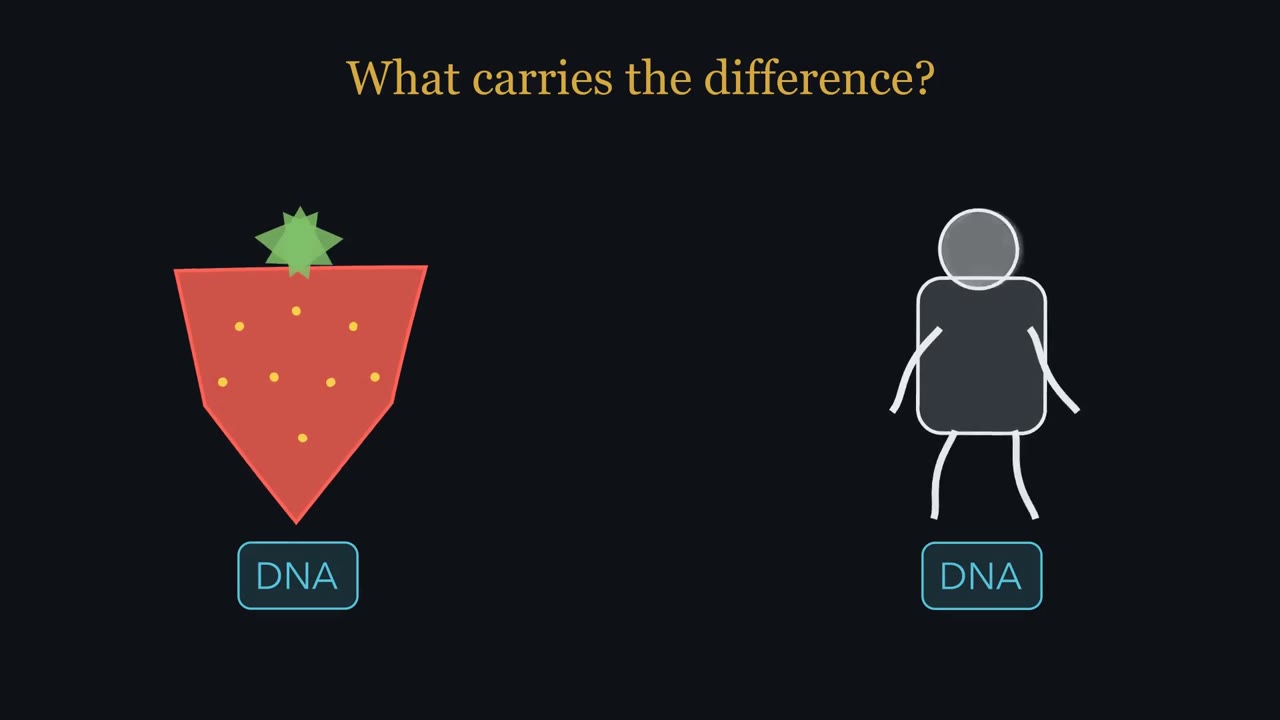 ▶ Watch Which Part of DNA Is the Code? · 3:20
Read the transcript of “Which Part of DNA Is the Code?”
Film transcript: Which Part of DNA Is the Code?
A strawberry and a person use the same kind of DNA. What inside that molecule can help make them different? Both lead into cells, then toward the same twisting ladder. The puzzle is where differences sit. DNA is a double helix, like a ladder twisted along its length. Sugar and phosphate form both sides. Those side parts are the same kinds in every living thing. The useful difference is not the frame around the rungs. The rungs carry base pairs. Each base has a letter name: A, T, C, or G. In ordinary double-stranded DNA, A pairs with T. C pairs with G. Pairing lets either side tell us the partner across each rung. Two ladders have matching blue sides.
Their rung letters appear in different orders. Which part can carry different instructions: the shared sides or the changing base order? Hold your answer while a small reader waits at the first rung. The changing order carries information.
Sequence means base order along DNA. Traits are features of living things. Here is the rule connecting both films. DNA sequence helps shape traits; DNA amount does not rank organism complexity. This film builds the sequence half. A highlighted sequence sits within a gene, a section of DNA. A chromosome is packaged DNA and carries many genes. Many genes carry instructions used to build proteins. Other genes carry code used in other ways. Follow one pea example. A working protein is needed to make purple flower colour. A change in its gene can stop that protein working. The flower can then be white. This case connects gene sequence, protein, and trait without making every trait simple.
The path is a first model, not a promise that each gene makes one trait. Many traits depend on several genes. Surroundings can matter too. Some base changes alter nothing you can see, so scientists test changes instead of guessing from letters alone. Almost every skin and muscle cell in one person carries the same DNA.
Yet each cell type uses different genes. Different proteins follow, so the cells look and work differently. The code matters together with how each cell uses it. Follow base order through a gene, protein, and trait. Shared parts can carry different sequences, and cells can use genes differently. So DNA sequence helps shape traits. Counting whole chromosome sets is a different question, for the second film.
From the film
- DNA sequence helps shape traits: the order of the bases in the rungs is the code.
- DNA's sugar-phosphate sides are the same in all living things.
- In ordinary double-stranded DNA, A pairs with T and C pairs with G.
- Many genes carry base sequences used to build proteins, and proteins can affect traits.
- Almost every cell in one body carries the same DNA, but each cell type uses different genes.
The first film showed which part of DNA carries the code. Here you test that idea with a real sample, a model and new sequences.
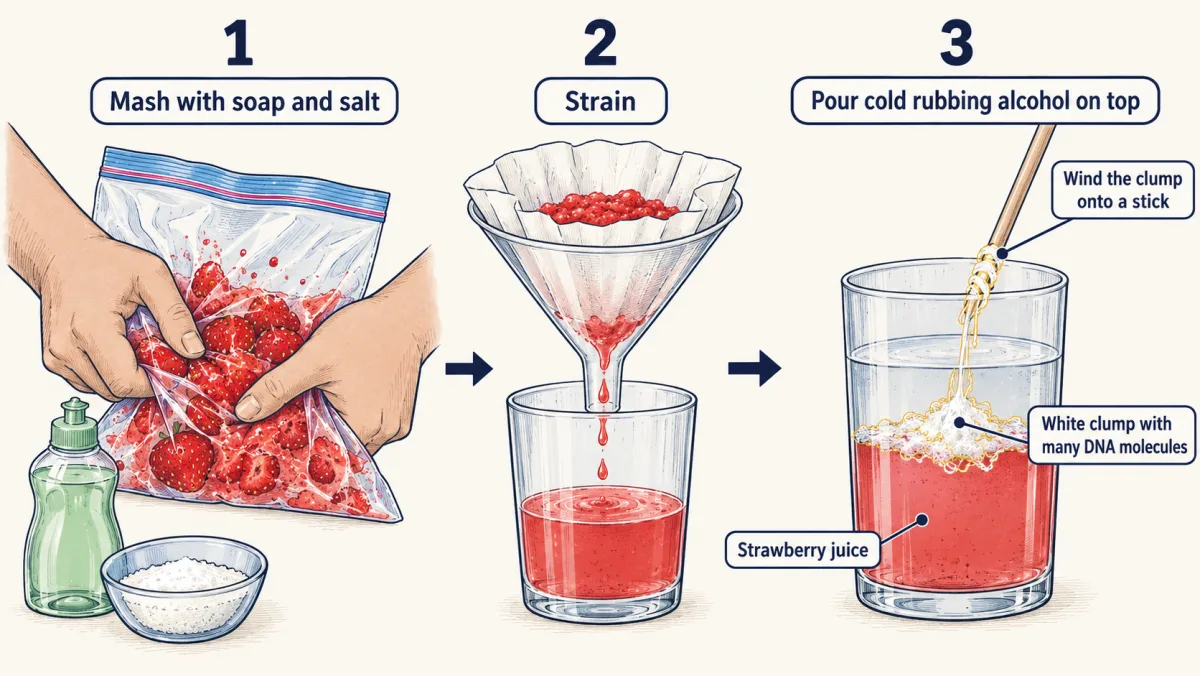
Mash a strawberry with soap and salt, strain it, and pour cold rubbing alcohol on top. A white, stringy clump collects where the alcohol meets the strawberry juice. You can wind it onto a stick. The clump holds many DNA molecules plus some other cell material. It shows you DNA, but it is not pure and does not measure an amount.
Test the code in a model
- DNA
- double helix
- base
- base pair
- sequence
- chromosome
- gene
- protein
- trait
The simulation starts with a pea plant. A slider zooms through organism, cell, nucleus, chromosome and gene to a DNA ladder of letter blocks, A, T, C and G. Tap a block on one side to change it. “Read the gene” shows the protein as a chain of coloured beads and a trait, such as flower colour.
Top row: the side this sketch reads. Two blocks joined in the middle make one rung, a base pair. Tap a block to change its letter.
The protein shown was read from the code before your change. Zoom to the bases and press Read the gene.
- Bead colour follows the top-row block: A red, T blue, C gold, G green.
- A ring marks a bead in the working part. A dashed ring means that bead changed.
Made up for this sketch: the gene has 6 base pairs so it fits; one bead and one made-up colour for each top-row block; the working part is 2 beads; the number of chromosomes drawn; every shape is not to scale. A real cell reads the code in a different way, and a real protein does not look like a row of beads. You learn how in high school Biology.
Rule to keep: the order of the bases is the code. A always pairs with T and C with G. A change in a gene can change a protein, and a change can stop a protein from working.
Try this.
- Predict where you will find DNA. Zoom one step at a time and check.
- Write what you expect the partner block to do when you change one block. Tap it and check.
- Change one block. Write whether you expect the protein or flower colour to change. Press “Read the gene,” then test several blocks.
The model links one base change to one protein and one trait so you can test a cause. Real cells are messier: some base changes alter nothing you can see.
Use pairing and sequence
Now use the first film’s pairing rule on a new sequence. In ordinary double-stranded DNA, A pairs with T, and C pairs with G.
Predict. One side reads G A C T T. Write the partner side before opening the answer.
Check your prediction
The partner reads C T G A A. Pair each position separately: G with C, A with T, C with G, T with A, and T with A.
Scientists write a DNA stretch as letters, such as ATTGCAC. They skip the sides, because the sides never change.
DNA is a bit like letters in a word. If you rearrange the letters, the message can change. But a cell does not read words. Its molecules follow the bases in order.
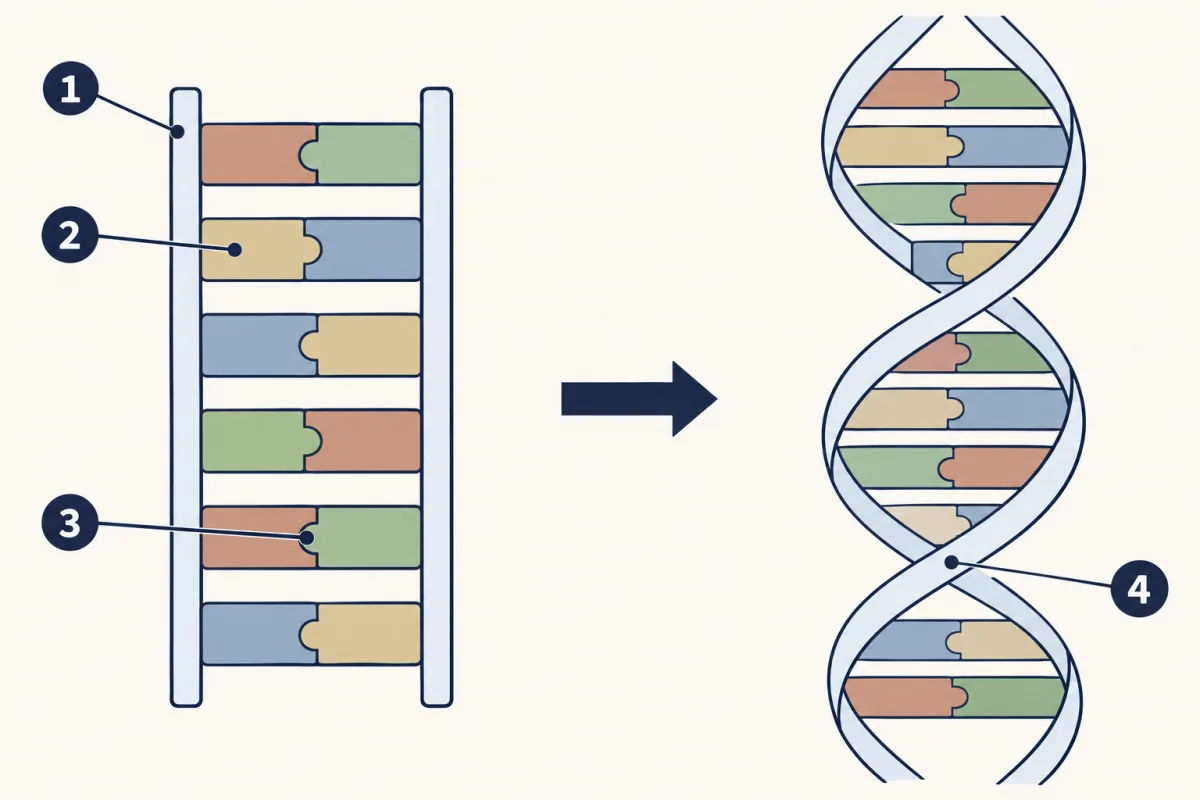
- sugar-phosphate side
- base
- base pair
- double helix
- sugar-phosphate side
- blank
- blank
- double helix
Word bank: base, base pair
- blank
- blank
- blank
- blank
Check your labels
- sugar-phosphate side
- base
- base pair
- double helix
Add scale and limits to the gene model
Now zoom out from the first film’s pea gene. DNA is very long and thin. In plants, animals and fungi, most DNA sits in the nucleus, which you met in Inside a Cell. A chromosome is a long strand of DNA packaged with proteins.
Before a cell divides, its chromosomes pack down even further. Predict: Does tighter packing make them easier or harder to see with a microscope?
Check your prediction
Easier. Packed chromosomes become thick enough to see with a microscope.
A gene is a section of a chromosome, and one chromosome carries many genes. Some genes carry code the cell uses in other ways, not for proteins. Proteins build cells, tissues and organs and do most of the work in cells. Some form hair, some carry oxygen in blood, and some speed up reactions.
Changes in DNA are called mutations (Mutations and Variation). High school Biology shows how a cell reads a gene to build a protein. Reproduction and Meiosis shows how chromosomes pass from parents to offspring.
So far you have asked what a base order does. The second film asks something new: does more DNA mean a more complex living thing?
Read the transcript of “Does More DNA Mean More Complex?”
Film transcript: Does More DNA Mean More Complex?
The first film followed DNA sequence to proteins and traits. Does more DNA have to mean a more complex organism? To test that idea, we need counts from real chromosome sets, not guesses. DNA amount means total base pairs in a full chromosome set. A base pair is a ladder rung. Scientists sequenced some living things and estimated others. These methods count DNA; they do not score complexity. Watch each ladder become a counter, then a bar. Each bar shows published data for an organism. Every estimated value keeps its estimate label on screen. The rows include a bacterium and fungus, then plant and animal examples. Every group represented here has DNA.
That supports a careful claim about this table. It does not let this small set represent every living thing everywhere. If amount ranked complexity, where should the human bar end compared with the onion bar? Make your prediction before either bar grows. Remember, this test compares a full chromosome set with a full chromosome set.
The human bar grows, but the onion bar continues far beyond it. The table's division appears on screen. The onion chromosome set has several times the human amount. A larger DNA total does not rank organism complexity. Now reveal every bar in data order.
Rice extends beyond fruit fly, and onion extends beyond human. The pattern does not march from simpler to more complex. Total base count and organism complexity are different questions. Amount counts all base pairs, not only genes carrying protein instructions. It also does not tell which genes a cell uses.
Sequence and gene use help explain traits. A total length cannot replace that information. Now both halves meet. DNA sequence helps shape traits; DNA amount does not rank organism complexity. The rule has scope. Amount here means base pairs in one chromosome set.
Sequence helps through genes, proteins and gene use, and many traits also depend on the surroundings. These bars come from published lab studies, not field samples. Most rows come from one strain or sample. Several values are estimates. The human row is a set without Y, and onion uses an earlier estimate. Good evidence keeps limits attached. The films began with a strawberry and person sharing DNA parts. The answer is not a bigger ladder. Different base orders and different gene use can guide different proteins.
DNA amount does not rank organism complexity.
From the film
- DNA sequence helps shape traits; DNA amount does not rank organism complexity.
- DNA amount counts base pairs in one full chromosome set.
- Every group in the table has DNA: bacterium, fungus, plant and animal.
- An onion chromosome set has about five times the human DNA amount in the table.
- Eight examples can test a claim, but they do not represent all living things.
Work with the full DNA-amount data
Here are the second film’s bars as a table, so you can do the math yourself. One million base pairs means 1,000,000 rungs.
| Living thing | Group | Base pairs in one set (millions) | How it was found |
|---|---|---|---|
| E. coli | Bacterium | 4.6 | Sequenced |
| Baker’s yeast | Fungus | 12.1 | Sequenced |
| Thale cress (a small weed) | Plant | about 157 | Estimated |
| Fruit fly | Animal | about 175 | Estimated |
| Woodland strawberry | Plant | about 240 | Estimated |
| Rice | Plant | about 389 | Estimated |
| Human | Animal | 3,055 | Sequenced |
| Onion | Plant | about 16,400 | Estimated |
- Divide the onion amount by the human amount. About how many times as much DNA is in one onion set?
- List the eight living things from least DNA to most. Does that list match how complex you think each one is?
Claim, evidence, reasoning
Use this data to make a claim about two questions: which living things have DNA, and does more DNA mean a more complex living thing?
Start with: The data show that blank have DNA, and that more DNA blank.
Start with: The table includes a blank, a blank, plants and animals. One onion set has about blank million base pairs, and one human set has blank million.
Start with: The amount of DNA counts blank, but it does not tell us blank.
Compare with a model answer
Every living thing in the table has DNA: a bacterium, a fungus, four plants and two animals. More DNA does not mean a more complex living thing. One onion set holds about 16,400 million base pairs, about five times the human amount of 3,055 million. Rice holds more than the fruit fly. The amount counts base pairs, not which proteins the genes code for or how cells use them. One limit: these are only eight living things, mostly one sample each, and several values are estimates.
Saved in this browser only.
What do you think? Decide before you read.
-
Scientists disagree: The strawberry clump is plant DNA. Scientists have read or measured the DNA of bacteria, fungi such as baker’s yeast, plants and animals. Every living cell that grows and divides has DNA, though a few special cells, such as human red blood cells, lose it as they mature.
What scientists think
Scientists disagree: The strawberry clump is plant DNA. Scientists have read or measured the DNA of bacteria, fungi such as baker’s yeast, plants and animals. Every living cell that grows and divides has DNA, though a few special cells, such as human red blood cells, lose it as they mature.
-
Scientists disagree: Almost every cell in your body carries the same DNA. Scientists find that each cell type uses a different set of genes. Skin and muscle cells make different proteins, so they look and work differently.
What scientists think
Scientists disagree: Almost every cell in your body carries the same DNA. Scientists find that each cell type uses a different set of genes. Skin and muscle cells make different proteins, so they look and work differently.
-
Scientists disagree: One set of onion chromosomes holds about five times as much DNA as one human set. The amount of DNA does not neatly line up with how big or complex a living thing is.
What scientists think
Scientists disagree: One set of onion chromosomes holds about five times as much DNA as one human set. The amount of DNA does not neatly line up with how big or complex a living thing is.
Design problem
In the strawberry activity, does the amount of dish soap change how much white clump you collect? Predict a pattern, then plan a fair test.
Saved in this browser only.
One way to do it
- Question: Does more dish soap give a bigger clump from the same amount of strawberry?
- Independent variable: dish soap in the mix: 0 mL, 5 mL and 10 mL.
- Dependent variable: the mass of the wet clump in grams, on a balance.
- Constants: 50 g of strawberry, the same salt, water, mashing time, filter and amount of cold alcohol.
- Control: the cup with 0 mL of soap.
- Repeated trials: three cups for each amount of soap. Find the mean mass for each.
- Safety: wear goggles. Rubbing alcohol catches fire easily, so keep it away from any flame or heat. Do not taste anything. Wash your hands after.
If the clump grows as soap goes up, that fits the idea that soap opens more cells. It does not prove it. The clump is not pure DNA, so its mass is only a rough measure.
Going deeper
How the shape was worked out
DNA’s shape was worked out step by step. In the early 1950s, X-ray photos and careful model building showed the double helix, and the model was published in 1953.
Where the table values came from
The values come from seven published lab studies, not field samples: E. coli K-12, 1997 (Blattner and others); yeast, 1996 (Goffeau and others); fruit fly and thale cress, 2003 (Bennett and others); woodland strawberry, 2011 (Shulaev and others); rice, 2005 (rice sequencing project, an estimate); human, 2022 (Nurk and others; 22 chromosomes plus X, rounded); and onion, 2021 (Finkers and others, quoting an earlier estimate). Most rows come from one strain or sample. The onion value combines several earlier measurements.
Sequencing reads base order and lets scientists count a finished sequence. Flow cytometry stains nuclei and compares their glow with nuclei of known DNA amount.
Check your thinking
The strawberry clump, the model, the paired bases and the table all point the same way: base order carries instructions, but the total amount of DNA is not a complexity score.
Science practices you used: making predictions and testing them with a model, naming where a model breaks, reading a data table, dividing to compare amounts, making a claim from evidence with reasoning, and planning a fair test with a control and repeated trials.
Your notes
Select any text in the lesson to highlight it or add a note to it. Your highlights and notes are saved in this browser and collected in your notebook.
This browser is not letting the site save anything (a private window or strict privacy settings), so highlights and notes will be lost when you leave the page.
How we measure it
DNA extraction with soap, salt and alcohol
Soap breaks open cell membranes, salt helps DNA clump together, and cold alcohol makes the DNA come out of the liquid as a white clump. The clump lets you see DNA, but it also holds some other cell material, and the method does not count or weigh the DNA itself.
DNA sequencing
A sequencing machine reads the order of the bases in many pieces of DNA, and computers join the pieces into whole chromosomes. Counting the bases in the finished sequence gives the DNA amounts for E. coli, yeast and humans in this lesson.
Flow cytometry
Cell nuclei are stained with a dye that sticks to DNA, and a machine measures how brightly each nucleus glows next to nuclei with a known amount. It gives the amount of DNA, not the order of the bases, and it gave the fruit fly, thale cress and strawberry values here.
Where this lesson fits
Before thisReview first
- Inside a CellThis course · Lesson 2
You need to know the nucleus holds DNA and that cells make proteins to place DNA inside the cell.
- Cells Are EverywhereThis course · Lesson 1
You need to know that all living things are made of cells, which is why every group in the table has DNA.
After thisStudy next
- Reproduction and MeiosisThis course · Lesson 28
It shows how chromosomes of DNA are passed from parents to offspring and shuffled in sex cells.
- Mutations and VariationThis course · Lesson 31
It uses the idea that changing the order of bases can change a protein and a trait.
- Predicting Traits with Punnett SquaresThis course · Lesson 29
It uses genes as sections of chromosomes to predict which traits offspring will show.
Elsewhere on the siteFilms, simulations and method films in other courses
- From Gene Copy to Protein ChainFilm · Biology
It follows how base order in a gene sets the order of amino acids in a protein.
- Transcribe, translate, mutateSimulation · Biology
You can change a gene's letters and see how the protein and trait change.
Suggested by an AI model from the lessons themselves, then checked. How we use AI
Finish line
Test yourself
8 questions
Practice and MCAT-style, with explained answers.
Next · Lesson 28
Reproduction and Meiosis
Why does a strawberry runner grow into a copy of its parent, but brothers and sisters do not come out as copies of each other?
Continue →