Life Science · Unit 8: Change over time
Evidence for Change Over Time
Rewritten on : new text, flashcards and film. Your notes and highlights stay, but the text around them may have moved.
How can a scallop shell millions of years old, a bat wing and a protein in your cells all tell the same story?
Pause when the reading reaches a film, and offer to play it. Saved on this device.
Watch the film now, or keep listening
Builds on:DNA: The Code of LifeNatural Selection in ActionDomains, Kingdoms and DNAWhy these?
Where this lesson sits
- Virginia SOL LS.11 b
- Practices LS.1 a, LS.1 c, LS.1 d, LS.1 f
Essential question: How do scientists know that living things have changed over time and are related?
-
Life Science (grade 7) LS.11 b You are here
This lesson
-
Biology
Preview it at high school level
In Biology you will learn how scientists find the age of a fossil. Rock layers give an order: in a stack that has not been disturbed, lower layers are older. Radioactive dating gives an age in years. Biology also gives names to kinds of body parts. For example, body parts that come from the same part in a common ancestor are called homologous structures. You will look at small leftover parts, like the hip bones inside a whale. You will add two more kinds of evidence: how embryos develop, and where species live on Earth. You will also use data to build family trees of life.
-
Biology II Biology II: Advanced Survey of Biology Topics, BIOII.5 a and BIOII.7 b; Genetics, GEN.2 e
Preview where it goes next
In Biology II: Advanced Survey of Biology Topics, BIOII.5 a asks how evidence from fossils, body comparisons, DNA, where species live, and direct observation of changing populations all point to one history. BIOII.7 b compares body structures across animals with and without backbones in more detail. In Biology II: Genetics, GEN.2 e uses the genetic code itself as evidence. Almost all living things read their genes with the same code, which is what you would expect if they share a common ancestor.
-
College
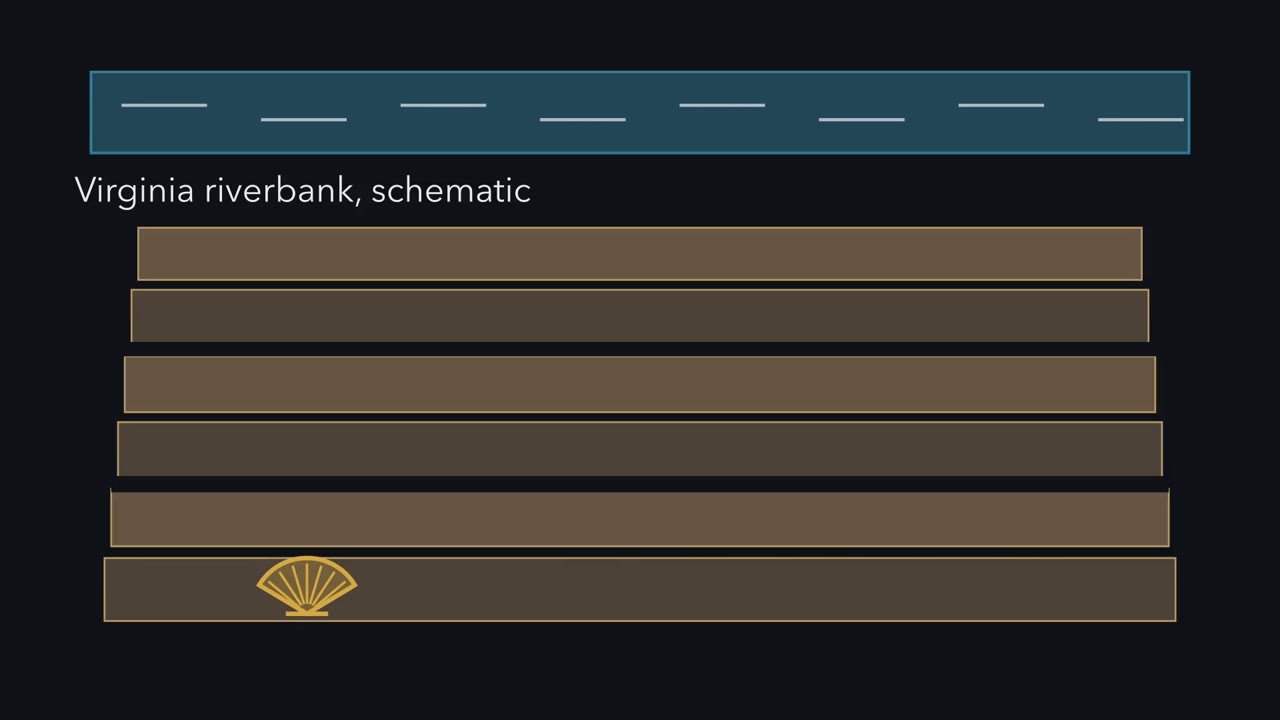 ▶ Watch What the Rocks Still Show · 3:30
Read the transcript of “What the Rocks Still Show”
Film transcript: What the Rocks Still Show
How can a record full of gaps still show that life changed? A fossil scallop rests inside a Virginia riverbank. Above it, a modern river crosses land that was once beneath a shallow sea. A fossil is the preserved remains or traces of past life. Shells, bones, teeth, and footprints can become fossils. Most remains rot or are eaten. Hard parts and quick burial improve the chance. The chance stays small. All fossils found so far make the fossil record. Because fossilization is rare, that record has gaps. A gap means some details are missing. It does not make the fossils beside it disappear. The pattern can survive. In undisturbed layers, read from older below to younger above.
Some kinds appear only in older rock. Some continue in changed forms. Sea shells inside inland rock also record an environment that is gone. Together, changes build history. Now remove one band of rock between two fossil layers. The lower layer holds one form. The upper layer holds a changed form. Does the missing band erase the pattern we can observe? Think before you decide.
No. We can still compare the fossils on both sides. The gap limits what we know between them, so keep it gray. Evidence stays honest when the picture shows both observations and uncertainty. Limits stay visible. Different groups also appear at different places on a time strip.
Fish, four-legged animals, mammal relatives, and bird-like dinosaurs have well-known early examples. They belong on separate branches, not one ladder. They are examples, not ancestors. Fossils record existence, extinction, change, and past environments. Each observation supports some claims and not others. A shell can place life in an old sea. It cannot name every branch by itself. Evidence needs clear scope. In science, a theory is a well-tested explanation backed by many lines of evidence.
Evolution explains why populations change and share ancestors. It also makes predictions that new evidence can test. That makes it testable. Return to the Virginia scallop. Its layer records a living thing and an ancient sea. Its resemblance to living scallops invites another question: which organisms share branches? Bones and sequences can test that next. The question continues. The record is incomplete, so every claim keeps its limits. Still, observed fossils remain evidence.
Across many layers, they show that life and environments changed through time.
From the film
- Fossils reveal life's change through time, even with gaps.
- Fossils are preserved remains or traces of living things from the past.
- Fossils record past life, extinction, change and environments.
- A gap limits the story but does not erase the evidence around it.
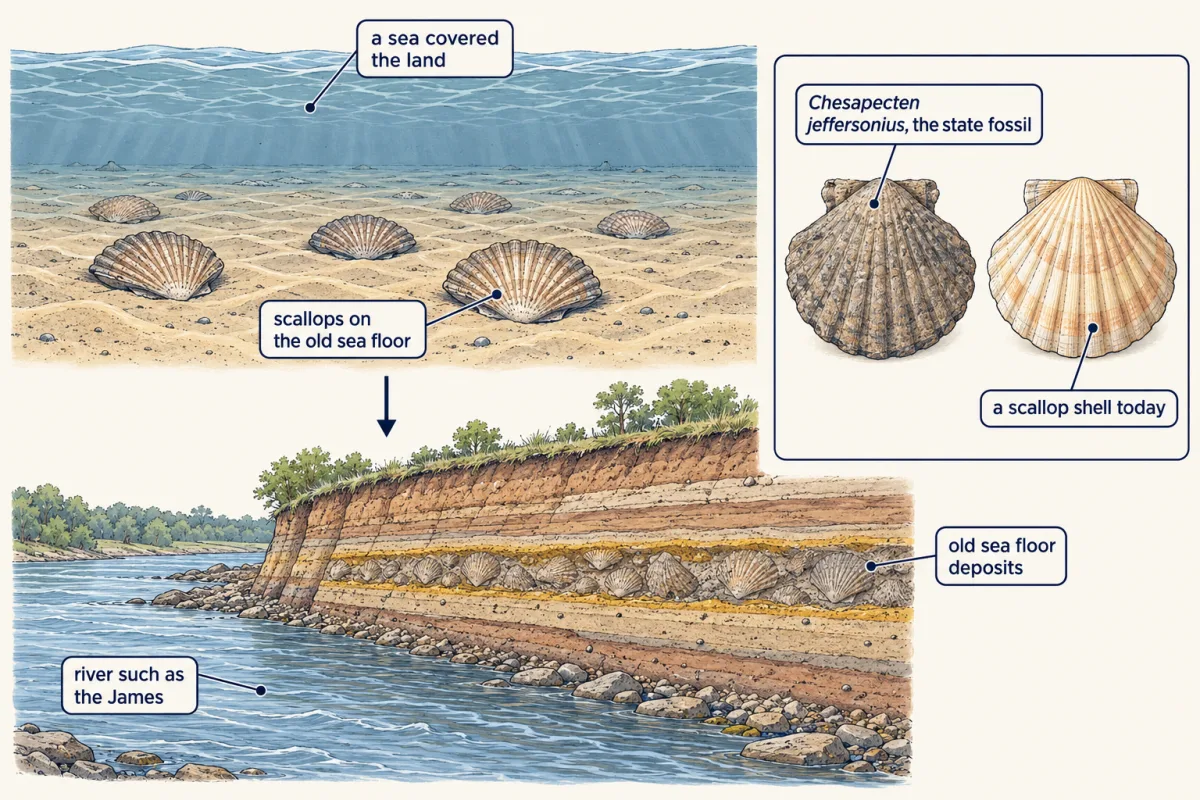
Virginia’s state fossil is a scallop shell called Chesapecten jeffersonius. It is millions of years old, yet it looks much like a scallop shell on a beach today. These fossils come from old sea-floor deposits that show along Virginia rivers such as the James. What can old shells, bones and sequences tell us about life’s history?
What do you think? Decide before you read.
-
Scientists disagree: In everyday talk, a theory is a hunch. In science, a theory is a well-tested explanation backed by a lot of evidence. It also makes predictions. For example, it predicts that close relatives will have similar DNA, and when scientists check, they do.
What scientists think
Scientists disagree: In everyday talk, a theory is a hunch. In science, a theory is a well-tested explanation backed by a lot of evidence. It also makes predictions. For example, it predicts that close relatives will have similar DNA, and when scientists check, they do.
-
Scientists disagree: Humans and chimpanzees share a common ancestor that lived millions of years ago. After the split, each group changed along its own branch. Neither one turned into the other, so both can be alive today. Their DNA is very alike, which fits a shared ancestor.
What scientists think
Scientists disagree: Humans and chimpanzees share a common ancestor that lived millions of years ago. After the split, each group changed along its own branch. Neither one turned into the other, so both can be alive today. Their DNA is very alike, which fits a shared ancestor.
-
Scientists disagree: Most dead plants and animals rot or get eaten. Fossils form only in special conditions, such as quick burial in mud or sand. So the record has gaps, but the fossils we have still show clear patterns of change.
What scientists think
Scientists disagree: Most dead plants and animals rot or get eaten. Fossils form only in special conditions, such as quick burial in mud or sand. So the record has gaps, but the fossils we have still show clear patterns of change.
- evidence
- fossil
- fossil record
- extinct
- common ancestor
- DNA sequence
- hypothesis
- theory
Evidence is information from observations or measurements that supports or argues against an idea. The first film defined a fossil, the preserved remains or traces of a living thing from the past, and showed why the fossil record, all fossils found so far, has gaps.
Read the fossil record
Here are the four patterns from the first film, in Virginia:
- Existence and diversity. Many kinds of life lived that are not alive now.
- Extinction. A group is extinct when no living members are left. Trilobites, extinct sea animals with hard shells, are found in western Virginia rocks.
- Change. Old forms look like, but are not the same as, living ones. The state fossil scallop is one example.
- Environments. Sea shells in Virginia’s coastal plain show that a shallow sea once covered that land.
The early fossils in this table sit on separate branches, not on steps in one line of ancestors.
| Group | Example fossil and place | About how old (millions of years) |
|---|---|---|
| Fish | Haikouichthys, China | about 518 |
| Four-legged animals | Ichthyostega, Greenland | about 365 |
| Mammal relatives | Morganucodon teeth | about 205 |
| Bird-like dinosaurs | Archaeopteryx | about 150 |
Predict. Does the oldest fossil found show the exact day its group began?
Check your prediction
No. It shows that the group existed by then. Some groups have older fossils than these, and new finds can push dates back.
Compare the same parts
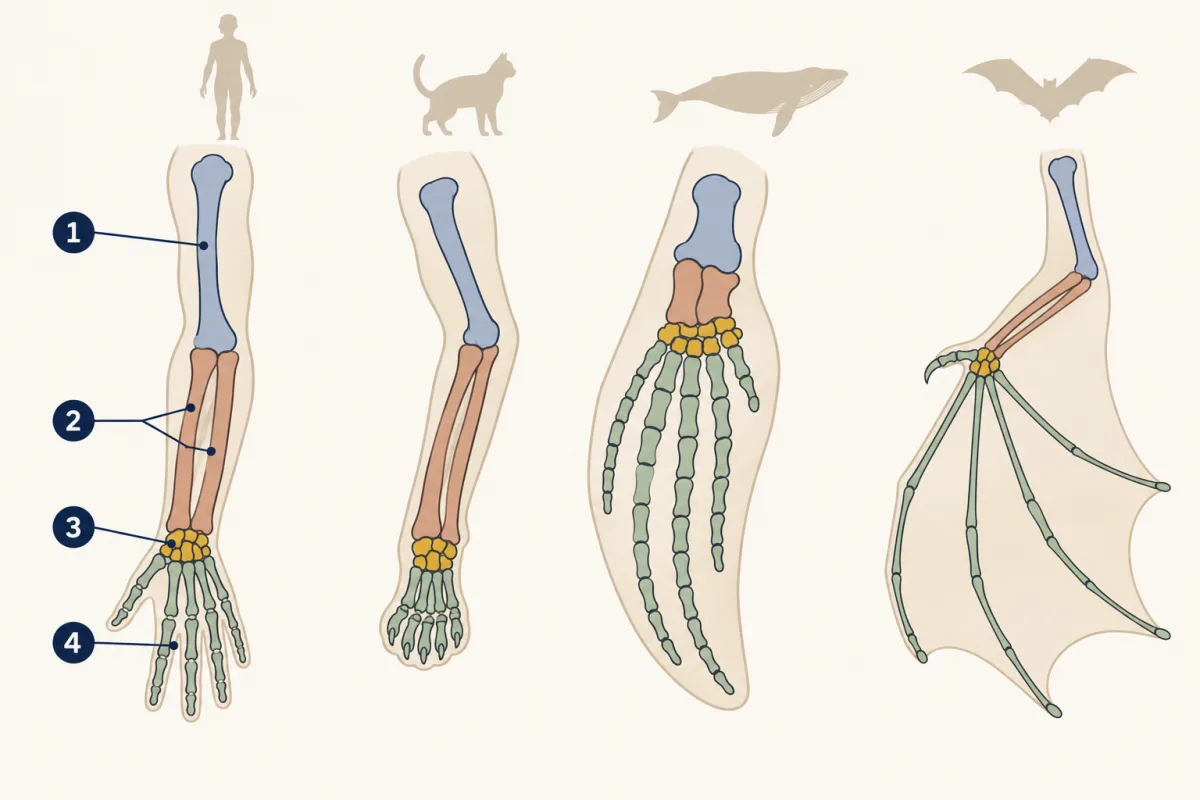
Hold out your arm. It has one upper arm bone, two lower arm bones, wrist bones and finger bones. A cat’s front leg, a whale’s flipper and a bat’s wing have the same set. Their shapes, sizes and jobs differ.
A common ancestor is an early population that two or more kinds of living things came from. Inherited changes can reshape an old set of parts, so a shared ancestor with this bone map explains the match best.
- upper arm bone
- two lower arm bones
- wrist bones
- finger bones
- upper arm bone
- blank
- blank
- finger bones
Word bank: two lower arm bones, wrist bones
- blank
- blank
- blank
- blank
Check your labels
- upper arm bone
- two lower arm bones
- wrist bones
- finger bones
Predict. A butterfly wing and a bird wing both fly, but only the bird wing has bones. Does the shared job show that they are close relatives?
Check your prediction
No. The job is alike, but the build is different. Scientists compare how parts are built and where they sit.
The second film adds an independent test and asks what to do when two tests disagree.
Read the transcript of “Two Clues, One Family Tree”
Film transcript: Two Clues, One Family Tree
How can a bat wing and a protein point to the same relatives? The first film used fossils to track change through time. Now we will test relationships among the branches. A common ancestor is an earlier population from which later groups came.
Picture one branch splitting. Each new branch inherits old features, then changes in its own direction. A human arm, cat leg, whale flipper, and bat wing have an upper bone and paired lower bones. Wrist and finger bones follow. Shapes and jobs differ, but positions match. Scientists compare construction and position, not only jobs.
Inherited changes can reshape an old set of parts. That shared bone map points back toward a common ancestor. Sequences offer a test. A DNA sequence is the order of its bases. Many genes carry instructions for proteins. Scientists can line up the same protein from several species, position by position. Some inherited DNA changes remain in later populations. Branches split at different times, so closer relatives usually have more similar sequences. Usually matters.
Changes do not build up at one steady rate. Now test two clues. Species A and B share a blue structure that C lacks. A teal protein strip joins A with C. Have the clues agreed, and should any branch turn green yet? No. The clues support different groupings. Keep the branches gray, check the comparison, and collect more evidence. A conflict is not something to hide. It is a question to investigate. Now a different case. Two species share a structure that a third species lacks. The protein strip groups that same pair. When independent clues agree, their shared branch is the stronger explanation. This is how a scientific theory earns trust. Each line of evidence could have told a different story.
Evolution predicts broad agreement among fossils, structures, and sequences. Their broad patterns largely agree. One limb or one small protein cannot settle every relationship. Similar jobs can evolve in different structures.
Scientists compare more body parts, more sequences, and the fossil record. Return to the family tree. Matching parts show inherited construction. Similar sequences in the same protein add an independent check. When both fit one branch pattern, common ancestry explains the match best. The clues do different jobs. Fossils place life in time.
Bones of living and fossil animals, plus sequences, test relationships. Their broad agreement supports evolution, while every uncertainty stays visible and open to testing.
From the film
- Matching structures and protein sequences point to common ancestry.
- Compare body parts by their construction and position, not only their job.
- Fewer differences in the same protein usually point to closer relatives.
- When clues conflict, scientists check more evidence.
- When independent clues agree, their shared branch is the stronger explanation.
Compare sequences
A DNA sequence is the order of the bases A, T, C and G along a piece of DNA. Many genes carry the code for a protein, as you saw in DNA: The Code of Life, so a protein difference comes from a difference in its gene’s DNA.
The second film said closer relatives usually have more similar sequences. “Usually” matters: changes do not build up at one steady rate, and one short protein is not a complete family tree. DNA also helps sort living things into groups, as in Domains, Kingdoms and DNA.
Explore: build an evidence board
Pick two living things and one kind of evidence, then place the pair on a family tree.
- 1 upper arm bone
- 2 two lower arm bones
- 3 wrist bones
- 4 finger bones
Made up in this sketch: the bone sizes, the shape of the tree (cat, whale and bat share one branch point because the lesson does not put them in order; fish is drawn outermost), the limit of four pairs, and which table row each animal uses (human, chimpanzee, cat, whale and bat use mammal relatives; chicken uses bird-like dinosaurs; fish uses fish). The order of the other joins is not from the lesson. The fossil ages and the protein counts are the lesson’s table values.
Keep this rule: scientists check fossils, bones and DNA together, and when they agree they are strong signs of a common ancestor. A join nearer the tips means a more recent common ancestor. This is a sketch of that logic, not a real tree.
Try this.
- Predict whether a whale’s flipper has the same bones as your arm. Choose whale and human, pick bones, and check.
- Predict which is the closer relative of humans, a chicken or a chimpanzee. Use the DNA bars to test it.
- Predict where a fish will join the family tree. Look at the fossil timeline, then place it on the tree and see.
Work with real protein data
Cytochrome c is a small protein that helps your cells release energy from sugar. Many animals make it. The table counts how many of its 104 positions differ from the human protein.
| Animal | Differences from human (out of 104 positions) |
|---|---|
| Human | 0 |
| Chimpanzee | 0 |
| Rhesus monkey | 1 |
| Mouse | 9 |
| Dog | 11 |
| Horse | 12 |
| Chicken | 13 |
| Eastern diamondback rattlesnake | 15 |
Source: one reviewed cytochrome c sequence per animal from the UniProt protein database, retrieved in October 2026 and compared position by position for this lesson.
Predict. Based only on this protein, which two animals differ from humans the least? Which differs the most?
Check your prediction
Not counting humans, chimpanzee and rhesus monkey differ least; the rattlesnake differs most. This broad pattern fits common ancestry, but one protein cannot settle every relationship by itself.
- How many positions match between the human and horse proteins?
- The chicken differs from humans at 13 positions and the rattlesnake at 15. Is a gap of two enough to decide which is closer to humans?
Predict. Chimpanzees show no differences in this protein. Does that mean their whole DNA is the same as ours?
Check your prediction
No. This table compares one small protein, not the whole genome. Other genes should be checked too.
- The animal with the fewest differences is blank, so it is probably blank.
- This fits the bone evidence because blank.
- One limit of these data is blank.
Claim, evidence, reasoning
Make a claim about which animals in the table are the closest relatives of humans. Use the protein data and one other kind of evidence from this lesson.
Start with: The closest relatives of humans in this table are blank.
Start with: The blank protein differs from ours at blank of 104 positions, while blank differs at blank. The arm bones of blank also blank.
Start with: Fewer differences mean blank, because blank. The bones agree because blank.
Compare with a model answer
Chimpanzees and rhesus monkeys are the closest relatives of humans in this table. Their cytochrome c differs from ours at 0 and 1 of 104 positions, while the chicken differs at 13 and the rattlesnake at 15. Changes in DNA build up over time, so species that split more recently share more of the same sequence. Monkeys and apes also have arm bones like ours. So do the other mammals, so the bones show shared ancestry, and the protein data show which animals are closest. One limit: this is one small protein from one animal of each kind, so other genes should be checked too. Do not use this one protein to call the chicken closer than the rattlesnake. Birds and snakes split from our line at the same branch point, so they are equally related to us. The protein just changed a little more on one of their branches.
Saved in this browser only.
Why scientists call it a theory
A hypothesis is a possible explanation that a test can support or reject. A theory, as the first film said, is a well-tested explanation backed by many lines of evidence, and it makes predictions that can be checked.
The theory of evolution says that populations change over time and share common ancestors. Natural selection is one important cause, as you saw in Natural Selection in Action; new mutations and chance also change populations. The theory predicts broad agreement among fossils, structures and sequences. Each could have told a different story. Instead, their broad patterns largely agree; when details conflict, scientists check more evidence.
Design problem: model burial and decay
Hard remains and fast burial make fossils more likely. This model tests only short-term decay.
Predict. Which should break down less: an apple slice buried in damp sand, an unburied slice, or a shell?
One way to test it
- Question: Do apple slices (soft remains) rot less when buried in damp sand than when left unburied on top of the same damp sand? Do shells change at all?
- Independent variable: buried under 3 centimetres of damp sand, or laid unburied on top of the same damp sand.
- Dependent variable: a rot score after 7 days, from 0 (fresh) to 3 (very soft, mouldy or smelly). Mass can mislead, because slices can dry out or pick up water and sand.
- Constants: the same slice size, cups, water and room.
- Control: unburied slices. Cover every cup the same way. Add clean shells to both groups as a hard-part check.
- Trials: five cups of each kind; find the mean rot score.
- Safety: use clear covered cups, wear gloves, never taste anything, and let the teacher discard anything mouldy. Wash your hands.
If buried slices score less rotten, burial slowed decay in this model. They may not, since damp sand still lets air in. Real fossils form best when remains are buried fast in fine mud with little oxygen and no scavengers, which this model leaves out. Shells should barely change. This is not real fossil formation, which takes thousands of years or more.
Going deeper: Virginia’s changing coast
The shallow sea recorded by the state fossil was here long before the Chesapeake Bay. The Bay began to fill as sea level rose after the last ice age, about 10,000 years ago. The old shells and the younger Bay record different changes in the same region.
Evaluate: check your thinking
Return to the guiding idea: fossils reveal life’s change through time, even with gaps; matching structures and protein sequences point to common ancestry. The state fossil scallop looks much like living scallops because scallops share common ancestors and have changed over time.
Science practices you used: asking a testable question, planning a fair test with a control, telling a hypothesis from a theory, and making a claim from evidence and reasoning.
Your notes
Select any text in the lesson to highlight it or add a note to it. Your highlights and notes are saved in this browser and collected in your notebook.
This browser is not letting the site save anything (a private window or strict privacy settings), so highlights and notes will be lost when you leave the page.
How we measure it
Comparing protein sequences
Scientists line up the same protein from two species, position by position, and count the places where the building blocks differ. Fewer differences in the same protein usually point to closer relatives.
Comparing bones
Scientists lay the bones of living and fossil animals side by side and match each bone by its place and shape, not by its job. Matching sets of bones are evidence of a shared ancestor.
Collecting and describing fossils
Scientists record where in the rock each fossil was found and describe its parts. Comparing fossils with living things shows which kinds of life changed and which went extinct.
Where this lesson fits
Before thisReview first
- DNA: The Code of LifeThis course · Lesson 27
This lesson compares protein differences that come from DNA differences, so you need to know DNA codes for proteins.
- Natural Selection in ActionThis course · Lesson 32
Here you use the idea that populations change over time through natural selection to explain why old and living forms differ.
- Domains, Kingdoms and DNAThis course · Lesson 8
You need to know how DNA evidence helps sort living things into groups before using it to judge relatives.
After thisStudy next
- Extinction and SurvivalThis course · Lesson 34
It uses the fossil pattern of groups dying out and asks what causes extinction and what lets others survive.
Elsewhere on the siteFilms, simulations and method films in other courses
- Rock layers and DNASimulation · Biology
Its rock layers and DNA simulation lets you test fossil and DNA clues for the same ancestry.
- Which Similarities Reveal Relatives?Film · Biology
It shows how shared traits point to the closest relatives, as you do with bones and proteins.
Suggested by an AI model from the lessons themselves, then checked. How we use AI
Finish line
Test yourself
8 questions
Practice and MCAT-style, with explained answers.
Next · Lesson 34
Extinction and Survival
American chestnut trees were once common in Virginia’s Blue Ridge. Why did a fungus nearly wipe them out, while their roots still send up sprouts today?
Continue →