The First Split
Read the transcript of “The First Split”
Film transcript: The First Split
A pond drop may hold cells from across life. Which question should we ask first? The cells drift together, but a useful key needs an order. We will follow one mystery cell and let each answer open the next path. Start with what a light microscope can show about cell organization.
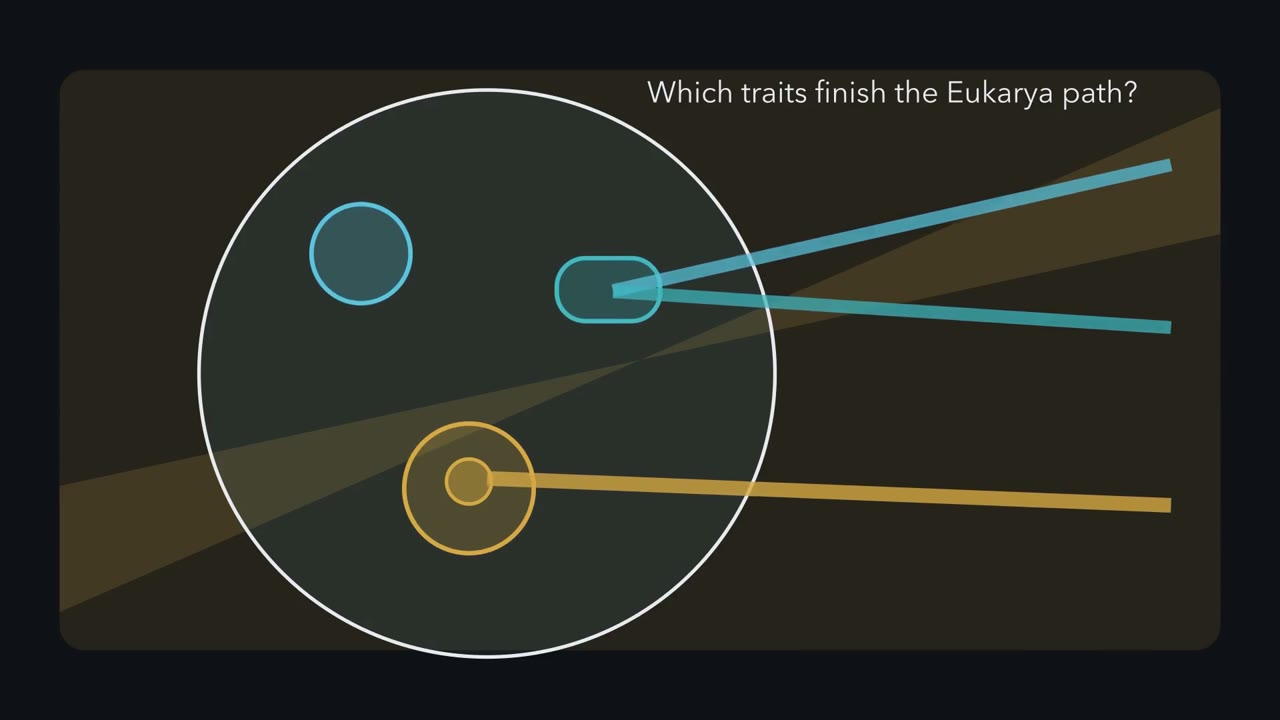
A nucleus is a membrane-wrapped compartment holding the DNA. If the cell has one, it belongs in Eukarya. If it does not, the organism is a prokaryote. Its DNA sits in the cytoplasm. Our mystery cell has no nucleus. That rules out Eukarya, but Bacteria and Archaea remain. Both domains are made up of prokaryotes. Most are single cells, though some grow in chains or filaments. Under a classroom microscope, members of these domains can look alike. Look at these nucleus-free cells. Their shapes and sizes appear similar. Can the microscope alone place one in Bacteria and the other in Archaea? Choose yes or no, and name the evidence you trust.
No. Appearance has reached its limit, so the key must change evidence. Ribosomal RNA offers one test. Every cell uses this molecule to build proteins. Its sequence patterns differ between Bacteria and Archaea. Picture each sequence as a labelled strip, not a molecular structure. Matching positions line up while differences flash.
Scientists compare these patterns to judge relatedness. Early comparisons separated methane-making microbes from typical bacteria. Where looks failed, the molecules still differed. Cell chemistry adds another route. Most bacteria have peptidoglycan in their walls.
Archaeal walls have none. In a membrane lipid, a chemical link holds the fatty tails. Typical bacteria use ester links; typical archaea use ether links. No single sketch proves identity. Use the full pattern of evidence. Now the mystery cell carries an archaeal sequence pattern, no peptidoglycan, and typical ether-linked membrane lipids. Together those traits support Archaea. A different pattern would support Bacteria. The gate opens only when the evidence supports the placement. Place the domains on branches, not steps.
Sequence comparisons show relatedness, not a ladder from simple to advanced. All branches share a root. The course drawing is simplified. Archaea and Eukarya are more closely related to each other than either is to Bacteria. This path has a limit. It places an unknown in the course's domain scheme; it does not identify every species. Keep the method, not a picture of rank. Classify by ordered traits; where looks fail, use molecular evidence.
One drop of pond water can hold organisms from all three domains of life. Which questions would you ask to tell them apart?
Continue in the lesson: Domains and Kingdoms →
3:36 · Free, with captions and a transcript. The lesson has the full text, the questions and the sources.
More films from this lesson
How this film was made. Narration: written from this lesson's text and read by an AI narrator voice (Kokoro, af_heart). Animation: AI-generated in code (Manim) by Claude, a schematic with no drawn molecular structures. Captions come from the narration script. See something wrong? Report it.