Life Science · Unit 3: Energy for life
Photosynthesis Feeds the World
Rewritten on : new text, flashcards and film. Your notes and highlights stay, but the text around them may have moved.
How can a tiny seed become a giant tree without the soil shrinking by the same amount?
Pause when the reading reaches a film, and offer to play it. Saved on this device.
Watch the film now, or keep listening
Builds on:Plant Cells and Animal CellsInside a CellWhy these?
Where this lesson sits
- Virginia SOL LS.4 a
- Virginia SOL LS.4 b
- Practices LS.1 b, LS.1 c, LS.1 d, LS.1 e
Essential question: A giant tree starts as a tiny seed, so where does all that wood come from?
-
Life Science (grade 7) LS.4 a, LS.4 b You are here
This lesson
-
Biology
Preview it at high school level
In Biology you will write photosynthesis with chemical formulas and balance it, so the same atoms appear on both sides. You will track where each kind of atom goes. One surprise: the oxygen a plant gives off comes from the water it took in, not from the carbon dioxide. You will follow the plant’s sugar as it is linked into long chains called starch and cellulose. You will also study light, carbon dioxide and temperature as limiting factors, using real survey data on underwater grasses in the Chesapeake Bay and how much light reaches them.
-
Biology II Biology II: Advanced Survey of Biology Topics, BIOII.3 b; Ecology, EC.3 a
Preview where it goes next
In Biology II: Advanced Survey of Biology Topics (BIOII.3 b), the single equation splits into two linked stages. In the first, light is captured, water is split and energy is held in carrier molecules. In the second, a cycle of reactions uses that energy to build sugar from carbon dioxide. The Ecology course (EC.3 a) scales up to whole ecosystems: how much new plant material the producers in a forest or a bay make each year, and how much of that energy reaches consumers.
-
College
 ▶ Watch What Becomes a Tree? · 3:26
Read the transcript of “What Becomes a Tree?”
Film transcript: What Becomes a Tree?
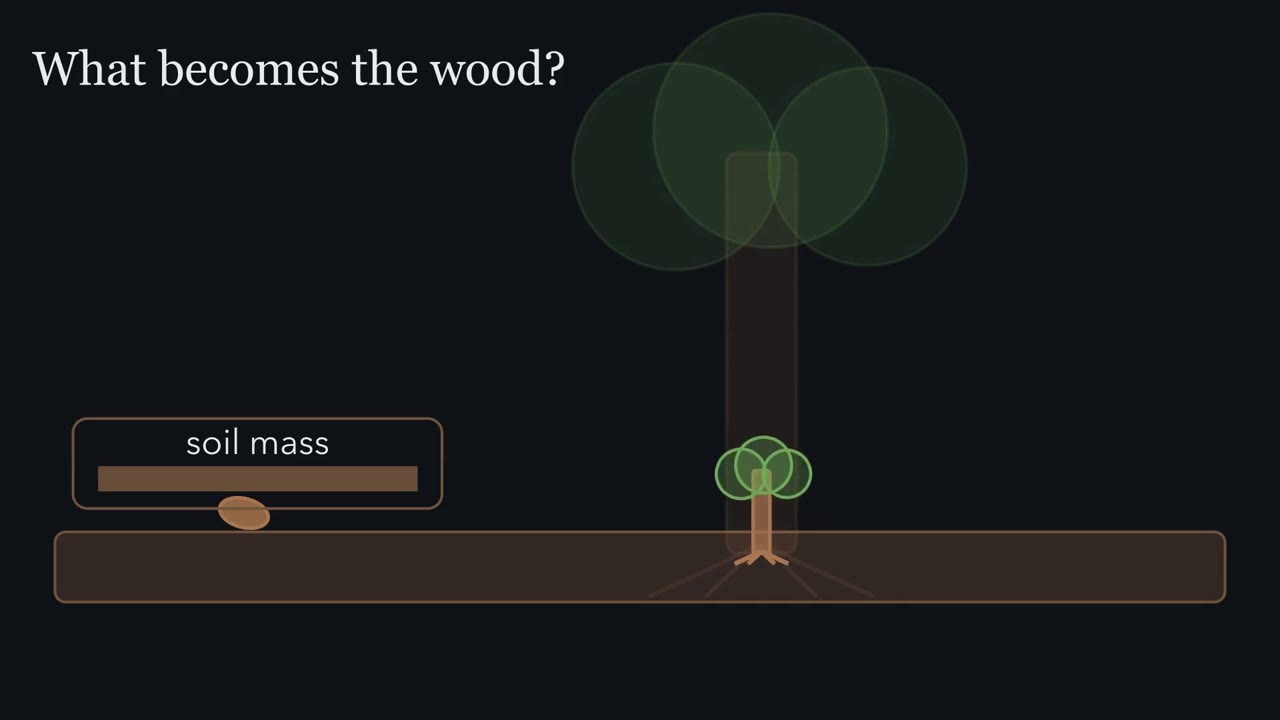
A seed can become a huge tree while the soil hardly shrinks. What becomes the wood? Watch one tiny seed beside a growing trunk. The tree gains layer after layer. The soil gauge barely moves. Something outside the soil must supply most of that new material.
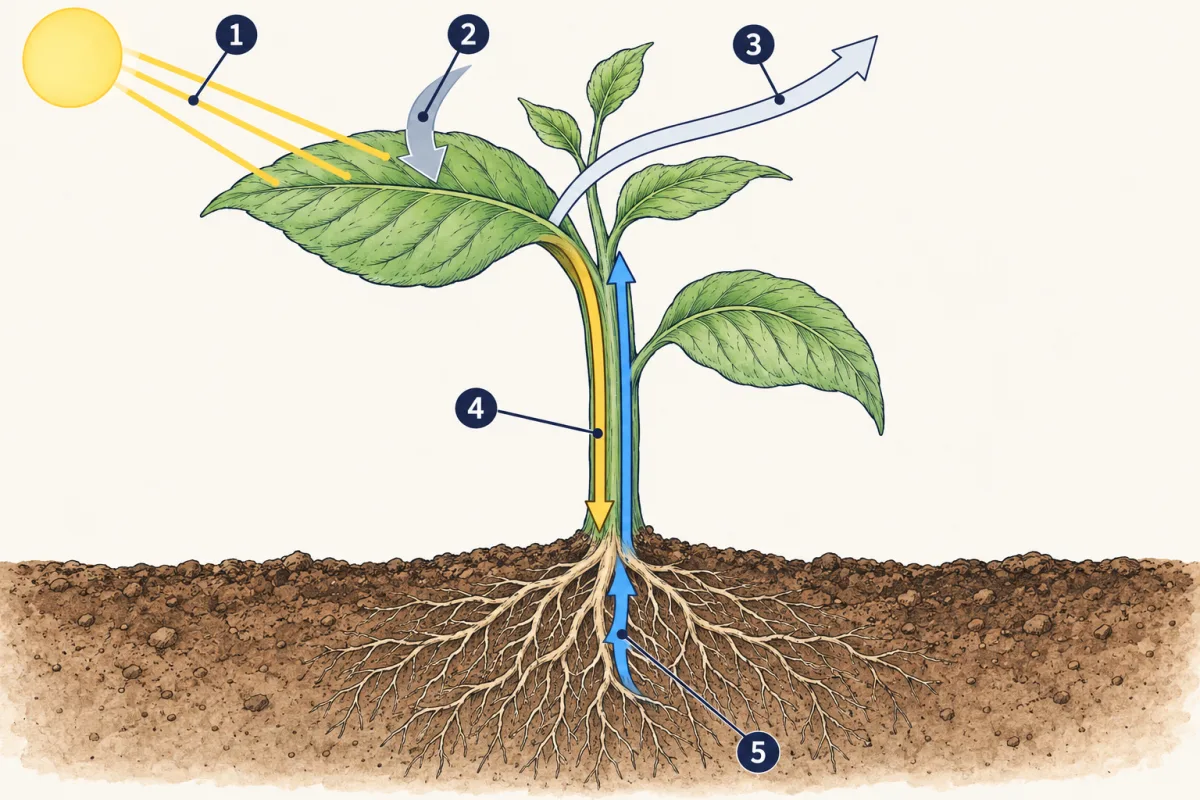
Start by sorting matter from energy. Matter has mass and can become part of the tree. Energy can move or change form, but it does not become wood. Sunlight reaches the leaf as radiant energy. It powers the building, the way electricity runs a factory's machines without becoming part of the product. Water enters through roots and moves upward.
Carbon dioxide enters leaves from the air. Light arrives at those leaves too. The plant uses the light energy to build sugar from carbon dioxide and water. Oxygen leaves as another product. The word equation is a summary, not one single step. Now predict. Which paths carry matter that can enter the trunk? Which path carries only energy? Follow each colour before the tree grows again.
The teal carbon dioxide and blue water paths carry matter. The gold light path carries energy. Light powers sugar-building from carbon dioxide and water; conditions limit its speed. The first half explains what can become wood. The second half reminds us that building cannot always run faster. In plants and algae, this work happens inside chloroplasts. Chloroplasts are green parts of some cells, mostly in leaves. Chlorophyll inside them captures radiant energy.
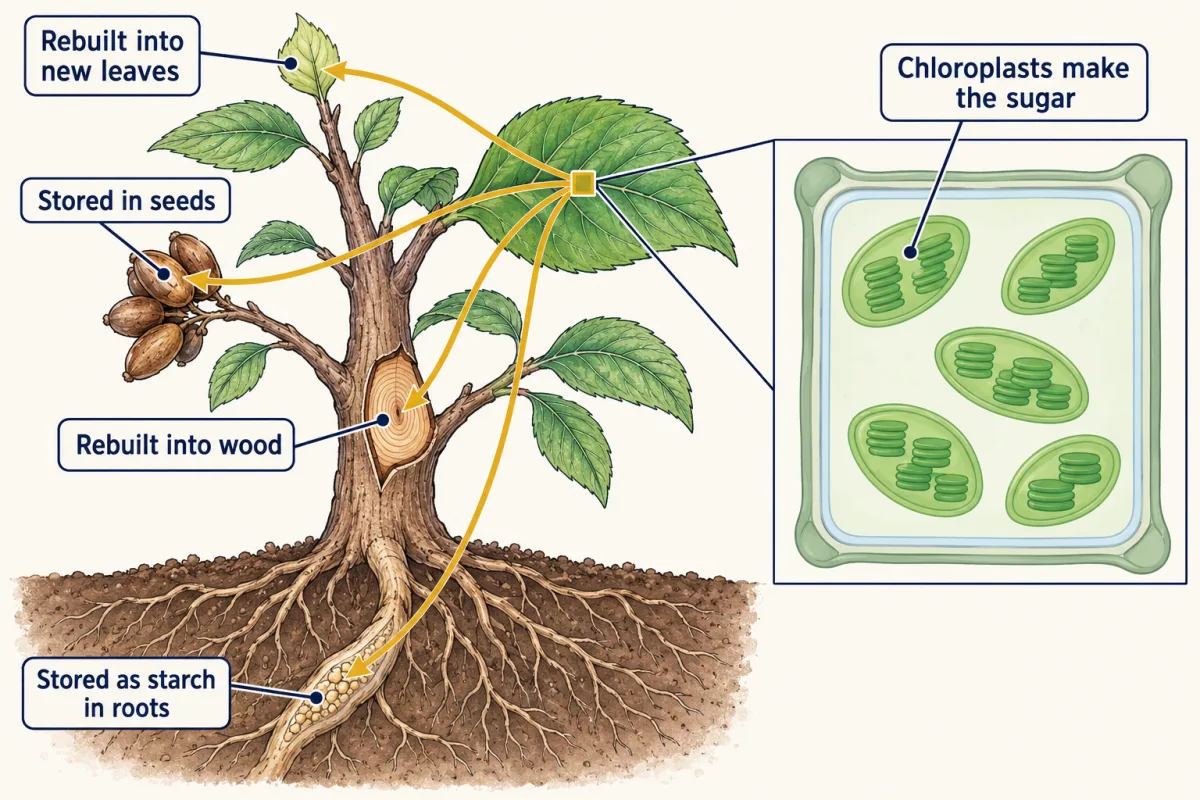
Roots, which sit in darkness, usually have no chloroplasts. Photosynthetic bacteria do the work without chloroplasts. Sugar does not have one destination. Some is used now as cells release energy for living. Some is linked into starch and stored. Some is rebuilt into wood and new leaves. Each route starts with the same green sugar block made in the leaf. That stored chemical energy can move through a food web. A rabbit eats clover, and a fox eats the rabbit. Both depend on energy captured by a producer.
Almost every food web begins this way. A few communities use chemical energy instead of light. Return to the tree. Its soil did not need to become the trunk. Matter arrived mainly as carbon dioxide, with water also supplying atoms.
Light supplied the energy for building sugar. Light supplies the energy; carbon dioxide and water supply the matter. The plant then used that sugar to make living material and feed other life.
From the film
- Light powers sugar-building from carbon dioxide and water; conditions limit its speed.
- Light supplies the energy; carbon dioxide and water supply the matter.
- Chloroplasts use chlorophyll to capture light energy and make sugar.
- Plants use sugar now, store it as starch or rebuild it into new material.
The first film argued that soil is not what becomes the tree. Test that with real numbers. On average, a tulip poplar seed weighs less than a tenth of a gram. In a Virginia forest, one tulip poplar held an estimated 10,000 kilograms of dry wood. If that material came mainly from soil, the soil should have lost a similar mass. Check your starting ideas before you see the evidence.
What do you think? Decide before you read.
-
Scientists disagree: When scientists dry and weigh soil before and after a plant grows, the soil hardly changes while the plant gains a lot. Roots take in water and small amounts of minerals. Most of the solid material in a plant is built from carbon dioxide taken from the air.
What scientists think
Scientists disagree: When scientists dry and weigh soil before and after a plant grows, the soil hardly changes while the plant gains a lot. Roots take in water and small amounts of minerals. Most of the solid material in a plant is built from carbon dioxide taken from the air.
-
Scientists disagree: Plants make their own food, a sugar called glucose, in their leaves. Fertilizer adds minerals such as nitrogen and potassium. Plants need these minerals to stay healthy, but minerals do not give the plant energy.
What scientists think
Scientists disagree: Plants make their own food, a sugar called glucose, in their leaves. Fertilizer adds minerals such as nitrogen and potassium. Plants need these minerals to stay healthy, but minerals do not give the plant energy.
-
Scientists disagree: Sunlight is energy, not matter, so it cannot become leaves or wood. The plant uses the energy of light to join carbon dioxide and water into sugar. The light supplies the energy and the air and water supply the matter.
What scientists think
Scientists disagree: Sunlight is energy, not matter, so it cannot become leaves or wood. The plant uses the energy of light to join carbon dioxide and water into sugar. The light supplies the energy and the air and water supply the matter.
Explore: grow a plant in a test chamber
In this virtual lab, you turn three dials on a plant in a clear growth chamber: light brightness, carbon dioxide in the air, and temperature. A counter shows oxygen bubbles, and a bar shows how much sugar (glucose) the plant makes each hour. A small graph traces the rate, how fast the plant makes sugar. The simulation uses smooth made-up curves, so look at the shape of each graph, not the exact numbers.
The line shows the rate as that one dial moves and the other two stay where you set them. The orange dot is your setting.
Move a dial and watch the bubbles, the sugar bar and the graph.
In this sketch the curves are smooth and made up, water never runs short, the plant is one block with a leaf, and every number is in relative units. The ends of the temperature graph are made up. Look at the shape of each graph, not the exact numbers.
Rule to keep: more light or more carbon dioxide speeds up photosynthesis only up to a point, then another factor holds it back, and too much heat slows it down.
Try this.
- Predict what happens to the bubble count as you turn the light from dim to very bright. Then test it. Does the rate keep rising?
- Set the light very bright. Now raise the carbon dioxide. Predict first: will the rate go up again?
- Hold light and carbon dioxide steady and move the temperature from cold to warm to very hot. Write your prediction, then run it.
Explain: how a plant makes its own food
- producer
- photosynthesis
- radiant energy
- chemical energy
- chloroplast
- chlorophyll
- sugar (glucose)
- rate
The first film sorted matter from energy; here are the words for it. A producer is a living thing that makes its own food: green plants, algae and phytoplankton. Phytoplankton are tiny producers that drift in water, including algae and some bacteria. Photosynthesis uses radiant energy, the energy that travels as light, to build sugar and oxygen from carbon dioxide and water. In words:
carbon dioxide + water + radiant energy → sugar (glucose) + oxygen
Sugar (glucose) is a small sugar molecule that stores energy. Light supplies the energy; carbon dioxide and water supply the matter. Energy is not made or destroyed here. The plant transfers some radiant energy into chemical energy, energy stored in the way atoms are joined. Most of the rest leaves as heat. Sugar holds more chemical energy than the carbon dioxide and water used to build it.
- sunlight
- carbon dioxide
- oxygen
- sugar (glucose)
- water
- sunlight
- blank
- blank
- blank
- water
Word bank: carbon dioxide, oxygen, sugar (glucose)
- blank
- blank
- blank
- blank
- blank
Check your labels
- sunlight
- carbon dioxide
- oxygen
- sugar (glucose)
- water
Explain: where it happens and where the sugar goes
In plants and algae, photosynthesis happens inside a chloroplast, a green organelle found in some cells, mostly in leaves. Each chloroplast holds chlorophyll, a green pigment that captures radiant energy. Root cells, which sit in the dark, usually have none. Bacteria that photosynthesize have none at all. Plant cells and animal cells shows where chloroplasts sit.
The first film left out a surprise. Carbon dioxide enters leaves through tiny openings, and it is only a tiny part of air. Even so, it supplies most of a plant’s solid material.
Stored sugar is linked into starch and kept in roots, seeds and leaves. Releasing energy from food follows the use-it-now route, where cells break sugar down to release energy.
The first film’s clover, rabbit and fox show why photosynthesis feeds almost every food web. The exceptions are some communities around deep-sea vents and in a few caves. They use chemical energy instead of light, so “almost every” matters. Build the longer paths in Food webs and energy.
Evidence: the willow rules out soil
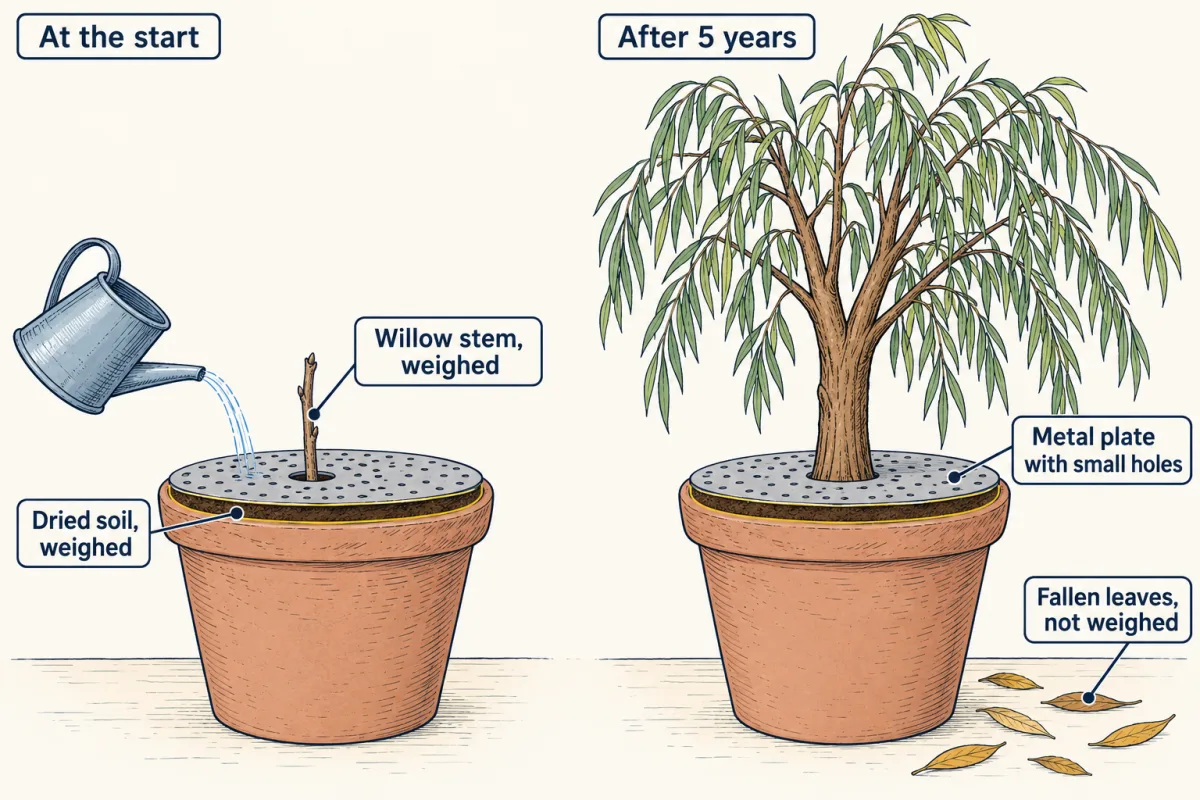
In the 1600s, van Helmont weighed dried soil and a willow stem. He supplied only water, covered the pot with a holed metal plate to keep out dust and weighed both again after five years. He did not weigh the leaves that fell each autumn.
| Measurement | Reported (pounds and ounces) | About (metric) |
|---|---|---|
| Willow stem at the start | 5 lb | 2.3 kg |
| Willow tree after 5 years | 169 lb and about 3 oz | 76.7 kg |
| Dried soil at the start | 200 lb | 90.7 kg |
| Soil lost after 5 years (dried again) | about 2 oz | about 57 g |
Source: van Helmont, Oriatrike (English edition, 1662), p. 109; one willow in one pot. Metric values are modern conversions.
Predict. Before calculating, compare the willow’s gain with the soil’s loss. Could the soil supply most of the new mass?
Check your prediction
The willow gained tens of kilograms, while the dried soil lost only grams. These measurements rule out soil as the main source. They cannot separate air from water, because van Helmont did not measure either one.
The next question is how fast a plant can keep building.
Read the transcript of “Why More Light Stops Helping”
Film transcript: Why More Light Stops Helping
The first film followed matter into sugar and wood. Now ask how fast that building can go. If light powers sugar-building, why can brighter light stop helping? Place the same plant inside a clear chamber. Its light dial starts low. A sugar meter waits beside it. We will change one condition at a time.
A rate tells how fast something happens. Here it tracks sugar made over time. Turn the light dial upward from dim. The gold beam brightens, and the green meter climbs. More light helps because light is holding the process back under these starting conditions. Keep turning the light dial. The curve still rises, but each equal turn adds less. Soon it bends toward a level stretch. The beam brightens again while the sugar meter barely moves. Light is plentiful now, so more light is no longer the main help. Predict before the next turn. If the light is already bright, will doubling it double the photosynthesis rate? Watch the curve and choose.
Here the rate changes little. Something else is now the tighter limit. A limiting condition holds a process back. When one condition becomes plentiful, a different one may matter more. The level curve reveals a limit, but it does not name that limit by itself. Carbon dioxide can limit the rate. Raising it may help after light stops helping.
Temperature also changes the rate. Warming can speed the process up to a point. Too much heat slows it down. These conditions interact, so the important limit can change. Light powers sugar-building from carbon dioxide and water; conditions limit its speed. This rule keeps two questions together. The first asks what supplies energy and matter. The second asks what controls the rate under these conditions.
Answering one does not answer the other. Real blueberry leaves show the same useful shape. At low light, added light raised carbon dioxide uptake strongly. At high light, much more added light changed uptake only a little. Those measurements show where light stopped being the main limit. They do not identify the next limit. Use a curve as a clue, not a slogan. A steep rise says the changed condition mattered strongly. A level stretch says more of it helped little. Then test another condition while holding the others steady. That is how a simple chamber becomes a fair investigation. When more light stops helping, something else is holding the rate back.
From the film
- Light powers sugar-building from carbon dioxide and water; conditions limit its speed.
- A limiting condition holds the photosynthesis rate back.
- More light helps most while light is the main limit.
- When more light stops helping, something else is holding the rate back.
Evidence: the blueberry curve
The second film plotted these blueberry measurements but skipped the value at zero light. Scientists clamped blueberry leaves in a gas analyzer at 20 °C and changed the light.
| Light (µmol of photons per m² per second) | Carbon dioxide taken in (µmol per m² of leaf per second) |
|---|---|
| 0 | −1.09 |
| 25 | 0.18 |
| 51 | 1.21 |
| 301 | 6.96 |
| 701 | 9.11 |
| 1,000 | 9.73 |
| 1,500 | 9.95 |
Predict. The zero-light value is negative. Does that mean photosynthesis ran backward?
Check your prediction
No. The leaf gave off carbon dioxide in the dark because its cells still released energy from sugar.
Source: Jorquera-Fontena, Alberdi and Franck (2014), blueberry leaves in normal air, Figure 4; approximate values read from that graph and posted in a table by Chen and colleagues (2016). See Going deeper for the study’s scope and curve details.
As the second film’s dials showed, light, carbon dioxide and warmth each help only up to a point (too much heat slows the rate), and they interact. A level curve shows that some other limit has taken over, but it does not name that limit.
Cells release the stored energy in respiration, and Partners in energy puts the two processes together.
Now use both data sets.
- How many kilograms did the willow gain? Compare that with the soil lost.
- How much did carbon-dioxide uptake rise from 51 to 301 light units? From 1,000 to 1,500?
- Where does the rate start to level off? What might be holding it back?
- The willow gained about blank while the soil lost only blank.
- When the light went from blank to blank, the carbon dioxide taken in blank.
- This shows that blank because blank.
Claim, evidence, reasoning
Make a claim that answers the essential question: where does a tree’s wood come from, and what limits how fast it is made? Use the willow and blueberry data.
Start with: Most of a tree’s solid mass comes from blank, and the rate of photosynthesis is limited by blank.
Start with: The willow gained about blank kg while the soil lost only blank g. In the blueberry leaves, uptake rose from blank to blank at low light but only from blank to blank at high light.
Start with: Photosynthesis builds sugar (glucose) from blank and blank using radiant energy, so blank.
Compare with a model answer
Most of a tree’s solid mass comes from carbon dioxide in the air, and light can limit how fast it is built. Van Helmont’s willow gained about 74 kg while the soil lost only about 57 g, so soil cannot explain the gain. Blueberry leaves took in much more carbon dioxide as light rose from 51 to 301, but almost no more from 1,000 to 1,500. So light limits the rate at first, then something else does. Limits: van Helmont had one tree, never dried it and never measured the air. His numbers rule out soil, but on their own they cannot tell air from water. The blueberry data come from one study.
Saved in this browser only.
Design problem
Plan an experiment to test how light affects the rate of photosynthesis in a water plant such as Elodea from a store. Name your variables, your constants, a control and how many trials you would run.
Predict. Moving a lamp closer can also warm the water. If bubbles increase, can you tell whether light caused the change?
Saved in this browser only.
Check your prediction
Not yet. Temperature may be a second changed variable. Measure and hold it steady, or the test cannot separate the effects of light and temperature.
One way to do it
- Question: Does the plant give off oxygen bubbles faster when a lamp is closer?
- Independent variable: distance from the lamp: 10, 20, 30 and 40 cm.
- Dependent variable: oxygen bubbles counted per minute.
- Constants: same length of plant, same amount of water and baking soda, same water temperature, same lamp. An LED lamp heats the water less than an old-style bulb, but check the water temperature with a thermometer at each distance.
- Control: one sprig in a tube wrapped in foil, so no light reaches it.
- Trials: three sprigs at each distance; find the mean bubble count.
- Safety: keep cords and lamps away from water. Wash your hands. Never pour the plant into a pond or stream, because it can spread.
If bubbles come faster as the lamp gets closer, then level off, light was the limit at first.
Evaluate: check your thinking
The tulip poplar’s wood came mostly from carbon dioxide in the air. Light supplied the energy; carbon dioxide and water supplied the matter. The tree rebuilt the leaves’ sugar into wood. Soil supplied water and a few minerals, so it did not need to shrink by thousands of kilograms. The blueberry curve adds the second half: when more light stops helping, something else is holding the rate back.
Science practices you used: making and testing predictions, planning a fair test with a control and repeated trials, doing simple math with data tables, and backing a claim with evidence and reasoning.
Going deeper
Sugar made inside the leaf, and the chemical equation
Inside the leaf, the plant first makes a smaller sugar, then builds glucose and other sugars from it. In chemistry this is written 6CO2 + 6H2O → C6H12O6 + 6O2, but you only need the words.
How much of air is carbon dioxide
Carbon dioxide is about 0.04 percent of air.
Where the blueberry curve comes from
The blueberry data are from leaves of four-year-old blueberry plants in an orchard in Chile. The study compared three pruning levels, and the curve used here is the conventional-pruning curve, with means of 12 leaves.
Your notes
Select any text in the lesson to highlight it or add a note to it. Your highlights and notes are saved in this browser and collected in your notebook.
This browser is not letting the site save anything (a private window or strict privacy settings), so highlights and notes will be lost when you leave the page.
How we measure it
Weighing before and after (with drying)
A balance measures mass at the start and the end of an experiment. Drying a sample first removes water, so the change in mass shows how much solid material was gained or lost.
Gas analyzer on a leaf
A leaf is clamped inside a small clear chamber, and an instrument measures how much carbon dioxide goes in and comes out. The difference shows how fast the leaf takes in carbon dioxide at each light level.
Laser scanning of trees
A scanner sends out laser light and records the shape of a whole tree in three dimensions. Scientists use that shape to estimate how much wood the tree holds without cutting it down.
Where this lesson fits
Before thisReview first
- Plant Cells and Animal CellsThis course · Lesson 3
It shows where chloroplasts sit in plant cells, which this lesson uses as the place where sugar is made.
- Inside a CellThis course · Lesson 2
You need to know what an organelle is before learning that the chloroplast is where photosynthesis happens.
After thisStudy next
- Partners in EnergyThis course · Lesson 11
It puts photosynthesis together with respiration to show how sugar and oxygen cycle through living things.
- Releasing Energy from FoodThis course · Lesson 10
It follows the sugar a plant uses now, showing how cells break it down to release energy.
- Food Webs and EnergyThis course · Lesson 12
It follows the sugar made by producers along the paths of energy through a food web.
Elsewhere on the siteFilms, simulations and method films in other courses
- Run a Fair Test With Your ChildFilm · Biology Together
It shows a fair test of whether a plant needs light and water to grow.
- Leaf-disk float raceSimulation · Biology
It lets you race leaf disks to see how light changes the rate of photosynthesis.
- A Tree Made of AirFilm · Biology
It follows the same willow puzzle and shows a tree's mass coming from carbon dioxide and water.
Suggested by an AI model from the lessons themselves, then checked. How we use AI
Finish line
Test yourself
8 questions
Practice and MCAT-style, with explained answers.
Next · Lesson 10
Releasing Energy from Food
Why do sprouting peas in a thermos get warmer than the room?
Continue →