Developmental Neuroscience · Unit 11: Rebuilding, evolving, and going wrong
Disorders of the Synapse: Built, Then Kept
Rewritten on : new text, figures, flashcards and film. Your notes and highlights stay, but the text around them may have moved.
Under review Parts of this lesson are still being checked.
- The paragraph on primate maternal immune activation models is being confirmed.
The text stays up while the check is done. If you spot a problem, report it. All lessons under review.
Switch a silenced gene back on in adult mice that already have symptoms, and many of the symptoms fade. If a circuit was built without a protein, is it wrong for good?
Pause when the reading reaches a film, and offer to play it. Saved on this device.
Watch the film now, or keep listening
Builds on:Building the Neuromuscular Junction: Agrin, Lrp4 and MuSKSynapses in the Brain: Adhesion, Scaffolds and AstrocytesOpening and Closing a Critical PeriodWhy these?
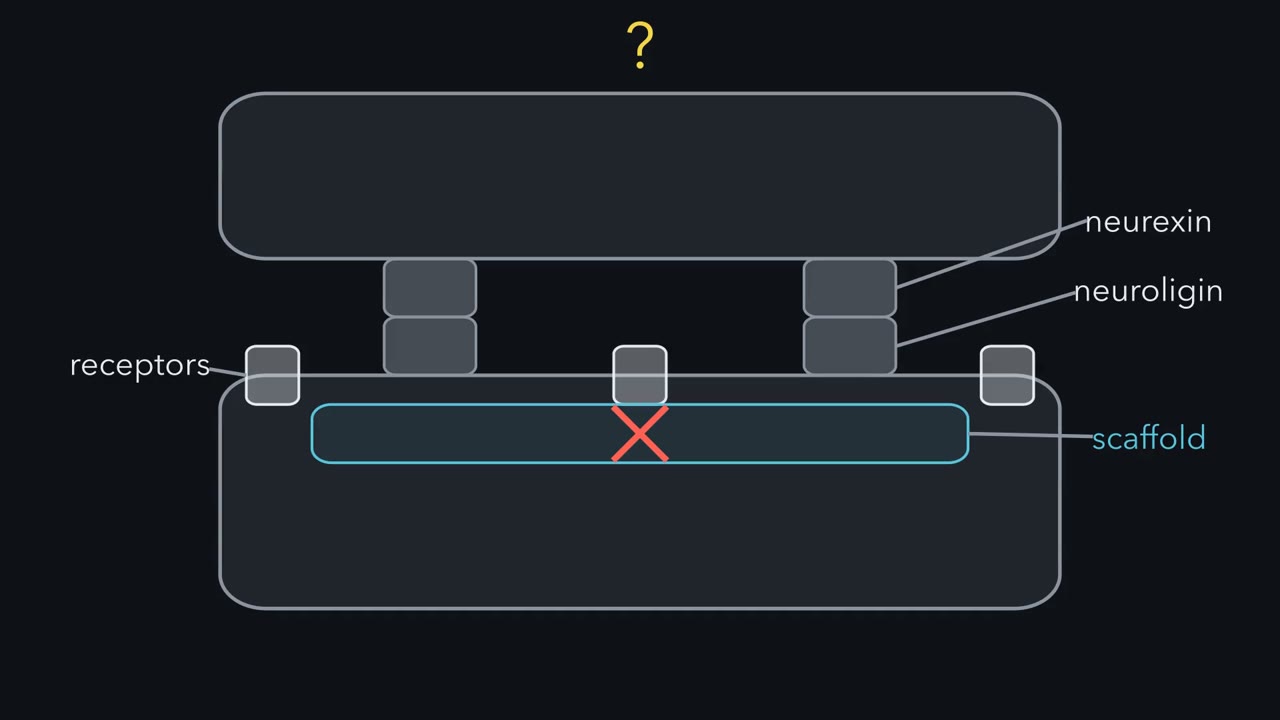 ▶ Watch Built, Then Kept · 2:26
Read the transcript of “Built, Then Kept”
Film transcript: Built, Then Kept
A circuit is built in development. If a child is born without one of its proteins, is the circuit wrong for good? Autism is diagnosed from behaviour, not from a gene, blood or scan test. Yet about a hundred genes now have strong evidence for a role in autism. Many fall into three jobs. Some build and hold the synapse. Some set how much protein a synapse makes. And some set which genes the neuron uses. The three jobs seem to meet at the synapse. Each can change what it is made of, and how strongly it responds. Much of building happens early, in windows that close. Picture a mouse born without one synapse protein, with symptoms by young adulthood.
One history: the protein was needed to build the circuit. The circuit was built wrong, and the window has closed. Another history: the circuit was built well enough. But it cannot run without the protein. The symptoms look the same either way. Predict. You can switch the gene on or off at any age. Which two late experiments would tell these histories apart?
First, put the gene back after symptoms begin. Second, take it away from a typical mouse, after its circuit is built. If the protein was needed only to build, and the damage cannot be repaired, both tests do nothing. If it keeps the circuit running, restoring it helps, and removing it harms. If it does both, restoring it may help fully, partly or not at all. Removing it still harms. A failed rescue is hard to read: the gene may have come back in too few cells, at the wrong level or too briefly, or the window may have closed. Deletion asks whether the adult circuit still needs the gene. You need both tests. Carry one idea through this lesson. Built, then kept. A synapse gene can be needed to build a circuit, to keep it running, or both.
Takeaway: restore the gene late, and delete it late. One asks if a trait can recover. The other asks if the adult circuit still needs it.
From the film
- A synapse gene can be needed to build a circuit, to keep it running, or both: built, then kept.
- Restoring the gene late asks whether a trait can still recover, and deleting it late asks whether the adult circuit still needs it.
- A failed rescue is hard to read, because the gene may have come back in too few cells, at the wrong level or too briefly.
Switch a silenced gene back on in adult mice that already have symptoms, and many of the symptoms fade.
The gene is Mecp2, the mouse version of the gene mutated in Rett syndrome. About a hundred genes now have strong evidence for a role in autism, and they are not a random list. Many build or run synapses, the junctions where neurons pass signals; many others control which genes a neuron expresses. Different genetic routes seem to converge on a few shared jobs in neurons. That raises the question this lesson answers: if these genes act on the synapses and circuits built during development, is the result fixed once they are built?
Built wrong, or not kept running?
Most of this course is about building. Neurons must gather in the right places, send axons to the right targets, win trophic support, and then build, prune and maintain their synapses. Much of that happens early, during windows that close.
Now picture a mouse born without one synapse protein. By young adulthood it has symptoms. Two histories could explain them. In one, the protein was needed while the circuit was built, the circuit was built wrong, and the window for building it has closed. In the other, the circuit was built well enough but cannot run without the protein. The symptoms look the same either way.
Predict. You can switch the gene on or off in a mouse at any age you choose. Which two experiments, done late, would tell these histories apart? What does each history predict for each experiment?
Check your prediction
Put the gene back after symptoms begin, and take it away from a typical mouse after its circuit is built.
| Gene’s role | Restore it late: does the trait recover? | Delete it late: do symptoms appear? |
|---|---|---|
| Needed only to build, and the built defect cannot be repaired | no | no |
| Needed only to keep the circuit running | yes | yes |
| Needed for both | not at all, partly or fully, depending on whether what was built can be repaired | yes |
The rows assume the gene really comes back, or goes, in enough cells at the right dose, that you wait long enough to see a change, and that long absence has not caused irreversible secondary damage. Deleting a build-only gene late does nothing because the circuit is already built and no longer needs it.
A late rescue shows that whatever was built can work again, not that it was built normally. A failed rescue has several readings: the window closed; the gene did not come back in enough cells, at the right level, or for long enough; or secondary damage prevented recovery.
The one idea to carry through this lesson. Built, then kept. A synapse gene can be needed to build a circuit, to keep it running, or both. Two late tests help tell which, trait by trait. Put the gene back after symptoms begin: if a trait recovers, it can still be reversed at that age. Take the gene away after the circuit is built: if symptoms appear, the adult circuit still needs it. Neither result rules out a role in building, and a failed rescue means little until you check that the gene really came back.
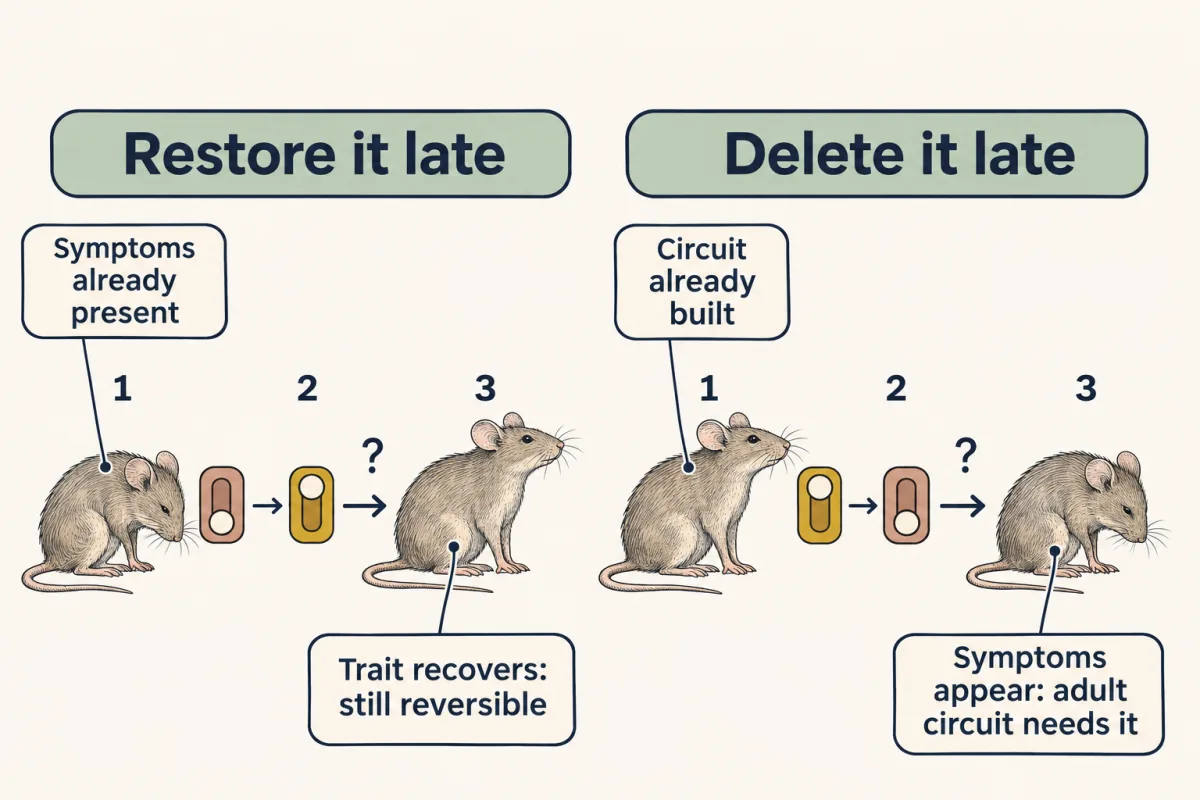
What the rule covers.
- Which genes. Single-gene conditions in which the gene can be switched in mice. Mecp2 is the clean case for both tests. Fragile X offers a different late test, a drug given to adults.
- Which effect. Each trait has its own window, so the tests are read trait by trait, not gene by gene.
What autism is, and why these two syndromes
A note on words first. Many autistic people prefer identity-first language (“autistic people”), and some prefer “people with autism”; this lesson mostly uses the first. Autism is a difference in how a brain develops, and the biology below is about mechanism, not about fixing people.
Autism is diagnosed from behaviour. Under DSM-5, published in 2013, autism spectrum disorder is defined by two areas of behaviour: differences in social communication and interaction, and restricted or repetitive behaviours and interests, present from early childhood. No gene, blood or scan test makes the diagnosis. “Spectrum” means that support needs range widely, from people who need help every day to people who need little.
Autism runs strongly in families. Twin studies estimate heritability at roughly 60 to 90 percent. That is a population measure: across a population, most of the variation in who is diagnosed tracks genetic variation. It is not the share of any one person’s autism that is genetic. No single gene explains it. Two kinds of variation contribute. Most of the genetic contribution is thought to come from many common variants, each with a tiny effect, and linking any one of them to a cellular mechanism is hard. Rare mutations, often new in the child, explain a smaller share of the overall genetic contribution, though in some individuals one rare mutation has a large effect. The hundred or so genes named by large sequencing studies come from such rare mutations, and they are the ones this lesson can follow, because one gene can be changed in a mouse.
Fragile X syndrome and Rett syndrome are single-gene conditions. Many people with fragile X syndrome, more often males, are autistic, and girls with Rett syndrome often pass through an autistic-like phase, though Rett syndrome is now diagnosed as its own condition. They are not all of autism. They are two cases in which we know the gene, can switch it in mice, and can ask which step fails.
Three jobs, one meeting point
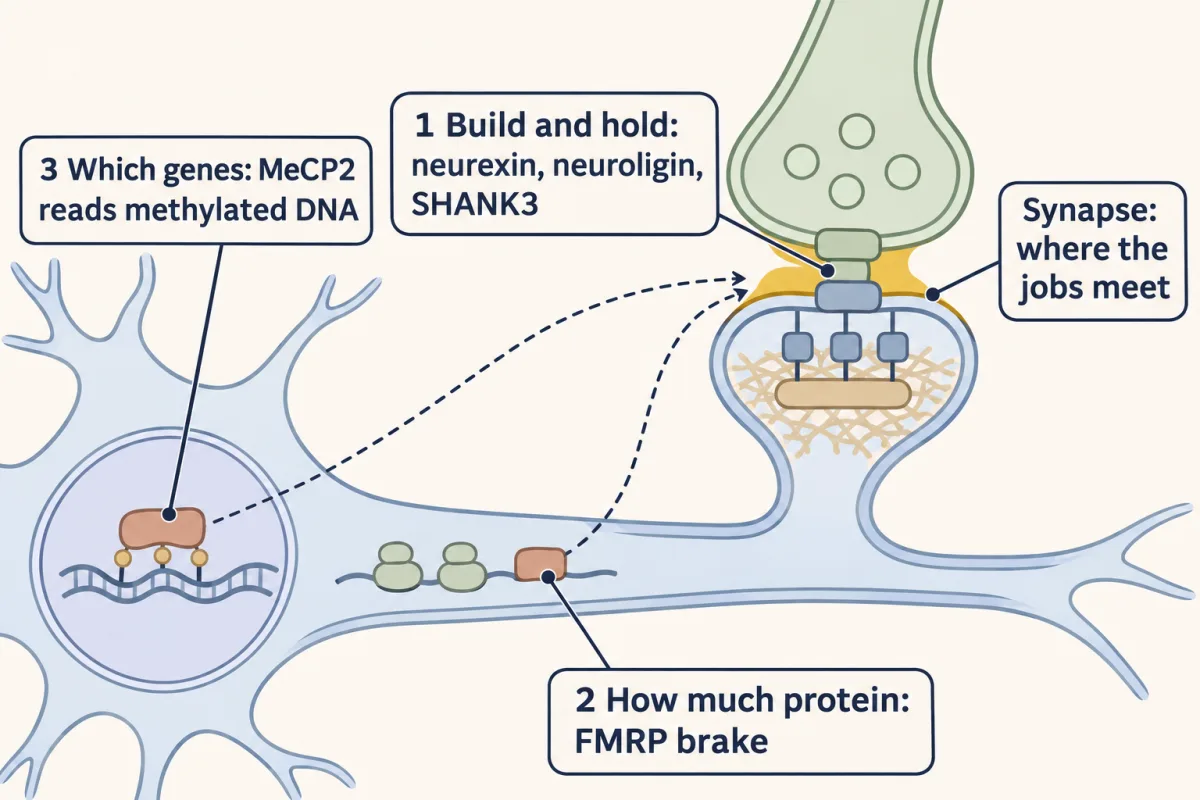
Sort the hundred genes by what their proteins do. Two large groups stand out, synaptic proteins and regulators of chromatin and transcription, and a theme links several others, giving three jobs.
- Build and hold the synapse. Neurexins on the sending side bind neuroligins on the receiving side and help specify a synapse (see CNS synapses). SHANK3 is a scaffold protein that holds receptors in the postsynaptic density, the protein-dense layer under the receiving membrane of excitatory synapses. Mice lacking Shank3 show altered synapses in the striatum and groom themselves excessively.
- Set how much protein a synapse makes. Synapses make some of their own proteins. Fragile X messenger ribonucleoprotein (FMRP), missing in fragile X syndrome, is a brake on that synthesis. TSC1, TSC2 and phosphatase and tensin homolog (PTEN) mutations all raise the activity of mTOR, a master regulator of protein synthesis (see mTOR and AMPK), so these syndromes push on the same output as fragile X, and each carries a higher chance of autism.
- Set which genes the neuron uses. Many autism genes regulate chromatin and transcription. Methyl-CpG-binding protein 2 (MeCP2), mutated in Rett syndrome, binds DNA where cytosines carry methyl groups (see below).
The three jobs seem to meet at the synapse. A protein that holds receptors, a brake on local translation and a reader of DNA work at very different scales, but each can change what a synapse is made of and how strongly it responds. Reviews of autism genetics name the same three points of convergence.
From synapse to circuit: excitation and inhibition
In the mature brain a synapse either excites the next neuron, pushing it toward firing, or inhibits it, holding it back. In the cortex most inhibition comes from interneurons, local neurons that release GABA and make up about a fifth of all neurons. A working circuit keeps excitation and inhibition in balance. That balance is set during development, as synapses form and mature, and then has to be maintained.
All three jobs can move that balance. A change in synapse number, in the receptors at a synapse, in how much protein a synapse makes or in a neuron’s own firing properties changes how strongly a circuit responds, in excitatory neurons or in interneurons. Reviews of fragile X syndrome, Rett syndrome and autism models keep returning to this bridge: altered excitation and inhibition links the molecular defect to the circuit.
John Rubenstein and Michael Merzenich proposed the idea for autism in 2003, partly because epilepsy is common in autistic people. The change is not always toward more excitation. Its direction differs between brain regions, cell types and ages, and between models, and no single imbalance explains autism. Rett syndrome, below, shows both directions in one brain.
Fragile X: a synapse that makes too much protein
Read the transcript of “Too Much Protein”
Film transcript: Too Much Protein
What happens to a synapse when the brake on its own protein making is gone? Fragile X syndrome is the most common inherited cause of intellectual disability. Its cause is a three-base repeat, CGG, near the start of the FMR1 gene. Above about 200 copies, the gene is usually silenced. So little or no FMRP is made. It binds RNA and holds back translation. Dendrites carry their own ribosomes, so synapses can make protein within minutes. FMRP is a brake on that. One signal that releases the brake comes through a glutamate receptor, mGluR5. In hippocampal slices, activating that class of receptor makes synapses weaken for hours. This long-term depression normally needs new protein.
Predict. Take the brake away. What happens to that weakening? And does it still need new protein? In fragile X mice, the weakening is exaggerated. Later work found it no longer needs new protein. Normally, the weakening waits for new protein. Without the brake, the usual reading goes, that protein is already there in excess. In 2004, Bear, Huber and Warren proposed the mGluR theory. Without FMRP, the receptor drives too much protein synthesis, and many features follow. Predict. If too much receptor signalling causes the traits, what should halving the receptor do?
In 2007, Gül Dölen and Bear bred fragile X mice with one working copy of the receptor gene. Protein synthesis, spine density and sound-triggered seizures all moved toward typical. Halving the receptor shows the two genes interact. It may be part of the cause, or it may offset the defect another way. Now a different late test, with a drug. In adult fragile X mice, chronic treatment with a receptor blocker corrected many traits. So in mice, the circuit could still be adjusted after it was built. The drug does not put FMRP back. Drugs like this were already being tested in people. Trials in adolescents and adults showed no benefit over placebo on the main measures.
A later trial in young children also found no benefit over placebo. Takeaway: a mouse rescue tests a mechanism, not a cure.
From the film
- In fragile X syndrome the FMR1 gene is usually silenced, so little or no FMRP is made, and FMRP normally holds back local protein synthesis at synapses.
- In mice, halving mGluR5 moved several fragile X traits toward typical, and an mGluR5 blocker in adult knockout mice corrected many traits.
- A mouse rescue tests a mechanism, not a cure: mGluR5 blocker trials in people showed no benefit over placebo on the main measures.
Fragile X syndrome is the most common inherited cause of intellectual disability. Its cause is a repeat of three bases, CGG, near the start of the FMR1 gene on the X chromosome. Most people have fewer than about 45 copies. Between about 55 and 200 copies is a premutation, which can grow when a mother passes it on. Above about 200 copies, the gene’s control region usually becomes methylated and the gene is silenced, so little or no fragile X messenger ribonucleoprotein (FMRP) is made.
FMRP binds RNA. In neurons it travels with hundreds of mRNAs, many encoding synaptic proteins, and holds back their translation. Dendrites carry their own ribosomes, so synapses can make protein locally within minutes of a signal. FMRP is a brake on that local synthesis.
One signal that releases the brake comes through mGluR5, a metabotropic glutamate receptor (a G protein-coupled receptor; see GPCRs and G proteins). In the hippocampus, activating group I mGluRs, the class that includes mGluR5, makes synapses weaken for hours, a long-term depression (LTD). Normally this mGluR-LTD needs new protein: block translation, and the weakening does not last.
Predict. In Fmr1 knockout mice the brake on synaptic translation is missing. What should happen to mGluR-LTD? And should it still need fresh protein synthesis?
Check your prediction
In 2002 Kimberly Huber, Mark Bear, Stephen Warren and colleagues found mGluR-LTD exaggerated in Fmr1 knockout mice. Later work found that in the knockout it no longer needs new protein. The usual reading is that in the knockout, with the brake gone, the proteins it depends on are already there in excess, so the weakening is larger and need not wait.
In 2004 Bear, Huber and Warren proposed the mGluR theory: without FMRP, mGluR5 signalling drives too much protein synthesis, and many features of the syndrome follow. That is a causal claim, and it can be tested in the genes.
Predict. If too much mGluR5 signalling causes the traits, what should halving the receptor do to a fragile X mouse? What would you see if mGluR5 had no influence on them?
Check your prediction
In 2007 Gül Dölen and Bear bred fragile X mice with only one working copy of the mGluR5 gene. Several traits moved toward those of typical mice, including protein synthesis, spine density (spine changes in these mice vary with age and brain region; see Going deeper) and seizures triggered by loud sound. If mGluR5 had no influence on these traits, halving it would have left them unchanged. A dosage rescue shows that the two genes interact; mGluR5 may be part of the cause, or lowering it may offset the defect through another route, as turning down a tap can offset a blocked drain without the tap being what broke. And because the halving was bred in, it was present throughout development, so it does not say whether lowering mGluR5 later would help.
Loss of FMRP also shows up at the level of circuits. In several brain regions of Fmr1 knockout mice, neurons and networks are more excitable than normal, partly because the neurons’ own firing properties change. One of the most reliable traits of these mice is a low threshold for seizures triggered by loud sound. Drugs that activate GABA receptors, which strengthen inhibition, reduce those seizures. Many people with fragile X syndrome are unusually sensitive to sound and touch, and some have seizures in childhood, which fits the same picture of circuits that respond too strongly.
Predict. Run a different late test: not the gene, but a drug that turns down mGluR5, a signal whose effects FMRP normally restrains, without replacing FMRP. Suppose an mGluR5 blocker given to adult knockout mice corrects many traits. What does that say about the fragile X circuit in mice? Can it tell you whether the drug will help people?
Check your prediction
In adult Fmr1 knockout mice, chronic treatment with an mGluR5 blocker did correct many traits (Michalon and colleagues, 2012). So in mice the fragile X circuit could still be adjusted after it was built. Because the drug does not put FMRP back, this does not say when FMRP itself is needed. For people, it predicts nothing for certain.
Drugs that block mGluR5 were already being tested in people. Placebo-controlled trials of two such drugs, mavoglurant (reported in 2016) and basimglurant (2018), in adolescents and adults with fragile X syndrome showed no benefit over placebo on the main behavioural measures. A later trial of mavoglurant in children aged about 3 to 6, combined with language-learning therapy, also found no benefit over placebo.
The theory still explains a great deal of mouse biology, but it has not yet transferred to a treatment.
Rett syndrome: a circuit that needs MeCP2 to keep running
Read the transcript of “Switch It Back On”
Film transcript: Switch It Back On
A circuit formed without one protein. Switch the protein on in an adult. Can that undo the damage? Rett syndrome puts this to the test. Girls with it seem to develop typically for many months. Then they lose purposeful hand use and speech. Most cases come from mutations in one gene, MECP2, on the X chromosome. Its protein binds methylated DNA, and is thought to help set the level of many genes.
Mice lacking the gene appear typical for several weeks. Then they develop tremor, breathing changes and reduced movement. Their neurons do not die in large numbers. They are smaller, with simpler dendrites. In 2007, Jacky Guy, Adrian Bird and colleagues built mice in which the gene is silent. A blocking sequence silences it. The mice also carry an enzyme, Cre. Cre enters the nucleus only after the drug tamoxifen is given. Then it cuts out the block.
Predict. If the circuit was built wrong for good, what does restoring the protein in a sick adult do? And if it only needs the protein to run? Many symptoms reversed, in young adult mice and in older adult mice. In typical mice, tamoxifen did nothing.
So circuits that formed without the protein can work again once it returns. That does not show their development was normal. Now the other test. In 2011, Huda Zoghbi's laboratory deleted the gene in adult mice. They developed symptoms like those of mice that never had it. The protein is needed continuously. Both late tests point the same way. The adult circuit still needs this protein. A building role is not ruled out. The balance of excitation and inhibition shifts too, and in one brain it runs both ways. The forebrain tends to be underactive. The brainstem tilts toward excitation.
One limit. This is a mouse result. Whether it holds for an older person is not known. A second limit. The dose matters. Too much of this protein causes a separate syndrome in males. Takeaway: some traits can still be reversed, and some proteins are still needed in adults. The late tests ask both questions.
From the film
- In mice, restoring MeCP2 in symptomatic adults reversed many symptoms, so circuits formed without it can work again.
- Deleting Mecp2 in adult mice caused symptoms like those of mice that never had it, so the adult circuit still needs it.
- Neither late test rules out a role in building, and these are mouse results that may not hold in people.
Rett syndrome shows the gene-regulation job. The condition was described in 1966 by the Austrian paediatrician Andreas Rett: girls who seemed to develop typically for many months and then lost purposeful hand use and speech, made repetitive hand movements, and had slowed head growth. Seizures, breathing irregularities, scoliosis and sleep problems are common. In 1999 the laboratory of Huda Zoghbi at Baylor College of Medicine, with Uta Francke’s group, found that mutations in MECP2 cause most cases.
MECP2 encodes methyl-CpG-binding protein 2, MeCP2. It is abundant in neurons and is thought to help set the level at which many genes are expressed, often by recruiting a co-repressor complex, rather than switching a few genes fully on or off.
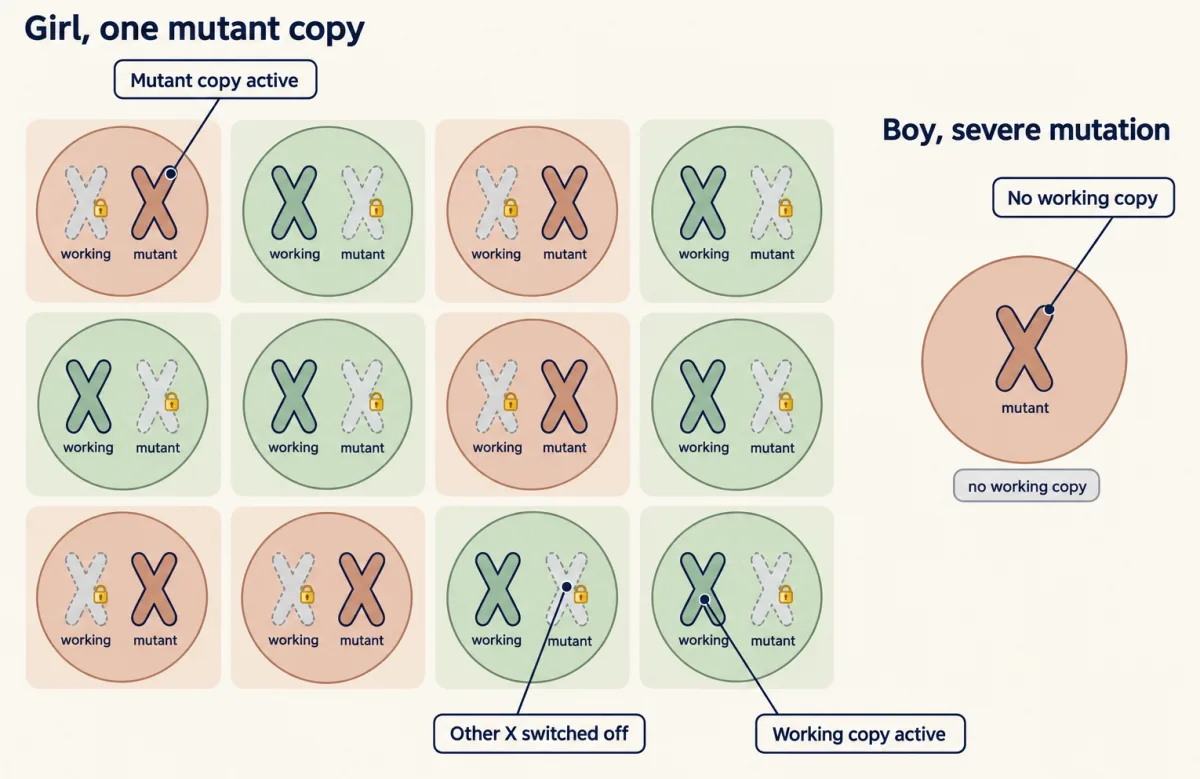
The gene is on the X chromosome, which shapes who is diagnosed. In each cell of a female embryo one X is switched off at random, so a girl with one mutant copy is a mosaic: some neurons use the working copy and others the mutant one. Most mutations arise new, most often in the father’s sperm, and a father passes his X only to daughters, so his new mutations land in girls. Boys with a severe mutation have no working copy and usually have a different, severe course from early infancy.
Mice lacking Mecp2 appear typical for several weeks and then develop tremor, breathing changes and reduced movement. Their neurons do not die in large numbers. They are smaller and more tightly packed, with simpler dendrites, as if built but under-maintained. That is a hint, not a test.
Design problem
Use mice in which Mecp2 is silent but can be switched on with a drug. If Rett syndrome comes from circuits built wrong, what should restoring MeCP2 in symptomatic adults do? What would show instead that the circuit needs MeCP2 to keep working? What second experiment, in typical adult mice, completes the argument?
Saved in this browser only.
One way to do it
If the defect is a permanent error made during building, adult restoration should do little: wrong connections made months earlier would stay wrong, much as a misrouted axon does not reroute because its guidance receptor returns. If MeCP2 is needed to maintain function, restoring it should improve symptoms even in adults, and the improvement should depend on the gene coming back, not on the drug.
In 2007 Jacky Guy, Adrian Bird and colleagues did this experiment. A blocking sequence flanked by loxP sites silenced Mecp2, and the mice carried Cre recombinase that enters the nucleus only after tamoxifen. Treating symptomatic adults restored MeCP2 and reversed many symptoms, in young adult and in older adult mice. Tamoxifen did nothing in mice without the silenced allele. So in mice, for the symptoms that recovered, the circuits were not irreversibly miswired: they could work once MeCP2 returned. That still does not show their development had been normal.
The second experiment is the late deletion. In 2011 Zoghbi’s laboratory deleted Mecp2 in adult mice, which then developed symptoms like those of mice that never had it. Both late tests point the same way: the adult circuit still needs MeCP2, though a role in building is not ruled out.
Circuits in these mice are changed too, and here the imbalance runs both ways. In parts of the cortex of mice lacking Mecp2, excitatory neurons have fewer excitatory synapses, and the forebrain as a whole tends to be underactive. The hindbrain tends to be overactive, and in the brainstem, which runs breathing, the balance tilts toward excitation. In these mice, drugs that strengthen GABA signalling reduced pauses in breathing. One gene, opposite imbalances, depending on the region.
The restored gene must also land in the right range. Too much MeCP2 is harmful: duplication of MECP2 causes a separate syndrome in males.
What mouse models can and cannot show
Most of the causal evidence in this lesson comes from mice. A mouse rescue tests a mechanism, not a cure: it shows what a gene does in a mouse circuit at a given age. It does not by itself show that the same step causes autism in a person, or that a drug will help, and the fragile X trials are the clearest example. Drugs that strengthen inhibition also improve symptoms in several animal models, but no trial of a drug targeting GABA receptors has yet succeeded in fragile X syndrome or autism.
Behaviour is the hardest part to model. In mice the usual tests score time spent near a stranger in a three-chamber box, ultrasonic calls, marble burying and grooming. They measure mouse behaviour. A mouse that buries marbles is not autistic.
Maternal immune activation is a smaller line of evidence that shows both the value and the limit of such models. Genes are not the whole story: some infections during pregnancy, such as rubella, are associated with autism in the children. These are associations, and most children of mothers with infections are not autistic. They concern infection, not vaccines: vaccines do not cause autism, and rubella vaccination prevents congenital rubella. Recent reviews judge the effect of maternal immune activation in people to be modest. What mouse models of it can do is identify a mechanism, such as a maternal cytokine acting on the developing cortex during a window of pregnancy, that human studies can then look for.
Putting it together
| Experiment | Animal and age | Observed result | What it supports | What it does not establish |
|---|---|---|---|---|
| mGluR-LTD in slices (2002) | Fmr1 knockout mouse, hippocampus | weakening exaggerated; later found not to need new protein | FMRP restrains mGluR-driven synaptic change | how behaviour follows |
| Halve mGluR5 (2007) | Fmr1 knockout mouse, halved by breeding, so throughout life | protein synthesis, spine density and sound-triggered seizures move toward typical | the genes interact, fitting the mGluR theory; offsetting by another route is not excluded | whether lowering it later helps |
| GABA-receptor drugs | Fmr1 knockout mouse | fewer sound-triggered seizures | stronger inhibition can offset the extra excitability | benefit in people |
| mGluR5 blocker, chronic (2012) | adult Fmr1 knockout mouse | many traits corrected | the circuit can still be adjusted after it is built | benefit in people |
| mGluR5 blocker trials (2016, 2018, then children) | adolescents and adults; later young children | no benefit over placebo on the main outcome measures | the mouse rescue did not transfer, for these drugs and measures | why it did not |
| Mecp2 null | mouse | typical for weeks, then tremor, breathing changes, reduced movement; neurons small, not dead | MeCP2 is needed for function | building versus upkeep |
| Restore Mecp2 (2007) | symptomatic young and older adult mice | many symptoms reversed; tamoxifen alone did nothing | circuits formed without MeCP2 can work once it returns | that development was normal; that it holds in people |
| Delete Mecp2 (2011) | adult mouse | symptoms like those of null mice | the adult circuit still needs MeCP2 | whether MeCP2 is also needed for building; that it holds in people |
| MECP2 duplication | human males | a separate syndrome | a dose window for any gene therapy | the size of the window |
Built, then kept: for Mecp2 both late tests show the adult circuit still needs the gene, so in mice Rett syndrome is not only a circuit built wrong. Fragile X offers a different late test, an mGluR5 blocker in adult mice that does not replace fragile X messenger ribonucleoprotein (FMRP), which showed that the circuit can still be adjusted, and the human trials mark where a mouse rescue stops.
Going deeper
Counting autism
DSM-5 merged autistic disorder, Asperger’s disorder and related categories into one diagnosis, autism spectrum disorder. DSM-IV had grouped Rett syndrome with the pervasive developmental disorders. Signs are often noticed in the second year of life. Identified autism has become more common in US surveillance, and much of the rise is generally attributed to broader criteria, more screening and better access to diagnosis. A CDC report in 2014 gave 1 in 68 for children who were eight in 2010. For children who were eight in 2022, the report published in 2025 estimated that about 1 in 31 in the communities it monitors had been identified as autistic. Boys were identified more than three times as often as girls in the 2022 data.
More on the synapse-building genes
Rare variants in NRXN1, NLGN3 and NLGN4X, which encode neurexins and neuroligins, have been found in some autistic people. Pruning may matter too, through microglia and complement (see microglia and complement).
Fragile X spines
In brain tissue from affected people, dendritic spines are often long and thin, like immature spines. Spines in Fmr1 knockout mice are abnormal too, and the most consistent change may be in how spines mature and respond to activity.
Why the fragile X trials may have failed
The reasons are still argued: behaviour scales may change too slowly, tolerance may develop, and compensation may differ between species. Age at treatment was one proposed reason, but the negative trial in young children makes it a weaker explanation.
More on circuit balance
Seizures occur in roughly 10 to 20 percent of people with fragile X syndrome, usually as a benign focal epilepsy of childhood that is controlled by medication and often resolves. In a small PET study, GABA-A receptor availability was about 10 percent lower across the brain in people with fragile X syndrome. In many immature neurons, higher chloride inside the cell makes GABA-A responses depolarizing, and as chloride handling matures they usually become hyperpolarizing (see CNS synapses); depolarizing GABA can still inhibit firing by shunting other inputs. In Fmr1 knockout cortex, this developmental switch has been reported to be delayed. In Rett models the cell type matters as much as the region: mice lacking methyl-CpG-binding protein 2 (MeCP2) only in somatostatin interneurons develop seizures but have typical memory and social behaviour, while mice lacking it only in parvalbumin interneurons do not have seizures but show cognitive deficits.
Each trait has its own window
In Shank3 mice, restoring the gene in adults rescued grooming and social traits but not anxiety or motor coordination, while restoring it in juvenile mice also improved some anxiety and motor measures (Mei and colleagues, 2016). In a mouse model of Angelman syndrome, restoring Ube3a rescued fewer traits the later it was done (Silva-Santos and colleagues, 2015). So the late tests are read trait by trait: for one gene, some traits can still be reversed at an adult age and others could not be, at the ages tested. Such results do not by themselves say which traits need the gene to be built and which to be kept.
A dose window, worked
A toy model shows why the dose window is narrow in a girl with Rett syndrome. The point first: if each vector copy adds a full normal dose, no dose beats doing nothing, because the cells that were already fine get pushed too high.
The setup, all assumptions chosen for illustration: exactly half her neurons make working MeCP2 at the normal level and half make none (real girls vary with X-inactivation, and many mutations leave some function). A gene-therapy vector enters cells at random, with an average of m copies per cell spread as a Poisson distribution, and each copy adds r times the normal level. A cell counts as in range from half the normal level up to, but not including, twice it, the duplication level.
| Each vector copy adds | Cells in range, no vector | Best fraction in range | At an average of |
|---|---|---|---|
| the normal level | 0.50 | 0.50 | no vector |
| half the normal level | 0.50 | 0.68 | 0.88 copies per cell |
| a quarter of the normal level | 0.50 | 0.73 | 2.4 copies per cell |
With full-strength copies, the working cells pushed to the duplication level or beyond always at least match, on average, the mutant cells brought into range, and mutant cells that get two or more copies overshoot too. It is a toy, since real constructs use weak or self-limiting promoters, but it shows where the main danger lies.
Maternal immune activation in mice
In mice, poly(I:C), a synthetic double-stranded RNA, mimics a viral infection and sets off an immune response with no virus present. In 2007 Stephen Smith, Paul Patterson and colleagues gave it to pregnant mice and found that the offspring behaved differently as adults; a single dose of the cytokine IL-6 had a similar effect, and blocking IL-6 prevented it. In 2016 Gloria Choi, Jun Huh and colleagues traced a step further: maternal T cells making IL-17a were required, and offspring had patches of disorganized cortex. A cytokine that changes a mouse’s behaviour has not been shown to cause autism in a child.
Maternal infection in people
The rubella association comes mainly from the epidemic of the mid-1960s. In a Danish registry study, hospital admission for a viral infection in the first trimester was associated with a roughly threefold higher rate of autism diagnosis in the child, though the estimate was imprecise and infection across pregnancy as a whole showed no link.
Monkeys and maternal antibodies
Monkeys bring the model closer to people. In 2014 researchers at the University of California, Davis gave pregnant rhesus monkeys a stabilized form of poly(I:C) in the first or second trimester. As the offspring grew, they showed more repetitive behaviour and fewer affiliative calls than controls, and some approached unfamiliar monkeys in unusual ways. An earlier study from the same centre tested a different idea, that antibodies in some mothers act on the fetal brain: pregnant monkeys given antibodies purified from mothers of autistic children had offspring with more repetitive movement and hyperactivity. These studies used small numbers of animals and need cautious reading.
Your notes
Select any text in the lesson to highlight it or add a note to it. Your highlights and notes are saved in this browser and collected in your notebook.
This browser is not letting the site save anything (a private window or strict privacy settings), so highlights and notes will be lost when you leave the page.
How we measure it
Conditional gene reactivation (lox-Stop and CreER)
A blocking sequence flanked by loxP sites is placed in a gene so that the gene is silent. The animal also carries Cre recombinase fused to a modified oestrogen receptor, which enters the nucleus only after tamoxifen is given. Cre then removes the block, so you choose when the gene comes back on.
Genetic dosage rescue
A mutant mouse is bred with a mouse carrying one broken copy of a second gene. If halving the second gene moves the mutant's traits toward typical, the two genes interact: the second gene's product may be part of the cause, or may compensate through another route. Fragile X mice with half the mGluR5 tested the mGluR theory.
Long-term depression in hippocampal slices
Living slices of hippocampus are kept in oxygenated fluid, and synaptic responses are recorded before and after a drug that activates group I mGluRs. The lasting fall in response size measures synaptic weakening, and blocking translation shows whether it needs new protein.
Mouse behaviour assays
Standard tests score how long a mouse spends near a stranger mouse in a three-chamber box, how many ultrasonic calls it makes, and how many marbles it buries or how long it grooms. They measure mouse behaviour, not autism, and are read as rough parallels.
Practice questions on this lesson (3) → MCAT-style, original, each with an explanation
Where this lesson fits
Before thisReview first
- Building the Neuromuscular Junction: Agrin, Lrp4 and MuSKThis course · Lesson 35
You need the agrin-Lrp4-MuSK logic of how a synapse is built before asking which synapse genes are needed to build versus keep.
- Synapses in the Brain: Adhesion, Scaffolds and AstrocytesThis course · Lesson 36
Neurexins, neuroligins, scaffolds and chloride-dependent GABA are used here as the synapse-building parts that autism genes alter.
- Opening and Closing a Critical PeriodThis course · Lesson 40
Its excitation-inhibition balance and GABA circuit work set up the question of whether a built circuit can still be changed.
After thisStudy next
- What Makes the Human Brain BigThis course · Lesson 50
It moves from single-gene disorders to the human-specific features of the developing cortex that such disorders disturb.
- Brains in a Dish: Stem Cells and OrganoidsThis course · Lesson 51
Human stem-cell organoids offer a way to test disease mechanisms in human cells, where mouse rescues cannot.
Elsewhere on the siteFilms, simulations and method films in other courses
- Depletion and the paired-pulse ratioSimulation · Neuroscience
Its paired-pulse ratio exercise shows how synaptic strength is measured, which underlies reading changes in synapse function.
- One More RopeFilm · Neuroscience
It shows how excitation and inhibition add up on a neuron, the balance that these disorders shift.
- Three Questions, Three Kinds of EvidenceFilm · Neuroscience
It shows what evidence from mice, families and autopsies can and cannot say about human disease, as mouse rescues do here.
Suggested by an AI model from the lessons themselves, then checked. How we use AI
Finish line
Test yourself
9 questions
Practice and MCAT-style, with explained answers.
Next · Lesson 50
What Makes the Human Brain Big
Your cortex is only about twice as thick as a mouse's. Why is its surface roughly a thousand times larger?
Continue →← Lesson 48 · When Building Goes Wrong: Microcephaly, Zika and Lissencephaly