Developmental Neuroscience · Skim version
Disorders of the Synapse: Built, Then Kept
Read the full lesson → Skim the whole course →
The guiding idea
Switch a silenced gene back on in adult mice that already have symptoms, and many of the symptoms fade. If a circuit was built without a protein, is it wrong for good?
Built, then kept: a synapse gene can be needed to build a circuit, to keep it running, or both, and two late tests in mice help tell which.
From the film: Built, Then Kept
- A synapse gene can be needed to build a circuit, to keep it running, or both: built, then kept.
- Restoring the gene late asks whether a trait can still recover, and deleting it late asks whether the adult circuit still needs it.
- A failed rescue is hard to read, because the gene may have come back in too few cells, at the wrong level or too briefly.
From the film: Too Much Protein
- In fragile X syndrome the FMR1 gene is usually silenced, so little or no FMRP is made, and FMRP normally holds back local protein synthesis at synapses.
- In mice, halving mGluR5 moved several fragile X traits toward typical, and an mGluR5 blocker in adult knockout mice corrected many traits.
- A mouse rescue tests a mechanism, not a cure: mGluR5 blocker trials in people showed no benefit over placebo on the main measures.
From the film: Switch It Back On
- In mice, restoring MeCP2 in symptomatic adults reversed many symptoms, so circuits formed without it can work again.
- Deleting Mecp2 in adult mice caused symptoms like those of mice that never had it, so the adult circuit still needs it.
- Neither late test rules out a role in building, and these are mouse results that may not hold in people.
-
Built wrong, or not kept running?
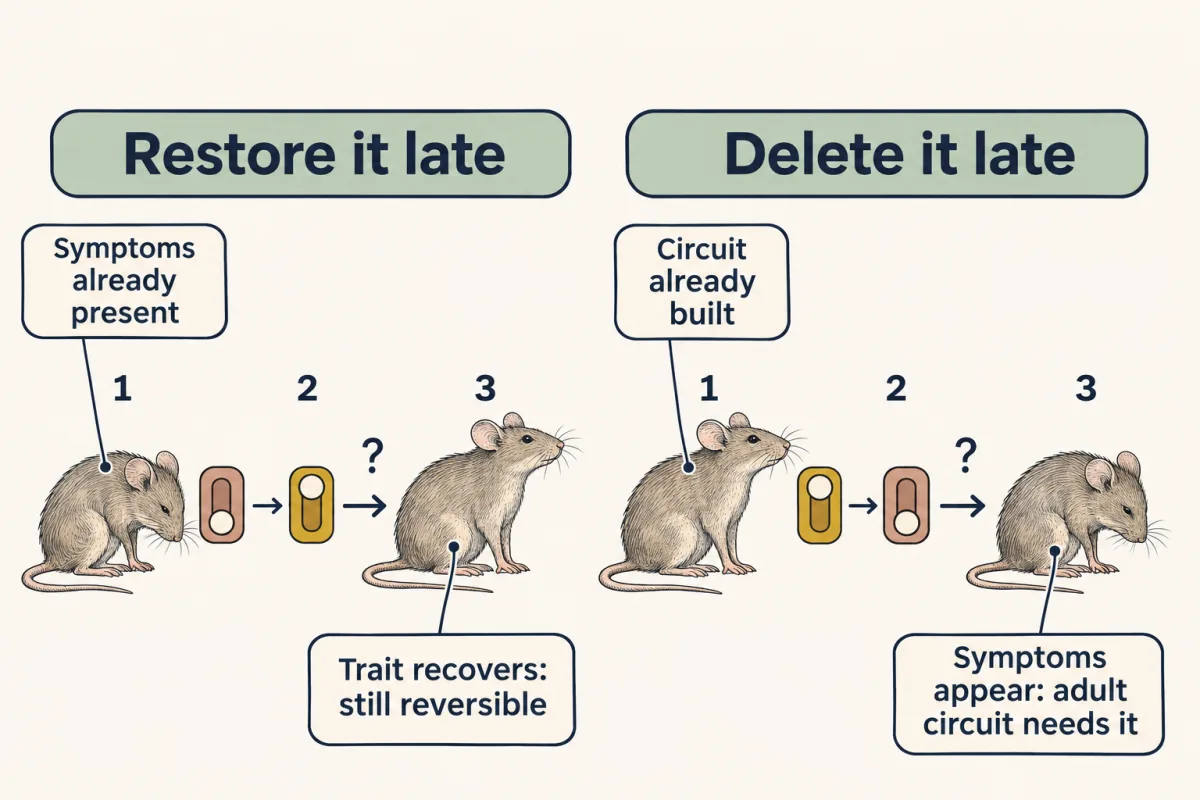
Two late tests, read trait by trait. Restore the gene after symptoms begin: if a trait recovers, it can still be reversed at that age. Take the gene away after the circuit is built: if symptoms appear, the adult circuit still needs it. Neither result rules out a role in building. AI-generated illustration -
What autism is, and why these two syndromes
-
Three jobs, one meeting point
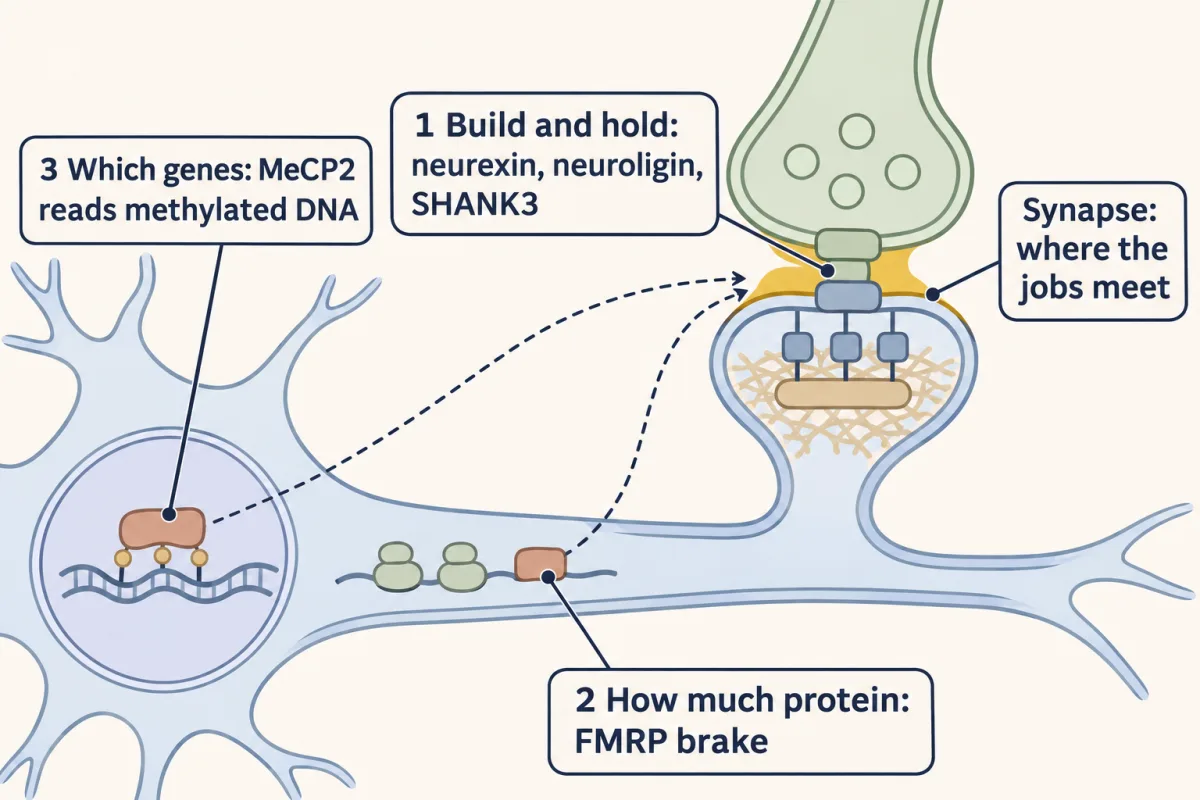
A protein that holds receptors, a brake on local protein synthesis and a reader of methylated DNA work at very different scales, yet each can change what a synapse is made of and how strongly it responds. AI-generated illustration -
From synapse to circuit: excitation and inhibition
-
Fragile X: a synapse that makes too much protein
-
Rett syndrome: a circuit that needs MeCP2 to keep running
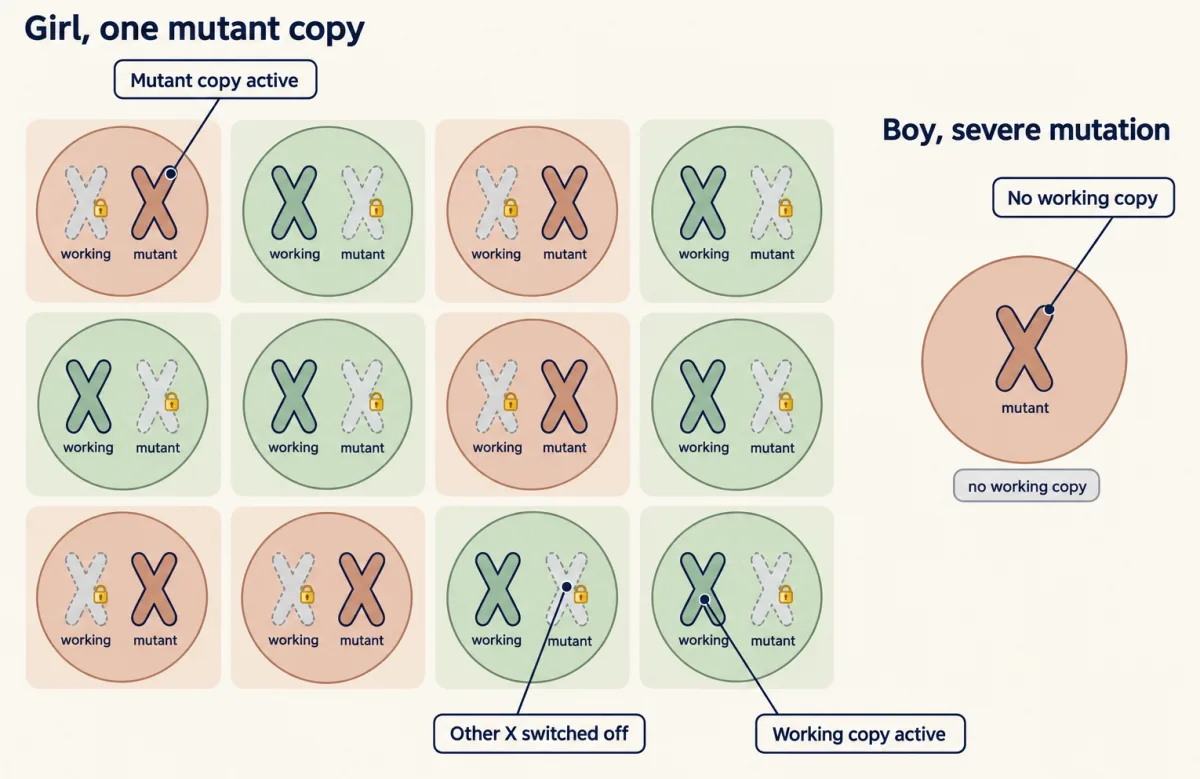
In a girl with one mutant MECP2 copy, one X was switched off at random in each early embryonic cell and stays off in its descendants, so her neurons form a mosaic of cells using the working or the mutant copy. A boy with a severe mutation has no working copy. AI-generated illustration -
What mouse models can and cannot show
-
Putting it together
-
Going deeper
Where this lesson fits
Before thisReview first
- Building the Neuromuscular Junction: Agrin, Lrp4 and MuSKThis course · Lesson 35
You need the agrin-Lrp4-MuSK logic of how a synapse is built before asking which synapse genes are needed to build versus keep.
- Synapses in the Brain: Adhesion, Scaffolds and AstrocytesThis course · Lesson 36
Neurexins, neuroligins, scaffolds and chloride-dependent GABA are used here as the synapse-building parts that autism genes alter.
- Opening and Closing a Critical PeriodThis course · Lesson 40
Its excitation-inhibition balance and GABA circuit work set up the question of whether a built circuit can still be changed.
After thisStudy next
- What Makes the Human Brain BigThis course · Lesson 50
It moves from single-gene disorders to the human-specific features of the developing cortex that such disorders disturb.
- Brains in a Dish: Stem Cells and OrganoidsThis course · Lesson 51
Human stem-cell organoids offer a way to test disease mechanisms in human cells, where mouse rescues cannot.
Elsewhere on the siteFilms, simulations and method films in other courses
- Depletion and the paired-pulse ratioSimulation · Neuroscience
Its paired-pulse ratio exercise shows how synaptic strength is measured, which underlies reading changes in synapse function.
- One More RopeFilm · Neuroscience
It shows how excitation and inhibition add up on a neuron, the balance that these disorders shift.
- Three Questions, Three Kinds of EvidenceFilm · Neuroscience
It shows what evidence from mice, families and autopsies can and cannot say about human disease, as mouse rescues do here.
Suggested by an AI model from the lessons themselves, then checked. How we use AI