Cell Signaling · Unit 4: Receptors with enzymes attached
mTOR and AMPK: Reading Nutrients and Energy
How does a cell decide it can afford to grow?
Pause when the reading reaches a film, and offer to play it. Saved on this device.
Watch the film now, or keep listening
Builds on:GTPase Switches: The TimerPI 3-Kinase, Akt and InsulinPhosphorylation: Kinases and PhosphatasesWhy these?
 ▶ Watch Two Yeses to Grow, One Veto · 3:15
Read the transcript of “Two Yeses to Grow, One Veto”
Film transcript: Two Yeses to Grow, One Veto
How does a cell decide it can afford to grow? Growth is expensive. Making protein uses amino acids and much of a cell's ATP. So a kinase called mTOR, inside a complex named mTOR C1, asks two questions. In the standard model, it switches on only when both get a yes. The first question: has the body said grow? A growth factor switches on Akt. Akt phosphorylates a protein of the TSC complex, which takes the complex out of action. The TSC complex is a GAP, an off switch for a small GT -Pase called Rheb. So Rheb stays loaded with GTP. Rheb with GTP is the direct activator of mTOR -C1. The second question: are there amino acids? How cells sense amino acids was unknown.
The link was the Rags, small GT paces. They do not raise the kinase activity of mTOR -C1. They move it. Without amino acids, mTOR -C1 stays spread through the cytoplasm. With them, it gathers on the surface of the lysosome, the cell's acidic digestive compartment. That surface is where it is thought to meet Rheb. Rheb with GTP can activate only a complex that has been brought to it. Growth factors set whether Rheb is on. Amino acids set delivery, and losing them also calls TSC to Rheb. This is an AND gate. With both, mTOR -C1 acts on proteins that control the first step of making protein. With no growth factor, Rheb is off, so the complex stays off.
With no amino acids, the complex leaves the lysosome and stays off. A third gauge reads energy. A healthy cell keeps ATP nearly constant, so ATP is a poor alarm. AMP moves most. With round numbers, when ATP falls by a tenth, AMP rises almost fourfold. So the kinase AMPK reads AMP. Once on, AMPK makes the TSC complex more active. That drains Rheb of GTP. It also phosphorylates Raptor, which inhibits mTOR -C1. Energy can veto growth, even when growth factors and amino acids are present. You can now predict a cell. When fed, every input says yes, and protein synthesis runs. With no amino acids, mTOR -C1 leaves the lysosome, and translation slows.
With no energy, AMPK switches on. It shuts mTOR -C1 off, even when everything else is present. Keep this rule: two yeses to grow, and low energy can veto them.
The drug that protects a transplanted kidney from rejection came out of soil collected on Easter Island in 1964–65. Working out what it hits inside a cell uncovered the enzyme that decides whether a cell grows.
Growth is expensive. Making protein uses amino acids and a large share of a cell’s ATP, so a cell that starts building without supplies runs short of both. Before it commits, a cell reads two gauges. One, built around the kinase mTOR, reads growth factors and amino acids. The other, AMP-activated protein kinase (AMPK), reads energy.
The story: an antifungal from island soil works only with a partner protein
Read the transcript of “Rapamycin Needs a Partner”
Film transcript: Rapamycin Needs a Partner
In December 1964, an expedition worked on Rapa Nui. One member, Georges Nogrady, collected soil. In Montreal, a bacterium was found to kill fungi. In 1972, Suren Sehgal isolated the compound and named it rapamycin. But why does it also stop cells from growing? In Michael Hall's laboratory, Joseph Heitman spread yeast on plates containing rapamycin, and kept the rare mutants that grew anyway. Most had mutations in the gene for FPR1, the yeast version of FKBP12. So rapamycin does nothing alone. It must first bind FKBP12. The pair is the poison. The remaining mutants had changes in one of two new genes, TOR1 and TOR2, for target of rapamycin. The screen was published in 1991.
In 1994 and 1995, several laboratories found the mammalian protein the pair binds. Its name is mTOR. mTOR is a large kinase. Beside its kinase domain is a small domain called FRB. Rapamycin sits between FKBP12 and FRB like glue between two blocks. The bound FKBP12 narrows the substrates' path to the active site. The drug does not compete with ATP. It is allosteric: it acts from a site other than the active site.
From December 1964 to February 1965 a Canadian medical expedition worked on Rapa Nui (Easter Island). One member, the Montreal bacteriologist Georges Nogrady, collected soil from across the island. At Ayerst Research Laboratories in Montreal, a strain of the bacterium Streptomyces hygroscopicus grown from one sample was found to kill fungi. In 1972 the Ayerst microbiologist Suren Sehgal isolated the compound responsible and named it rapamycin, after the island.
Why it also stops cells from growing was answered in yeast. In Michael Hall’s laboratory in Basel, Joseph Heitman spread yeast on plates containing rapamycin and kept the rare mutants that grew anyway. Most had mutations in the gene for a small protein called FPR1, the yeast version of your FKBP12. So at the doses that matter, rapamycin does little alone. It must first bind FKBP12, and the pair is the poison.
The remaining mutants had changes in one of two new genes, which the group named TOR1 and TOR2, for “target of rapamycin”. The screen was published in 1991. In 1994 and 1995 several laboratories found the mammalian protein that the FKBP12–rapamycin pair binds. The name that lasted is mTOR.
mTOR is a large protein kinase. Beside its kinase domain is a small domain called FRB. Rapamycin sits between FKBP12 and FRB like glue between two blocks, and the bound FKBP12 narrows the path that substrates take to the active site. The drug does not compete with ATP. It is an allosteric inhibitor, meaning one that acts from a site other than the active site.
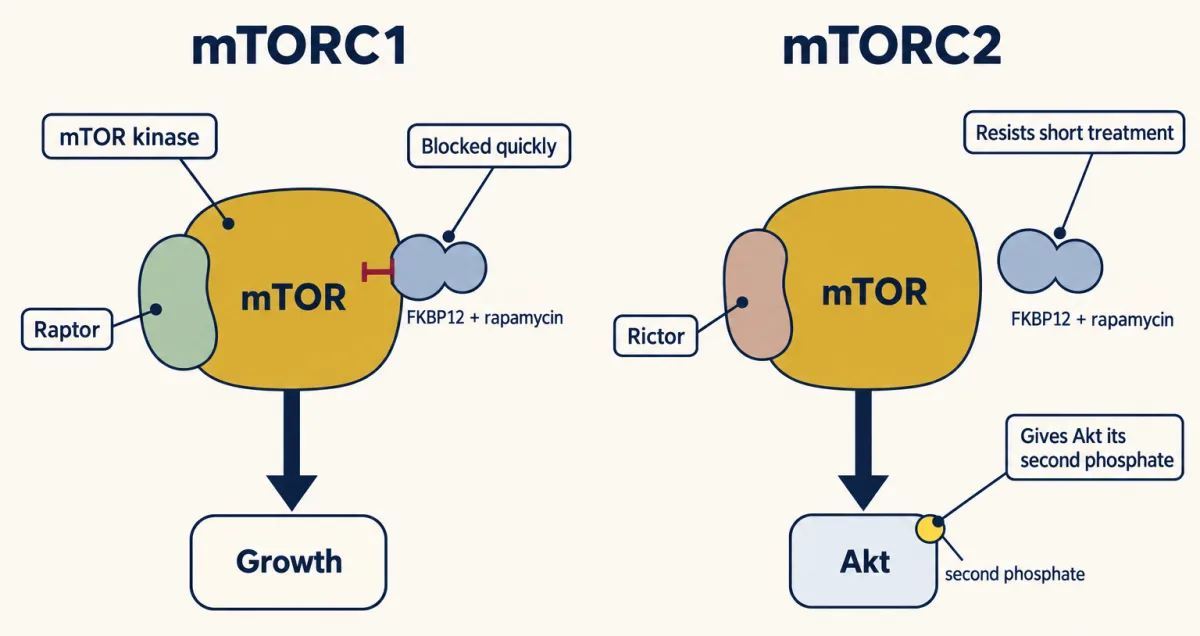
Yeast has two TOR genes and you have one, but in both the kinase works inside two different complexes. mTORC1, built around a partner protein called Raptor, controls growth and is the complex rapamycin blocks quickly. mTORC2, built around a partner called Rictor, is the kinase that gives Akt its second activating phosphate (the previous lesson), and it resists short rapamycin treatment.
The idea: mTORC1 switches on only when two questions get a yes
In 1996 Hall’s group reported that yeast without working TOR behave as if starved, even in rich medium: they sharply cut back the starting of new proteins and enter a resting state. Growth, they argued, is actively controlled, and TOR is the controller. What must mTORC1 hear before it gives the order? Two things, read by separate systems.
Has the body said grow? A growth factor such as insulin switches on Akt. Akt phosphorylates TSC2, one protein of the TSC complex, and that takes the complex out of action. The TSC complex is a GAP, the GTPase off-switch you met in the lesson on GTPase switches, and its target is a small GTPase called Rheb. With the GAP out of action, Rheb stays loaded with GTP, and Rheb-GTP is the direct activator of mTORC1. In the summer of 2003 several laboratories, Kun-Liang Guan’s among them, reported within weeks of one another that TSC2 is a GAP for Rheb and that Rheb acts just upstream of mTOR.
Are there amino acids to build with? How cells sense amino acids was then unknown. In 2008 Yasemin Sancak, in David Sabatini’s laboratory, and independently Guan’s laboratory, found the link in another family of small GTPases, the Rags. Sancak’s paper carried a surprise: the Rags do not raise mTORC1’s kinase activity. They move it. In cells starved of amino acids, mTORC1 is spread through the cytoplasm. Add amino acids back and it gathers on one compartment, which the same laboratory identified in 2010 as the surface of the lysosome, the cell’s acidic digestive compartment. Rheb is anchored to internal membranes by a lipid tail, and the lysosome surface is where the two are thought to meet.
Rheb-GTP can activate only an mTORC1 that has been brought to it. Growth factors set whether Rheb is on. Amino acids set whether mTORC1 is delivered, and their loss also brings the TSC complex to the lysosome to switch Rheb off. This is an AND gate: output only when both inputs are present. It is the standard model, not the whole story: glutamine, for one, can switch on mTORC1 by a route that does not need the Rags.
mTORC1 gives the order only when the growth-factor input and the amino acid input are both there, and low energy can veto it. The picture is a sketch of the logic: in this sketch, an arrowhead is an activation and a flat bar is an inhibition; teal means an input is present and being passed on, rust means a brake or the energy veto is acting, and grey means quiet. Where Akt and AMPK both act on the TSC complex, the sketch lets AMPK win.
In 2011 Roberto Zoncu and colleagues reported that part of the amino acid reading is taken inside the lysosome and requires the proton pump in its membrane. Sensor proteins found since then include Sestrin2 for leucine and CASTOR1 for arginine in the cytoplasm, and the transporter SLC38A9 in the lysosomal membrane. All report to the Rags. Which sensor matters most in which tissue is not settled, and neither is where the working pool of Rheb sits.
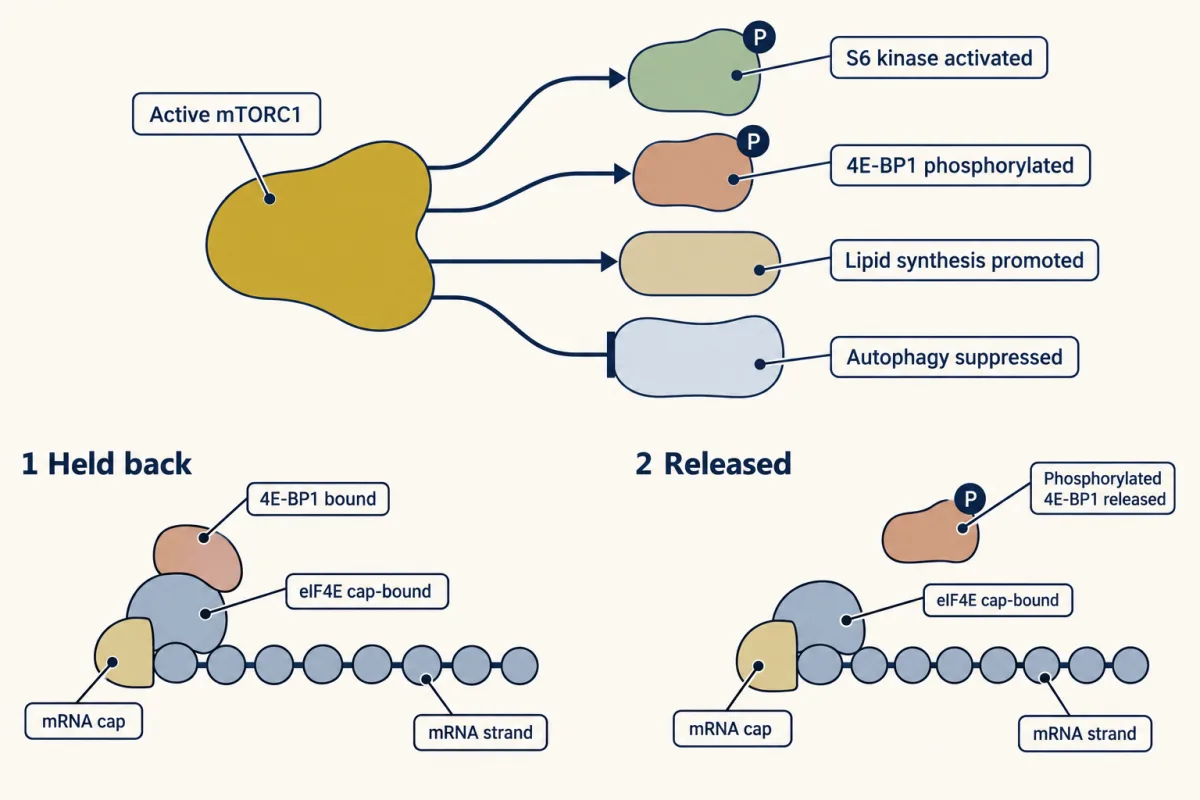
When both answers are yes, mTORC1 phosphorylates two proteins that control the first step of translation. S6 kinase is switched on. 4E-BP1, which holds back eIF4E, the factor that grips the cap at the start of an mRNA, lets go. mTORC1 also promotes lipid synthesis and holds off autophagy, the process in which a cell digests its own contents in lysosomes to recover building blocks.
The idea: AMPK reads AMP, because AMP moves most
Read the transcript of “Why AMPK Reads AMP”
Film transcript: Why AMPK Reads AMP
Is there enough ATP? A healthy cell holds its ATP nearly constant, so ATP is a poor alarm. The kinase AMPK reads AMP instead. Adenylate kinase keeps the three adenine nucleotides near equilibrium. Two ADP make one ATP and one AMP. Divide by ATP. The AMP to ATP ratio goes as the square of the ADP to ATP ratio. At rest, ATP is 5 millimolar and AMP is 0.025. Let work use up a tenth of the ATP. ATP falls to 4.5, ADP settles near 0.93, and AMP becomes 0.096. ATP fell 10 percent, and AMP rose almost fourfold. The needle has barely moved, and the light is on. In AMPK, alpha carries the kinase, beta holds the complex together, and gamma carries the sensor.
AMP, ADP and ATP compete for sites on gamma, so gamma reads their ratio. The main switch is one threonine on alpha, phosphorylated by LKB1. With AMP on gamma, that phosphate is harder to remove, and by most accounts easier to add. AMP moves most, so AMPK reads AMP.
AMP-activated protein kinase (AMPK) answers a third question: is there enough ATP? You met it in the biochemistry course as a fuel gauge. Here is why the gauge watches AMP, more than ATP itself.
A healthy cell holds ATP nearly constant, so ATP is a poor alarm. The enzyme adenylate kinase interconverts the three adenine nucleotides and keeps them near equilibrium:
2 ADP ⇌ ATP + AMP, so [AMP] = K × [ADP]² / [ATP]
Divide by [ATP] and you have the rule that matters:
[AMP] / [ATP] = K × ( [ADP] / [ATP] )²
The AMP:ATP ratio goes as the square of the ADP:ATP ratio. Try round numbers, taking K as 0.5, which lies within the range of reported values. At rest, ATP is 5.0 mM and ADP is 0.5 mM, so AMP is 0.5 × 0.25 / 5.0 = 0.025 mM. Now let work use up a tenth of the ATP. ATP is 4.5 mM, ADP settles near 0.93 mM, and AMP is 0.5 × 0.86 / 4.5 = 0.096 mM. ATP fell by 10 percent and AMP rose almost fourfold. Think of a low-fuel light: the needle has barely moved and the light is on.
AMPK has three subunits. Alpha carries the kinase, beta holds the complex together, and gamma carries the sensor: sites where AMP, ADP and ATP compete to bind, so gamma reads their ratio. The main switch is one threonine in the activation loop of alpha, threonine 172, phosphorylated mainly by an upstream kinase called LKB1. A second kinase, CaMKK2, adds the same phosphate when calcium rises, with no change in AMP. That phosphate raises activity a hundredfold or more. LKB1 is active all the time. What AMP changes is AMPK itself: with AMP on gamma, the phosphate is harder for phosphatases to remove and, by most accounts, easier for LKB1 to add, and the kinase gets a further allosteric push. ADP on gamma also protects the phosphate, though at higher concentrations than AMP, and only AMP gives the allosteric push.
Once on, AMPK cuts spending and raises income. It phosphorylates and inactivates acetyl-CoA carboxylase, which slows fat synthesis and, as malonyl-CoA falls, lets fatty acids into mitochondria to be burned. It inactivates 3-hydroxy-3-methylglutaryl coenzyme A (HMG-CoA) reductase, the rate-setting enzyme of cholesterol synthesis. In muscle it brings more GLUT4 glucose transporters to the cell surface.
Two gauges, one decision: energy can veto growth
AMP-activated protein kinase (AMPK) phosphorylates TSC2 at sites different from Akt’s, and here the phosphate makes the TSC complex more active, which drains Rheb of GTP. AMPK also phosphorylates Raptor, which inhibits mTORC1 directly.
Both gauges also write on ULK1, the kinase that starts autophagy. mTORC1 adds a phosphate that keeps it off. In the model built on work published in 2011, AMPK adds phosphates at other sites that switch it on. Later studies complicate AMPK’s side of this, so hold it loosely.
You can now predict three states.
- Fed. Akt silences TSC, Rheb holds GTP, the Rags hold mTORC1 on the lysosome and AMPK is quiet. Protein and lipid synthesis run. Autophagy is held low.
- No amino acids. Rheb may still hold GTP, but the Rags release mTORC1 and it leaves the lysosome. Translation slows and autophagy starts, which returns amino acids to the cell.
- No energy. AMP rises and AMPK switches on. Fat and cholesterol synthesis slow, fat burning rises, glucose uptake rises in muscle, and mTORC1 is shut off through TSC2 and Raptor even when growth factors and amino acids are present.
Design problem
A cell should build new protein only when three things are true at once: a growth factor is present, amino acids are plentiful and ATP is plentiful. Design the logic using the parts in this lesson. Say where in the cell each condition is read, and name one mutation that would let the cell ignore each condition.
Saved in this browser only.
One way to do it
Make the output “mTORC1 is active” and require two things for it: Rheb holds GTP, and mTORC1 is on the lysosome.
- Growth factor. Read at the plasma membrane by a receptor and relayed by Akt, which takes the TSC complex out of action so that Rheb keeps its GTP. To ignore it: lose PTEN, so that PIP3 and Akt stay on with no growth factor.
- Amino acids. Read in the cytoplasm and inside the lysosome by sensors that report to the Rags, which bring mTORC1 to the lysosome. To ignore it: lock RagA or RagB in its GTP form, so that mTORC1 stays on the lysosome in a starved cell.
- ATP. Read in the cytoplasm by the gamma subunit of AMPK, as the AMP:ATP ratio. To ignore it: lose LKB1, so that AMPK barely switches on when AMP rises.
TSC2 is where two conditions meet. A cell without it largely ignores growth factors and has lost one of AMPK’s two routes to mTORC1, but it mostly keeps the amino acid check.
When a gauge is drugged or broken
Rapamycin. T cells need mTORC1 to grow and divide when interleukin-2, a signaling protein of the immune system, tells them to. Rapamycin, under the drug name sirolimus, blocks that step, and it was approved in the United States in 1999 to prevent rejection of transplanted kidneys. Every other tissue uses mTORC1 too, so mouth ulcers and raised blood sugar are among its side effects.
Tuberous sclerosis. People born with a faulty copy of TSC1 or TSC2 develop benign growths in the brain, kidneys, skin and other organs. In cells without a working TSC brake, Rheb stays on and mTORC1 largely stops waiting for a growth factor. Drugs of the rapamycin family are used to shrink some of these growths.
Metformin. This is the most widely prescribed drug for type 2 diabetes, and how it works is still not fully understood. The liver, where it reduces glucose output, was long thought to be its main site of action, but the gut now looks important too. At high concentrations metformin partly inhibits complex I of the mitochondrial respiratory chain, which raises AMP and switches on AMP-activated protein kinase (AMPK). At lower, clinically relevant concentrations it has been reported to switch on AMPK at the lysosome without changing AMP. Whether AMPK is the reason blood glucose falls is also argued. Mice lacking AMPK in the liver still respond to the drug, and other targets have been proposed in the liver and in the gut.
Your notes
Select any text in the lesson to highlight it or add a note to it. Your highlights and notes are saved in this browser and collected in your notebook.
This browser is not letting the site save anything (a private window or strict privacy settings), so highlights and notes will be lost when you leave the page.
How we measure it
Drug-resistance screen in yeast
Spread millions of yeast cells on plates containing a drug that stops growth and keep the rare colonies that grow anyway. Then sort the survivors by which gene is changed. In the rapamycin screen the genes that turned up again and again encoded the drug's partner (FPR1) and its target (TOR1 and TOR2). In other screens such genes can also encode drug pumps or bypass routes.
Affinity purification with a drug–protein bait
Fix FKBP12 loaded with rapamycin to a solid support, pass a tissue extract over it, and look for proteins that stick only when the drug is present. This is how the mammalian target of rapamycin was pulled out of extracts.
Immunofluorescence co-localization
Fix cells, label mTOR with one fluorescent antibody and a lysosomal membrane protein with another, and ask whether the two signals overlap. Comparing starved and re-fed cells shows mTORC1 moving off and on the lysosome.
Phospho-specific immunoblotting
Separate cell proteins on a gel and probe them with antibodies that bind a protein only when one chosen residue carries a phosphate. Phosphorylated S6 kinase reports mTORC1 activity, and phosphorylated acetyl-CoA carboxylase reports AMPK activity, so one blot can read both gauges.
Practice questions on this lesson (3) → MCAT-style, original, each with an explanation
Where this lesson fits
Before thisReview first
- GTPase Switches: The TimerThis course · Lesson 7
TSC is a GAP that switches off Rheb, and the Rags are GTPases, so you need the GTPase timer idea.
- PI 3-Kinase, Akt and InsulinThis course · Lesson 20
Akt, switched on by insulin, phosphorylates TSC2 here, and mTORC2 gives Akt its second phosphate.
- Phosphorylation: Kinases and PhosphatasesThis course · Lesson 6
mTORC1, AMPK and LKB1 all work by adding or removing phosphates on target proteins.
After thisStudy next
- Stress Signals: p38 and JNK, p53, Unfolded Proteins and OxidantsThis course · Lesson 33
Stress pathways also cut growth and switch on autophagy, and they build on the energy and nutrient sensing here.
- Endocytosis and Signaling EndosomesThis course · Lesson 36
mTORC1 is activated on the lysosome surface, an example of signals running from a membrane compartment.
- Drugs Against a PartThis course · Lesson 42
Rapamycin acting through FKBP12 and allosteric kinase inhibition are drug-design examples that this lesson takes further.
Elsewhere on the siteFilms, simulations and method films in other courses
- Balloon on a flaskSimulation · Life Science
It shows how cells make ATP from food, the energy supply that AMPK monitors through AMP.
- How cells pull reactions uphillFilm · Biochemistry
It shows how ATP pays for uphill reactions, which explains why a cell's ATP and AMP levels matter to AMPK.
- How the body switches fuelsFilm · Biochemistry
It shows how the body switches between building and burning fuels, the decision that AMPK and mTORC1 make in a cell.
Suggested by an AI model from the lessons themselves, then checked. How we use AI
Finish line
Test yourself
8 questions
Practice and MCAT-style, with explained answers.
Next · Lesson 22
Cytokine Receptors and JAK–STAT
How does a signal reach a gene when the only relay between the receptor and the DNA is one kind of protein?
Continue →