Three Questions, Three Kinds of Evidence
Read the transcript of “Three Questions, Three Kinds of Evidence”
Film transcript: Three Questions, Three Kinds of Evidence
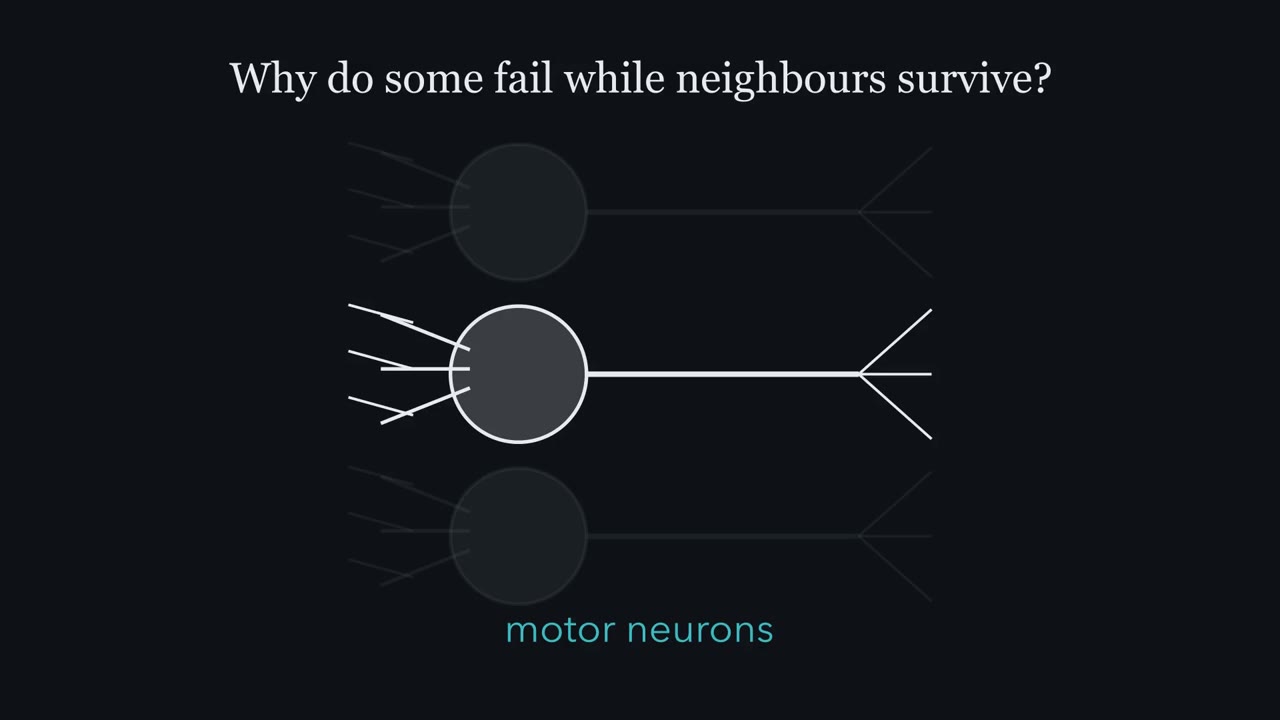
Three diseases each kill a particular set of adult neurons. How do we learn what causes them, and what might treat them? In Alzheimer disease, early losses include neurons of the entorhinal cortex, and of field CA1 in the hippocampus. Both belong to the circuit for new memories. In Parkinson disease, the defining loss is of dopamine neurons in the substantia nigra, in the midbrain. In ALS, motor neurons die. Upper ones sit in the motor cortex. Lower ones send axons to muscle. In each disease, a protein misfolds and clumps. Alzheimer disease has amyloid plaques outside neurons, and tau tangles inside them. In Parkinson disease, α-synuclein is the main protein in the filaments of Lewy bodies. Most ALS has clumps of TDP-43.
Now three questions, each with its own kind of evidence. First, an autopsy tells you what a clump is made of. It does not tell you whether the clump kills the cell. Now look at rare families. A gene variant passes from parent to child along with the illness. That travelling together is called cosegregation. It is strong evidence for a cause. But a harmless variant nearby can travel along too. A second family, and tests of what the variant does, make the case. Here is a puzzle. A family's ALS is caused by a mutation in SOD1. Most people with ALS carry TDP-43 clumps. Will this family's motor neurons have them?
No. In a postmortem series, cases with SOD1 mutations lacked TDP-43 clumps. Their motor neurons died anyway. A disease-causing gene need not encode the protein in the usual deposit. In Alzheimer disease, the three classic dominant genes all affect how amyloid-beta is made or processed. Neither deposits nor disease-causing genes alone show that removing a protein after onset will help. Randomized trials in people give the most direct test, judged on how they think, function or survive. So ask what each finding can show. Autopsy shows what builds up. Families can show what starts it. Trials test whether changing it helps, and what it costs.
Ask two things of every finding. What does it show? And what can it not show?
Lecanemab slowed worsening in early Alzheimer disease by about 27%. The treated group still got worse.
Continue in the lesson: When Mature Neurons Fail: Neurodegeneration →
2:56 · Free, with captions and a transcript. The lesson has the full text, the questions and the sources.
More films from this lesson
How this film was made. Narration: an AI narrator voice (Kokoro, af_heart) reading narration written from this lesson's text. Animation: AI-generated in code (Manim) by Claude, a schematic with no drawn molecular structures. Captions come from the narration script. See something wrong? Report it.