One More Rope
Read the transcript of “One More Rope”
Film transcript: One More Rope
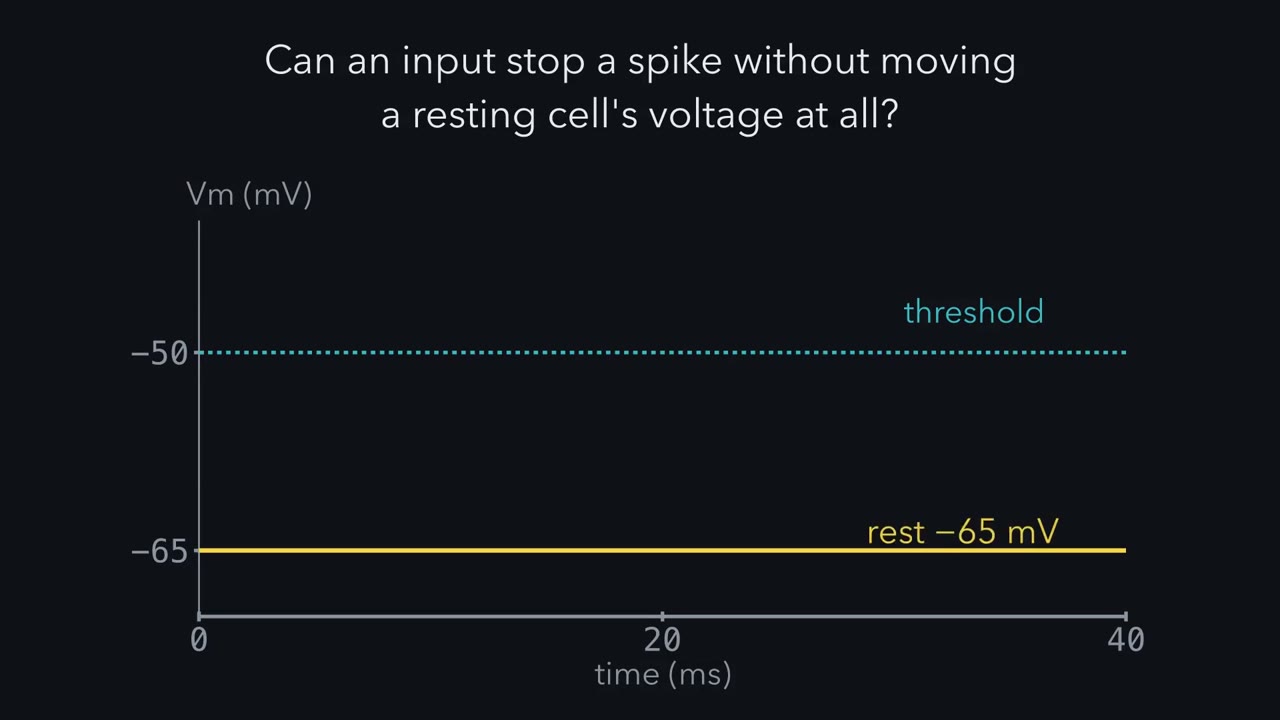
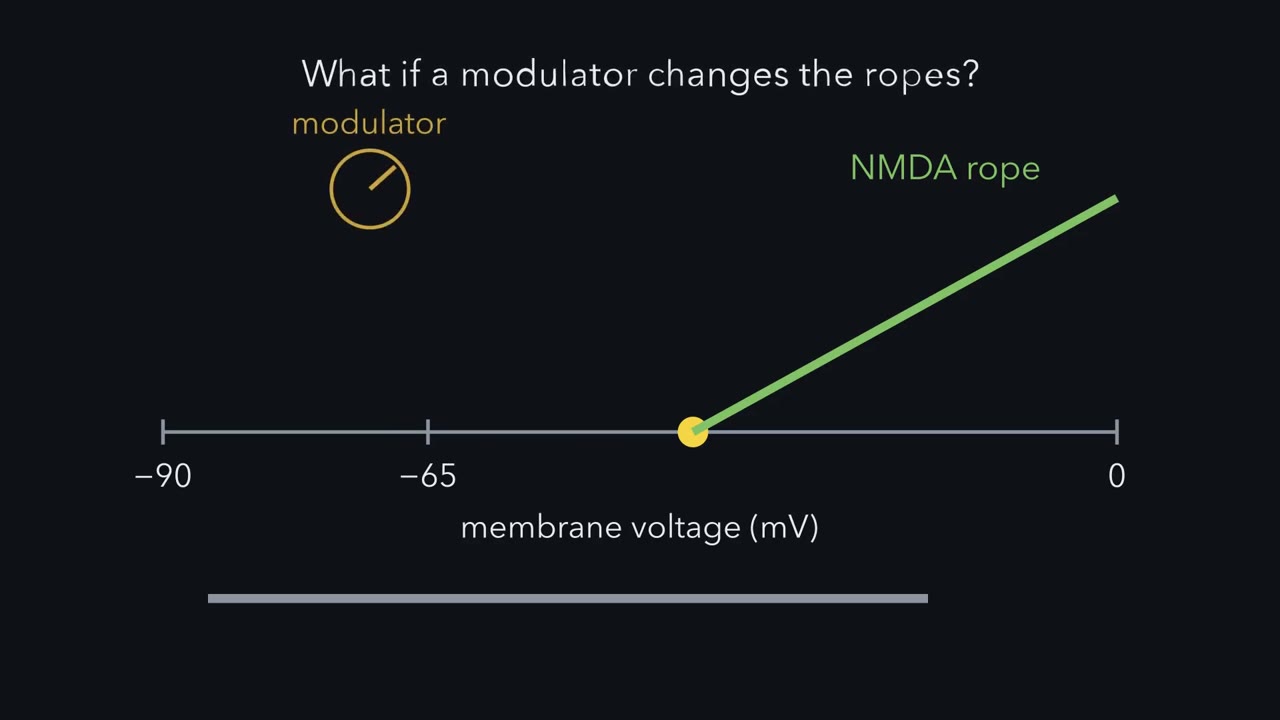
How can an inhibitory input stop a cell from firing, while leaving its resting voltage unchanged? Start with the balance point. It is the voltage the cell settles at, if its open channels stay as they are. A marker on a voltage scale shows the membrane potential. Every kind of open channel has a rope, tied at its own reversal potential. Each rope pulls the marker toward its end. How hard a rope pulls is its current: conductance times driving force, Conductance is mostly how many channels are open. Driving force is the gap between the marker and the rope's end. In our model, one rope, the leak, stands in for the channels open at rest. It is 10 nS, tied at minus −65 mV.
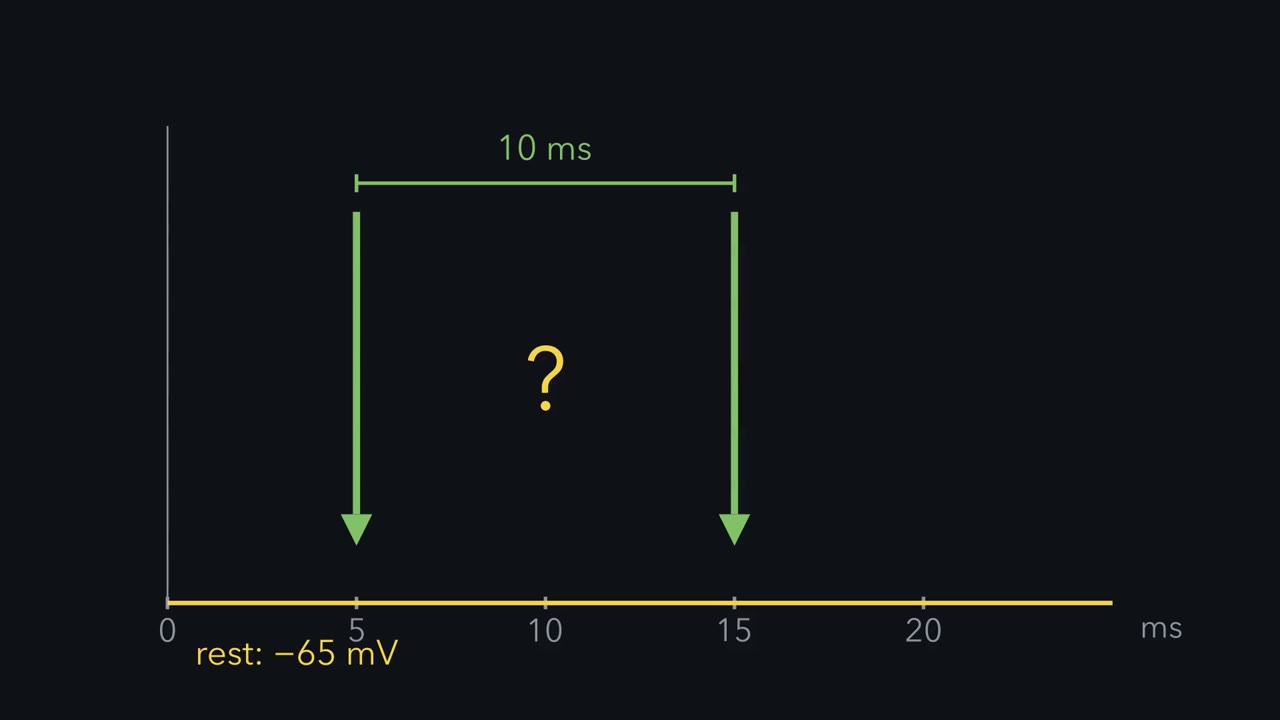
Now a glutamate synapse fires. Its AMPA receptors add a second rope, tied near 0 mV. The marker is pulled up, but the leak holds it back. So it settles between the two ropes. That rise is a postsynaptic potential. When the channels close, the new rope goes slack. The marker drifts back to rest. GABA_A receptors are chloride channels. Where their rope is tied depends on the cell's chloride gradient. Here is a question. A GABA rope is tied at minus −75 mV. The cell rests at minus −65 Which way does the marker move?
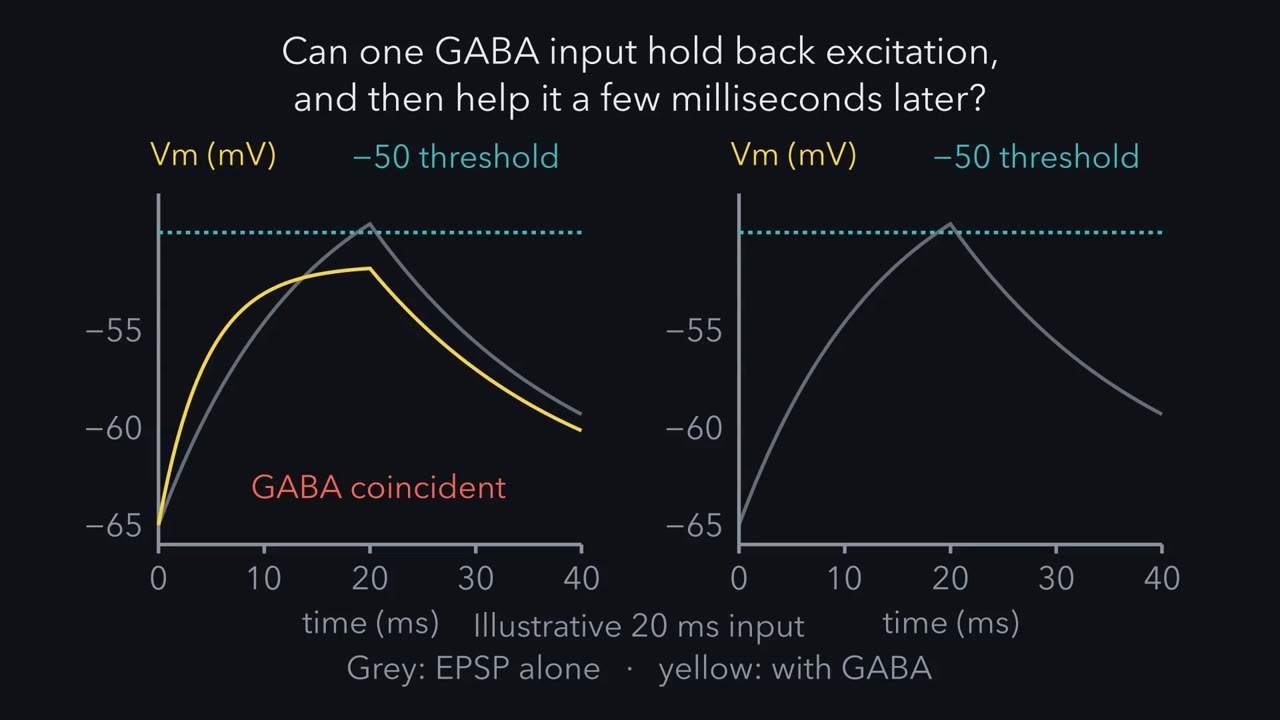
Down, toward minus −75 The rope is tied below the marker, so the balance point drops below rest. That is the textbook IPSP. An EPSP makes the cell more likely to fire. An IPSP makes firing less likely. The definition is about firing, not about which way the trace moves. So this lesson will show an IPSP that leaves a resting cell's voltage unchanged. And a GABA input that moves the voltage up, yet can still hold back excitation. Written out, the balance point is an average of the ropes' ends. This holds for a passive cell, with one voltage everywhere. Each end is weighted by that rope's share of the total conductance.
It also assumes no current injected through an electrode, and conductances that do not change with voltage. The marker then chases this point over time. So a new synapse does two jobs. First, it pulls the balance point toward its own end. Second, it adds to the total conductance. Every other rope's share shrinks, so every other rope counts for less. In this passive cell, the voltage also settles faster when a synapse opens. The next chapter shows why. A synapse is one more rope on the balance point. Conductances add. The balance point is their weighted average.
An inhibitory input can leave a resting cell's voltage unchanged and still stop it from firing. How?
Continue in the lesson: Integration, Inhibition and Neuromodulation →
3:09 · Free, with captions and a transcript. The lesson has the full text, the questions and the sources.
More films from this lesson
How this film was made. Narration: an AI narrator voice (Kokoro, af_heart) reading narration written from this lesson's text. Animation: AI-generated in code (Manim) by Claude, a schematic with no drawn molecular structures. Captions come from the narration script. See something wrong? Report it.