Genetics and Molecular Biology · Unit 1: Inheritance
Sex Linkage, Dosage Compensation and Non-Mendelian Inheritance
Rewritten on : new text, flashcards and film. Your notes and highlights stay, but the text around them may have moved.
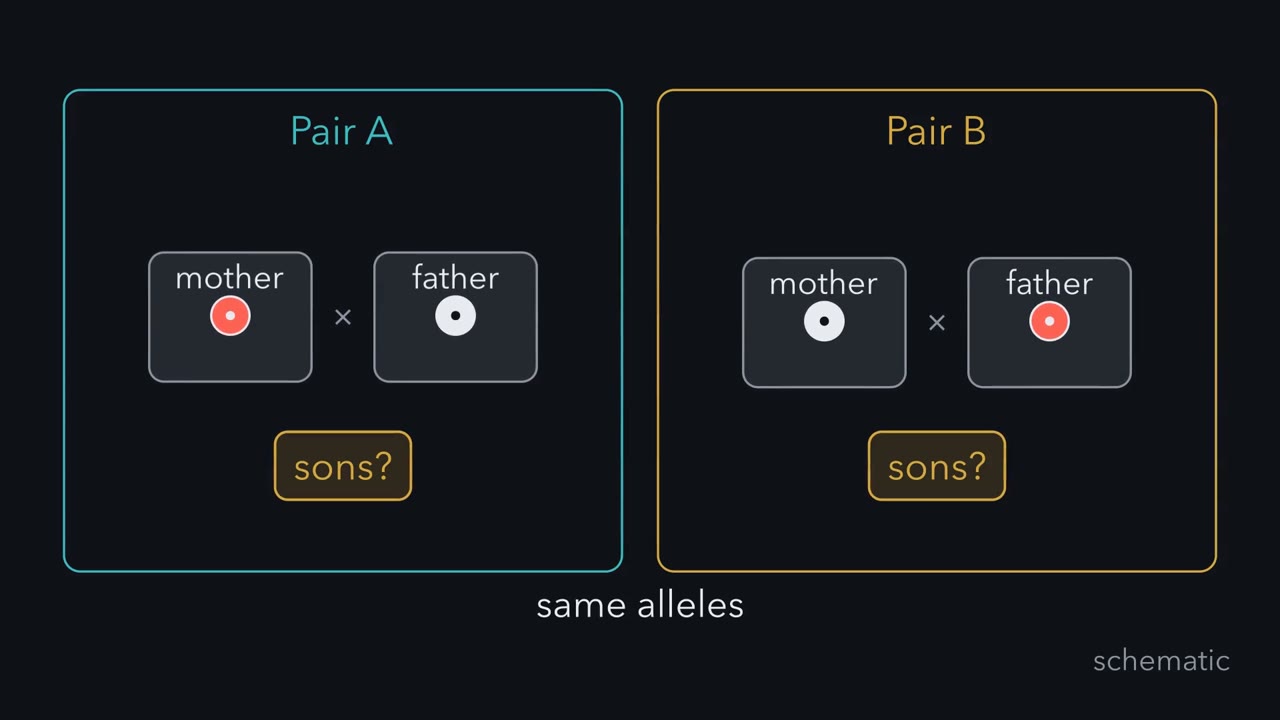
Why can swapping which parent has white eyes change every son?
Pause when the reading reaches a film, and offer to play it. Saved on this device.
Watch the film now, or keep listening
Builds on:Mendel's Peas: Segregation and Independent AssortmentChromosomes and Meiosis: The Physical Basis of Mendel's LawsExtending Mendel: Dominance, Multiple Alleles and Gene InteractionWhy these?
 ▶ Watch Why Reciprocal Crosses Split · 3:27
Read the transcript of “Why Reciprocal Crosses Split”
Film transcript: Why Reciprocal Crosses Split
Why can swapping which parent has white eyes change every son? Morgan's reciprocal fly crosses looked almost identical at the start. Their offspring did not. The difference points to a chromosome route, not a new inheritance law. Start inside the flies. A female has a pair of X chromosomes. A male has an X and a Y. The white gene sits on the X, not the Y. Gene location decides which chromosome carries an allele through egg or sperm. A male fly has one X, so he is hemizygous for white. His Y carries no white gene. A recessive white allele therefore shows in a male. No dominant allele can mask it. A female can carry white without showing it when a red allele is present.
Now follow the chromosomes, not the eye colours. Sons receive their only X from their mother, while daughters receive their father's X. The father's Y makes the other route into sons. That unequal route is the key to the reciprocal-cross puzzle. Begin with a red-eyed mother carrying only red alleles. Every child receives her red X. The white-eyed father's X reaches daughters, where her red allele masks it. Every offspring is red-eyed. The daughters carry white, but their red maternal allele determines eye colour. Reverse only the parental eye colours. The mother now carries white alleles, and the father carries red. Before the chromosomes move, which offspring will have white eyes?
Every daughter gets the father's red X and a maternal white X. She is red-eyed. Every son gets a maternal white X and the father's Y. He is white-eyed. This is criss-cross inheritance: father to daughter, mother to son. The two crosses use the same red and white alleles. Only the carrier's sex changed. Yet their first offspring differ. Reciprocal crosses can separate X-linked inheritance from ordinary autosomal inheritance. An ordinary autosomal allele would not change routes when the carrier's sex changes. This pattern does not replace Mendel's segregation. It adds chromosome location to the bookkeeping.
Inheritance patterns depend on allele identity, chromosome location, and parental origin. Here, location changes the route. Parent of origin matters here because sex determines the chromosome route. Read the family board from the son backward. His X points to his mother. Read a daughter backward, and one X points to each parent. Swapping the carrier therefore changes where the allele can go. The allele itself behaves the same; its possible destinations have changed.
From the film
- The route of an X-linked allele depends on its carrier parent.
- A male fly has one X, so he is hemizygous for white; his Y carries no white gene.
- Sons receive their only X from their mother, while daughters receive their father's X.
- Reciprocal crosses can separate X-linked inheritance from ordinary autosomal inheritance.
- Criss-cross inheritance: father to daughter, mother to son.
In 1910 a white-eyed male fruit fly appeared in Thomas Hunt Morgan’s laboratory, and swapping which parent was white changed the offspring.
Mendel’s peas gave the same result whichever plant was the mother.
The one idea. Inheritance patterns depend on allele identity, chromosome location, and parental origin.
Scope: the inheritance patterns in this lesson. Most alleles do not show a parent-of-origin effect, and the rule does not replace Mendelian segregation.
One white-eyed male: follow the X
In Morgan’s laboratory at Columbia University, which bred Drosophila melanogaster, the white-eyed male crossed to red-eyed females gave red-eyed offspring of both sexes, so white is recessive: it shows only when no dominant allele is present. He published the work that year in Science as “Sex limited inheritance in Drosophila.” Sex-linked means carried on a sex chromosome.
A female fly is XX and a male XY (chromosomes and meiosis). The white gene sits on the X; the Y carries no copy. A male is therefore hemizygous for white: one allele rather than a pair, so whatever his X carries is what you see. Write X+ for red and Xw for white.
The first film traced both F1 crosses. The table assumes ordinary segregation, equal survival, half the offspring of each sex and complete penetrance.
| Cross | Daughters | Sons |
|---|---|---|
| Red X+X+ female × white XwY male | X+Xw, red | X+Y, red |
| White XwXw female × red X+Y male | X+Xw, red | XwY, white |
The second row is the reciprocal cross, the same phenotypes with the sexes swapped. It shows criss-cross inheritance: father to daughter, mother to son.
The film stopped at the F1. Intercross the first row’s F1, X+Xw by X+Y. Daughters get X+ from their father, so they are half X+X+ and half X+Xw, all red. Sons get X+ or Xw from their mother, so half are white. The F2 expectation is three red to one white, every white fly male.
Predict. Now intercross the reciprocal F1, X+Xw by XwY. What four genotype-and-sex classes should appear, and in what proportions?
Check your prediction
The mother makes X+ and Xw eggs; the father makes Xw and Y sperm. Each pairing has probability one half times one half, one quarter:
X+Xw red female : XwXw white female : X+Y red male : XwY white male = 1 : 1 : 1 : 1
Among 400 F2 flies, expect 100 in each class: 200 of each sex and 200 white. Real broods vary around an expectation. In Morgan’s own F2 from the first cross, white-eyed males made up less than one quarter of all flies.
With the same parental genotypes, an ordinary non-imprinted autosomal allele gives the same F1 both ways.
| Class | F1 expected | F1 observed | F2 expected | F2 observed |
|---|
Assumes ordinary segregation, equal survival, half of each sex and complete penetrance, as in the lesson’s worked problem; the F1 female is taken as an ideal X⁺Xʷ and the F1 male’s X comes from his mother. Counts are chance draws around the expected values; real broods are noisier, and in Morgan’s own F2 from the red-female cross the white-eyed males were under a quarter of the flies.
The exceptions that tested the model
Calvin Bridges crossed white XwXw females to red X+Y males. Roughly 1 in 1,600 offspring were exceptional white daughters or red sons.
Predict. Keep white on the X. What meiotic error could make both exceptions, and what chromosome sets should they carry?
Check your prediction
If the mother’s X chromosomes occasionally fail to separate, a nondisjunction covered in chromosome changes, some eggs carry XwXw and others no X.
- XwXw egg plus Y sperm gives an XwXwY white daughter, with both X chromosomes from her mother.
- An egg with no X plus X+ sperm gives an X+O red son. His only X came from his father, and without a Y he should be sterile.
- XwXw plus X+, and an empty egg plus Y, would be expected to die or be rare.
The model predicts that exceptional white daughters carry a Y and exceptional red sons lack one. It also predicts that an XXY female, whose two X chromosomes and Y must sort at meiosis, produces XX and Y eggs much more often than 1 in 1,600. Bridges found both and published the work in 1916. Matching an unusual phenotype to an unusual chromosome set tied white to the X. It also showed that an XO fly is male and an XXY fly female, so the Y does not decide sex in flies.
Human X-linked conditions follow the same logic. Glucose-6-phosphate dehydrogenase deficiency (pentose phosphate pathway) and HPRT deficiency in Lesch-Nyhan syndrome (nucleotide metabolism) are both much more common in males. Pedigrees follows the pattern through families.
How sex is decided: mammal versus fly
Predict. Bridges’ exceptions were XO males and XXY females. XO and XXY people also occur. If the Y were the sex switch in humans, how should each develop?
Check your prediction
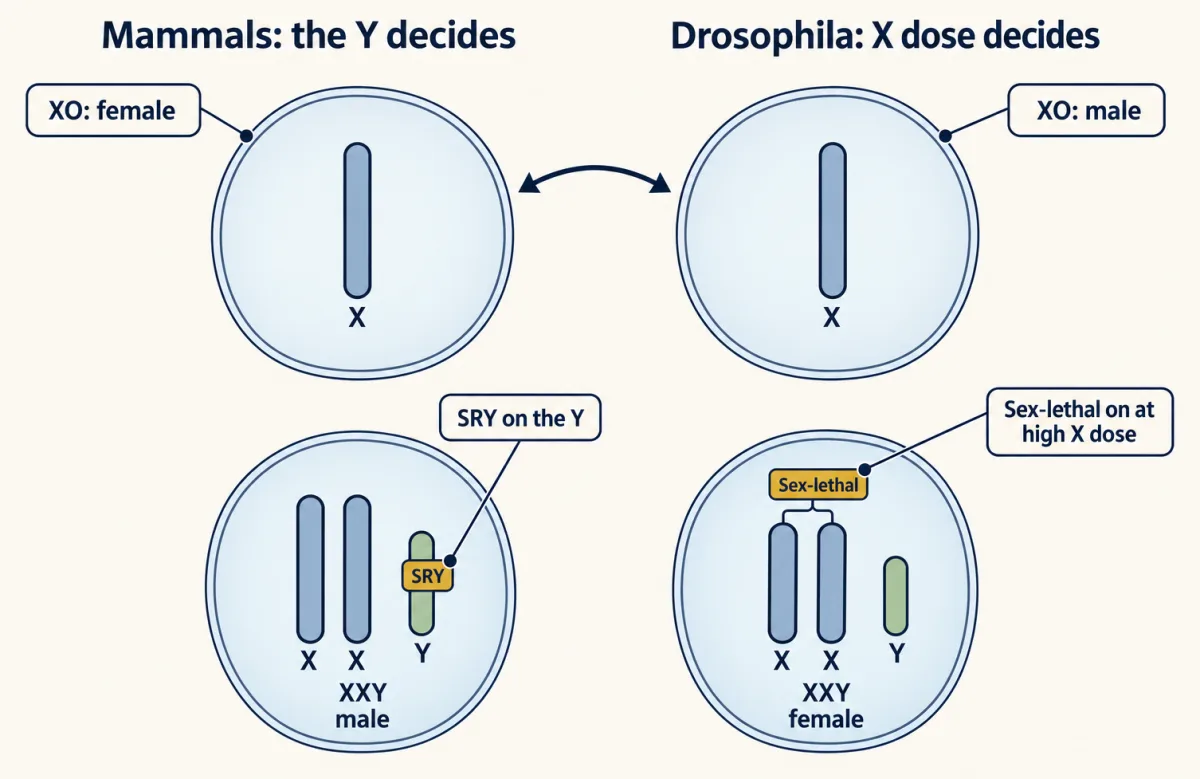
In most mammals, including mice and humans, one Y carrying SRY in humans or Sry in mice starts testis development. Thus XO individuals with Turner syndrome develop as females, while XXY individuals with Klinefelter syndrome develop as males. Sinclair and colleagues reported SRY in 1990. In 1991 Koopman and colleagues added a 14-kilobase fragment containing Sry to chromosomally female mouse embryos; it was sufficient to make them develop testes.
In flies, as Bridges found, the Y is needed for male fertility, not maleness; in a diploid fly, two X chromosomes ordinarily specify female development and one specifies male.
The classic fly description uses the ratio of X chromosomes to sets of autosomes. Erickson and Quintero argued in 2007 that the embryo instead reads the combined dose of several X-linked signal genes. Either way, high X dose switches on Sex-lethal in females, which maintains its own activity through RNA splicing and steers splicing of genes below it.
Balancing X-linked output
In a simplified model with every X-linked copy fully active, an XX animal begins with twice the dose of an XY or XO animal. Dosage compensation reduces that difference.
Predict. Which strategies could bring two active X copies and one active X copy toward the same output?
Check your prediction
Turn one of two X chromosomes down, turn the single X up, or reduce output from both. Different animals use all three.
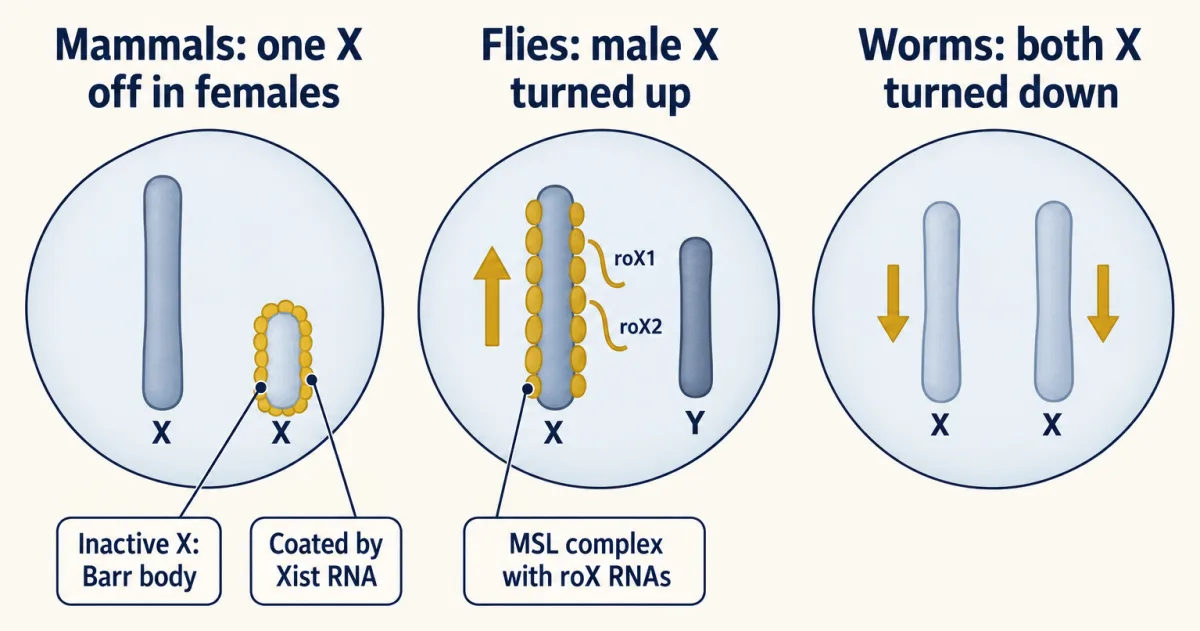
Mammals mainly inactivate one female X. Mary Lyon proposed in 1961 that each cell of a female mouse inactivates either its maternal or paternal X early in development, and its descendants keep that choice. A heterozygous female is therefore a mosaic, a patchwork of cell lineages expressing different X-linked alleles. The tortoiseshell cat makes this visible: its X-linked Orange alleles produce orange and usually black patches. A calico is a tortoiseshell with an autosomal white-spotting allele, which adds patches that X inactivation does not explain. Tortoiseshell and calico males are rare and usually XXY.
In placental mammals the inactive X forms the condensed Barr body and is coated by Xist, an RNA that appears not to encode protein. Mouse deletions showed that Xist is required for inactivation. It acts in cis, silencing the chromosome that makes it. Mosaicism also matters in Rett syndrome, which mainly affects girls and involves X-linked MECP2 (synapse disorders): a girl’s cells can differ in which MECP2 allele they express.
Flies turn the male X up. The MSL, or male-specific lethal, complex coats the single male X with help from the noncoding RNAs roX1 and roX2. It raises transcription of active X-linked genes toward the output of two female X chromosomes. In females, Sex-lethal blocks translation of the mRNA for MSL2, the subunit that starts complex assembly.
So far, a parent mattered only through the sex chromosome it sends, and in Lyon’s model either parent’s X can be the one silenced. The second film asks whether parent of origin matters beyond the sex chromosomes.
Read the transcript of “Two Ways Parent of Origin Matters”
Film transcript: Two Ways Parent of Origin Matters
The first film followed an allele because it sat on the X. Can parent of origin matter beyond the sex chromosomes? It can, in two different ways. The key is to ask whether transmission or expression changed. In the first lane, organelle inheritance changes which DNA arrives. In the second, genomic imprinting changes which parental nuclear allele is expressed. Keep transmission and expression separate. Both mechanisms make pedigrees depend on parent, but for different physical reasons. Mitochondria and chloroplasts carry small genomes outside the nucleus. An egg supplies abundant cytoplasm and organelles. A male gamete usually contributes far less cytoplasm.
That difference gives maternal organelles an enormous numerical head start. Many species also exclude, deplete, or destroy paternal organelles or their DNA. Organelle genomes are therefore generally inherited from the mother. The mother's organelle pattern reaches sons and daughters. Some species instead show paternal or biparental organelle transmission. Both sexes can inherit a maternal organelle variant. Each child now carries the mother's organelle DNA. But carrying a variant is not the same as passing it on. Imprinting is different. An imprinted gene is nuclear. Both parents transmit a copy, but only one parental copy is expressed. A parent-of-origin mark decides which.
The mark does not change the DNA sequence. The marks are set during egg or sperm formation, then reset in the next generation. Both a daughter and a son inherit the same maternal organelle variant. Each carries it. Which child can place that variant into the next generation's eggs? Trace the lineage, not the child's own phenotype. The question is about transmission, not expression.
The daughter can usually pass it through eggs into another generation. The son can carry the variant, but his sperm usually do not transmit those organelles. The children can therefore share a variant while only one sex continues its lineage. Now compare the lanes. Organelle inheritance usually filters transmission through the egg. Imprinting transmits both nuclear copies, then filters expression by parental origin. These mechanisms can produce different pedigrees. Inheritance patterns depend on allele identity, chromosome location, and parental origin. Here, parent of origin can decide which DNA arrives or which allele acts. Most nuclear genes use both parental copies, so imprinting is a special case.
When a pedigree depends on the mother, ask what is moving. Is organelle DNA traveling through eggs? Or are both nuclear alleles present while a parental mark controls expression?
From the film
- Parent of origin can decide which DNA arrives or which allele acts.
- Organelle genomes are generally inherited from the mother, though some species show paternal or biparental transmission.
- A son can carry a maternal organelle variant, but usually only daughters pass it on.
- An imprinted gene is nuclear: both parents transmit a copy, but only one parental copy is expressed.
Genes that remember their parent
In short, parent of origin can decide which DNA arrives or which allele acts.
Organelle genes: which DNA arrives
As the second film showed, organelle genomes are generally inherited from the mother. In humans, Giles and colleagues showed in 1980 that children carried their mother’s pattern of mitochondrial DNA variants rather than their father’s; sons and daughters inherited the pattern, but only daughters passed it on. Human sperm mitochondria do enter the egg, but a 2023 study found that mature human sperm mitochondria lack intact mitochondrial DNA. Baur’s Pelargonium showed plastid inheritance from both parents, and paternal or biparental organelle transmission occurs in other species.
Genomic imprinting: which allele acts
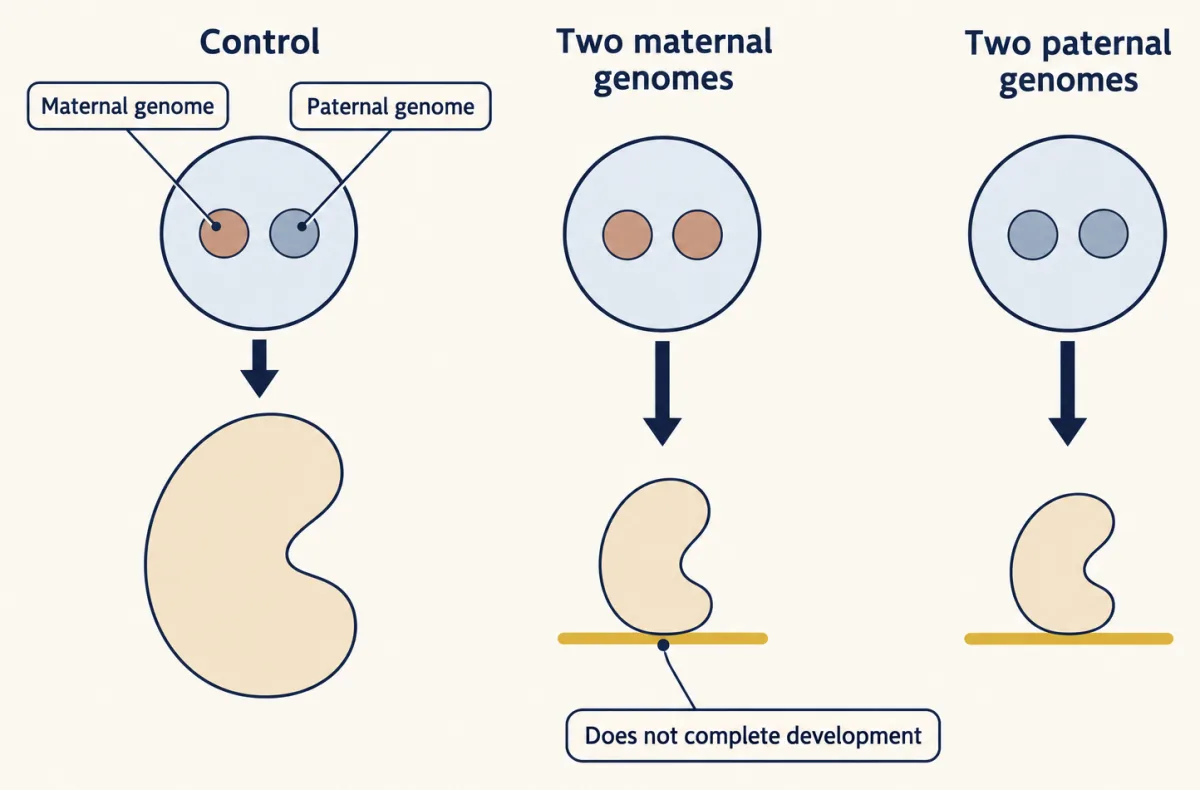
In 1984 McGrath and Solter, and independently Surani, Barton and Norris, built mouse embryos with two maternal or two paternal genomes. Controls underwent the same manipulation but kept one genome of each parental kind.
Predict. If maternal and paternal nuclear genomes were functionally interchangeable, how should all three groups develop? What result would show that parental origin matters?
Check your prediction
If the genomes were interchangeable, every diploid embryo should complete development. Instead, neither uniparental group did, while the one-of-each controls did. The parental genomes are not functionally equivalent.
Genomic imprinting explains the difference: a subset of nuclear genes is expressed from only one parental allele. The second film’s parental mark is chiefly DNA methylation at imprinting control regions, laid down during egg or sperm formation, erased in each generation’s primordial germ cells and rewritten according to the animal’s sex. The mark therefore follows the parent, not the grandparent.
In mouse, the growth-factor gene Igf2 is expressed from the paternal allele in most tissues; nearby H19 is expressed from the maternal allele. A disrupted paternal Igf2 makes a mouse small, while the same allele inherited from the mother leaves size normal.
In humans, imprinted genes lie in region 15q11-q13. Loss of the paternal contribution causes Prader-Willi syndrome; loss of the maternal contribution causes Angelman syndrome.
Going deeper
Refining X inactivation
X inactivation is not random everywhere. It is random in the mouse embryo proper, but the paternal X is inactivated in mouse extraembryonic tissues and in marsupials. Nor is the inactive X completely silent: a 2017 human-tissue survey found incomplete inactivation in no fewer than 23 percent of the X-linked genes it assessed. Eukaryotic regulation develops the silencing mechanism.
How fly and worm compensation differ
The fly MSL complex includes the enzyme MOF, which acetylates histone H4 at lysine 16, a mark associated with open chromatin. MSL knockdown measured an effect smaller than twofold, so other mechanisms may contribute. Forcing MSL2 into females gathers the complex on their X chromosomes and lowers female viability. In the nematode C. elegans, XX hermaphrodites instead reduce expression from each X by about half, matching the single X of XO males.
Your notes
Select any text in the lesson to highlight it or add a note to it. Your highlights and notes are saved in this browser and collected in your notebook.
This browser is not letting the site save anything (a private window or strict privacy settings), so highlights and notes will be lost when you leave the page.
How we measure it
Reciprocal crosses with sex-stratified scoring
The same two phenotypes are crossed twice, swapping which sex carries the mutant allele, and offspring are counted separately by sex. An ordinary autosomal gene, one that is not imprinted, gives the same result both ways; an X-linked gene does not. This is how Morgan's white-eyed crosses pointed to the X.
Pronuclear transplantation
A pronucleus is removed from a fertilized egg with a fine pipette and replaced with one from another egg. Embryos can be built with chosen parental combinations, with one-of-each controls made the same way. In mouse it showed that both parental genomes are needed.
Transgenesis to test sufficiency
A defined piece of DNA is injected into fertilized eggs so that it integrates into the genome. Koopman and colleagues added a 14-kilobase fragment containing Sry to chromosomally female mouse embryos and asked whether testes formed.
RNA fluorescence in situ hybridization
A fluorescent probe complementary to an RNA is applied to fixed cells to show where in the cell that RNA sits. Brown and colleagues used it to show human XIST RNA at the position of the Barr body, on the inactive X.
Practice questions on this lesson (3) → MCAT-style, original, each with an explanation
Where this lesson fits
Before thisReview first
- Mendel's Peas: Segregation and Independent AssortmentThis course · Lesson 1
You need segregation and the idea of dominant and recessive alleles from there to predict the F1 and F2 here.
- Chromosomes and Meiosis: The Physical Basis of Mendel's LawsThis course · Lesson 2
The lesson uses XX and XY meiosis and chromosome separation, which that lesson shows, to explain hemizygous males and Bridges' exceptions.
- Extending Mendel: Dominance, Multiple Alleles and Gene InteractionThis course · Lesson 4
It prepares you to expect phenotypes that depart from simple dominance ratios, such as mosaic patterns and parent-dependent effects.
After thisStudy next
- Chromosome Number and Structure: Aneuploidy and RearrangementsThis course · Lesson 7
Nondisjunction, which Bridges used to explain exceptional flies, is developed there as the source of extra and missing chromosomes.
- Eukaryotic Gene Regulation and EpigeneticsThis course · Lesson 20
It takes the silencing and DNA methylation behind X inactivation and imprinting further, as part of how gene expression is controlled.
Elsewhere on the siteFilms, simulations and method films in other courses
- Where the White Was HidingFilm · Biology
It shows how Punnett squares predict offspring chances, the tool used here for X-linked crosses.
- Homologs First, Sister Chromatids SecondFilm · Biology
It shows how homologs separate in meiosis, which sets which X a gamete carries.
- Copies, Halves, and PairsFilm · Life Science
It shows how sex cells get half the chromosomes, which explains why sons get their mother's X.
Suggested by an AI model from the lessons themselves, then checked. How we use AI
Finish line
Test yourself
8 questions
Practice and MCAT-style, with explained answers.
Next · Lesson 7
Chromosome Number and Structure: Aneuploidy and Rearrangements
How can one missed separation give a cell an extra chromosome, and why can a balanced rearrangement still matter?
Continue →