Where the White Was Hiding
Read the transcript of “Where the White Was Hiding”
Film transcript: Where the White Was Hiding
How can white flowers disappear, then return in the next generation? Crossing a true-breeding purple pea plant with a white one gives only purple offspring. Later, white flowers return among their descendants. The flower-color gene comes in different versions, called alleles. We will track a purple allele and a white allele. Each plant carries a pair. The original purple parent carried only purple alleles. The white parent carried only white alleles. Their offspring received one allele from each parent. That allele pair is the genotype. The visible flower color is the phenotype. This plant looks purple, yet it still carries white. Matching allele pairs are homozygous.
A mixed pair is heterozygous. The first-generation plants are heterozygous, which explains how the white allele stays present. Here, the purple allele is dominant, so one copy makes purple flowers. The white allele is recessive, so white appears only when no purple allele is present. Dominant does not mean common, stronger, or more likely to be passed on. It describes which phenotype appears when the two alleles differ. When a plant makes sex cells, its allele pair separates during meiosis. A heterozygous plant therefore makes both kinds in about equal numbers. Fertilization brings one sex cell from each parent together. Which sex cells meet is a matter of chance.
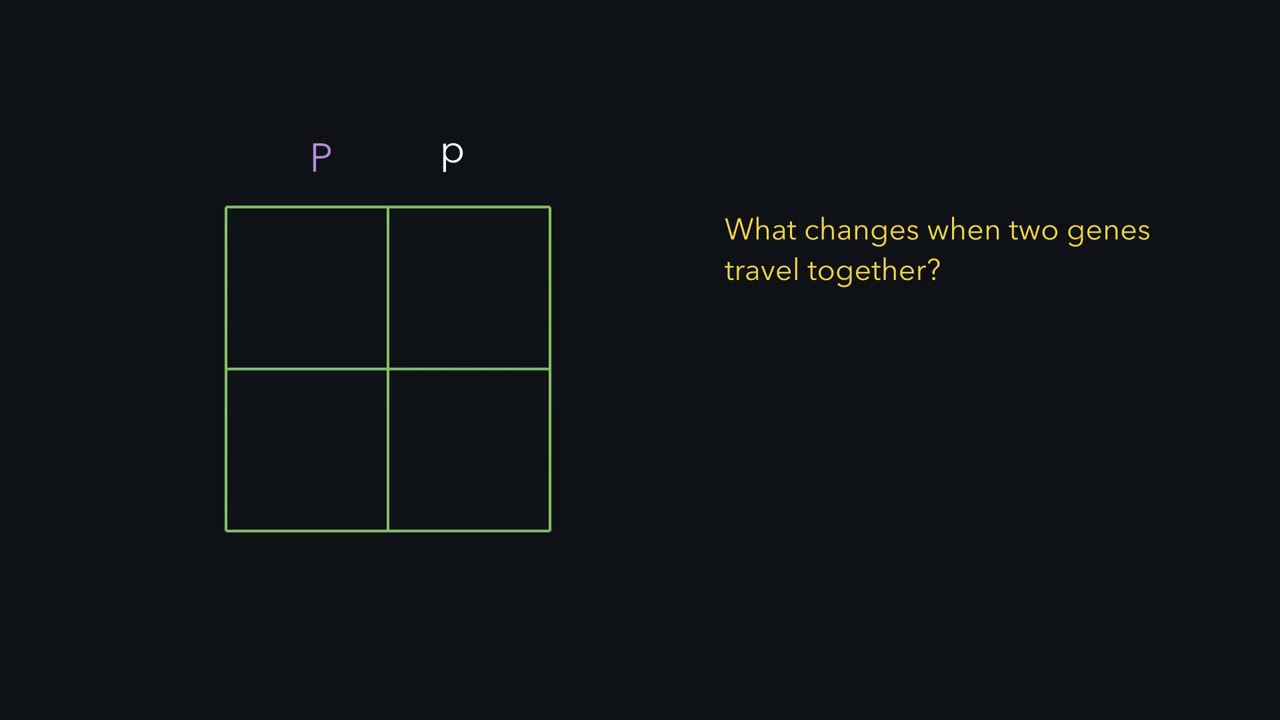
A grid can organize every possible pairing. Because each parent makes both sex-cell types equally often, every box has the same probability. The grid's area becomes a probability map. Both parents can send either allele. Predict which pairing can make a white plant. Watch the allele cards before the flowers appear.
White appears only when a small p arrives from both parents. The other pairings carry a dominant allele, so their flowers are purple. Read genotype before phenotype. The genotype pattern has three groups. Complete dominance combines the first two groups into the same purple phenotype. The grid predicts the genotype pattern shown below it. Grouping by visible color gives the phenotype pattern. Both describe chances across repeated offspring. These four boxes are equally likely outcomes, not four promised offspring. A small batch may miss white entirely. Another batch may contain several. Alleles separate, and sex cells meet by chance. The square organizes those chances.
It does not promise which offspring will arrive.
How can white flowers disappear in one generation, then return in the next?
Continue in the lesson: Mendel and Punnett Squares →
3:18 · Free, with captions and a transcript. The lesson has the full text, the questions and the sources.
More films from this lesson
How this film was made. Narration: written from this lesson's text and read by an AI narrator voice (Kokoro, af_heart). Animation: AI-generated in code (Manim) by Claude, a schematic with no drawn molecular structures. Captions come from the narration script. See something wrong? Report it.